

Health and fitness calculators turn a few body or training numbers into a clear result: a BMI and healthy weight range, a daily calorie target, a running pace and finish time, or a pregnancy due date. These free health and fitness calculators show the formula, so you can see how each number is reached.
Quick answer: Use the BMI calculator for a weight range (BMI = kg ÷ m²), the calorie calculator for daily energy needs (Mifflin-St Jeor), the pace calculator for running splits and the due date calculator for pregnancy (40 weeks from the last period). Example: 5 ft 10 in and 160 lb is a BMI of 23.0, in the healthy range.
Not medical advice. These calculators give general estimates for adults and cannot diagnose anything. For decisions about weight, diet, exercise or pregnancy, talk to a doctor, midwife or dietitian.
How to choose the right health and fitness calculator
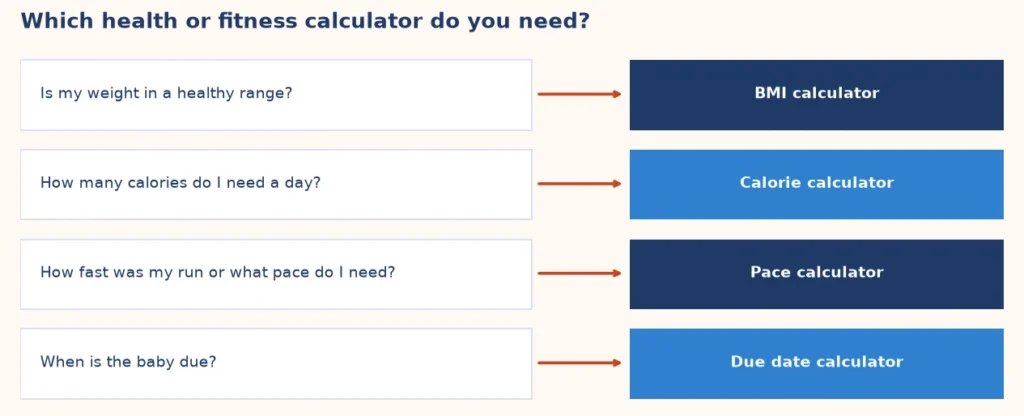
Health and fitness calculators answer four different questions, and each uses its own formula. The table matches your question to the tool and shows what you get back. Every tool runs in your browser, with metric and US units, and does not store what you type.
| If you want to… | Use this calculator | You get |
|---|---|---|
| Check weight against height | BMI calculator | BMI, category and healthy weight range |
| Plan food for maintenance, loss or gain | Calorie calculator | Maintenance calories, a goal and a macro split |
| Check the calories in a coffee-shop order | Starbucks calorie calculator | Calories, sugar and caffeine for 200+ drinks and foods, with size, milk and syrup options |
| Find your running pace or finish time | Pace calculator | Pace per mile and km, speed and race predictions |
| Find a pregnancy due date | Due date calculator | Due date, week of pregnancy and trimesters |
| Convert pounds, stone or kilograms | Unit converter | Any unit of weight, length or volume |
| Work out time between workouts or dates | Days between dates calculator | Days and weeks between two dates |
| Add up workout minutes | Time calculator | A total in hours and minutes |
BMI and calorie calculators: body measures and daily energy
BMI and calorie calculators are the most used health calculators. Body mass index compares weight with height: BMI = weight in kg ÷ height in m², or 703 × weight in pounds ÷ height in inches². For 5 ft 10 in (70 in) and 160 lb, BMI = 703 × 160 ÷ 4,900 = 22.96, which rounds to 23.0.
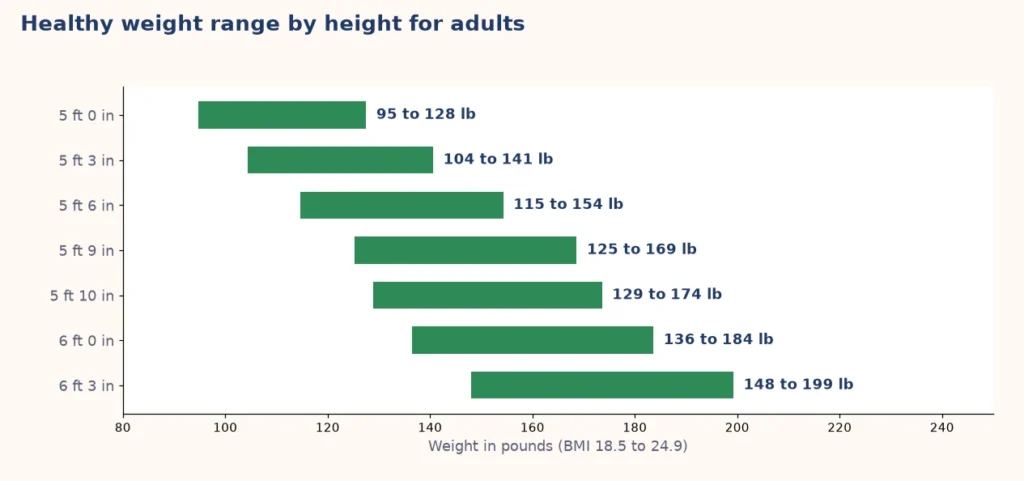
The World Health Organization defines overweight as a BMI of 25 or more and obesity as 30 or more in adults, and 18.5 to 24.9 is the healthy range. The BMI calculator works out the weight range for your height, so for 5 ft 10 in the healthy range is 128.9 to 173.6 lb.
| BMI | Category |
|---|---|
| Under 18.5 | Underweight |
| 18.5 to 24.9 | Healthy weight |
| 25 to 29.9 | Overweight |
| 30 to 34.9 | Obesity, class 1 |
| 35 to 39.9 | Obesity, class 2 |
| 40 or more | Obesity, class 3 |
Limits of BMI
BMI is a screening number, not a diagnosis. It does not measure body fat or where fat sits, so muscular athletes can have a high BMI and older adults a normal BMI with little muscle. Some health bodies use different cut-offs for people of Asian descent, and BMI does not apply to children in the same way. Treat it as a starting point for a conversation with a clinician.
Calorie calculators and daily energy needs
A calorie calculator estimates how much energy you burn. The Mifflin-St Jeor equation gives basal metabolic rate (BMR): 10 × weight (kg) + 6.25 × height (cm) − 5 × age, then + 5 for men or − 161 for women. For a 35-year-old woman who is 165 cm and 65 kg, BMR = 650 + 1,031 − 175 − 161 = 1,345 calories. Multiplying by an activity factor gives daily maintenance calories, so a moderately active woman needs 1,345 × 1.55 = 2,085.
| Activity level | Factor | Maintenance for BMR 1,345 |
|---|---|---|
| Sedentary: desk job, little exercise | 1.2 | 1,614 |
| Lightly active: exercise 1 to 3 days a week | 1.375 | 1,849 |
| Moderately active: 3 to 5 days a week | 1.55 | 2,085 |
| Very active: hard exercise 6 to 7 days | 1.725 | 2,320 |
A common rule of thumb says 3,500 calories equals about one pound of body weight, so a 500-calorie daily gap changes weight by about one pound a week. That is an approximation, because bodies adapt. The calorie calculator lets you set a goal and also shows a protein, carbohydrate and fat split. To see how a coffee-shop drink fits that goal, the Starbucks calorie calculator shows calories, sugar and caffeine for each size and customization.
Running and pace calculators: from 5K to the marathon
Running and pace calculators connect three numbers: distance, time and pace. Pace = time ÷ distance. A 25:00 5K is 1,500 seconds over 5 km, so the pace is 5:00 per kilometer, or 8:03 per mile (a 5K is 3.107 miles). Speed is 12 km/h or 7.46 mph. Enter any two numbers in the pace calculator and it finds the third.
| Pace per mile | Pace per km | 5K time | 10K time | Half marathon | Marathon |
|---|---|---|---|---|---|
| 7:00 | 4:21 | 21:45 | 43:30 | 1:31:46 | 3:03:32 |
| 8:00 | 4:58 | 24:51 | 49:43 | 1:44:53 | 3:29:45 |
| 9:00 | 5:36 | 27:58 | 55:55 | 1:57:59 | 3:55:58 |
| 10:00 | 6:13 | 31:04 | 1:02:08 | 2:11:06 | 4:22:11 |
| 12:00 | 7:27 | 37:17 | 1:14:34 | 2:37:19 | 5:14:38 |
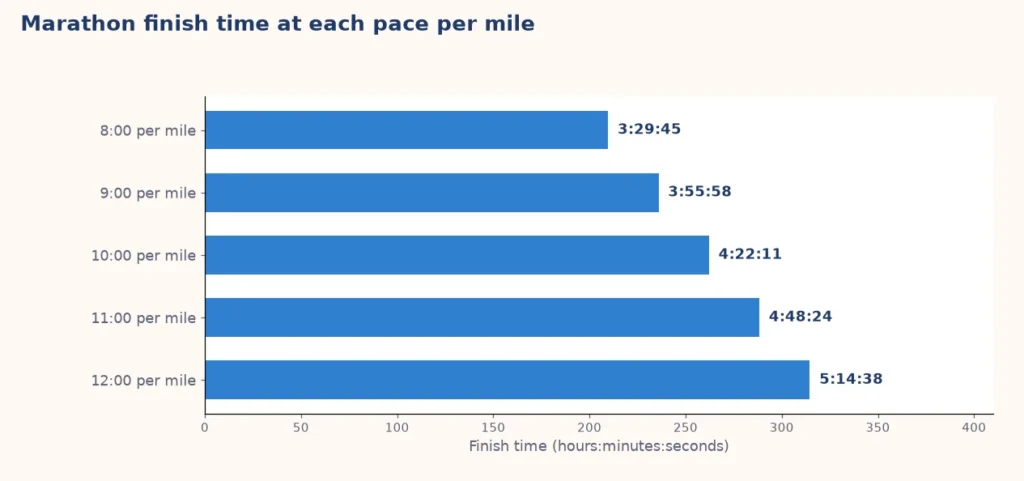
Race predictors such as the Riegel formula scale a known time to a longer distance: T2 = T1 × (D2 ÷ D1)^1.06. A 25:00 5K predicts about 3:59:47 for a marathon, while holding the 5K pace for 26.2 miles would give 3:30:59, which almost nobody can do. Real marathons depend on training, so treat the prediction as a guide. The same running and pace calculators work for walking and cycling by changing the unit.
Pregnancy due date calculators: weeks, trimesters and dates
Pregnancy due date calculators count forward from the first day of the last menstrual period (LMP). A normal pregnancy lasts about 40 weeks, or 280 days, from that date, according to the American College of Obstetricians and Gynecologists (ACOG). Naegele’s rule adds 280 days. With an LMP of July 30, 2026, the due date is May 6, 2027, and on October 8, 2026 the pregnancy is 10 weeks 0 days.
| Milestone | Weeks | Date for LMP of July 30, 2026 |
|---|---|---|
| First trimester ends | 13w6d | November 4, 2026 |
| Second trimester starts | 14w0d | November 5, 2026 |
| Third trimester starts | 28w0d | February 11, 2027 |
| Full term starts | 39w0d | April 29, 2027 |
| Estimated due date | 40w0d | May 6, 2027 |
ACOG notes that only about 1 in 20 women give birth on their due date, so think of it as the middle of a window, not a deadline. The due date calculator also adjusts for a cycle longer or shorter than 28 days, for conception dates, IVF transfers and ultrasound dating, which midwives often prefer when the dates disagree.
Body calculators: simple checks beyond BMI
Body calculators do not have to be complicated. Waist-to-height ratio divides your waist measurement by your height, and many health guidelines suggest keeping the waist below half the height. For a person 70 inches tall that means a waist under 35 inches. A rough maximum heart rate is 220 minus your age, so a 40-year-old has a maximum near 180 beats per minute, and moderate exercise is often placed at 50% to 70% of that, or 90 to 126 beats.
| Height | Waist limit (half of height) | Height in cm | Waist limit in cm |
|---|---|---|---|
| 60 in | 30 in | 152 | 76 |
| 64 in | 32 in | 163 | 81 |
| 68 in | 34 in | 173 | 86 |
| 70 in | 35 in | 178 | 89 |
| 72 in | 36 in | 183 | 91 |
| Age | Rough max heart rate | Moderate zone (50% to 70%) |
|---|---|---|
| 20 | 200 | 100 to 140 |
| 30 | 190 | 95 to 133 |
| 40 | 180 | 90 to 126 |
| 50 | 170 | 85 to 119 |
| 60 | 160 | 80 to 112 |
These are quick checks, not diagnoses. Use the percentage calculator and the ratio calculator for the arithmetic, and treat any number as a conversation starter with your doctor.
Fitness calculators: turning a weekly goal into a plan
Fitness calculators help turn a goal such as “150 minutes a week” into a schedule. Thirty minutes on five days reaches the World Health Organization target. At a brisk walking pace of 15 minutes per mile, 150 minutes covers 10 miles a week, and a pace calculator shows that a 3 mile walk then takes 45 minutes. Add a few minutes each week and review the numbers monthly.
A simple routine with health calculators
A beginner can use health calculators in four steps. First check BMI and the healthy weight range for your height. Second find maintenance calories and decide whether to eat the same, a little less or a little more. Third set a weekly activity target and a pace you can hold. Fourth repeat the calculators every month, because weight, activity and goals change.
Health calculators around the world: units and terms
Health calculators use different units in different countries. The United States uses pounds and inches, Canada mixes pounds and metric, the United Kingdom uses stone and pounds (1 stone = 14 pounds, so 160 lb is 11 stone 6 lb) and most other countries use kilograms and centimeters. BMI is the same everywhere. Food labels in Australia and New Zealand show energy in kilojoules (1 kcal = 4.184 kJ), so a 2,085 calorie target is about 8,724 kJ. Running distances are in miles in the US and UK and in kilometers elsewhere.
Real-life uses of fitness calculators
Setting a goal. Someone who weighs 180 lb at 5 ft 10 in has a BMI of 25.8. To reach 24.9 they would need to weigh 173.6 lb, a change of 6.4 lb, which a calorie target of 250 below maintenance covers in about 13 weeks.
Training for a race. A runner who wants a 4-hour marathon needs 4:00:00 ÷ 26.22 miles = 9:09 per mile. The pace calculator shows the splits for each mile and each 5K.
Planning a family. After a positive test the due date calculator gives the date and the first prenatal appointments by week, which the doctor will confirm with a scan.
Starting a walking habit. Someone new to exercise sets a goal of 30 minutes, five days a week. The pace calculator shows that 30 minutes at 15:00 per mile is 2 miles, and the calorie calculator estimates the extra energy used so that eating does not cancel the effort.
Which health calculators should you trust?
Trustworthy health calculators share four traits. They name the formula they use, such as Mifflin-St Jeor for calories or Naegele’s rule for due dates. They accept both metric and US units. They state their limits, for example that BMI is for adults. And they do not ask for personal details or an email address to show a result. Use health calculators and fitness calculators as planning aids, and let a clinician interpret anything that worries you.
Questions people ask about health calculators
What is a healthy BMI?
For adults, a healthy BMI is between 18.5 and 24.9. Below 18.5 is underweight, 25 to 29.9 is overweight and 30 or more is obesity. BMI is a screening tool and does not measure fat directly, so it should be read with other measures.
How many calories should I eat a day?
It depends on age, size, sex and activity. The Mifflin-St Jeor equation gives your resting needs, and an activity factor from 1.2 to 1.725 scales it up. A moderately active 35-year-old woman of 65 kg and 165 cm needs about 2,085 calories to maintain weight.
How much exercise do adults need each week?
The World Health Organization recommends at least 150 minutes of moderate-intensity physical activity per week for adults. A brisk walk, an easy jog or cycling all count, and shorter sessions add up across the week.
Do men and women use different BMI ranges?
No. Adult BMI uses the same cut-offs for men and women, although women usually carry more body fat at the same BMI. The calorie calculator does use sex in the Mifflin-St Jeor equation, because the formula adds 5 for men and subtracts 161 for women. These health and fitness calculators ask for it only for that step.
Common mistakes with health and fitness calculators
- Treating BMI as a diagnosis. It is a screening number and ignores muscle and fat distribution.
- Using the wrong units. Mixing pounds with centimeters gives nonsense, so check the unit boxes.
- Aiming for extreme calorie cuts. Very low targets can be unsafe; get advice before eating well below maintenance.
- Expecting a race prediction to be exact. It assumes you trained for the longer distance.
- Treating the due date as a deadline. Only about 1 in 20 babies arrive on it, and full term spans 39 weeks to 40 weeks 6 days.
Frequently asked questions
9 quick answers
What are health and fitness calculators?
Health and fitness calculators are free tools that turn simple measurements into estimates such as BMI, daily calories, running pace and a pregnancy due date. They show the formula and are meant for general information, not diagnosis.
How do I calculate BMI?
Divide weight in kilograms by height in meters squared, or multiply pounds by 703 and divide by inches squared. For 160 lb at 70 inches, 160 × 703 ÷ 4,900 = 22.96, which rounds to 23.0.
What is the BMI range for a healthy weight?
The healthy BMI range for adults is 18.5 to 24.9. For a person 5 ft 10 in tall that is 128.9 to 173.6 lb. Under 18.5 is underweight and 25 or more is overweight.
How is daily calorie need calculated?
The Mifflin-St Jeor equation gives basal metabolic rate, then you multiply it by an activity factor between 1.2 and 1.725. For a BMR of 1,345 and a factor of 1.55, maintenance is 2,085 calories a day.
How do I calculate running pace?
Divide your time by the distance. A 5K in 25:00 is 1,500 seconds ÷ 5 km = 300 seconds, so the pace is 5:00 per kilometer or about 8:03 per mile.
How long will a marathon take at my pace?
Multiply your pace per mile by 26.22. At 10:00 per mile the marathon takes 4:22:11, and at 8:00 per mile it takes 3:29:45. Each extra minute per mile adds about 26 minutes.
How is a due date calculated?
Add 280 days, which is 40 weeks, to the first day of the last menstrual period. For a period starting July 30, 2026, the due date is May 6, 2027. Ultrasound dating can adjust it.
How many weeks are the trimesters?
The first trimester runs to 13 weeks 6 days, the second from 14 weeks 0 days to 27 weeks 6 days and the third from 28 weeks 0 days to birth, according to ACOG.
Are these health calculators accurate and private?
They use standard published formulas and run in your browser, so your numbers are not stored. They give estimates for adults, so check your results with a health professional.
More calculator hubs
- All free online calculators with steps for every topic
- Conversion calculators for pounds, kilograms, stone and temperature
- Date and time calculators for pregnancy weeks, workouts and countdowns
- Math calculators for percentages, averages and ratios
- Home improvement calculators for energy use and projects
- Random generators for random picks and probability
Sources and further reading
- World Health Organization: Obesity and overweight (adult BMI cut-offs)
- World Health Organization: Physical activity (150 minutes a week)
- ACOG: How your fetus grows during pregnancy (40 weeks and the trimesters)
- Wikipedia: Body mass index (formula and limits)
This page is general information, not medical advice. Last updated: October 2026.