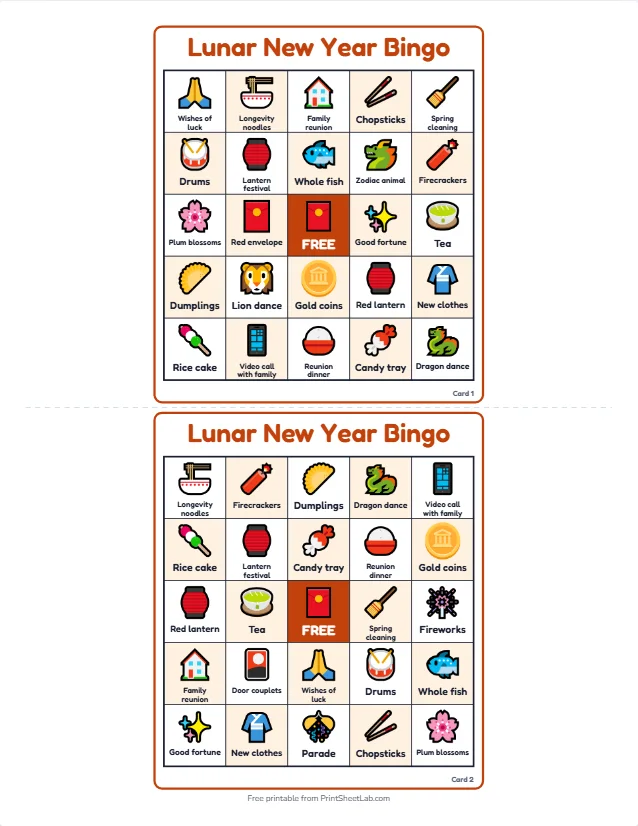
Lunar New Year bingo turns the biggest family holiday of the year into a game that a four-year-old and a great-grandmother can play together. The card on this page has 28 squares that most homes produce somewhere between New Year’s Eve and the Lantern Festival, from the red envelope and the plate of dumplings to the lion dance in the street and the video call with relatives far away. Pick a card size, press print, and every guest gets a different card. Searchers also call it Chinese New Year bingo, and the list works for both names.
In short: open the card maker above and press Edit and print this card, choose how many cards you need and download one PDF. It is free, there is no account, and nothing you type leaves your browser. Every square can be rewritten, so a Chinese, Vietnamese or Korean family, a classroom and an office can each get their own list.
How to play Lunar New Year bingo
The rules are the bingo rules everyone already knows, with one change: nobody has to call numbers, because the festival makes the calls. Each player holds a card and something to mark with. When one of the squares happens in front of them, they mark it. Five in a row, across, down or on a diagonal, wins. The free center is already marked, so a first line needs only four more squares.
- Give every guest a card and a way to mark it. Pencils, crayons and small red stickers work well. Wet markers bleed through thin paper.
- Agree on the rules first. A square counts when you see it yourself, and it counts once. Anyone may ask a player to point out the square they are claiming.
- Mark Lunar New Year bingo squares as the festival unfolds. The lanterns go up, the dumplings arrive, a drum starts in the street: each of those is a square.
- Announce a line out loud. The winner reads the five squares, a neighbor checks them, and the prize changes hands.
- Play another round of Lunar New Year bingo. Switch to four corners, an X or a full card once the first line is won, or keep the same card for the next day of the festival.
The festival suits Lunar New Year bingo because it is built from small, visible things. The Wikipedia article on Chinese New Year describes red paper-cuts and couplets on windows and doors, a reunion dinner, firecrackers and red envelopes. A Lunar New Year bingo card that names them makes children look closely at the decorations instead of only at the candy tray. For every winning shape, see the bingo patterns guide, and for the basic rules the how to play bingo guide.
Lunar New Year bingo cards: all 28 squares
These Lunar New Year bingo cards are made from a list of 28 squares. A standard 5×5 card with a free center needs 24 of them, so each card leaves out four and the cards differ from one another. The table sorts the list into groups and says what each square means, using customs described in the Wikipedia articles on the festival.
| Group | Squares on the list | What they stand for |
|---|---|---|
| Food and drink | 🍚 Reunion dinner, 🥟 Dumplings, 🐟 Whole fish, 🍜 Longevity noodles, 🍡 Rice cake, 🍊 Mandarin oranges, 🍬 Candy tray, 🍵 Tea, 🥢 Chopsticks | The reunion dinner on New Year’s Eve is the center of the festival. Dumplings resemble old gold ingots, so they stand for wealth. Fish is served because the word sounds like surplus, and some of it is left over on purpose. Long noodles wish for a long life, and rice cake (nian gao) sounds like a higher year. |
| Decoration and home | 🧹 Spring cleaning, 🎴 Door couplets, 🏮 Red lantern, 🌸 Plum blossoms, 🐲 Zodiac animal, 🏮 Lantern festival | Homes are cleaned before the new year to sweep out bad luck, then decorated with red paper couplets, lanterns and flowers. The 15th day, the Lantern Festival, closes the festival. |
| Luck and gifts | 🧧 Red envelope, 🪙 Gold coins, ✨ Good fortune, 🙏 Wishes of luck | Red envelopes carry money from married adults to children and unmarried juniors. Greetings and wishes of good fortune are exchanged all festival long. |
| Sound and spectacle | 🧨 Firecrackers, 🎆 Fireworks, 🦁 Lion dance, 🐉 Dragon dance, 🥁 Drums, 🎊 Parade | Noise and color to drive away bad spirits and welcome the new year. Lion and dragon dances are performed in streets, shops and community halls. |
| People | 🏠 Family reunion, 👘 New clothes, 📱 Video call with family | Families travel to be together, wear new clothes for a new beginning and call the relatives who could not come. |
The Lunar New Year bingo list is not random. Lantern and decoration squares fill in at almost every home, while spectacle squares (a dragon dance, drums, a parade) depend on where you live, which turns a card into a treasure hunt. Fireworks are the rarest square in our simulation, because many cities restrict them.
How many different cards can you print?
With 28 squares and 24 places on a 5×5 card, the number of different sets of squares is 28 choose 24, which is 20,475. Each set can also be arranged in a huge number of orders, so a family of 12 and a community hall of 120 can both give every player a different card. Smaller grids use fewer squares and have far more possible sets.
| Card size | Squares used | Different sets from the 28 | Best for |
|---|---|---|---|
| 3×3 with free center | 8 | 3,108,105 | Ages 3 to 5 and the very short game |
| 4×4 | 16 | 30,421,755 | A quick round before dinner |
| 5×5 with free center | 24 | 20,475 | The classic evening or the 15-day game |
What Lunar New Year is and why people play games
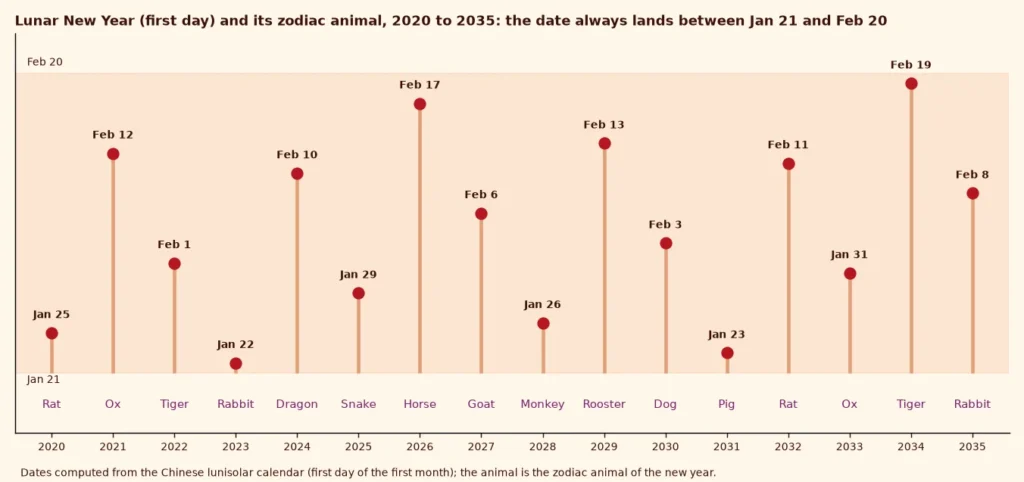
Chinese New Year, also called the Spring Festival, marks the beginning of a new year on the traditional lunisolar Chinese calendar. The first day falls on the new moon that appears between January 21 and February 20, and the festival runs from New Year’s Eve to the Lantern Festival on the 15th day. The Wikipedia article calls it one of the most important holidays in Chinese culture, a time to honor deities and ancestors and for families to gather for the annual reunion dinner.
In English the festival is often called Lunar New Year, which is the more inclusive name and the reason this page says Lunar New Year bingo. The same new moon starts the new year in several cultures: the Tet of Vietnam, the Seollal of Korea and the Losar of Tibet, each with its own customs.
In 2023 the United Nations General Assembly recognized the Spring Festival, designating Lunar New Year as a UN holiday. The Lunar New Year bingo template leans on Chinese customs because they are the most widely documented, so families who keep Tet or Seollal should edit the list, and a later section shows how.
The 15 days and the squares that go with them
The festival is not one evening. The article describes a New Year’s Eve dinner, a first day for visiting elders and a long run of days with their own customs. The table lists the stages most relevant to bingo, with the squares of our list that usually belong to each. Customs differ between regions and families, so treat it as a guide and not a rule.
| Day | What happens | Squares that fit |
|---|---|---|
| New Year’s Eve | Homes are cleaned in the days before. The reunion dinner is held, dumplings are made in the north and rice cake in the south, and families stay up late. | Spring cleaning, Reunion dinner, Dumplings, Whole fish, Rice cake, Family reunion |
| Day 1 | Deities are welcomed at midnight, with firecrackers and lion dances. Families visit elders. Mandarin oranges are traded, and red envelopes are given to children. | Red envelope, Mandarin oranges, Firecrackers, Lion dance, New clothes, Good fortune, Wishes of luck |
| Day 2 | Married daughters visit their birth parents, relatives and close friends. | Family reunion, Candy tray, Tea |
| Days 3 to 7 | A quieter stretch. Day 5 has firecrackers and dumplings in northern China, and Day 7 is the day when everyone grows a year older. | Dumplings, Firecrackers, Tea, Door couplets |
| Days 8 to 14 | People return to work by the eighth day, and some hold another family dinner. Decorations stay up. | Red lantern, Door couplets, Plum blossoms |
| Day 15 | The Lantern Festival: lanterns, riddles and sweet rice balls called tangyuan. | Lantern festival, Red lantern |
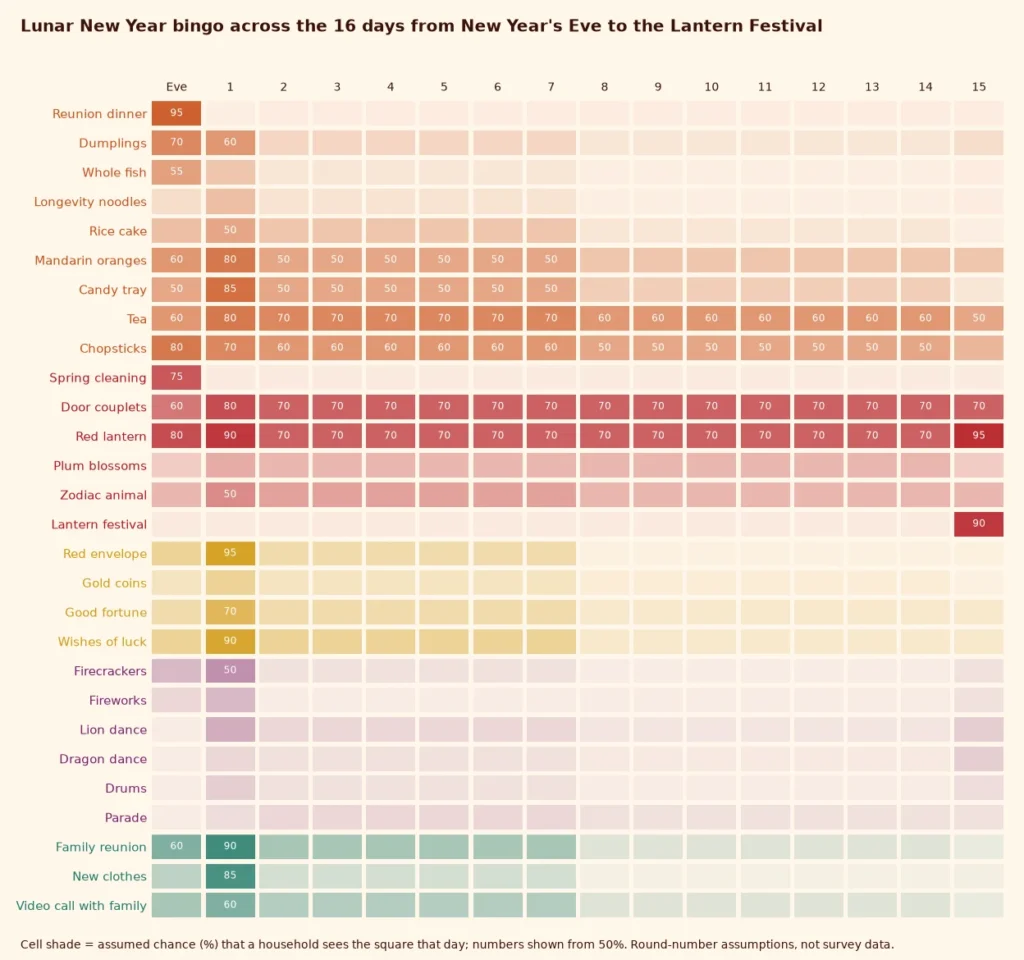
Because the festival is so long, a single Lunar New Year bingo card can last through all of it. Early squares such as the reunion dinner fill in on the first evening, while the Lantern Festival can only be marked on the last day. That shape is what the simulation below uses.
When is Lunar New Year? Dates for 2026 to 2028
The festival moves on the Gregorian calendar because it follows the new moon. We computed the first day of the first lunar month and the date of the Lantern Festival from the Chinese lunisolar calendar. Always confirm the date for your location with a local calendar, because a country in a different time zone can place the new moon on a different day, and Vietnam has occasionally celebrated on a different day from China.
| Year | Lunar New Year (first day) | Lantern Festival (15th day) | Zodiac animal |
|---|---|---|---|
| 2026 | Tuesday, February 17 | March 3 | Year of the Horse |
| 2027 | Saturday, February 6 | February 20 | Year of the Goat |
| 2028 | Wednesday, January 26 | February 9 | Year of the Monkey |
Across 2020 to 2035 the first day always lands between January 21 and February 20, and it can be as early as January 22 (in 2023) or as late as February 19 (in 2034). The 12 zodiac animals repeat in a cycle: Rat, Ox, Tiger, Rabbit, Dragon, Snake, Horse, Goat, Monkey, Rooster, Dog and Pig. The Wikipedia article on the zodiac connects the order to a legend of a race the Jade Emperor held, which is a good story to tell while the cards are being marked.
Red envelopes, oranges and lucky numbers
The red envelope is called hongbao in Mandarin, lai see in Cantonese and li xi in Vietnamese. According to the red envelope article, married couples or the elderly give them to unmarried juniors or children. One legend says the money was meant to scare away a demon called Sui. Amounts starting with 8 are favored because the word sounds like wealth, and amounts with 4 are avoided because the word sounds like death. Notes are traditionally new.
This matters for the card. The Red envelope square should be marked when an envelope appears, and never as a way to compare amounts. If you give prizes, use envelopes with a sticker, a handwritten wish or a small treat instead of money, so that the game stays a game.
The Nian, the noise and the color red
A popular legend says the festival began with a beast called the Nian that came out once a year, and that villagers learned it feared the color red and loud noise. That is why red paper, firecrackers and drums are everywhere.
The article on the Nian notes that the earliest written sources that describe it as a creature date from the early twentieth century, so tell it as a story and not as history. The squares for Firecrackers and Drums are fun for children because they are easy to spot, but keep them at a safe distance, and remember that firecrackers have been banned in various countries and towns since the 2000s.
Three ways to play a Lunar New Year bingo game
One printed card supports three very different evenings of Lunar New Year bingo. Pick the version that fits your guests, or run two in a row. The table compares them, and the sections underneath give the rules and prize ideas.
| Game | Who calls | Length | Best for |
|---|---|---|---|
| The reunion-dinner spotting game | Nobody. The evening does. | 2 to 4 hours | New Year’s Eve dinners and open houses |
| The 15-day family game | Nobody. Each day does. | 15 days, a few minutes a day | Families and group chats who keep one card from Eve to the Lantern Festival |
| Calling cards for a crowd | A host draws cut-out squares | 10 to 20 minutes | Classrooms, community halls, offices and video calls |
Game one: the reunion-dinner spotting game
This is the Lunar New Year bingo game most hosts want, and the Lunar New Year bingo game is easy to start. Guests arrive with a card and a pencil, and every time they notice a square (the red lanterns, a plate of dumplings, a fish on the table, an envelope handed over) they mark it. A lighter rule is that a square counts when someone else points it out to you, which turns the card into a reason to talk to relatives you do not see often.
The reunion dinner is the heart of the festival, so mark the squares quietly and let the eldest at the table lead. Do not interrupt a toast to claim a line. Prizes that suit the evening are first pick from the candy tray, the job of pouring the tea and the right to choose the next song.
Game two: the 15-day Lunar New Year bingo family game
Because the festival spans 15 days, one Lunar New Year bingo card can last through all of them. The rule that works is a daily allowance, and the simulation below shows why: with no limit a card is finished on the first evening, while a cap of one or two marks a day keeps the game alive until the lanterns. Send relatives the same PDF before New Year’s Eve, let each household play at its own pace, and ask for a photo of the winning line on the Lantern Festival.
- Prize for the first line: choose the dessert for the next dinner.
- Prize for four corners: pick the family photo pose.
- Prize for everyone: a small red envelope with a handwritten wish.
- Grown-up job: one adult keeps spare cards for children who lose theirs among the wrapping and the oranges.
Game three: calling cards for a crowd
When the guests do not move around the house, the drawn-card Lunar New Year bingo game is easier to run. In the Print tab, switch on the calling cards and the caller sheet. Cut the cards out, shuffle them in a bowl and draw one at a time: “Lion dance… who has a lion dance?” Everyone with that square marks it.
For a live round on a screen, with guests joining by link, the play bingo online page hosts the 75-ball game, and the play custom bingo online page explains how to play with your own list. For relatives in different cities, the virtual bingo ideas guide has timing and group-size advice, and the Zoom bingo page suits a call.
Lunar New Year bingo game: a real simulation
A host planning a Lunar New Year bingo game always asks how long the Lunar New Year bingo game will last. To answer with numbers instead of a guess, we simulated the festival. Every square has an assumed chance of showing up on each of 16 days (New Year’s Eve and the 15 days after it), and we ran 8,000 festivals.
The chances are our assumptions, chosen to feel like a typical family. They are not survey data. A red lantern is seen on 70 to 95 of 100 days, a reunion dinner on New Year’s Eve 95 times out of 100, and a dragon dance on 2 to 20 of 100.
In an average festival a household sees about 26 of the 28 squares, and 11 of them on New Year’s Eve alone. A 5×5 card with 24 squares has nearly everything within reach, so without a limit the Lunar New Year bingo game is over almost at once.
One evening of Lunar New Year bingo: the reunion dinner alone
If you play only on New Year’s Eve, a single 5×5 card has a line 14% of the time, six cards 48% of the time and twelve cards 66% of the time. A full card on the first evening almost never happens. The evening is a good warm-up, and it explains why a 15-day Lunar New Year bingo game needs a limit.
Fifteen days of Lunar New Year bingo: the rule decides the length
With no limit, a single card has a line by the end of the first day 83% of the time, and six cards more than 99% of the time. The table compares the daily allowances a host can choose, for one card and for a family group of six cards. The day reported is the day of the festival, with New Year’s Eve as day zero.
| Rule for marks | One card: median day of a first line | Six cards: median day of a first line | Six cards: line by Day 5 | Six cards: line by Day 10 | Six cards: line by Day 15 |
|---|---|---|---|---|---|
| No limit | Day 1 | Day 1 | 100% | 100% | 100% |
| 3 marks a day | Day 4 | Day 3 | 100% | 100% | 100% |
| 2 marks a day | Day 7 | Day 4 | 86% | 100% | 100% |
| 1 mark a day | only 63% by Day 15 | Day 9 | 4% | 67% | 100% |
| 3 marks on Eve and Day 1, then 1 a day | Day 10 | Day 5 | 54% | 99% | 100% |
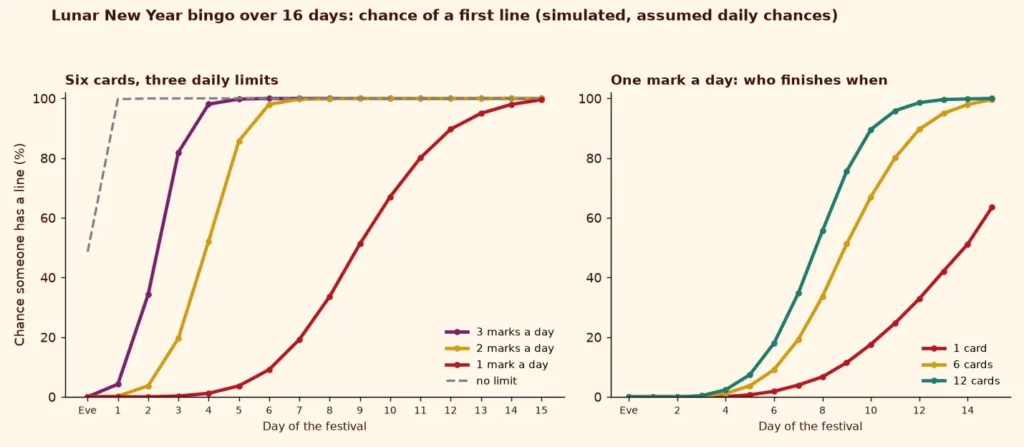
For Lunar New Year bingo, two marks a day is a good fit for a single card, which gets a line by day 7 at a median and about 98% of the time by Day 15.
For a family group of six cards, one mark a day produces a first line on day 9, and twelve cards on day 8, so the game lasts into the second week and the Lantern Festival still matters. A single card on one mark a day has a line by Day 15 only 63% of the time, so one mark a day suits groups better than individuals.
The marks in the simulation are chosen at random among the squares a player has seen that day, so a careful player does a little better. Treat the table as a guide to how long to plan the game, not a promise. A full card is hard: only 16% of single cards reach a blackout in the whole festival even with no limit, and 41% of twelve-card groups have one.
Lunar New Year bingo with calling cards: how many calls?
The drawn-card version of Lunar New Year bingo is the most predictable. All 28 squares are called exactly once, in random order, so we simulated 8,000 games to see how many calls it takes before someone has a line, and how often two players finish on the same call.
| Cards in play (5×5) | Calls to the first line (median) | Middle half of games | Calls to a full card (median) |
|---|---|---|---|
| 1 card | 16 | 14 to 18 | 28 |
| 4 cards | 12 | 11 to 14 | 28 |
| 8 cards | 11 | 10 to 13 | 27 |
| 15 cards | 10 | 9 to 11 | 27 |
| 25 cards | 9 | 8 to 10 | 27 |
| 30 cards | 9 | 8 to 10 | 27 |
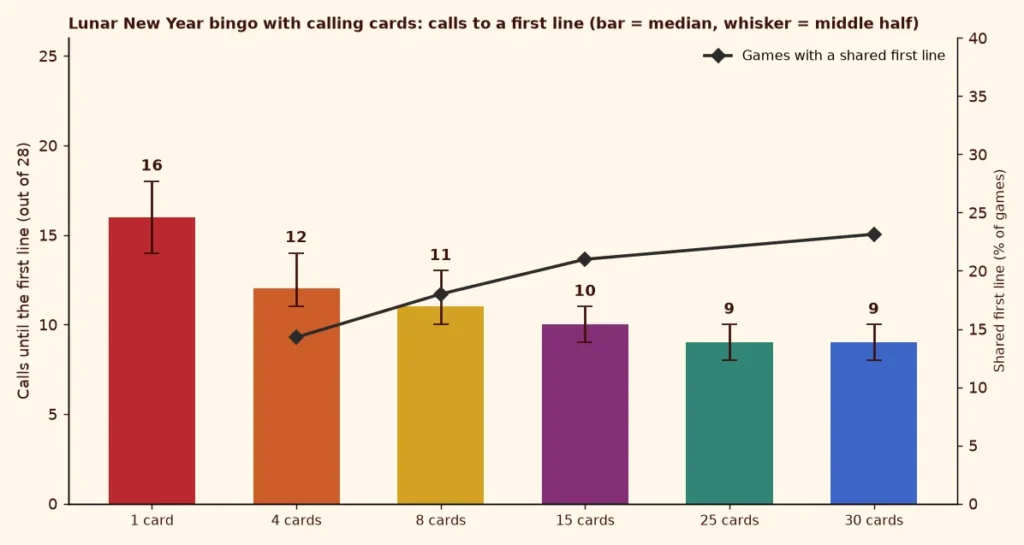
A party with 15 players usually sees a first line after 10 calls, and a full card needs a median of 27 calls. For a quicker game, 4×4 cards with 8 players reach a first line at 10 calls and 3×3 cards with 8 players at 5.
With 15 cards about 21% of games have a shared first line, with 30 cards 23%, and with 60 cards 27%. Decide the tie rule before the first call: share the prize, or let the tied players draw a red envelope with a number inside. The assumptions: every call is equally likely at each step, cards are independent random draws, and nobody misses a call.
Printable Lunar New Year bingo: print, cut and hand out
For printable Lunar New Year bingo, the Print tab has the controls you need and nothing you do not. Choose how many different cards to print, from 1 to 100, how many go on a page (1, 2, 4 or 6), Letter or A4 paper, and portrait or landscape. Cut guides are available for sheets that need trimming. For a family of 14, print 16 cards, two to a page, and keep two spares for the guest who arrives late.
- Use light cardstock. A Lunar New Year bingo card that will travel between rooms survives the evening better when it is thicker than copy paper.
- Print names on the cards. The Design tab can put a name on each card, which prevents the usual argument over whose card is whose.
- Use big squares for little hands. One card per page in portrait gives the biggest squares, which is best for ages 3 to 5.
- Print the caller sheet and calling cards for the drawn-card game. They come out of the same Print tab.
- Pick red and gold. The Design tab holds color themes, and a red Lunar New Year bingo card with a gold border suits the festival.
Hosts who are away from a printer can save the Lunar New Year bingo PDF to a phone or a USB stick and print it anywhere. The shareable link in the card maker keeps only your word list, with no names or photos, so you can send it to relatives and let everyone print their own.
Lunar New Year bingo for kids
Lunar New Year bingo for kids is a calm way to channel a loud, sugary festival, and Lunar New Year bingo for kids needs no reading skills. Children who are busy looking for a red lantern are children who are standing still long enough to enjoy it. The pictures on every square let pre-readers play without help, and the squares teach the names of things that adults at the table have known for years. The right setup depends on age.
| Age | Card | How to play |
|---|---|---|
| 3 to 4 | 3×3, one per page | A grown-up reads the pictures. Sticker dots, no pens. Everyone wins at the first line. |
| 5 to 7 | 3×3 or 4×4 | Words with pictures. Children spot and shout. Play for a line, then for four corners. |
| 8 to 10 | 5×5 | Two marks a day over the festival, plus two squares they invent themselves, like a pet or a family joke. |
| 11 and up | 5×5 with a custom list | Let them write the list for the family, or add a rule that a square counts only when they can say its name in the family language. |
Classrooms get a lot from Lunar New Year bingo. A round fits into the last half hour before a school celebration, and it needs no preparation beyond printing. Pair it with the Lunar New Year worksheets and the classroom bingo page for a full lesson, and see the bingo activities for the classroom guide for routines that keep a group calm.
Do not assume that every child with an East Asian background celebrates, or that all celebrate in the same way. Let children who celebrate say a sentence about a square only if they want to, and never ask a child to speak for a whole culture.
Two safety notes: candy and rice cakes can hide allergens, and firecrackers belong to adults at a distance. The card asks children to spot them, not to light them.
Chinese New Year bingo for adults, offices and community events
Chinese New Year bingo at a party needs a lighter touch than the sticker-dot version. Guests already have conversation to make and plates to hold, so the card should ask for very little. The best rule for Chinese New Year bingo is that a square counts when someone else points it out to you, which makes the game a way to talk to people you have not met. At a community event, a calling-card round before the lion dance and a spotting game during the meal both work.
Three tweaks make Chinese New Year bingo grown-up. First, change the list: replace Chopsticks with “Someone teaches you a greeting in a language you do not speak.” Second, use a 4×4 card with no free space so the game ends in about 40 minutes.
Third, give prizes that suit the party: first pick of the sweets, a pack of tea or the chance to choose the next song. For a workplace, the office bingo guide has inclusive advice, and the human bingo page offers a get-to-know-you format. A Lunar New Year bingo game at work should stay open to anyone and should never single out one colleague as the expert.
Lunar New Year bingo free printable: what you get
Free, private and nothing to install
This Lunar New Year bingo free printable does not ask for an email or an account, and nothing is added to your PDF but the card itself and a small footer. The editor runs in your browser, so your word list never goes to a server. You need only a printer or a PDF viewer.
What you can change
The card maker has five tabs: Setup, Items, Design, Templates and Print. On the Items tab you can rewrite any square, add an emoji or upload your own picture, and decide what the free space shows. The Design tab holds color themes, fonts, text size, ALL CAPS, borders, rounded corners, tiles or plain grids, and a card background that can be a color, a pattern or your own picture.
You can also add a title, a logo and a footer line, for example “Wong family New Year”. The Templates tab holds the other ready-made lists, and the Print tab holds the numbers: how many cards, which paper, which layout.
You do not have to start from this page. The bingo card generator offers every card type in one place, the blank bingo cards page gives you an empty grid to fill by hand, and the how to make bingo cards guide explains the do-it-yourself methods.
Customize the cards in the card maker
The best Lunar New Year bingo card names your own table. Open the Items tab and every square turns into a text box. Here is how a few common situations change the list.
- A Vietnamese family keeping Tet. Replace Dumplings with banh chung, Plum blossoms with yellow apricot or peach blossoms, and add a kumquat tree, which the Tet article lists as a popular decoration in the north and center.
- A Korean family keeping Seollal. Replace Dumplings with tteokguk (rice cake soup), add a formal bow to the elders, a hanbok and a game of yutnori.
- Your own family. “Grandma makes the dumplings,” “The cousin who always arrives last,” “Uncle tells the zodiac story.”
- A school or library event. Swap the firecracker squares for drawings of a lantern, add “Someone reads a New Year story aloud,” and keep the sweets nut-free.
- A very young group. Keep the friendly squares (lantern, dumplings, red envelope, lion dance) and delete the abstract ones (Good fortune, Wishes of luck).
- A language class. Write the squares in Chinese, Vietnamese or Korean next to the English word.
When your list has more than 24 words, the card maker gives every card a different mix. With exactly 24, every card has the same words in a different order. The free space can say “Free” or show its own emoji, text or picture. Shuffle re-deals the squares across all cards, Undo takes back your last change, and the preview lets you zoom in before you download.
Playing Lunar New Year bingo respectfully
Lunar New Year is a cultural and, for many families, a religious festival, and a game of Lunar New Year bingo should sit comfortably beside it. A few habits make that easy. They apply to any bingo you play at a festival, not only this one.
- Use the right names. Say Lunar New Year, Chinese New Year, Tet or Seollal as the people in the room do. The names are not interchangeable to everyone, and a festival of one culture should not be called by another’s name.
- Keep ritual separate from play. Offerings to ancestors and temple visits are not squares. Do not interrupt them to claim a line.
- Skip stereotypes. Do not use costumes, accents or “Oriental” props. Ask the people who celebrate what they want on the table.
- Watch the numbers. The number 4 sounds like the word for death in Chinese, and chrysanthemums are tied to ancestor veneration, so avoid 4-piece sets or chrysanthemums in prize bags.
- Think about food and safety. Ask about allergies, and keep fireworks to professional displays or sparkler-free squares.
- Keep it kind. Squares such as Red envelope and New clothes should never be a way to compare who has more.
None of this is a rulebook. It is the kind of care a good host already takes. The best Lunar New Year bingo cards are made together with the people who celebrate, so ask a grandparent, a teacher or a neighbor to look over the list before you print. They will find the square you forgot.
More festival bingo for the new year season
Lunar New Year bingo is one of a whole set of occasion lists in the card maker, so Lunar New Year bingo sits beside the winter holidays below. The winter lights have their own printable bingo cards companions, such as New Year bingo for the calendar change and Hanukkah bingo for the eight nights of candles. For a festival of lights in autumn, see Diwali bingo. Number-based bingo runs on the bingo caller, and for crowds the bingo for large groups guide covers cards, ties and prizes.
Frequently asked questions
10 quick answers
What is Lunar New Year bingo?
Lunar New Year bingo is a bingo variation in which every square names something you see or do at the festival, such as a red envelope, dumplings, a lantern or a lion dance. Players mark squares as they spot them or as a host calls them, and the first to complete a line wins.
Is this the same as Chinese New Year bingo?
It is the same festival and the same card. Chinese New Year bingo and Lunar New Year bingo both use the squares on this list, and you can retitle the card in the Design tab. For Tet or Seollal, edit the squares to fit.
Are these Lunar New Year bingo cards really free?
Yes. You can make, edit and print the Lunar New Year bingo cards without an account or a payment. The editor runs in your browser, so the words and pictures you add never leave your device.
How many squares does the template have?
It has 28 squares. A 5×5 card with a free center uses 24 of them, a 4×4 card uses 16 and a 3×3 card with a free center uses 8. Because the list holds more words than a card has squares, cards differ from one another.
How many different cards can I print?
Up to 100 different Lunar New Year bingo cards in one PDF. There are 20,475 different sets of 24 squares to choose from, so even a large community hall can give every guest a card without repeats.
Can I play over the whole festival?
Yes. Lunar New Year bingo works over 15 days with a daily allowance of one or two marks. In our simulation six cards at one mark a day produce a first line on day 9, and a single card at two marks a day gets a line by day 7 at a median.
How do I run the calling-card version?
In the Print tab, add the calling cards and the caller sheet. Cut the cards out, shuffle them and draw one at a time. A game with 15 players on 5×5 cards usually has a winner after about 10 calls.
When is Lunar New Year?
The festival moves each year because it follows the new moon. In 2026 the first day is Tuesday, February 17, in 2027 it is Saturday, February 6 and in 2028 it is Wednesday, January 26. Check a calendar for your location, and print the cards a week ahead.
Can I change the squares to match my family or school?
Yes. In the card maker, every Lunar New Year bingo square can be rewritten, given an emoji or a picture. Swap dumplings for tteokguk or banh chung, add your own family jokes, and use the free space for something personal.
What size should I print for young children?
For Lunar New Year bingo with young children, print a 3×3 card, one per page, with large pictures for ages 3 to 5. It has only eight squares plus a free center, so a first line comes quickly and the child stays interested.