Rounding worksheets to print (PDF)
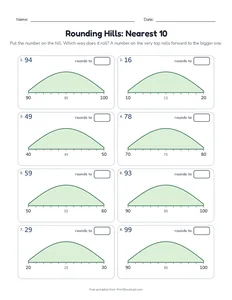
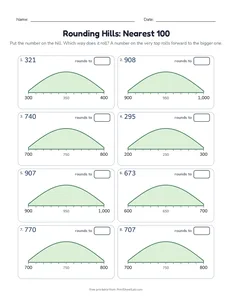
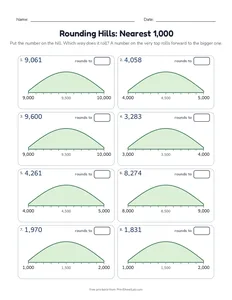
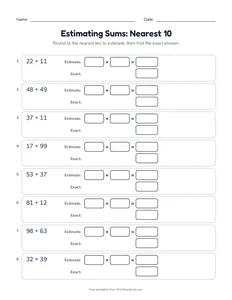
These rounding worksheets are a sample of the 17 printable PDFs in this section, from rounding hills to estimating sums. Click a picture for the PDF, or open one of the sets below.
Rounding in one picture
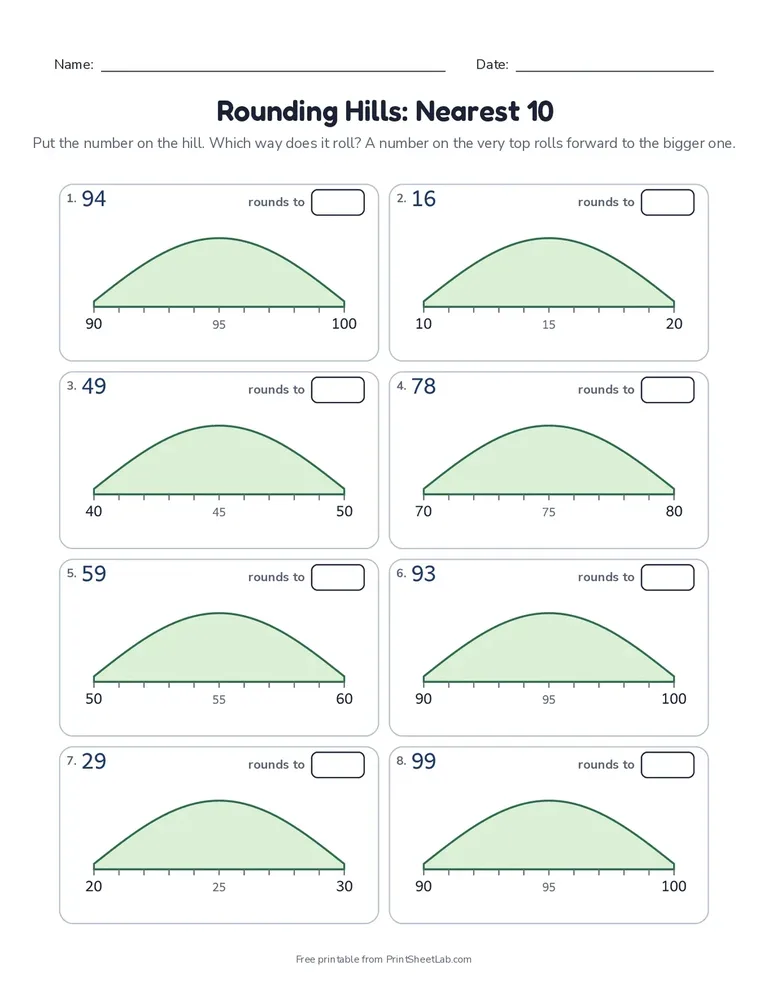
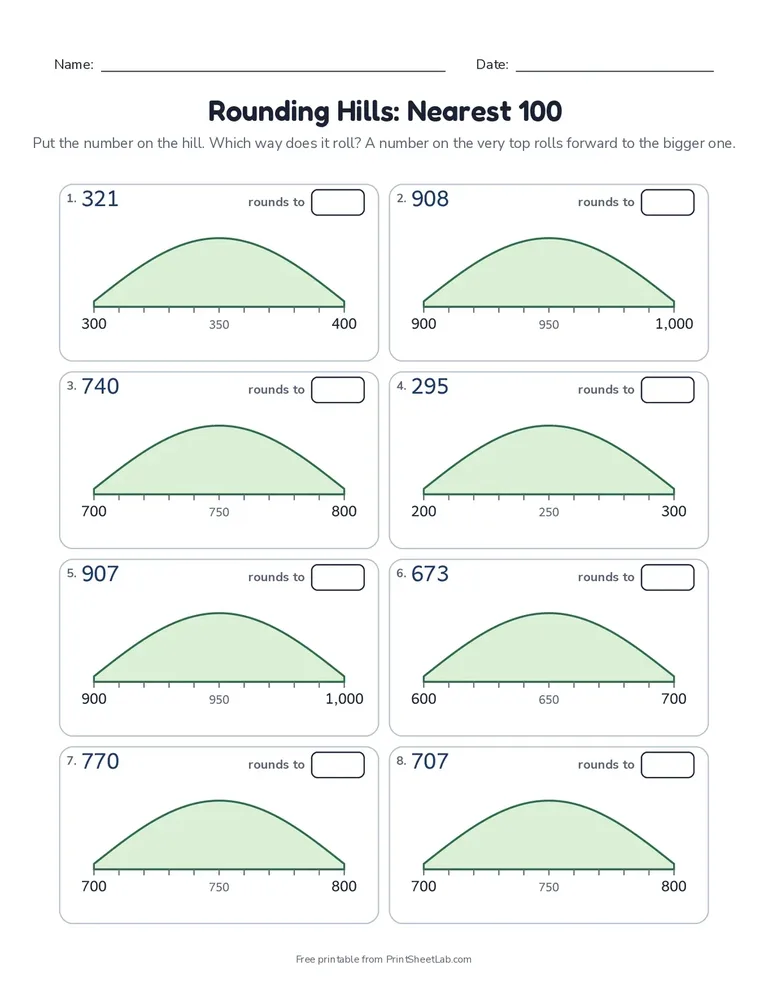
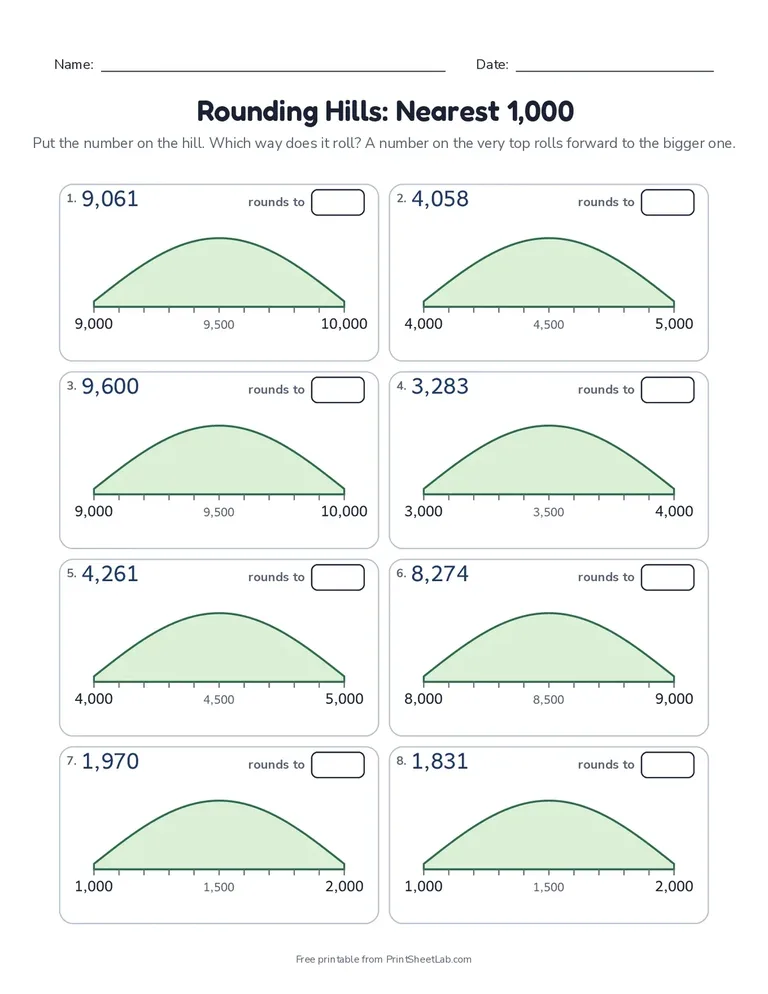
Imagine every number between two tens sitting on a hill. 40 is at the bottom on one side, 50 at the bottom on the other, and 45 is right at the top. A number like 43 is on the 40 side of the hill, so it rolls down to 40. A number like 47 rolls down to 50. And 45, balanced right on the top, rolls forward to 50. That is the whole rule of rounding, and it is why our rounding worksheets start with hills instead of rules to memorize.
The rule in words
- Find the place you are rounding to and look at the digit just to its right.
- If that digit is 5 or more, round up. If it is 4 or less, round down.
- Every digit after the rounding place becomes 0.
So 347 rounded to the nearest ten is 350 (look at the 7), and to the nearest hundred is 300 (look at the 4).
Why rounding matters
Rounding is how people estimate: a shopping bill of $38.75 + $21.40 is “about $60”. Children who can round can check whether an answer is sensible, which catches many mistakes in addition, subtraction and multiplication. In the Common Core standards, grade 3 children round to the nearest 10 or 100 (3.NBT.A.1) and grade 4 children round multi-digit numbers to any place (4.NBT.A.3).
What is in the rounding worksheets
There are 17 rounding worksheets in four sets, each with an answer key:
- Rounding to the nearest 10 (5 worksheets)
- Rounding to the nearest 100 (5 worksheets)
- Rounding to the nearest 1,000 and beyond (4 worksheets)
- Estimating sums and differences (3 worksheets)
Rounding to the nearest 10 worksheets: look at the ones
When you round to a place, one digit decides the answer: the digit just to the right of that place. This table shows which digit to look at for each place, using the same number every time:
| Round to the nearest | Look at the | Example | Rounded |
|---|---|---|---|
| 10 | ones digit | 4,687: the 7 is 5 or more | 4,690 |
| 100 | tens digit | 4,687: the 8 is 5 or more | 4,700 |
| 1,000 | hundreds digit | 4,687: the 6 is 5 or more | 5,000 |
| 10,000 | thousands digit | 24,687: the 4 is less than 5 | 20,000 |
The rounding to the nearest 10 worksheets use only the ones digit, so children can focus on the rule. Of the 99 numbers from 1 to 99, the rule works out like this:
| Numbers from 1 to 99 rounded to the nearest 10 | How many |
|---|---|
| Round up | 50 |
| Round down | 40 |
| Stay the same (multiples of 10) | 9 |
Of the 99 numbers, 50 round up (the ones digit is 5 to 9), 40 round down (the ones digit is 1 to 4) and the 9 multiples of 10 stay where they are. Five of the ten ones digits round down or stay (0 to 4) and five round up (5 to 9), which is why the digit 5 goes with the group that rounds up.
Which numbers round to the same answer?
A useful question for children is the reverse of rounding: which numbers round to 350? Every number from 345 to 354 does. This table gives the range for some other answers, and shows that the answer at the edge of the number line has fewer numbers:
| Rounds to | Whole numbers that round to it | How many |
|---|---|---|
| 350 | 345 to 354 | 10 |
| 40 | 35 to 44 | 10 |
| 0 | 0 to 4 | 5 |
| 300 | 250 to 349 | 100 |
| 700 | 650 to 749 | 100 |
This idea of a range is the start of estimation and of the “is my answer reasonable?” check. The rounding to the nearest 100 worksheets in the second set use the same picture with a bigger hill.
Rounding to the nearest 100 and 1,000 worksheets
Rounding to the nearest 100 means looking at the tens digit, and rounding to the nearest 1,000 means looking at the hundreds digit (3.NBT.A.1 and 4.NBT.A.3). To see how the same number changes, here is 7,356,498 rounded to six places:
| Round 7,356,498 to the nearest | Digit to look at | Answer |
|---|---|---|
| 10 | the ones digit | 7,356,500 |
| 100 | the tens digit | 7,356,500 |
| 1,000 | the hundreds digit | 7,356,000 |
| 10,000 | the thousands digit | 7,360,000 |
| 100,000 | the ten thousands digit | 7,400,000 |
| 1,000,000 | the hundred thousands digit | 7,000,000 |
The answers get simpler as the place gets bigger, and each one is within half a unit of the original number. The worksheets for 1,000 and beyond include population and distance problems, where rounding gives a number that is easy to say.
Estimating sums worksheets: how close is the estimate?
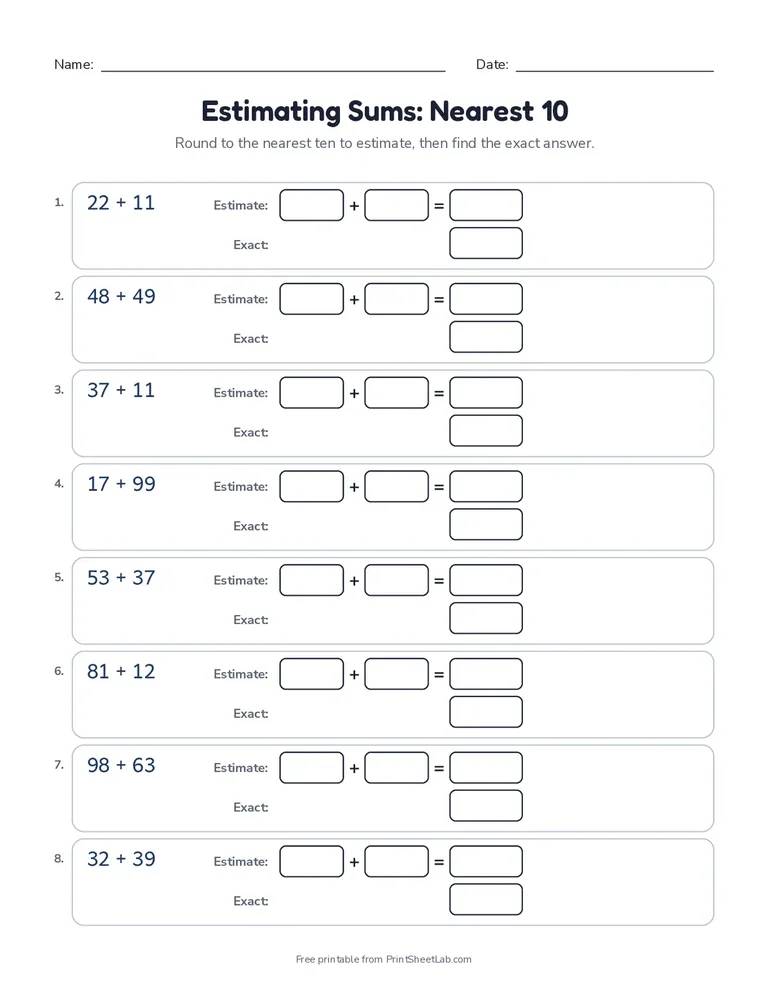
Estimating sums worksheets teach that rounding is a tool: round each number first, add the rounded numbers in your head, and compare the result with the exact answer. These five sums show how close an estimate is:
| Sum | Exact answer | Estimate by rounding | How far off |
|---|---|---|---|
| 38 + 47 | 85 | nearest 10: 40 + 50 = 90 | 5 |
| 276 + 418 | 694 | nearest 100: 300 + 400 = 700 | 6 |
| 593 + 408 | 1,001 | nearest 100: 600 + 400 = 1,000 | 1 |
| 1,684 + 2,317 | 4,001 | nearest 1,000: 2,000 + 2,000 = 4,000 | 1 |
| 4,862 + 3,139 | 8,001 | nearest 1,000: 5,000 + 3,000 = 8,000 | 1 |
Rounding to a place that matches the size of the numbers gives an estimate within a few percent of the answer. The error can be at most half the unit for each number, so for two numbers it is at most one unit:
| Rounded to the nearest | Biggest error for one number | Biggest error when adding two rounded numbers |
|---|---|---|
| 10 | 5 | 10 |
| 100 | 50 | 100 |
| 1,000 | 500 | 1,000 |
Rounding worksheets grade 3 and grade 4
Rounding worksheets grade 3 stay within 1,000 and round to the nearest 10 or 100. In grade 4 children round any whole number up to 1,000,000 to any place. In both grades the hardest numbers are those with 9s, because the 9s turn to 0 and the next digit goes up:
| Number | Round to the nearest | Answer | What happens |
|---|---|---|---|
| 396 | 10 | 400 | the 9s turn to 0 and the next digit goes up |
| 996 | 10 | 1,000 | the 9s turn to 0 and the next digit goes up |
| 996 | 100 | 1,000 | the 9s turn to 0 and the next digit goes up |
| 9,996 | 1,000 | 10,000 | the 9s turn to 0 and the next digit goes up |
Children can check these with the number line: 396 is between 390 and 400, and it is closer to 400. Wikipedia’s article on rounding describes other rules, such as rounding half to even, which is used in some computer programs. The classroom rule on these worksheets is always round half up.
Common mistakes on rounding worksheets
- Looking at the wrong digit. To round 4,687 to the nearest 100, children must look at the 8, not the 7.
- Rounding every digit. Only the digit to the right decides, and the digits after the place all become 0.
- Not carrying. 396 to the nearest 10 is 400, not 390 or 310.
- Rounding down 5. A 5 always rounds up in school math.
Practice it as a game
Free online games for the same skill: balloon pop, memory match, races and more. No sign-up.

Frequently asked questions
3 quick answers
Does 5 round up or down?
Up. When the digit to the right is exactly 5, the number is exactly halfway, and the usual rule is to round up.
What is the difference between rounding and estimating?
Rounding changes one number to a nearby, simpler number. Estimating uses rounded numbers to get a quick, close answer to a calculation.
Do the worksheets have answer keys?
Yes, every worksheet has an answer key on the last page of the PDF.