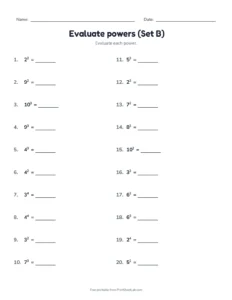
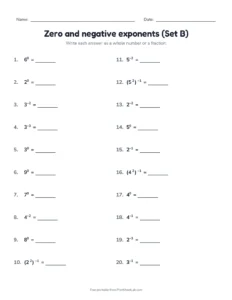
Exponents worksheets help students move from repeated multiplication to the rules that make algebra work. These free printable exponents worksheets start with evaluating powers like 25, then cover the product, quotient and power rules, and finish with zero and negative exponents. Every PDF has an answer key, and the maker below builds fresh problems in seconds.
Quick answer: An exponent tells you how many times to multiply a base by itself: 25 = 2 × 2 × 2 × 2 × 2 = 32. To multiply powers with the same base, add the exponents; to divide, subtract them. This page has 6 free exponents worksheets (PDF) with answer keys for grades 6 to 8, plus a maker for new problems. Updated October 2026.
Exponents worksheets: ready-to-print samples
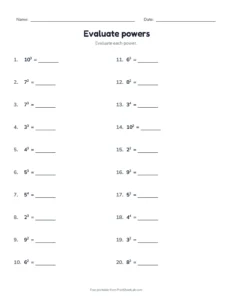
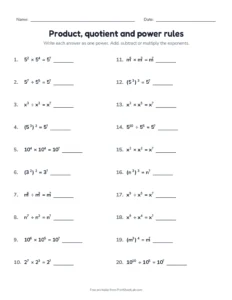
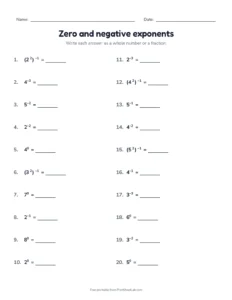
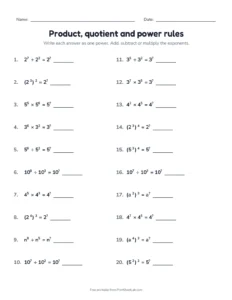
The four previews below are Level 1 (evaluating powers such as 34), Level 2 (the product, quotient and power rules), Level 3 (zero and negative exponents) and Set B of the rules level. Levels 1 and 3 have a Set B too, so there are six PDFs in all, each in US Letter and A4, listed under Ready-to-print worksheets.
Evaluate powersLevel 1 with a full answer key.PDFProduct, quotient and power rulesLevel 2 with a full answer key.PDFZero and negative exponentsLevel 3 with a full answer key.PDFExponent rules (Set B)A second set of problems.PDF
What is an exponent?
An exponent is a small raised number that shows how many times the base is multiplied by itself. In 53, the base is 5 and the exponent is 3, so the value is 5 × 5 × 5 = 125. Exponents give a short way to write long products, and they are the basis of squares, cubes, area, volume and scientific notation.
Evaluating powers: worked examples
Each row writes the power as repeated multiplication and gives the value. Cover the last column and try each one first:
Base
Power
Repeated multiplication
Value
2
23
2 × 2 × 2
8
2
25
2 × 2 × 2 × 2 × 2
32
3
34
3 × 3 × 3 × 3
81
5
53
5 × 5 × 5
125
10
104
10 × 10 × 10 × 10
10,000
4
43
4 × 4 × 4
64
7
72
7 × 7
49
6
63
6 × 6 × 6
216
Work two factors at a time and write each step down: 63 is 6 × 6 = 36, then 36 × 6 = 216. Students who know their times table facts up to 12 × 12 can do most squares in their head, which leaves attention for the cubes and higher powers.
The laws of exponents: six rules
The exponent rules save work when the base is the same. Learn the pattern, then check it with small numbers:
Rule
In words
Example
Result
Product
Same base: add the exponents
23 × 24
27 = 128
Quotient
Same base: subtract the exponents
56 ÷ 52
54 = 625
Power of a power
Multiply the exponents
(32)3
36 = 729
Zero exponent
Any non-zero number to the power 0 is 1
90
1
Negative exponent
Flip to the reciprocal
2-3
1/8
Power of a product
Apply the exponent to each factor
(2 × 3)2
22 × 32 = 36
Negative exponents: what do they mean?
A negative exponent does not make the number negative. It means take the reciprocal. Each step down in the exponent divides by the base, so 23 = 8, 22 = 4, 21 = 2, 20 = 1, 2-1 = 1/2. This pattern also shows why any non-zero number to the zero power is 1:
Expression
Reciprocal form
Value
2-1
1/21
1/2
2-2
1/22
1/4
3-2
1/32
1/9
5-3
1/53
1/125
10-3
1/103
1/1,000 = 0.001
(1/2)-3
23
8
Exponents in the order of operations
Exponents are worked out right after parentheses and before multiplication, division, addition and subtraction. In 4 + 32 × 2, square the 3 first to get 9, multiply by 2 to get 18, then add 4 for an answer of 22. The table shows how parentheses change the result:
Expression
First step
Value
4 + 32 × 2
32 = 9
22
(4 + 3)2
4 + 3 = 7
49
2 × 52
52 = 25
50
(2 × 5)2
2 × 5 = 10
100
102 – 62
100 – 36
64
18 ÷ 32
32 = 9
2
The second and fourth rows are the ones students get wrong most often: (4 + 3)2 is 49, not 42 + 32 = 25.
Negative and fraction bases
A negative base raised to an even exponent gives a positive answer, and raised to an odd exponent it gives a negative answer, as long as the negative number sits inside parentheses. Each pair of negative factors multiplies to a positive, the same sign rule students use when multiplying positive and negative integers.
Power
Repeated multiplication
Value
(-2)2
(-2) × (-2)
4
(-2)3
(-2) × (-2) × (-2)
-8
(-3)4
(-3) × (-3) × (-3) × (-3)
81
(-1)5
(-1) × (-1) × (-1) × (-1) × (-1)
-1
(1/2)3
1/2 × 1/2 × 1/2
1/8
(2/3)2
2/3 × 2/3
4/9
(3/4)2
3/4 × 3/4
9/16
For a fraction base, raise the numerator and the denominator separately: (2/3)2 = 22/32 = 4/9. A fraction less than 1 gets smaller each time it is multiplied by itself, so (1/2)3 = 1/8 is smaller than 1/2. It is the same skill as multiplying a fraction by a fraction, repeated. Use this table as an extension once Level 1 feels easy.
Try ten powers and exponents problems
Use these as a warm-up. Write each power as repeated multiplication if you are stuck. Answers use commas for thousands.
#
Problem
Answer
1
26
64
2
33
27
3
54
625
4
105
100,000
5
44
256
6
62
36
7
93
729
8
210
1,024
9
73
343
10
82
64
Exponents vocabulary
Mixing up the base and the exponent is the most common reason a Level 1 answer comes out wrong, so check these words first. In 53, a student should be able to point to the base (5) and the exponent (3), and read the power aloud as “five cubed” or “five to the third power”:
Word
Meaning
Example
Base
The number being multiplied
5 in 53
Exponent
How many times the base is used as a factor
3 in 53
Power
An expression with a base and an exponent
53
Square
A number to the power 2
62 = 36
Cube
A number to the power 3
43 = 64
Reciprocal
A number turned upside down
1/8 is the reciprocal of 8
Make a new set of problems
Customize loads the same level into the maker for a fresh set of problems.
Write and evaluate numerical expressions with whole-number exponents
Grade 8
8.EE.A.1
Know and apply the properties of integer exponents
Grade 8
8.EE.A.3
Use numbers in scientific notation, which relies on powers of 10
Common mistakes with exponents
Mistake
Example
Fix
Multiplying the base by the exponent
23 = 6
Multiply the base by itself 3 times: 2 × 2 × 2 = 8
Multiplying exponents in the product rule
23 × 24 = 212
Add the exponents: 27
Treating a negative exponent as a negative number
2-3 = -8
It is a reciprocal: 1/8
Saying anything to the power 0 is 0
50 = 0
It is 1
Missing the parentheses
-32 = 9
The exponent applies to 3 only: -9. With parentheses, (-3)2 = 9
Real-life uses of exponents
Exponents describe anything that grows or shrinks by the same factor each step:
Situation
Power
Value
Area of a square with side 9 cm
92
81 cm²
Volume of a cube with side 5 in
53
125 in³
A message forwarded to 2 people, 10 times
210
1,024 people
Bacteria that double every hour, after 6 hours
26
64 times the start
Memory sizes: 210 bytes in a kilobyte
210
1,024
Area and volume are where squares and cubes show up most in school. Doubling the side of a cube multiplies its volume by 23 = 8, so a 10 in cube holds 1,000 in³ while a 5 in cube holds 125 in³. A volume calculator for cubes, boxes and cylinders is a quick way to check answers like these.
Exponents are also the reason scientists plot some data on graph paper with a logarithmic scale on both axes. When y = xn, the points form a straight line whose slope is the exponent n, so a cube’s volume plotted against its side climbs 3 cycles for every 1 cycle across.
Powers of 2 also hide inside a classic puzzle. The fewest moves for a tower of n disks is 2n − 1, so 5 disks need 31 moves and 7 disks need 127. Children can test the pattern for themselves with the free online disk-stacking puzzle.
Which exponents worksheet should you start with?
Start with level 1 if students still write 23 as 6. Move to level 2 when powers come easily, and use Set B a week later for a retest.
Level
Skill
Best for
Level 1
Evaluate powers
Grade 6
Level 2
Product, quotient and power rules
Grade 8
Level 3
Zero and negative exponents
Grade 8
A weekly plan for exponents
Day
Focus
Suggested block
Monday
Evaluate powers
15 min
Tuesday
Product and quotient rules
15 min
Wednesday
Power of a power
15 min
Thursday
Zero and negative exponents
15 min
Weekly total
Four short sessions
60 min
Frequently asked questions
9 quick answers
Where can I download free exponents worksheets?
All six PDFs are in the Ready-to-print list: Level 1 and its Set B for evaluating powers, Level 2 and its Set B for the exponent rules, and Level 3 and its Set B for zero and negative exponents. Choose US Letter or A4, then print or save; every sheet has an answer key and no account is needed.
How do you evaluate an exponent?
Multiply the base by itself as many times as the exponent says. For example, 43 = 4 × 4 × 4 = 64.
What are the laws of exponents?
When the base is the same, add exponents to multiply, subtract them to divide, and multiply them for a power of a power. Any non-zero number to the power 0 is 1.
What is a negative exponent?
A negative exponent means the reciprocal. For example, 2-3 = 1/23 = 1/8.
What grade learns exponents?
Grade 6 evaluates whole-number exponents, and grade 8 learns the integer exponent rules.
Why is the answer always 1 on a zero exponent worksheet?
Each step down in the exponent divides by the base: 2 to the power 3 is 8, then 4, 2 and finally 1 at the power 0. So any non-zero number to the power 0 is 1, and writing 5 to the power 0 as 0 is a common mistake.
What real-life examples suit a powers and exponents worksheet?
The area of a square with 9 cm sides is 9 squared, 81 cm², and a cube with 5 in sides holds 125 in³. Bacteria that double every hour reach 64 times the start after 6 hours, and a kilobyte is 2 to the power 10, or 1,024 bytes.
Is a negative number to an even power always positive?
Yes, when the negative number is in parentheses: (-5)2 = 25 and (-2)4 = 16. An odd power stays negative, so (-2)3 = -8. Without parentheses, -52 means -(52), which is -25.
How do you raise a fraction to a power?
Raise the numerator and the denominator to the power separately. For example, (3/4)2 = 9/16 and (1/2)4 = 1/16.
More math practice
Once these exponents worksheets feel easy, the skills below use powers in new ways.
We hope you're enjoying Print Sheet Lab! Need a different option, noticed something missing, or have an idea for a new tool or calculator?
Whether it's a small improvement, a technical issue or something customized for your business, we'd love to hear from you.
✓ Existing tool improvements and bug fixes – Free
✓ Custom calculators, tools and websites – Affordable development charges
We aim to respond within 24 hours.
How Can We Help You?
Tell us what you're looking for. Whether you need an improvement to an existing tool, want to report an issue, or have an idea for something new, we're here to help.
✓
Thank you for sharing your request!
We've successfully received your message. Our team will review it and aim to respond within 24 hours.
We'll contact you at your provided email address with an update.