


Math calculators are online tools that solve a problem and explain how: they add fractions, find a percent, solve a quadratic, work out a standard deviation or measure a triangle. These free math calculators with steps show the formula first and then the numbers, so you can learn the method as well as get the answer.
Quick answer: Choose a math calculator by the kind of problem. Fractions and decimals: fraction calculator. Percent questions: percentage calculator. Averages and spread: mean, median and mode, or standard deviation. Equations and triangles: quadratic formula and Pythagorean theorem. Example: 3/4 + 5/6 = 19/12, which is 1 7/12.
How to choose the right math calculator
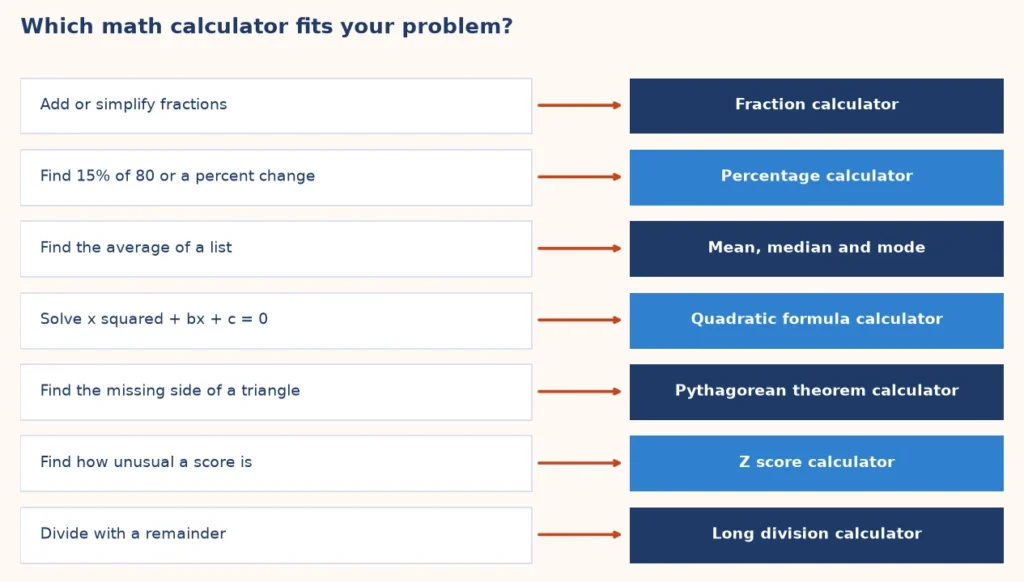
The fastest way to choose among math calculators is to name the operation you need. Each tool below solves one kind of problem and shows its working, which is what teachers ask for when they say “show your steps”. Every calculator runs in your browser and needs no sign-up.
| If you want to… | Use this calculator | Example |
|---|---|---|
| Add, subtract, multiply or divide fractions | Fraction calculator | 3/4 + 5/6 = 1 7/12 |
| Reduce a fraction | Simplify fractions calculator | 18/24 = 3/4 |
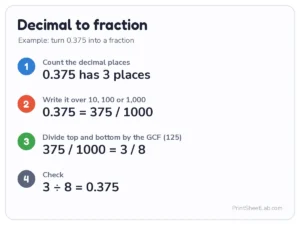
| Turn a decimal into a fraction | Decimal to fraction calculator | 0.375 = 3/8 |
| Solve percent questions | Percentage calculator | 15% of 80 = 12 |
| Compare or split by a ratio | Ratio calculator | 3:5 of $240 = $90 and $150 |
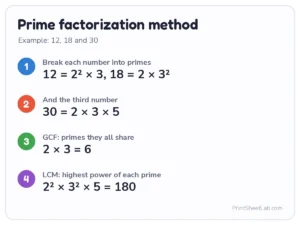
| Find GCF and LCM | GCF and LCM calculator | GCF(12, 18) = 6, LCM = 36 |
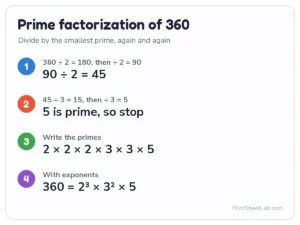
| Break a number into primes | Prime factorization calculator | 360 = 2³ × 3² × 5 |
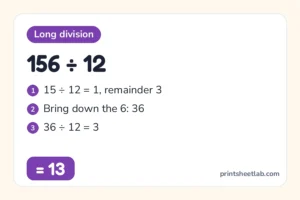
| Divide with a remainder | Long division calculator | 487 ÷ 12 = 40 r 7 |
| Round a number | Rounding calculator | 3.14159 ≈ 3.14 |
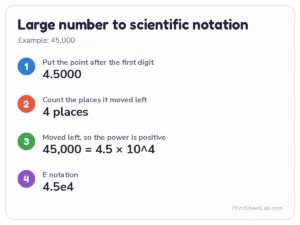
| Write very large or small numbers | Scientific notation calculator | 45,600,000 = 4.56 × 10⁷ |
| Find a mean, median or mode | Mean, median and mode calculator | Mean of 4, 8, 6, 5, 3, 8, 9 is 6.14 |
| Measure spread | Standard deviation calculator | Sample SD 2.27 |
| Solve a quadratic equation | Quadratic formula calculator | x² − 5x + 6 = 0 gives 2 and 3 |
| Find a missing triangle side | Pythagorean theorem calculator | 6 and 8 give 10 |
Step by step math calculators: how the working is laid out
Step by step math calculators follow the same pattern every time, so you can read any answer the way a teacher marks it. First comes the formula or rule in words. Next the numbers are substituted into it. Then each operation is done in order, and the last line gives the answer with its unit. If your own working differs, you can see exactly which line to fix.
Good math calculators also check your input. They reject a zero denominator, warn when a triangle cannot exist and explain when a quadratic has no real roots, instead of returning an error code. For teachers and parents, math calculators with steps work as an answer key that explains itself: project one on the board, solve a problem together and let students predict each line before it appears.
Fraction and percent calculators: the everyday math tools
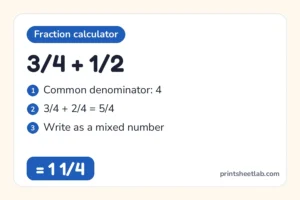
Fraction and percent calculators handle the numbers people meet most often. A fraction calculator finds a common denominator, combines the numerators and simplifies. For 3/4 + 5/6, the lowest common denominator is 12, so the sum is 9/12 + 10/12 = 19/12, or 1 7/12. The fraction calculator shows each step and the mixed number.
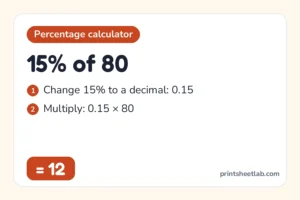
A percentage calculator answers the common percent questions. Percent of: 15% of 80 is 0.15 × 80 = 12. Percent change: from 80 to 100 is (100 − 80) ÷ 80 = 25% more. Use the percentage calculator for both, and the simplify fractions calculator when you need a fraction in lowest terms such as 18/24 = 3/4.
Fraction, decimal and percent equivalents
Memorizing these equivalents makes mental math faster, and the decimal to fraction calculator and percentage calculator fill in any others.
| Fraction | Decimal | Percent |
|---|---|---|
| 1/8 | 0.125 | 12.5% |
| 1/5 | 0.2 | 20% |
| 1/4 | 0.25 | 25% |
| 1/3 | 0.333… | 33.3% |
| 3/8 | 0.375 | 37.5% |
| 1/2 | 0.5 | 50% |
| 2/3 | 0.666… | 66.7% |
| 3/4 | 0.75 | 75% |
| 7/8 | 0.875 | 87.5% |
The ratio calculator works the same way for comparisons: a ratio of 3:5 split over $240 gives 240 ÷ 8 = $30 per part, so the shares are $90 and $150.
Number theory calculators: GCF, LCM and prime factors
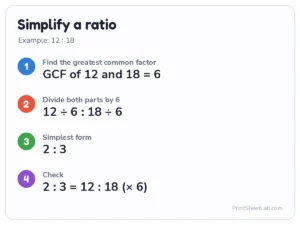
These math calculators work on whole numbers. The greatest common factor (GCF) is the largest number that divides both numbers, and the least common multiple (LCM) is the smallest number both divide into. For 12 and 18 the GCF is 6 and the LCM is 36, and the two are linked: GCF × LCM = 12 × 18 = 216.
Prime factorization writes a number as a product of primes, which is how the prime factorization calculator and the GCF and LCM calculator find their answers. Since 360 = 2 × 2 × 2 × 3 × 3 × 5, it is 2³ × 3² × 5.
| Numbers | GCF | LCM | Use |
|---|---|---|---|
| 12 and 18 | 6 | 36 | Simplify 12/18 to 2/3 |
| 48 and 36 | 12 | 144 | Simplify 36/48 to 3/4 |
| 84 and 126 | 42 | 252 | Simplify 84/126 to 2/3 |
| 4, 6 and 10 | 2 | 60 | Common denominator for 1/4 + 1/6 + 1/10 |
Algebra calculators: quadratics, slope and square roots
Algebra calculators solve equations and describe lines. The quadratic formula solves ax² + bx + c = 0: x = (−b ± √(b² − 4ac)) ÷ 2a. For x² − 5x + 6 = 0, the discriminant is 25 − 24 = 1, so x = (5 ± 1) ÷ 2, which gives 3 and 2. The quadratic formula calculator also draws the vertex and tells you when the roots are complex.
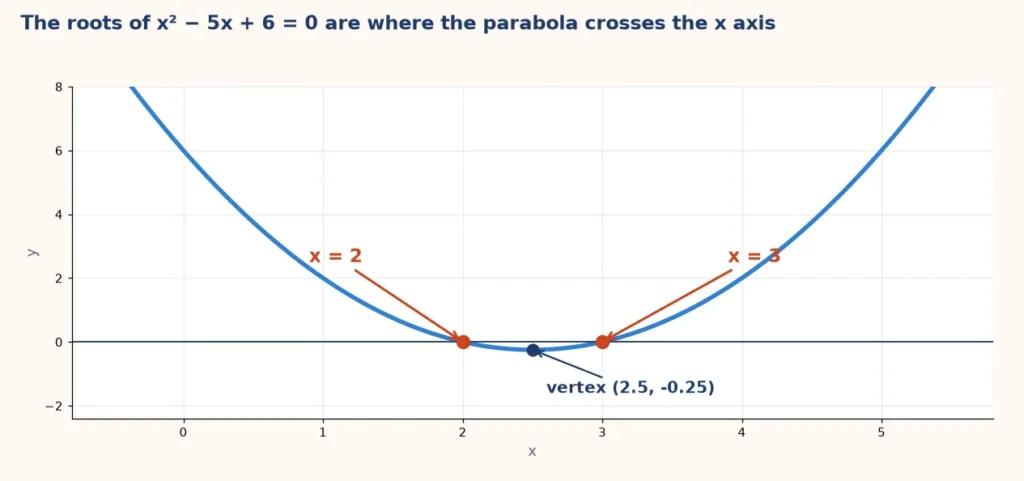
The discriminant b² − 4ac tells you how many real answers to expect before you solve anything.
| Discriminant | Real roots | Example |
|---|---|---|
| Positive | Two different roots | x² − 5x + 6: 1, so x = 2 and 3 |
| Zero | One repeated root | x² − 6x + 9: 0, so x = 3 |
| Negative | No real roots (two complex) | x² + 2x + 5: −16 |
Slope measures steepness: m = (y₂ − y₁) ÷ (x₂ − x₁). Between (1, 2) and (5, 10) the slope is 8 ÷ 4 = 2. The slope calculator also writes the line equation y = 2x, and the square root calculator simplifies radicals, so √72 = 6√2 ≈ 8.485. These algebra calculators are the ones to use for homework checks.
Statistics calculators: mean, standard deviation and z scores
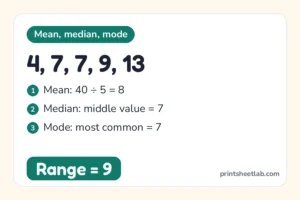
Statistics calculators summarize a list of numbers. Take the test scores 4, 8, 6, 5, 3, 8, 9. The mean is 43 ÷ 7 = 6.14, the median (the middle value when sorted) is 6, the mode (the most frequent) is 8 and the range is 9 − 3 = 6. The mean, median and mode calculator finds all four with the sorted list shown.
Standard deviation measures how far values sit from the mean. For the same list the sample standard deviation is 2.27 (divide by n − 1) and the population standard deviation is 2.10 (divide by n). The standard deviation calculator shows both, with the sum of squared differences laid out.
A z score says how many standard deviations a value is from the mean: z = (x − mean) ÷ SD. A test score of 85 where the mean is 70 and the SD is 10 has z = 1.5, which is the 93rd percentile. These statistics calculators are common in science and social studies classes.
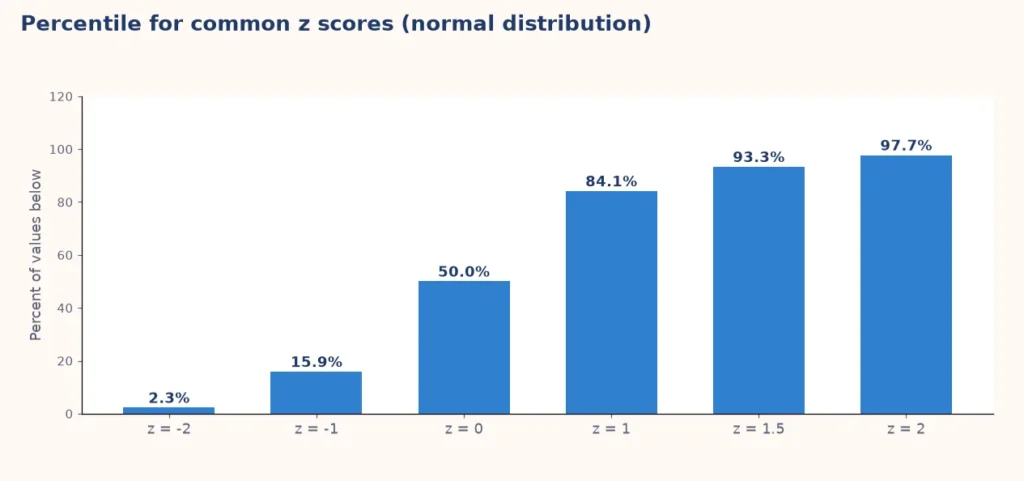
The z score calculator turns any z into a percentile, and the permutation and combination calculator counts arrangements: 5P3 = 60 ordered ways and 5C3 = 10 unordered ways to pick 3 from 5.
Geometry calculators: triangles, area and volume
Geometry calculators measure shapes. The Pythagorean theorem says a² + b² = c² in a right triangle. A ladder 10 ft long with its foot 6 ft from a wall reaches √(10² − 6²) = √64 = 8 ft up. The Pythagorean theorem calculator works out any missing side and checks whether three sides make a right triangle.
| Shape | Area formula | Example |
|---|---|---|
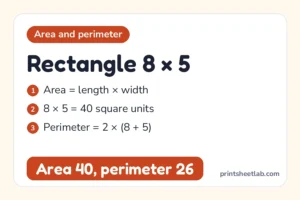
| Rectangle | length × width | 12 × 5 = 60 (perimeter 34) |
| Triangle | base × height ÷ 2 | 10 × 6 ÷ 2 = 30 |
| Circle | π × r² | r = 4 gives 50.27 |
| Trapezoid | (a + b) ÷ 2 × height | (6 + 10) ÷ 2 × 4 = 32 |
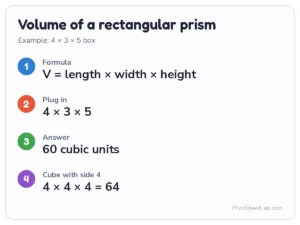
The perimeter and area calculator covers the shapes above, and the volume calculator adds three-dimensional shapes: a cylinder with radius 3 and height 10 has volume π × 3² × 10 = 282.74. These geometry calculators also take units, so the answer comes back in square or cubic units.
Precision tools: rounding, significant figures and percent error
Science and engineering classes ask how precise an answer is. The rounding calculator rounds to any place using the half-up rule, so 3.14159 becomes 3.14. The significant figures calculator counts the digits that carry meaning: 0.004050 has 4. The scientific notation calculator writes 45,600,000 as 4.56 × 10⁷. Percent error compares a measurement with the accepted value: |9.6 − 9.81| ÷ 9.81 = 2.14%, which the percent error calculator computes.
Math calculators by grade level
The Common Core State Standards place these topics across grades. Use this as a guide, because schools vary.
| Grade band | Topics | Calculators to try |
|---|---|---|
| Grades 3 to 5 | Fractions, long division, rounding, factors | Fraction, long division, rounding, GCF and LCM |
| Grades 6 to 8 | Ratios, percent, mean and median, Pythagorean theorem | Ratio, percentage, mean median mode, Pythagorean |
| Grades 9 to 12 | Quadratics, slope, standard deviation, probability | Quadratic, slope, standard deviation, z score, permutations |
Math calculators around the world: terms and notation
Math notation differs by country. Americans and Canadians say “math”, while British, Australian and Indian students say “maths”. The order of operations is PEMDAS in the United States (parentheses, exponents, multiply and divide, add and subtract), BEDMAS in Canada and BODMAS in the UK and India, and all three give the same answers. In the UK and India the GCF is often called the HCF, the highest common factor.
Many European countries write a decimal comma, so 3,14 means 3.14. The calculators use a decimal point, so replace the comma before you type. Wikipedia’s article on the order of operations explains the conventions.
Real-life uses of math calculators
Shopping. A $60 jacket at 25% off costs 60 − 0.25 × 60 = $45. The percentage calculator confirms it and also finds the sale price when you know only the final price.
Cooking. To scale a recipe from 4 to 6 servings, multiply by 6/4 = 3/2, so 2/3 cup of flour becomes 1 cup. The fraction calculator handles the multiplication.
DIY. A rafter that rises 4 ft over a 12 ft run has length √(4² + 12²) = 12.65 ft, found with the Pythagorean theorem calculator.
Questions people ask about math calculators
Is there a free math calculator with steps?
Yes. Every calculator on this page is free and shows the formula and each step, from the common denominator in a fraction to the discriminant in a quadratic. That makes them useful for checking homework and for learning the method.
Which calculator is best for algebra?
For algebra, start with the quadratic formula calculator for equations and the slope calculator for lines. Algebra calculators that show the discriminant and the line equation help you see why the answer is right, not only what it is.
Is using a math calculator cheating?
It depends on the rules of the assignment. Using step by step math calculators to check your own work or to study a solved example is good practice, but copying the answer without learning the method will hurt you on tests.
Frequently asked questions
9 quick answers
What are math calculators?
Math calculators are online tools that solve a specific kind of problem, such as adding fractions, finding a percent or solving a quadratic, and explain the working. Math calculators with steps help you learn the method as well as get the answer.
How do I add fractions with different denominators?
Find a common denominator, rewrite each fraction, add the numerators and simplify. For 3/4 + 5/6 the common denominator is 12, so 9/12 + 10/12 = 19/12, or 1 7/12.
How do I calculate a percent of a number?
Convert the percent to a decimal and multiply. For 15% of 80, 0.15 × 80 = 12. To find a percent change, divide the difference by the original value: (100 − 80) ÷ 80 = 25%.
How do I solve a quadratic equation?
Write it as ax² + bx + c = 0 and use x = (−b ± √(b² − 4ac)) ÷ 2a. For x² − 5x + 6 = 0, x = (5 ± 1) ÷ 2, so the solutions are x = 2 and x = 3.
What is the difference between mean, median and mode?
The mean is the sum divided by the count, the median is the middle value of the sorted list and the mode is the most frequent value. For 4, 8, 6, 5, 3, 8, 9 they are 6.14, 6 and 8.
What is the difference between sample and population standard deviation?
Population standard deviation divides the squared differences by n, and sample standard deviation divides by n − 1. Use the sample version when your data is only part of a larger group. For 4, 8, 6, 5, 3, 8, 9 they are 2.27 and 2.10.
How do I find the missing side of a right triangle?
Use a² + b² = c². If the legs are 6 and 8, c = √(36 + 64) = 10. If you know the hypotenuse and one leg, subtract the squares: b = √(c² − a²).
What does a z score tell me?
A z score says how many standard deviations a value is above or below the mean. A z of 1.5 is higher than about 93% of values in a normal distribution, while a z of −2 is lower than about 98%.
Are these math calculators free and private?
Yes. The calculators are free, need no sign-up and run in your browser, so your numbers are not sent anywhere. Check your answers against your own working on important tests.
More calculator hubs
- All free online calculators with steps for every topic
- Grade and GPA calculators for grades, GPA and final exams
- Financial calculators for percent, interest and tax problems
- Conversion calculators for units and temperature
- Home improvement calculators for area and volume projects
- Random generators for probability and random numbers
Sources and further reading
- Common Core State Standards: Mathematics (what students learn in each grade)
- Wikipedia: Order of operations (PEMDAS, BEDMAS and BODMAS)
- Wikipedia: Standard deviation (sample and population formulas)
- Wikipedia: Fraction (types of fractions and their arithmetic)
Last updated: October 2026.