New: compare numbers by position on a printable number line, including negative numbers.
Comparing numbers worksheets to print (PDF)
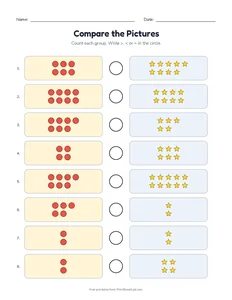
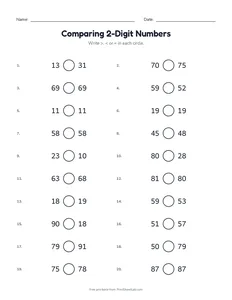
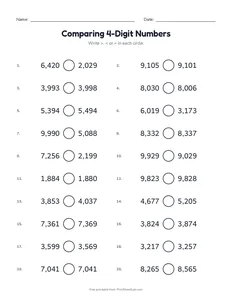
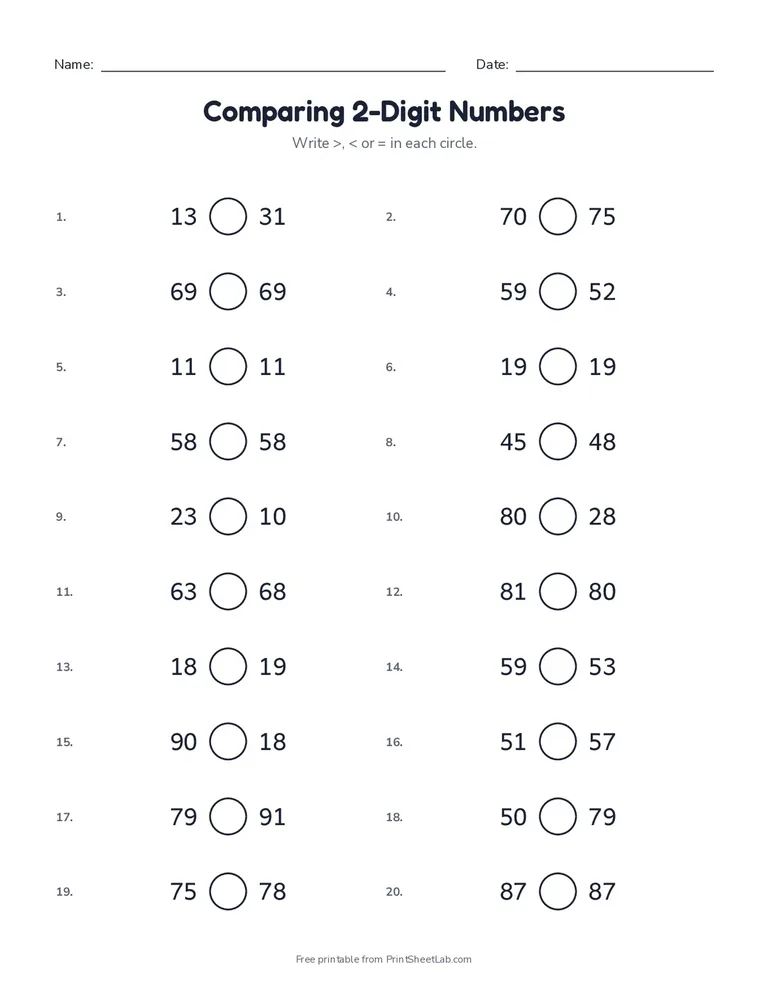
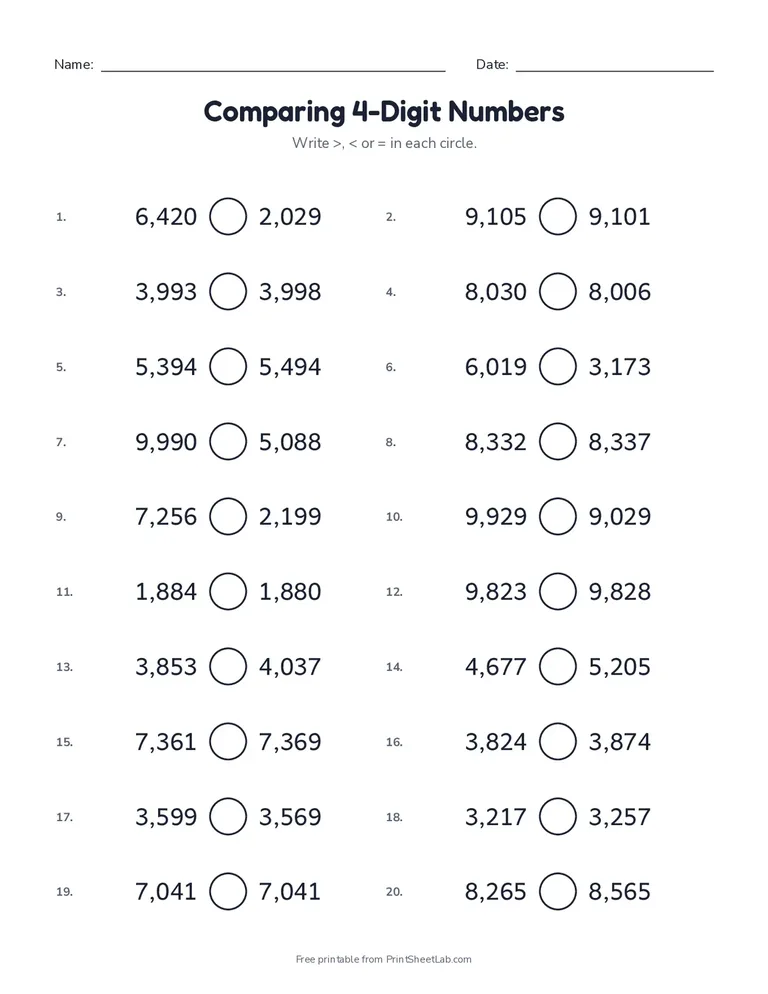
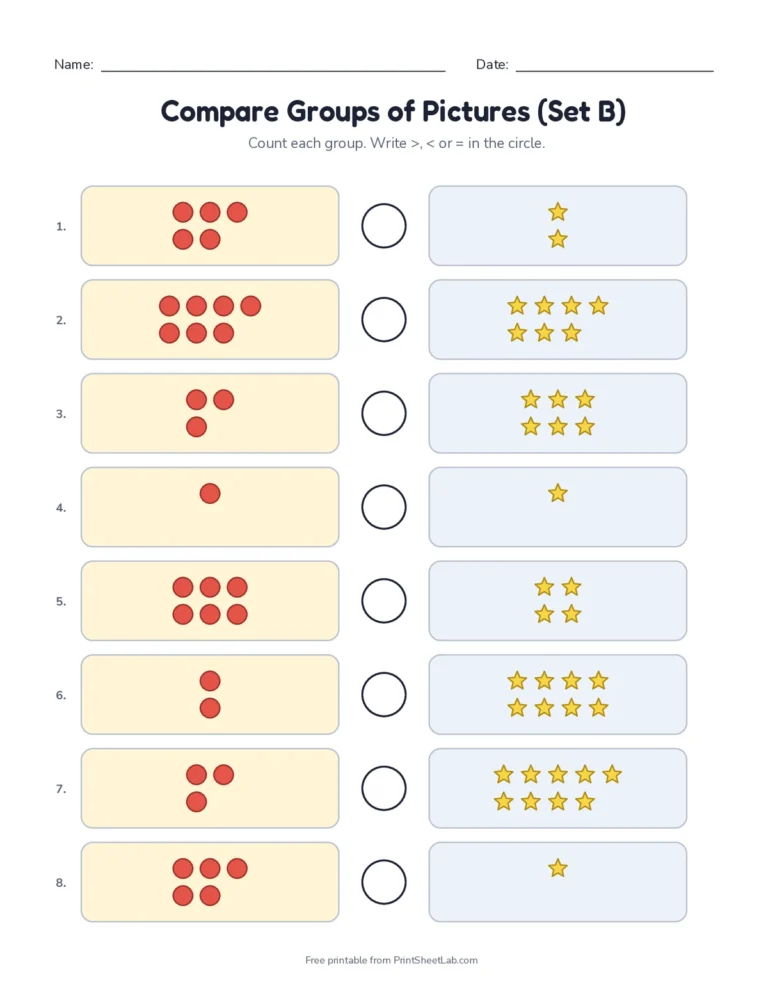
These comparing numbers worksheets are a sample of the 18 printable PDFs in this section, from groups of pictures to large numbers. Click a picture for the PDF, or open one of the sets below to see them all.
How to compare numbers
To compare two numbers, children decide whether the first is greater than (>), less than (<) or equal to (=) the second. With small numbers they can count or match objects. With larger numbers they compare place by place, starting from the left: in 472 and 468, the hundreds are the same, so look at the tens; 7 tens is more than 6 tens, so 472 > 468.
Remembering the signs
- The open side of > and < always faces the bigger number.
- The point faces the smaller number.
- Read the sentence from left to right: 7 > 3 is “7 is greater than 3”.
Comparing numbers by grade
| Grade | What children practice |
|---|---|
| Kindergarten | Comparing groups of objects and numbers from 1 to 10 (K.CC.C.6, K.CC.C.7) |
| Grade 1 | Comparing 2-digit numbers with >, = and < (1.NBT.B.3) |
| Grade 2 | Comparing 3-digit numbers (2.NBT.A.4) |
| Grade 4 | Comparing multi-digit numbers (4.NBT.A.2) |
What is in the comparing numbers worksheets
There are 18 comparing numbers worksheets in three sets, all with answer keys:
- Comparing numbers to 20 (Kindergarten and grade 1, 7 worksheets)
- Comparing 2-digit and 3-digit numbers (Grades 1 and 2, 6 worksheets)
- Comparing and ordering large numbers (Grade 4, 5 worksheets)
Each set opens a page with every worksheet in it, and the Customize link makes a new version with different numbers. All the comparing numbers worksheets are free to print.
Greater than less than worksheets: where the signs come from
The greater than and less than signs are younger than most people think. The equals sign was first used by the Welsh mathematician Robert Recorde in 1557, because he thought nothing could be more equal than two parallel lines. The signs < and > were introduced by Thomas Harriot, an English mathematician, in a book that was published in 1631. Wikipedia’s less-than sign article tells the story. Greater than less than worksheets help children use these signs in the right direction, with the open side facing the larger number.
Comparing numbers kindergarten: from groups to numerals
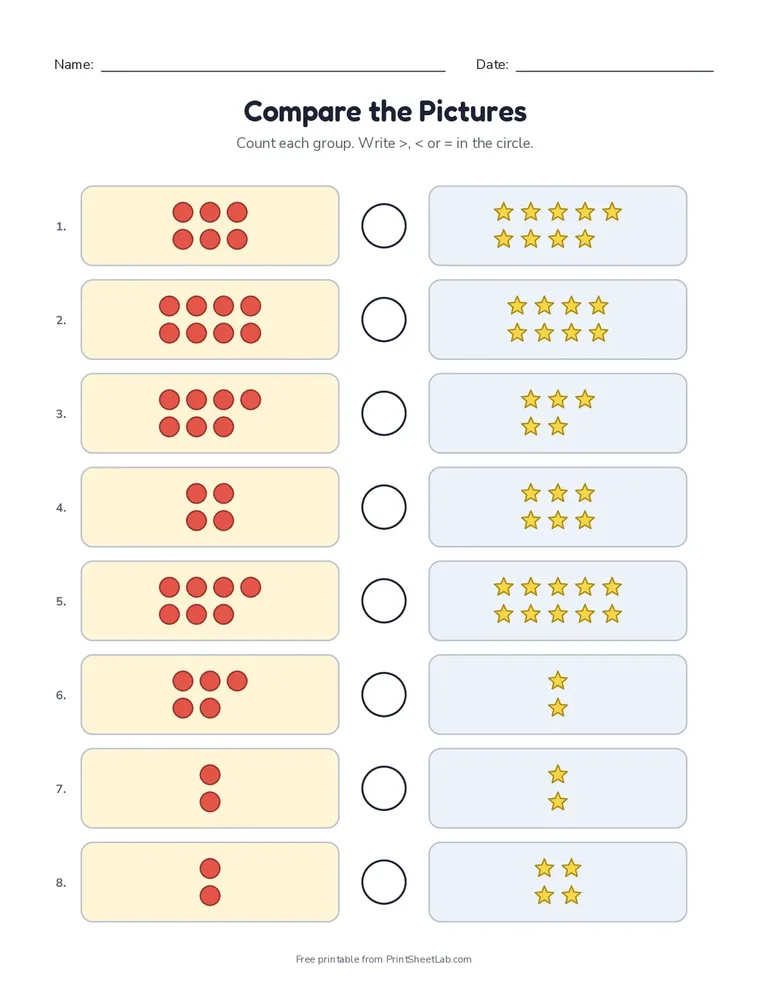
Comparing numbers in kindergarten starts with objects, not numerals. Children match or count two groups and say which has more, and then they compare written numbers to 10. The skill grows in steps through the grades:
| Stage | What children do | Example | Standard |
|---|---|---|---|
| Groups of objects | Match or count two groups and say which has more | 7 stars and 4 stars: 7 > 4 | K.CC.C.6 |
| Numbers to 10 and 20 | Compare two written numbers | 12 and 15: 12 < 15 | K.CC.C.7 |
| 2-digit numbers | Compare the tens, then the ones | 47 and 74: 47 < 74 | 1.NBT.B.3 |
| 3-digit numbers | Compare the hundreds, tens and ones | 506 and 489: 506 > 489 | 2.NBT.A.4 |
| Large numbers | Compare place by place from the left | 45,302 and 45,230: 45,302 > 45,230 | 4.NBT.A.2 |
Comparing 3 digit numbers: start at the left
To compare 3 digit numbers, find the first place, from the left, where the digits differ. That place decides the comparison. If the hundreds are different, you are finished; if they are the same, look at the tens; if those are the same too, look at the ones. This table shows six examples:
| Compare | Where they first differ | Sign | Read it as |
|---|---|---|---|
| 472 and 468 | tens | > | 472 is greater than 468 |
| 305 and 350 | tens | < | 305 is less than 350 |
| 999 and 1,000 | the number of digits | < | 999 is less than 1,000 |
| 120 and 102 | tens | > | 120 is greater than 102 |
| 856 and 856 | none: the numbers are equal | = | 856 is equal to 856 |
| 4,305 and 4,350 | tens | < | 4,305 is less than 4,350 |
A number with more digits is always greater, which is why 1,000 is greater than 999. Children who know this do not need to look at any other place.
How often does the first digit decide?
Because the leftmost digit decides most comparisons, children get a quick answer in most cases. This table counts every pair of different numbers with the same number of digits, and the share where the first digit is enough to decide:
| Numbers | How many | Pairs of different numbers | Pairs decided by the first digit | Share |
|---|---|---|---|---|
| 2-digit numbers | 90 | 4,005 | 3,600 | 89.9% |
| 3-digit numbers | 900 | 404,550 | 360,000 | 89.0% |
| 4-digit numbers | 9,000 | 40,495,500 | 36,000,000 | 88.9% |
So about 89 comparisons in 100 of numbers with the same number of digits are settled by the first digit alone, however many digits there are. Comparing numbers worksheets with numbers that start with the same digit, such as 4,305 and 4,350, are the ones that make children look further, so a good worksheet includes plenty of them.
Ordering numbers worksheets: least to greatest
Ordering numbers worksheets ask children to put a set of numbers in order, from least to greatest or from greatest to least. Compare the numbers two at a time. For 4,305, 4,035, 4,350, 4,053, all four have four digits and start with 4, so the hundreds decide first: 0 hundreds is less than 3, and then the tens separate 4,035 from 4,053 and 4,305 from 4,350. The order from least to greatest is 4,035 < 4,053 < 4,305 < 4,350.
Comparing negative numbers
In grade 6 children compare negative numbers, and the rule reverses: the bigger the number after the minus sign, the smaller the value. A number line makes it clear, because numbers to the right are always greater (6.NS.C.7). You can print a number line with negative numbers from the link at the top of this page. These examples show the rule:
| Compare | Sign | Why |
|---|---|---|
| −3 and −1 | −3 < −1 | −3 is further left on the number line |
| −10 and −2 | −10 < −2 | A bigger number after the minus sign means a smaller number |
| −5 and 2 | −5 < 2 | Every negative number is less than every positive number |
| 0 and −4 | 0 > −4 | Zero is greater than any negative number |
Common mistakes on comparing numbers worksheets
- Reading the sign backwards. Say the sentence aloud from left to right: “7 is greater than 3”.
- Comparing digits from the right. In 472 and 468, the ones (2 and 8) are different, but the tens decide.
- Thinking a longer number of digits is smaller. 1,002 is greater than 998 because it has more digits.
- Forgetting equal. Good comparing numbers worksheets include equal pairs, such as 312 and 312, so children do not assume that one number must be larger.
Practice it as a game
Free online games for the same skill: balloon pop, memory match, races and more. No sign-up.
Frequently asked questions
2 quick answers
What is the trick for greater than and less than?
Many children imagine the sign is a mouth that eats the bigger number. The open side always faces the bigger number.
How do you compare numbers with different numbers of digits?
A whole number with more digits is always greater: 1,002 is greater than 998.