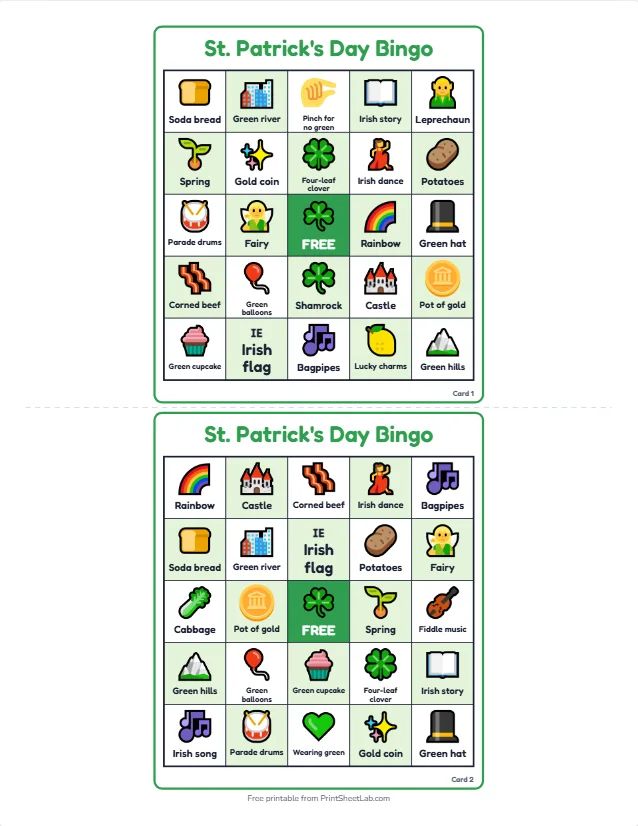
St Patricks Day bingo turns a green-filled holiday into a game that everyone can join, from a toddler holding a paper shamrock to a grandparent on the sidelines of a parade. The template on this page has 28 squares, among them a shamrock, a four-leaf clover, a pot of gold, parade drums, soda bread and a green cupcake. Choose a card size, press print and every player gets a different card, free and without an account.
In short: open the card maker above and press Edit and print this card, pick how many cards you need and download one PDF. Nothing you type leaves your browser. Every square can be rewritten, so a classroom, a family dinner and a parade-day party can each get a St Patricks Day bingo list of their own.
How to play St Patricks Day bingo
St Patricks Day bingo is the bingo everyone knows, with the holiday doing the calling. Each player gets a card, and when one of the squares turns up in front of them they mark it. A full row, column or diagonal wins. The free shamrock in the middle is already marked, so a first line on a 5×5 card needs only four more squares. St Patricks Day bingo is quick to explain, which suits a crowd that includes people of every age.
- Hand out a St Patricks Day bingo card and a pencil to every player. Colored pencils work well, and a green one is the obvious choice.
- Agree the rules in one sentence. A square counts when you see or hear it yourself, and each square counts once.
- Mark St Patricks Day bingo squares as they appear. A green hat, the first drumbeat, a plate of soda bread: each one is a square.
- Call a line out loud. The winner reads the five squares aloud, and a neighbor checks them.
- Keep going if you like. After the first line of St Patricks Day bingo, switch to four corners or an X, or play to a full card.
St Patricks Day bingo works because the holiday is full of things you can point at. The Wikipedia article on St. Patrick’s Day describes public parades and festivals, Irish traditional music sessions, and the wearing of green attire or shamrocks. A card that names those moments gives children a reason to look around, and gives adults an excuse to talk to the stranger who is wearing the biggest green hat.
St Patricks Day bingo cards: all 28 squares
These St Patricks Day bingo cards are made from a list of 28 squares. A standard 5×5 card with a free center needs 24 of them, so each card leaves out four and no two cards are alike. The table groups the list by theme, which helps when you decide what to keep and what to replace with something from your own town.
| Group | Squares on the list | Where you will see them |
|---|---|---|
| Symbols and luck | ☘️ Shamrock, 🍀 Four-leaf clover, 🧝 Leprechaun, 🌈 Rainbow, 🪙 Pot of gold, ✨ Gold coin, 🍋 Lucky charms, 🧚 Fairy | Decorations, paper cutouts, chocolate coins and cereal boxes. The shamrock is everywhere, the fairy is a long shot. |
| Green things to wear | 💚 Wearing green, 🎩 Green hat, 🇮🇪 Irish flag, 🎈 Green balloons, 🤏 Pinch for no green | The first ten minutes of any gathering. Almost everyone has something green on. |
| Music and dance | 🥁 Parade drums, 🎻 Fiddle music, 🎶 Irish song, 💃 Irish dance, 🎶 Bagpipes | Parades, pubs, school concerts and the speaker in the corner. |
| Food | 🥔 Potatoes, 🍞 Soda bread, 🥓 Corned beef, 🥬 Cabbage, 🧁 Green cupcake | The table. They arrive late in the morning and fill in the end of the card. |
| Places and stories | 🏙️ Green river, 🏰 Castle, 🌱 Spring, 🏔️ Green hills, 📖 Irish story | Storybooks, slideshows and the window. A green river is a rare sight, a spring day is not. |
The mix on a St Patricks Day bingo list is deliberate. The wearable squares fill in within minutes, while the long shots (a fairy, a castle, a green river) give each card the feel of a treasure hunt. If every square on a St Patricks Day bingo card were as common as a green shirt, the game would end before the second round of greetings.
How many different cards can you print?
With 28 squares and 24 places on a 5×5 card, the number of different sets of squares is 28 choose 24, which is 20,475. Each set can be put in a huge number of orders, so a class of 30 and a parade-day crowd of 100 can both get a different St Patricks Day bingo card for every player. A smaller grid needs fewer squares, so a 4×4 or 3×3 card has even more possible sets.
| Card size | Squares used | Different sets from the 28 | Best for |
|---|---|---|---|
| 3×3 with free center | 8 | 3,108,105 | Ages 3 to 5, and the short game |
| 4×4 | 16 | 30,421,755 | A quick round before the food comes out |
| 5×5 with free center | 24 | 20,475 | The classic party game |
What St. Patrick’s Day is, and why people play games on it
St. Patrick’s Day, or the Feast of Saint Patrick, is a religious and cultural holiday held on 17 March, the traditional death date of Saint Patrick, who is the foremost patron saint of Ireland. According to the Wikipedia article, it commemorates the arrival of Christianity in Ireland and, by extension, celebrates the heritage and culture of the Irish in general.
It is a public holiday in the Republic of Ireland and in Northern Ireland, and it is widely marked wherever there is a large Irish diaspora, including Great Britain, Canada, the United States, Australia and New Zealand. The article adds that it is celebrated in more countries than any other national festival.
Many people go to church that day, and the same article notes that the Lenten restrictions on eating and drinking were traditionally lifted for the feast, which helped the day become a time for celebration. That mix of faith, family and community is why a game suits it. St Patricks Day bingo is gentle, it needs no special skill, and it lets a child, a teenager and a grandparent play on equal terms. It is also easy to keep alcohol-free, which is how a school, a library or a family dinner will want it.
| Square | What stands behind it |
|---|---|
| Shamrock | A three-leaved clover that is a symbol of Ireland. Saint Patrick is said to have used it to explain the Holy Trinity, a story that first appears in writing in 1726. |
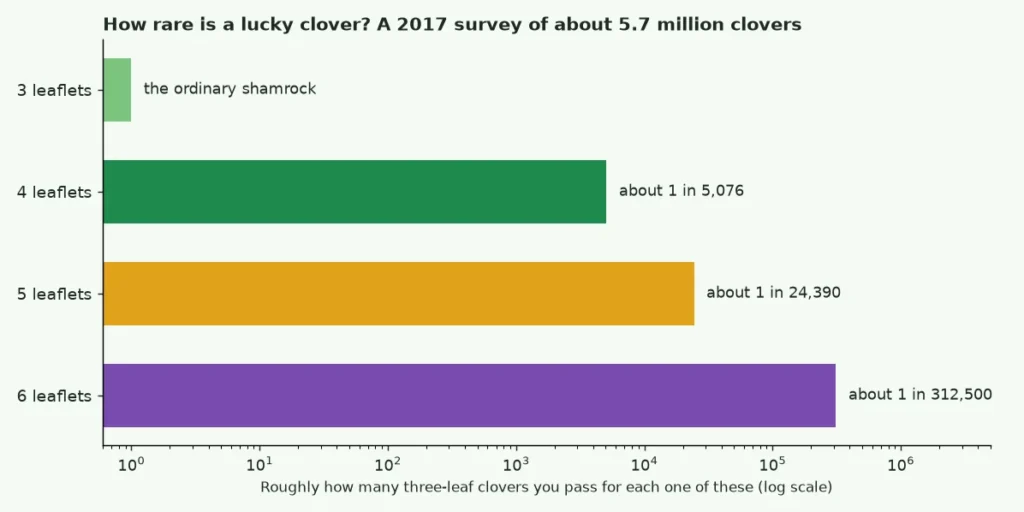
| Four-leaf clover | A rare variation of the clover with four leaflets. A 2017 survey of about 5.7 million clovers in six European countries found about one four-leaf clover for every 5,076 ordinary ones. |
| Leprechaun and pot of gold | A small mischievous figure in Irish folklore, usually shown as a little bearded man in a coat and hat. Later stories made him a shoemaker with a hidden pot of gold at the end of the rainbow. |
| Wearing green | Green came to stand for Ireland over time. One group, the Order of St Patrick, used blue, and the United Irishmen adopted green in the 1790s. A 1795 poem is the first to call Ireland the Emerald Isle. |
| Irish flag | The national flag is a vertical tricolor of green, white and orange, meant to show a hoped-for peace between the traditions of Ireland. |
| Parade drums and bagpipes | Marching bands, pipe bands, fire brigades, youth groups and community clubs often take part. Parades began in North America in the 18th century. The first one in Ireland was held in Waterford in 1903. |
| Soda bread | Traditionally made with flour, buttermilk, salt and baking soda. It developed in the early to mid 1800s, soon after baking soda became available as a raising agent. |
| Corned beef and cabbage | In North America corned beef dishes are linked to Irish food on this holiday. They are less common in Ireland, where corned beef was historically expensive. |
| Green river | Some cities color a river or fountain green for the day. The Wikipedia article mentions the Vilnia River in Vilnius, which is dyed green every year, and London fountains that were dyed in 2008. |
Landmarks go green as well. Since 2010 a campaign called the Global Greening Initiative has lit famous buildings green on 17 March, beginning with the Sydney Opera House and the Sky Tower in Auckland, and the article says more than 300 landmarks in fifty countries have taken part since. Your list can follow whichever tradition your family or class keeps, and a short talk about the squares turns St Patricks Day bingo into a small lesson in culture and history.
How rare is a four-leaf clover?
The Four-leaf clover square is a good place to talk about luck and numbers. A four-leaf clover is a rare mutation of the common three-leaf kind, and a belief that it brings good luck dates back to at least the 17th century. The Wikipedia article on the four-leaf clover quotes the 2017 survey, which also counted five-leaf clovers at about 1 in 24,390 and six-leaf clovers at about 1 in 312,500. The chart shows how steeply the odds climb. Its horizontal axis is logarithmic, so each tick is ten times the one before it.
It also makes a nice classroom activity: hide one paper four-leaf clover among a bag of three-leaf ones and ask how long the search will take. A child who looks for ten minutes and finds nothing has learned something real about rare events, and the Four-leaf clover square of a St Patricks Day bingo card will feel suitably special when it finally gets marked.
Three ways to play a St Patricks Day bingo game
One printed card supports three quite different celebrations. Pick the St Patricks Day bingo game that suits your group, or run two in a row. The table compares them, and the sections below give the rules and some prize ideas.
| Game | Who calls | Length | Best for |
|---|---|---|---|
| Parade-day spotting game | Nobody. The day does. | 1 to 2 hours | Parades, school fairs, street festivals and family outings |
| Calling cards | A host draws cut-out squares | 10 to 20 minutes | Classrooms, libraries, offices and indoor parties |
| Listen-for-it dinner game | The room, with a short list of sounds and dishes | A whole meal | Family dinners, pub nights and quiet gatherings |
Game one: the parade-day spotting game
This is the version most hosts want. St Patricks Day bingo players carry a card and mark squares as they see them: the first drumbeat, a bagpipe band marching by, someone in a green top hat. A useful rule keeps it going: mark only one square at a time, then wait for something new. Without it, one St Patricks Day bingo player can tick every wearable square in the first ten minutes. The simulation further down gives the numbers.
- Prize for the first line: first pick from the dessert table, or the front spot for the next group photo.
- Prize for four corners: choose the next song on the speaker, or the next game.
- Prize for everyone: a sticker, a green pencil or a paper shamrock.
- Grown-up job: a helper keeps a spare card for anyone whose card is lost in the crowd.
Game two: St Patricks Day bingo with calling cards
When everyone sits down, the drawn-card St Patricks Day bingo game is easy to run. In the Print tab, switch on the calling cards and the caller sheet, cut out the squares and shuffle them in a bowl. The host draws one at a time, reads it aloud, and everyone with that square marks it.
For a live round where guests join from their own devices, the play bingo online page hosts a 75-ball game with cards that mark themselves, and the play custom bingo online page explains how to play with your own list of words.
It is also the better choice for a mixed-age room, because the host controls the speed. Add a small rule for the squares that are hard to verify: a Leprechaun or a Fairy square is marked when the host shows a picture, and a Green river square when the host reads out a city that does it.
Game three: the listen-for-it dinner game
This slow, friendly St Patricks Day bingo game is made for a table. Before the meal, each guest gets a card. During dinner they listen for the music squares (an Irish song, fiddle music, bagpipes on the playlist) and watch the plates for the food squares (potatoes, soda bread, cabbage, a green cupcake).
The host plays a short playlist of Irish and Celtic tunes, and the first player to hear all five squares in a line wins a dessert. It is a good way to include grandparents, who often know the songs, and to start a conversation about where each dish comes from.
A real simulation of a St Patricks Day bingo game
A host planning a St Patricks Day bingo game always asks how long it will take. To answer with numbers instead of a guess, we simulated a two-hour parade-and-festival morning and ran 8,000 mornings. Every square has an assumed chance of showing up in a time window. These chances are our assumptions, chosen to feel like a lively community event, and are not survey data.
For example, the Wearing green square is seen at 99 of 100 mornings in the first eight minutes, parade drums at 92, bagpipes at 85, soda bread at 40 and a green river at only 6. If your event is a small classroom party, your own St Patricks Day bingo numbers will differ, but the shape of the results holds.
The parade day: a first line comes after about 67 minutes with six cards
In an average morning a guest sees about 16 of the 28 squares, so a 5×5 card with 24 squares ends the morning with about 14 marked, plus the free center. A full card essentially never happens, because the rare squares (the river, the castle, an Irish story) are unlikely to all turn up. The chart shows when each square usually appears, colored by group.
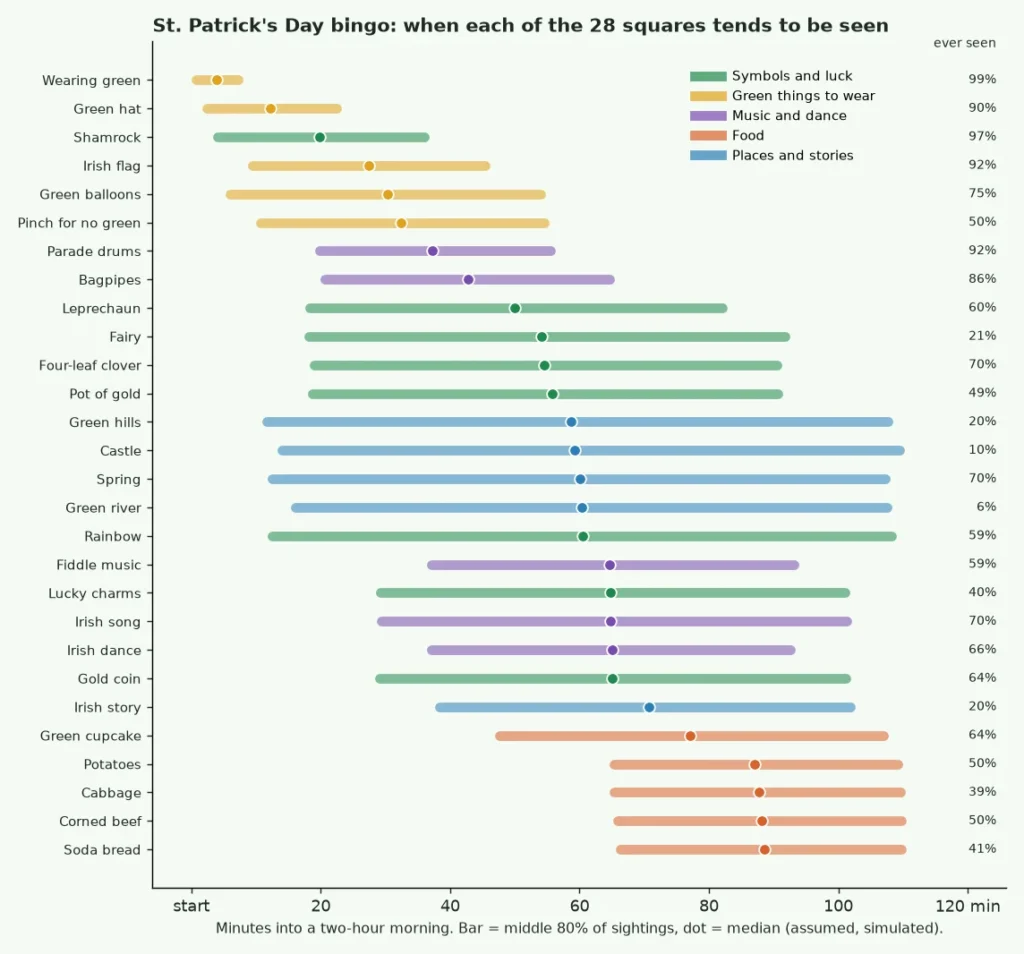
The wearable squares come first, within the first 25 minutes, and the music squares follow as the parade passes. The food squares come last, around the 90-minute mark, once the crowd reaches the tables. In St Patricks Day bingo that order is useful for a host: give the youngest players the cards that lean on early squares, and keep the late ones for a second round.
| Cards at the event (5×5) | Median time of a first line | Middle half of mornings | Line within 60 minutes | Line within 90 minutes |
|---|---|---|---|---|
| 1 card (one guest) | 106 minutes | 81 minutes to the end of the morning | 9% | 34% |
| 6 cards | 67 minutes | 52 minutes to 85 minutes | 39% | 81% |
| 12 cards | 58 minutes | 45 minutes to 72 minutes | 55% | 92% |
In St Patricks Day bingo a single guest has a first line at a median of 106 minutes, and only 9% of lone guests get one within the hour. With six guests, the first line arrives at about 67 minutes, and with twelve a little earlier, at 58 minutes. Smaller cards are quicker: a 3×3 card with six players has a median of 27 minutes, and a 4×4 card with six players 60 minutes. The curves show how the chance climbs.
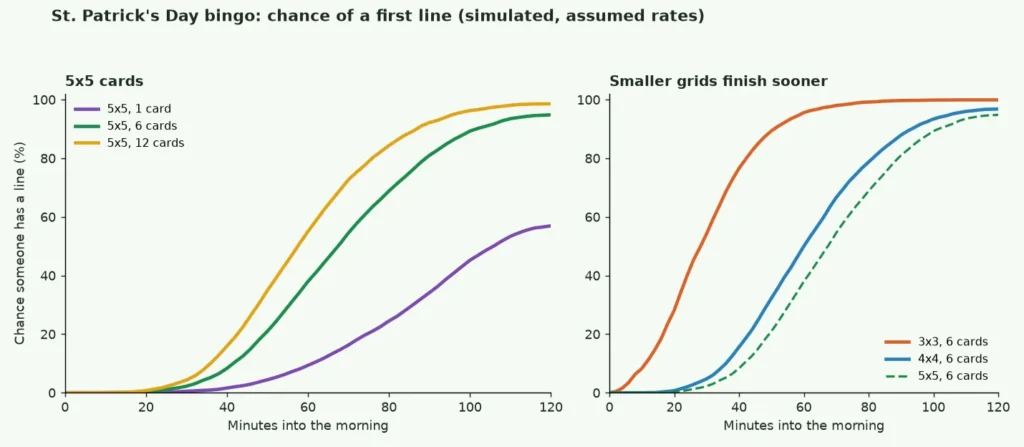
The practical lesson is that St Patricks Day bingo is a group game. One lone card often does not finish a line in two hours, and nobody minds, because the marking itself is the fun. If you want a quick win for a single child, print a 3×3 card.
Other patterns for a longer game
A first line comes quickly in St Patricks Day bingo, so a host who wants the event to last should add a second prize. We simulated four corners, an X and a full card as well. With six cards on the table, four corners finished in about 45% of mornings and an X in only about 6%. A full card did not happen once in 8,000 mornings, which is why we suggest “most squares marked at the end of the day” as a prize instead.
| Pattern (5×5 card) | 1 card | 6 cards |
|---|---|---|
| Any line | 57% of mornings, median 106 minutes | 94% of mornings, median 67 minutes |
| Four corners | only 11% of cards ever get there | 45% of mornings |
| X pattern | only 1% of cards | 6% of mornings |
| Full card | almost never | almost never |
Calling cards in a big room: how many calls, and how often is there a tie?
In the drawn-card game all 28 squares are called exactly once, in random order, so the length of the St Patricks Day bingo game is predictable. We simulated 8,000 games for each room size. The bigger the room, the sooner someone has a line, and the more likely it is that two or more players finish on the same call.
| Cards in play (5×5) | Calls to the first line (median) | Middle half of games | Games with a tied first line | Calls to a full card (median) |
|---|---|---|---|---|
| 1 card | 16 | 14 to 18 | 0% | 28 |
| 4 cards | 13 | 11 to 14 | 14% | 28 |
| 8 cards | 11 | 10 to 13 | 19% | 27 |
| 15 cards | 10 | 9 to 11 | 21% | 27 |
| 30 cards | 9 | 8 to 10 | 24% | 27 |
| 60 cards | 8 | 7 to 9 | 27% | 26 |
| 100 cards | 7 | 6 to 8 | 31% | 26 |
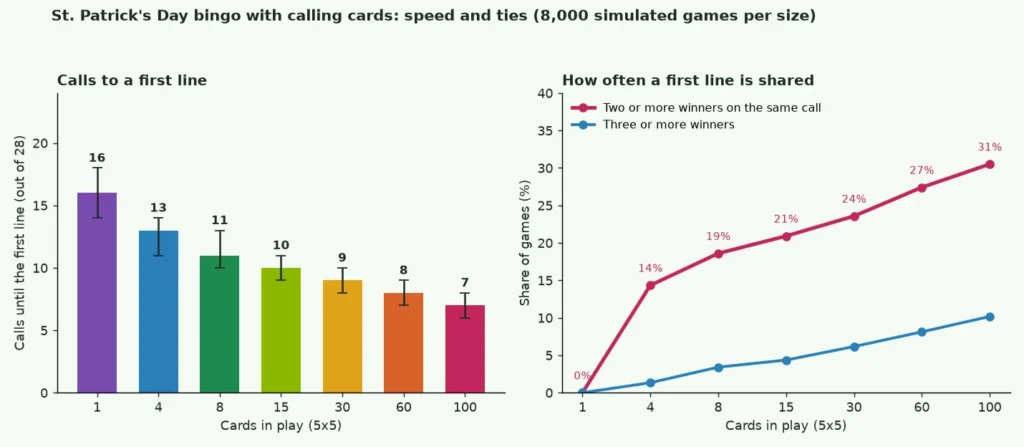
With 30 players on 5×5 cards a first line usually arrives after 9 calls, and about 24% of games have a tie. With 100 players a tie happens in about 31% of games, and as many as 8 players have shared a first line at the same moment.
Plan a tie-break before a big St Patricks Day bingo night starts: the usual choices are a rock-paper-scissors round, a shared prize or a quick draw from the calling cards. For rooms of 50 or more, the guide to bingo for large groups goes deeper into numbered cards and tie rules. The assumptions are that every call is equally likely at each step, that cards are independent random draws and that nobody misses a call.
Printable St Patricks Day bingo: print, trim and hand out
For printable St Patricks Day bingo, the Print tab has the controls you need and nothing extra. Choose how many different cards to print, from 1 to 100, how many go on a page (1, 2, 4 or 6), Letter or A4 paper, and portrait or landscape. Cut guides help with sheets that need trimming. For a class of 28, print 30 cards, two per page, and keep two spares for the card that ends up under a chair.
- Print on green paper for a party. Light green paper keeps the squares readable and makes the stack of St Patricks Day bingo cards look ready for the day.
- Put names on the cards. The Design tab can print a name on each St Patricks Day bingo card, which saves tears when two cards look alike.
- Use big squares for little hands. One card per page in portrait gives the largest squares, best for ages 3 to 5.
- Print the caller sheet and calling cards for the drawn-card game. They come out of the same Print tab.
- Print a spare set. Keep a pile of cards for latecomers and for the second round.
Hosts who are away from a printer can save the St Patricks Day bingo PDF to a phone or a USB stick and print it anywhere. The shareable link in the card maker keeps only your word list, with no names or photos, so you can send it to other parents or teachers and let everyone print their own.
St Patricks Day bingo for kids
St Patricks Day bingo for kids is a tidy way to organize a lively day. Children who are hunting for a shamrock or a rainbow stay with the group, and the pictures on every square let pre-readers play without help. The right St Patricks Day bingo setup depends on age.
| Age | Card | How to play |
|---|---|---|
| 3 to 4 | 3×3, one per page | A grown-up reads the pictures. Sticker dots, no pens. Everybody wins at the first line. |
| 5 to 7 | 3×3 or 4×4 | Words with emoji. Kids spot and shout. Play for a line, then four corners. |
| 8 to 10 | 5×5 | One square at a time, plus two squares they invent themselves, like a green sock or a favorite song. |
| 11 and up | 5×5 with a custom list | Let them write the list for the group, or let them run the calling-card version for younger kids. |
Classrooms get a lot from it. A round of St Patricks Day bingo fits into the last half hour of the day, and it needs only a printer. Pair it with the St. Patrick’s Day worksheets for a full lesson, and compare the squares with a map of Ireland or a short story about the shamrock.
If a class includes children who do not celebrate, let them play as observers, and ask a child who does celebrate to say a sentence about each square. St Patricks Day bingo becomes an introduction, and the child who knows the answers is proud to share them. For other games that suit a class, see classroom bingo and the guide to bingo activities for the classroom.
Keep the pinch playful, or skip it
The Pinch for no green square refers to a playful North American habit of pinching people who forget to wear green. It is not part of the history of the holiday as far as we could verify, and many schools and workplaces ask people not to touch each other. Swap it for something kinder: a sticker for anyone who is not wearing green, or a friendly “I spy no green!” with a smile. Changing a square takes seconds in the card maker.
St Patricks Day bingo for adults, offices and parties
St Patricks Day bingo for adults is a different animal from the version with sticker dots, and it needs a lighter touch. Guests already have a plate or a drink in hand, so the card should ask for very little. The best rule is that a square counts when someone else points it out to you. That turns the game into a conversation: “Is that your green hat? It counts for my card!” The card becomes an excuse to talk to a stranger, not a puzzle to solve alone.
Three tweaks make St Patricks Day bingo grown-up. First, change the list: replace Fairy with “Someone tells a story from Ireland,” and Castle with “A toast to someone who is not here.” Second, use a 4×4 card with no free space so the game ends in about an hour.
Third, give prizes that suit the party: first pick of the dessert, a pot of chocolate coins, or a turn at choosing the next song. Many offices use the game as a quiet icebreaker, and the guide to office bingo has more ideas. The human bingo and getting to know you bingo templates work well for the same crowd, and number-based tambola is covered on the party games hub.
If you do serve drinks, bingo works just as well without them. The card does not depend on anything alcoholic, and a good host makes sure there is a non-alcoholic choice for everyone who wants one, including the designated drivers and the children.
St Patricks Day bingo free printable: what you get
Free, private and nothing to install
This St Patricks Day bingo free printable does not ask for an email or an account, and nothing is added to your PDF but the card itself and a small footer. The editor runs in your browser, so your word list never goes to a server. You need only a printer or a PDF viewer.
What you can change
The St Patricks Day bingo card maker has five tabs: Setup, Items, Design, Templates and Print. On the Items tab you can rewrite any square, add an emoji or upload your own picture, and decide what the free space shows. The Design tab holds color themes, fonts, text size, ALL CAPS, borders, rounded corners, tiles or plain grids, and a card background that can be a color, a pattern or your own picture.
You can also add a title, a logo and a footer line, for example “Room 12 Lucky Day Bingo”. The Templates tab holds the other ready-made lists, and the Print tab holds the numbers: how many cards, which paper, which layout.
You do not have to start from this page. The bingo card generator offers every card type in one place, and the blank bingo cards page gives you an empty grid to fill by hand. The guide on how to make bingo cards explains the other ways of making them.
Customize the cards in the card maker
The best St Patricks Day bingo card names your own street. Open the Items tab and every square turns into a text box. Here is how a few common situations change the list.
- Your family. A family St Patricks Day bingo list might say “Grandpa wears his green tie,” “A story about someone from Ireland,” “A second helping of soda bread.”
- A school or library event. In a St Patricks Day bingo list, swap corned beef for something every family can eat, add “Someone explains the shamrock story,” and keep the food squares free of nuts.
- A very young group. Delete the squares that need reading skills and add friendly ones (a smiling sun, a flower, a rainbow sticker).
- A workplace. Use “Colleague in a green shirt,” “Green cupcakes in the kitchen” and “A green balloon at reception.”
- A music class. Write each square as a tune or an instrument, such as fiddle, tin whistle, drum and bagpipes, and play a short clip for each.
When your list has more than 24 words, the card maker gives every card a different mix. With exactly 24, every card has the same words in a different order. The free space can say “Free” or show its own emoji, text or picture. Shuffle re-deals the squares across all cards, Undo takes back your last change, and the preview lets you zoom in before you download.
Keeping St Patricks Day bingo respectful
St. Patrick’s Day is a joyful holiday, and it is also a real religious feast and a heritage day for many families. A few habits keep the game kind. They apply to St Patricks Day bingo and to any other game you play on the day.
- Treat the leprechaun as a folklore figure, not a costume. The Wikipedia article says that “leprechaun outfits” are based on derogatory 19th century caricatures, and that in 2014 the Ancient Order of Hibernians campaigned to stop major American retailers selling novelty items that promoted negative stereotypes. Use a picture from a storybook instead of a costume.
- Name the day with care. Irish people usually shorten it to Paddy’s Day. Patty’s Day is mostly a North American form that Irish people often point out as wrong, and the full name is always safe.
- Keep the faith side of the day in view. For many people it begins with church. A square that says “Irish story” or “Irish song” is more inclusive than one about drinking.
- Include people who do not celebrate. Everyone can mark a spring day or a green balloon.
- Mind allergies and diets. Soda bread contains wheat and buttermilk, and cupcakes may contain nuts. Ask first.
None of this is a rulebook. It is what a thoughtful host already does. A St Patricks Day bingo card works best when it is written together with the people who celebrate, so ask a grandparent or a friend with Irish roots to look over the list before you print it. They will point out the square you forgot, and quite likely the story that goes with it.
More bingo cards for spring and the holiday season
St Patricks Day bingo is one of a whole set of occasion lists in the card maker. The spring holiday that follows is Easter bingo, and the summer break is covered by summer bingo. For a day in the family calendar, try Mother’s Day bingo or Father’s Day bingo, and for a spring classroom there is Earth Day bingo. Every template is gathered on the printable bingo cards hub, and number-based bingo runs on the bingo caller. For the rules in more detail, see the guides on how to play bingo and bingo patterns.
Frequently asked questions
10 quick answers
What is St Patricks Day bingo?
St Patricks Day bingo is a bingo variation in which every square names something you see, hear or eat on St. Patrick’s Day, such as a shamrock, parade drums or soda bread. Players mark squares as they spot them or as a host calls them, and the first to complete a line wins.
Are these St Patricks Day bingo cards really free?
Yes. You can make, edit and print the cards without an account or a payment. The editor runs in your browser, so the words and pictures you add never leave your device.
How many squares does the St Patricks Day bingo template have?
It has 28 squares. A 5×5 card with a free center uses 24 of them, a 4×4 card uses 16 and a 3×3 card with a free center uses 8. Because the list holds more words than a card has squares, cards differ from one another.
How many different St Patricks Day bingo cards can I print?
Up to 100 different cards in one PDF. There are 20,475 different sets of 24 squares to choose from, so even a big parade crowd can get a card each without repeats.
Can I play St Patricks Day bingo for adults?
Yes. Change the list to your own event, use a 4×4 card for a short game and keep the rule that a square counts when someone else points it out. The game works well as a gentle icebreaker with or without drinks.
How long does a St Patricks Day bingo game last?
On a parade morning, a six-guest group with 5×5 cards usually has a first line after about 67 minutes in our simulation, and a 3×3 card after about 27 minutes. A calling-card game with 30 players usually has a winner after about 9 calls.
When is St. Patrick’s Day?
St. Patrick’s Day falls on 17 March every year. It is the traditional death date of Saint Patrick. Print the St Patricks Day bingo cards a few days ahead, and check a local calendar for parades, which many cities hold on the nearest weekend.
Why is the leprechaun on the St Patricks Day bingo card?
The leprechaun is a figure from Irish folklore, usually shown as a little bearded man who hides a pot of gold at the end of the rainbow. Many families like the character, and you can use a storybook picture instead of a costume if you prefer.
Can I change the squares to match my class or family?
Yes. In the card maker, every St Patricks Day bingo square can be rewritten and given an emoji or a picture. Swap corned beef for a food everyone eats, add family jokes and use the free space for something personal.
What size should I print for young children?
For St Patricks Day bingo with young children, print a 3×3 card, one per page, with large pictures for ages 3 to 5. It has only eight squares plus a free center, so a first line comes quickly and the child stays interested.