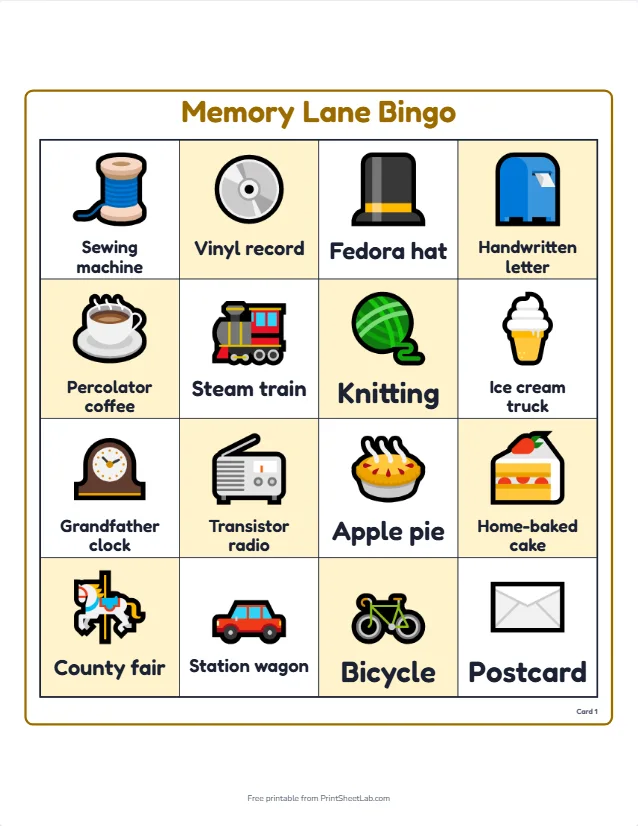
Bingo for seniors works best when the card is easy to see, the pace is easy to follow and nobody feels talked down to. This page gives activity staff, families and community groups a ready-made card: a 4×4 grid of everyday things from other decades, printed one card per page at 125 percent text so each square is big and readable. Press print, hand out the cards, and let bingo for seniors start the conversation while the game runs at the speed of the room.
In short: open the card maker above and press Edit and print this card. Each Memory Lane card has 16 of 28 pictures and words, a different mix on every card, and prints on its own page with large squares. For a number game, the same card maker makes 75-ball cards you can enlarge with the Text size slider, and the bingo caller reads the numbers slowly and aloud. It is free, there is no account, and nothing you type leaves your browser.
How to play bingo for seniors
Bingo for seniors follows the rules most people already know, which is exactly why it works as a group activity. Nobody has to learn anything new for bingo for seniors, and a player who has not played for years can join in after one round. The difference in bingo for seniors lies in the setup: bigger print, a slower caller, and a host who treats the game as an afternoon together rather than a race.
- Seat everyone comfortably with good light. Put a firm tray, a clipboard or a table in front of each player so the card does not slide.
- Give each player one card and something big to mark with. Large chips, jumbo counters, a thick marker or a helper who marks for them all work well.
- Explain the aim in one sentence. “When we call something on your card, cover it. Four in a row wins.” Offer to read through the first round as an example.
- Call each square slowly and clearly. Say the item, pause, show it if you can, and repeat it once. A call every 20 to 30 seconds leaves time for a story.
- Check the winner together. Read the squares aloud, thank everyone for playing and start the next round when people are ready.
With four squares in each row, a first win comes quickly, so there are many small victories in a session. The simulation further down shows how long a round of bingo for seniors lasts. Many groups find that three short rounds of bingo for seniors suit them better than one long one, because a win every few minutes keeps the room lively.
Large print bingo cards: what is on the page
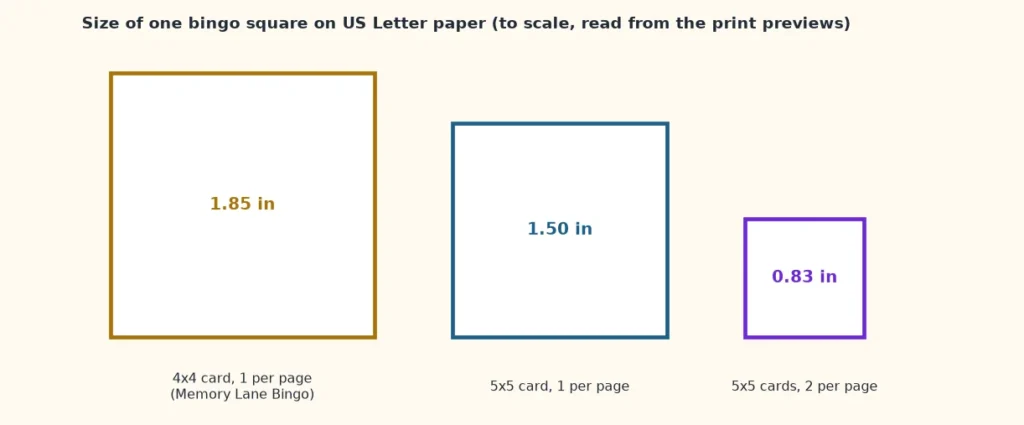
The large print bingo cards on this page are a 4×4 grid, 16 squares, with no free space. Fewer squares than the standard 5×5 card means each square gets more of the page, which is the first rule of bingo for seniors. Each square holds a small picture and a word, and the text is set to 125 percent of the usual size. The card prints alone on a sheet, so the whole page is the card. Measured from the print previews on US Letter paper, each square is about 1.85 inches across.
| Setting | Square size on Letter | When to choose it |
|---|---|---|
| 4×4 card, one per page (this template) | About 1.85 inches | The default for large print. Easy to see, easy to touch, easy to cover with a chip. |
| 5×5 card, one per page | About 1.5 inches | A standard-looking bingo card for players who want the traditional grid |
| 5×5 cards, two per page | About 0.83 inches | Only for confident readers with good sight. Not a large print choice. |
| 3×3 card, one per page | Larger than 4×4 | Short rounds or players who find 16 squares too many |
How large is large print?
There is no single size. The Wikipedia article on large print says large print is typically at least 18 points, and library guidance often gives a minimum of 14 points and prefers 18. Readers differ, and a printer can shrink a file slightly, so print one test page and hold it at arm’s length before you print for the whole room. If a word looks small, open the Design tab and raise the text size, or use fewer words per square, and try again.
The card maker has a Text size slider on the Design tab. This template starts at 125 percent, which you can raise for players who need bigger words. Two other choices help: plain white squares have the best contrast, and ALL CAPS can be easier to read at a glance for short words. The Alternate tint option is a pale shade on every other square, and it is fine on this card, but turn it off if the printer makes it look gray.
Memory Lane Bingo: all 28 squares
Memory Lane Bingo is built from a list of 28 everyday things from the middle of the last century. A 4×4 card needs 16, so each card leaves out 12 and the cards are all different. The table groups the squares by the kind of memory they spark. Use it to decide which squares of this bingo for seniors card to keep and which to swap for something that belongs to your own group.
| Family | Squares on the list | What it can get people talking about |
|---|---|---|
| Home and kitchen | ☕ Percolator coffee, 🍰 Home-baked cake, 🥧 Apple pie, 🧺 Picnic basket, 🧵 Sewing machine, 🧶 Knitting, 🕰️ Grandfather clock | Who baked, who sewed, and what the kitchen smelled like on Sunday |
| Sound and screen | ☎️ Rotary phone, 📻 Transistor radio, 📺 Black-and-white TV, 💿 Vinyl record, 📼 Cassette tape, 🎵 Jukebox | Favorite songs, the family radio and the first television in the street |
| Letters and pictures | 📮 Handwritten letter, ✉️ Postcard, 📷 Polaroid photo, 📰 Newspaper | Pen friends, holiday postcards and the photos in the drawer |
| Getting about | 🚲 Bicycle, 🚂 Steam train, 🚗 Station wagon | First bikes, long journeys and family cars |
| Days out | 🍦 Ice cream truck, 🎠 County fair, 🎬 Drive-in movie, 🎲 Board game | Treats, fairs, dates and rainy afternoons |
| Style and keepsakes | ⌚ Pocket watch, 🎩 Fedora hat, 👓 Reading glasses, 🌹 Garden roses | Heirlooms, fashion and favorite flowers |
With 28 squares and 16 places on a 4×4 card, there are 28 choose 16 different sets of squares, which is 30,421,755. Each set can be arranged in many orders, so a care home with 40 residents can give every player a different card, with no two sitting side by side holding the same one.
Real dates behind some of the squares
A host who can add a small fact makes bingo for seniors feel richer. These are well documented. The first drive-in theater opened in New Jersey in June 1933. The 33 1/3 rpm long-playing record, or LP, arrived from Columbia Records in 1948, the same year the first Polaroid instant camera went on sale.
The Regency TR-1, the first commercial transistor radio, appeared in 1954, and Philips introduced the compact cassette in 1963. You do not need to read out the dates. A single line such as “This one is from the 1950s. Who had one?” invites everyone in.
Nostalgia bingo as a conversation starter
Nostalgia bingo does something plain number bingo cannot: every call is an invitation to talk. A host who calls “Steam train” and then waits a moment may hear about a journey, a station or a first job. That makes nostalgia bingo as much about the people as the squares, and it is why a small group can happily play fewer rounds. Bingo for seniors is a social activity. It is not a treatment and makes no claims about health, and a host should never test anyone’s memory or point out a mistake.
| If you call | You could ask | Keep it light by |
|---|---|---|
| Rotary phone | What was the first number you ever learned by heart? | Letting people laugh at how long a dial took |
| Transistor radio | Whose radio did you listen to, and what was playing? | Humming a tune and seeing who joins |
| Home-baked cake | Who baked for the family, and what was the specialty? | Taking recipes down for the activity board |
| Drive-in movie | What was the first film you saw outdoors? | Accepting any answer, even “I don’t remember” |
| Polaroid photo | Who took the pictures at family occasions? | Offering photos from the day, not the past, if memories are hard |
| Bicycle | Where did you ride as a child? | Moving on gently when a story ends |
Birth years differ, so the list belongs to the group in front of you. A transistor radio and a vinyl record suit people who grew up in the 1950s and 1960s, while a cassette tape and a station wagon may suit a younger crowd. For a group that is new to the game, start with the template as it is and watch which squares draw stories, then edit the Items tab for next time. The birthday bingo list works well for a milestone party in the same room.
Bingo games for seniors: three ways to run a session
One set of printed cards supports quite different afternoons. Pick the format of bingo for seniors that fits the group, and keep the first session short. The table compares the three.
| Format | Who calls | Cards | Pace | Good for |
|---|---|---|---|---|
| Memory Lane with calling cards | The host draws a cut-out card | 4×4, one per page | About 30 to 60 seconds per call, with chat | Small groups and conversation |
| 75-ball with the slow caller | The bingo caller, spoken aloud | 5×5 at a large text size | Auto-call every 20 or 30 seconds | Larger rooms, familiar bingo |
| Family call-in | The host on a shared screen | Cards printed or on screen | Chosen by the host | Relatives joining from other places |
Format one: Memory Lane Bingo with calling cards
In the Print tab you can add calling cards to cut out, one for each of the 28 squares, plus a caller sheet. Shuffle the calling cards, draw one at a time, hold it up and say the name. Because you control the speed, you can stop to talk or repeat a square. Bingo for seniors rarely suffers from running slowly, and the best sessions have more chat than calls. Keep a list of what has been called so you can check a winner.
Format two: large print 75-ball bingo with the slow caller
Some players want bingo for seniors with the traditional numbers. The card maker makes 75-ball cards, and the Design tab includes the Text size slider and a one-card-per-page layout on the Print tab, so you can enlarge the numbers. The bingo caller then runs the game. It shows a big ball with the number just called and says it aloud in English or Hindi, and the speed and device voice can be changed. Set it to auto-call every 20 or 30 seconds, and use Pause whenever the room needs a moment.
- Big-screen mode fills a TV or projector with the current ball and the call board, so players can read the number as well as hear it. Press Esc to leave.
- Repeat last call (the R key) says the number again without moving the game on, which saves the host from repeating it by voice.
- Undo (the U key) takes back a call made by accident, and the call board marks what has been called and highlights the last number.
- Check a winning card lets you type the numbers on a card and see at once whether all of them were called.
- The game is saved in the browser, so a break for tea or a reload does not lose the numbers called so far.
The caller has no sound effects and no guest login: it is a calling screen for a host to run. If relatives want to join from far away, the play bingo online page hosts a live 75-ball game with guests joining by link and cards that mark themselves, and the Zoom bingo template suits a video call.
Format three: a family afternoon
When families visit, bingo for seniors becomes a game for all ages. Grandchildren can read out the squares, mark cards for a grandparent who prefers to watch, or draw the calling cards. Print a few extra cards so visitors can play too. For bingo for seniors, a card with pictures and words works well because a child who cannot read a word can still match the picture, and a grandparent can tell the child what the object was.
How long does a round last? A simulation
Hosts planning bingo for seniors want to know how many calls a round will take, so we simulated it. For Memory Lane, we dealt each player a random 4×4 card from the 28-item list and called all 28 squares once in random order. For the 75-ball game we used standard 5×5 cards with a free center. We ran 5,000 games per row for the Memory Lane list and 4,000 for the 75-ball game. A first line is any complete row, column or diagonal, and every call is assumed to be heard and marked.
| Players with a card | Memory Lane: calls to a first line (median) | Middle half of games | Memory Lane: calls to a full card | 75-ball: calls to a first line | 75-ball: calls to a full card |
|---|---|---|---|---|---|
| 1 | 16 | 13 to 18 | 28 | 42 | 74 |
| 5 | 11 | 9 to 13 | 26 | 30 | 70 |
| 10 | 10 | 8 to 11 | 25 | 26 | 69 |
| 15 | 9 | 8 to 10 | 25 | 24 | 68 |
| 20 | 9 | 7 to 10 | 25 | 23 | 67 |
| 30 | 8 | 7 to 9 | 24 | 21 | 66 |
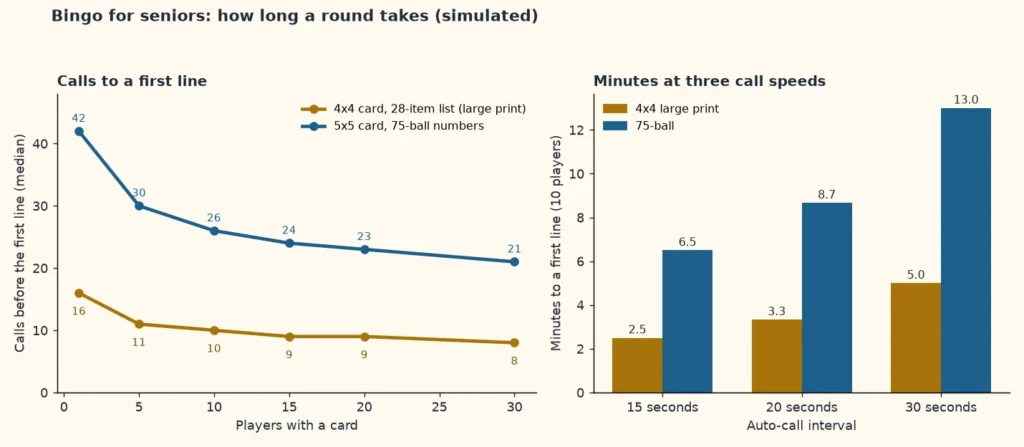
With 10 players, a first line in Memory Lane takes a median of 10 calls, and a full card takes 25 of the 28. The 75-ball game with 10 players needs 26 calls for a first line and 69 for a full card.
A single player needs 16 calls for a Memory Lane line, and 42 for 75-ball, because there is no other card to get lucky first. That is why bingo for seniors on a 4×4 grid gives a game of about three to five minutes at the pace below, and why the smaller list suits a group that wants frequent wins.
Minutes per round at a gentle pace
| Round (10 players) | Calls | 20 seconds per call | 30 seconds per call | 60 seconds per call, with stories |
|---|---|---|---|---|
| Memory Lane, any line | 10 | 3.3 min | 5.0 min | 10.0 min |
| Memory Lane, four corners | 16 | 5.3 min | 8.0 min | 16.0 min |
| Memory Lane, full card | 25 | 8.3 min | 12.5 min | 25.0 min |
| 75-ball, any line | 26 | 8.7 min | 13.0 min | 26.0 min |
| 75-ball, full card | 69 | 23.0 min | 34.5 min | 69.0 min |
A 75-ball full card is a long game: 69 calls with ten players is about 34.5 minutes at 30 seconds a call. For most groups playing bingo for seniors, a line or four corners is the right target. Use the full card only when you want a long, quiet afternoon of bingo for seniors with a cup of tea. The chart below shows the full shape of the Memory Lane game, which climbs steeply between call 6 and call 12 for ten players.
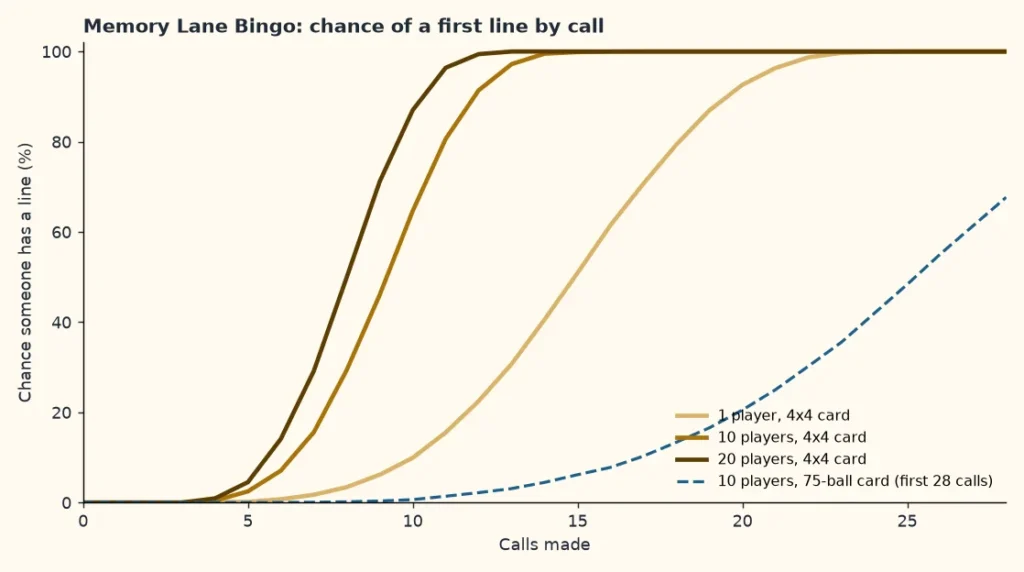
Assumptions: every square is called exactly once in random order, every player marks every square, and players are independent. In a real room somebody misses a call, which stretches the game a little. Treat the figures as a guide to pace in bingo for seniors, and let the room set the speed.
Printable bingo for seniors: print and set up
For printable bingo for seniors, the Print tab has what you need. Choose how many different cards to print, from 1 to 100, and pick one card per page. Choose Letter or A4 paper, and portrait for a 4×4 card. Cut guides are available if you want to trim cards, and the preview zooms so you can check the words. For a group of 20, print 24 cards, which leaves spares for visitors and for the card that gets coffee on it.
- Use matte paper or card. Glossy lamination can reflect bright ceiling lights. A matte sleeve or a plain sheet is easier on the eyes.
- Print names on the cards. The Design tab can put a name on each card, and a helper can then place the right card in front of the right person.
- Pick big markers. Large chips, buttons, dried beans or jumbo counters are easier to handle than small tokens, and a bingo dauber with a wide tip suits those who can hold one.
- Keep some spares in a folder. A few clean cards keep the game going when one gets bent or marked.
- Test the print. Run one page through the printer, hold it at reading distance and ask a player whether it is easy to read before you print the batch.
The PDF of your bingo for seniors cards can be saved to a phone or a USB stick and printed at a library or a copy shop, and the shareable link keeps only your word list, so a colleague can open the same list and print their own cards for another unit. The blank bingo cards page offers an empty grid if a resident wants to write their own squares by hand.
Bingo cards for seniors: make them your own
The best bingo cards for seniors speak the language of the group in front of you. On the Items tab every square is a text box, and you can rewrite it, add an emoji or upload a picture. The Design tab has color themes, fonts, borders and a title, so a card can read “Rose Garden Court Memory Lane Bingo” with a date in the footer. The free space is not used in a 4×4 card, but on 3×3 and 5×5 cards it can hold a hello.
| Group | Squares you could swap in | Squares you could remove |
|---|---|---|
| A garden club | Watering can, Seed packet, Sweet peas, Wheelbarrow, Greenhouse | Jukebox, Drive-in movie |
| A faith community | Hymn book, Church bell, Harvest supper, Candle, Choir | Fedora hat, Percolator coffee |
| An Indian family group | Steel tiffin, Ceiling fan, Radio program, Black-and-white film, Mango pickle | Drive-in movie, Station wagon |
| A seaside town | Beach hut, Fish and chips, Deck chair, Lighthouse, Rock pool | Steam train, County fair |
| A music afternoon | Piano, Dance hall, Favorite singer, Sheet music, Harmonica | Sewing machine, Knitting |
The custom card type allows 3×3 up to 7×7 grids. When your list has more words than squares, every card has a different mix. A 4×4 card needs 16 words, so a list of 28 is a good number: it keeps cards different without making any square rare. If you add photos, use clear, high-contrast pictures. A photo of a local landmark can be a strong square for people who lived nearby, and every photo stays on your device.
Dignity and accessibility for bingo games for seniors
Good bingo for seniors is not a simplified game for old people. They are normal games, adjusted so everyone can take part. That difference shows in tone, in choices and in small details of the setup. The points below come from common sense, and a group’s own staff and members know their needs best.
- Offer, do not insist. Invite people to join and let anyone watch first. Some residents prefer to sit near the game without a card.
- Use the words your group likes. Some people dislike “seniors” or “elderly.” “Members,” “residents” or simply “everyone” work well, and the page name is only a keyword.
- Avoid childish cues. The Memory Lane pictures are everyday objects, so the card does not look like a nursery sheet. Do not use stickers, songs or voices meant for small children.
- Do not test. Never ask “Do you remember?” in a way that expects a right answer. Say “Tell us about it if you like.”
- Let helpers help quietly. A volunteer can mark a card or read out a square without making a point of it.
- Speak facing the room, slowly and clearly, and repeat a call once. Switch on the big-screen mode so people can read each number or word as well as hear it.
- Keep the prizes kind. A cup of tea first, a small plant, a choice of the next song, or a round of applause. Nothing that makes the loser feel it matters.
- Respect privacy. Names on cards are optional, and a photo in a square should only be of someone who agrees.
Adapting bingo for seniors to different needs
Groups are never uniform. In bingo for seniors a single room can hold a sharp-eyed reader, a person with low vision, someone who finds small markers difficult and someone who prefers to listen. A few options let the same bingo for seniors game suit all of them without singling anyone out. These are practical adjustments, not medical advice, and an occupational therapist or care lead can suggest more.
| What a player may find hard | An adjustment to try |
|---|---|
| Reading small print | One card per page at a high text size, plain white squares, and big-screen mode with the caller |
| Hearing the calls | Show the call on a screen or a held-up card, and use the call board that highlights the last number |
| Gripping a small marker | Jumbo chips or large counters, a tray with a lip, or a buddy who marks the square |
| Following a long list of squares | A 3×3 card, which has fewer squares, and a slower caller |
| Sitting for a long round | Short rounds of a first line only, with a break between |
| Seeing across the room | Seat the player near the screen and place the card on a lap tray or table |
| Feeling rushed | Increase the auto-call interval, press Pause, or use calling cards and draw by hand |
More bingo cards and ideas
Bingo for seniors is one of the occasion lists in the card maker. Every template sits on the printable bingo cards hub, and the bingo card generator handles every card type, from custom words to 75-ball and 90-ball.
If your group prefers a card with a list of numbers, see the bingo number chart. For a ladies’ afternoon of bingo for seniors, the kitty party bingo template is a friendly option, and beginners will find the rules in the how to play bingo guide. For a different line to play for, the bingo patterns guide shows four corners, the X and the letter T.
Frequently asked questions
10 quick answers
What is the best bingo for seniors?
The best bingo for seniors has large print, a slow caller, a first win that comes quickly and a friendly host. A 4×4 card at a large text size, with pictures and words, and a call every 20 to 30 seconds is a good place to begin.
Are these large print bingo cards really free?
Yes. You can edit and print them without an account or a payment. The editor runs in your browser, so the words and pictures you add never leave your device.
How big is the print?
The Memory Lane card prints one per page with the text at 125 percent, and each square is about 1.85 inches across on US Letter paper. You can raise the text size on the Design tab and print a test page first.
How many squares does the template have?
It has 28 squares. A 4×4 card uses 16 of them, so every card is a different mix, and there are 30,421,755 possible sets.
How long does a round take?
With 10 players and a call every 30 seconds, a first line on a Memory Lane card takes about 5.0 minutes, and a first line in 75-ball bingo about 13.0 minutes.
Can I use real numbers instead of pictures?
Yes. The card maker also makes 75-ball cards, and the Text size slider and the one card per page setting enlarge them. The bingo caller reads the numbers aloud at the speed you choose.
Is nostalgia bingo a therapy?
No. It is a social game with conversation starters. It makes no health claims, and a host should never test anyone’s memory or correct a story.
Can I change the pictures and words?
Yes. On the Items tab you can rewrite any square, add an emoji or upload your own picture. A local landmark, a favorite song or a name from the group makes a card feel personal.
What prizes suit a group of seniors?
Keep them small and kind: a cup of tea first, a small plant, a choice of the next song or a round of applause. Prizes that feel childish or competitive tend to fall flat.
Can family join in from far away?
Yes. Use the play bingo online page to host a live 75-ball game with guests joining by link, or print cards and use a video call with the bingo caller on a shared screen.