Random generators produce a result nobody can predict: a die roll, a coin flip, a winning name or a number in a range. These free online random generators cover dice, coins, names and numbers, use your browser’s secure random source and explain the odds behind every result.
Quick answer: Use the dice roller for tabletop and board games, the dice probability calculator for the odds, the coin flip for quick decisions, the random name picker for winners and teams, and the random number generator for numbers in any range. Example: two six-sided dice total 7 about 16.7% of the time, which is 6 of 36 outcomes.
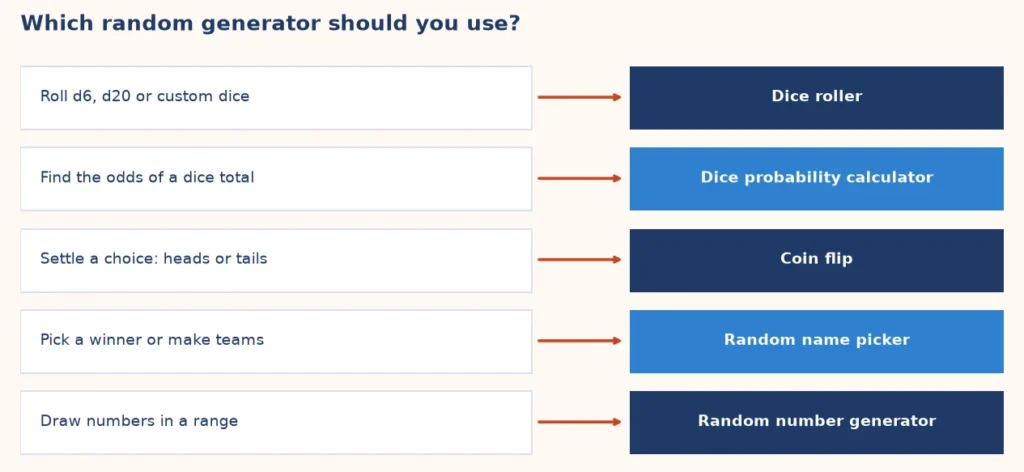
How to choose the right random generator
Random generators differ in what they return and what they remember. A dice roller returns numbers from 1 to the number of sides. A coin flip returns two outcomes with a chance you can change. A name picker chooses from your list and can avoid repeats. The table matches each need to a tool, and all of them run in your browser.
| If you want to… | Use this tool | You get |
|---|---|---|
| Roll one or many dice, with a bonus or advantage | Dice roller | Each die, the total and any dropped dice |
| Know the odds of a dice total | Dice probability calculator | The exact chance, as a percent and a fraction |
| Flip one or up to 100 coins | Coin flip | Heads, tails and the longest streak |
| Pick winners or split a class into teams | Random name picker | Winners or balanced teams |
| Draw a number between two limits | Random number generator | One or many numbers, with or without repeats |
| Work out a percent or a ratio of the results | Percentage calculator | Chances as percents |
| Average a long list of rolls | Mean, median and mode calculator | The mean, median and mode |
Dice and random generators: dice types and notation
Dice and random generators use a short notation. The code NdS means roll N dice with S sides each, so 2d6 is two six-sided dice and 1d20 is one twenty-sided die. A +3 after it adds a modifier. The average roll of one die with S sides is (S + 1) ÷ 2, so a d6 averages 3.5 and a d20 averages 10.5.
| Die | Sides | Average roll | Chance of any one face | Common use |
|---|---|---|---|---|
| d4 | 4 | 2.5 | 25% | Damage dice in tabletop games |
| d6 | 6 | 3.5 | 16.7% | Board games, Yahtzee, Monopoly |
| d8 | 8 | 4.5 | 12.5% | Weapon damage in role-playing games |
| d10 | 10 | 5.5 | 10% | Percentile pairs, skill checks |
| d12 | 12 | 6.5 | 8.3% | Heavy weapon damage |
| d20 | 20 | 10.5 | 5% | Attack and skill rolls |
| d100 | 100 | 50.5 | 1% | Random tables and percentage rolls |
The dice roller handles all of these and custom dice with up to 1,000 sides. It also supports d20 advantage and disadvantage, which roll two dice and keep the higher or lower, and “drop the lowest” rolls such as 4d6, which average 12.24 once the lowest die is removed.
Dice probability: the odds behind the roll
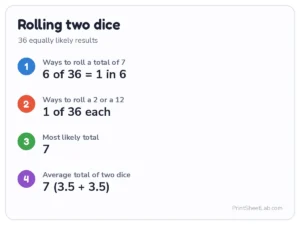
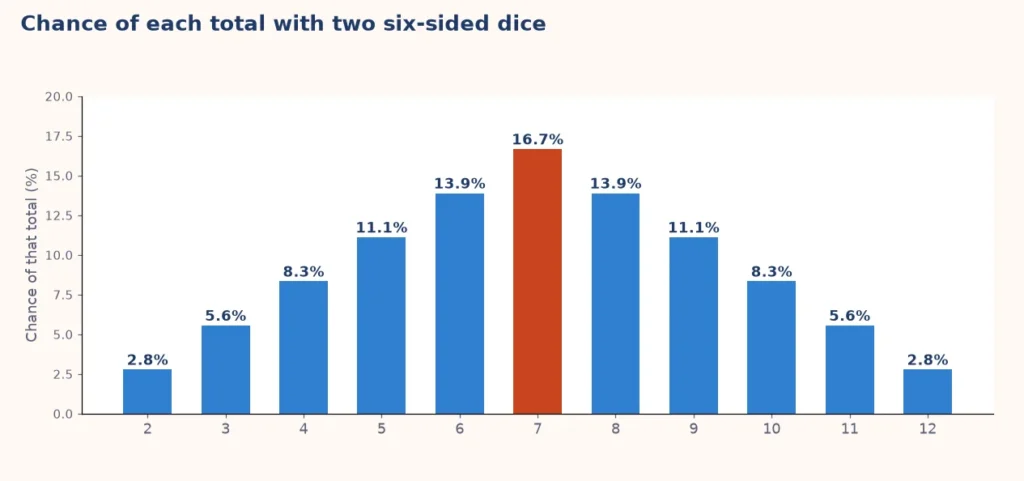
A dice probability calculator counts outcomes. Two six-sided dice have 6 × 6 = 36 equally likely outcomes, and the total 7 can be made six ways (1+6, 2+5, 3+4 and the reverses), so the chance is 6 ÷ 36 = 16.7%. A total of 2 or 12 has only one way each, so it comes up 2.8% of the time.
| Total | Ways | Chance |
|---|---|---|
| 2 | 1 | 2.78% |
| 3 | 2 | 5.56% |
| 4 | 3 | 8.33% |
| 5 | 4 | 11.11% |
| 6 | 5 | 13.89% |
| 7 | 6 | 16.67% |
| 8 | 5 | 13.89% |
| 9 | 4 | 11.11% |
| 10 | 3 | 8.33% |
| 11 | 2 | 5.56% |
| 12 | 1 | 2.78% |
More dice make the middle even more likely. With three six-sided dice, 10 and 11 each come up 27 ways in 216, which is 12.5%, while 3 and 18 come up once, 0.46%. A total of 15 or more has a 9.3% chance. The dice probability calculator answers questions like these for up to 100 dice with exact fractions.
Advantage in a d20 game
Rolling two d20 and keeping the higher raises the chance of a natural 20 from 5% to 1 − (19 ÷ 20)² = 9.75%. Disadvantage does the opposite: a natural 20 needs both dice to show 20, which is 0.25%. The average result of advantage is 13.83 against 10.5 for a single d20.
Coin and dice simulators: coin flip streaks and fairness
Coin and dice simulators let you run many trials fast. A fair coin lands heads 50% of the time, so five heads in a row has a chance of 0.5⁵ = 3.1%, and at least one head in three flips has a 1 − 0.5³ = 87.5% chance. Streaks look suspicious but are normal. In 100 flips, a run of 6 or more identical results appears about 81% of the time.
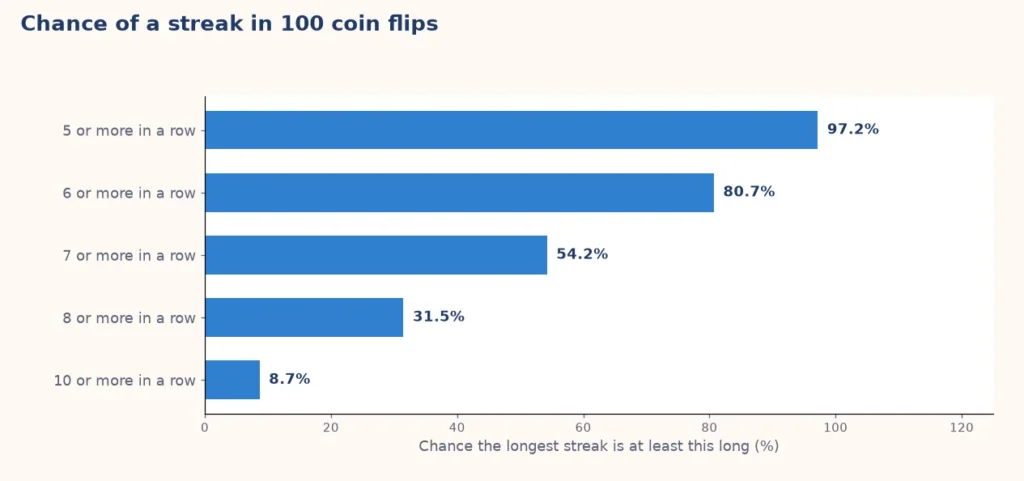
The average longest streak in 100 flips is about 7. This is why a sequence with no long runs looks random to people but is actually less likely than one with a streak. Each flip is independent, so after five heads the next flip is still 50% heads. Believing otherwise is the gambler’s fallacy. The coin flip tool lets you change the chance of heads to model a loaded coin.
Random name and number generators: pickers, teams and ranges
Random name and number generators draw from a list or a range. In a name picker every name has the same chance, 1 ÷ n for a list of n names. Choosing 3 winners from 10 names gives 10C3 = 120 equally likely groups. Removing a winner from the pool, as the random name picker can do, stops the same name winning twice.
Teams work the same way. A class of 25 split into teams of 4 makes 6 teams of 4 and one extra person, so a balanced split gives five teams of 4 and one team of 5. The picker shuffles the list and deals the names into teams so no one can choose their group.
The random number generator covers numbers. A range of 1 to 100 gives each number a 1% chance. Drawing 6 unique numbers from 1 to 49 can produce 13,983,816 different sets, and none is more likely than any other, so no generator can improve lottery odds.
Common ranges for random number generators
The size of the range sets the odds of any one number. These ranges are the ones random generators are used for most, and each number in a range is equally likely.
| Range | Typical use | Chance of one number |
|---|---|---|
| 1 to 2 | Heads or tails | 50% |
| 1 to 6 | A die | 16.7% |
| 1 to 10 | Ratings and short lists | 10% |
| 1 to 52 | A deck of cards | 1.9% |
| 1 to 100 | Percentages and raffles | 1% |
| 1 to 1,000 | Ticket numbers | 0.1% |
Random picker tools: how many ways can a list be drawn?
Random picker tools are the simplest random generators to trust, because the odds are easy to count. The chance that any one name wins is 1 ÷ n, the number of ways to choose three winners is the combination nC3, and the number of different orders for a whole list is n factorial. The numbers grow fast, which is why a draw is hard to rig by hand.
| Names in the list | Chance one name wins | Ways to pick 3 winners | Different orders of the list |
|---|---|---|---|
| 5 | 20% | 10 | 120 |
| 10 | 10% | 120 | 3,628,800 |
| 20 | 5% | 1,140 | About 2.4 quintillion |
| 30 | 3.3% | 4,060 | About 2.65 × 10³² |
Use random picker tools for anything where fairness matters more than speed: who goes first in a game, which student presents, who does a chore this week or which restaurant wins when nobody can decide. Everyone can see the list, so the result is hard to dispute.
Online random generators for kids and families
Online random generators turn plain activities into games. Roll two dice and move that many steps on a number line to practice adding, flip ten coins and graph the heads count, or use a name picker to choose a “helper of the day”. Children learn that chance has patterns once they have many results, which is the idea behind probability.
For printable games, pair these random generators with printable bingo cards: a random number draw replaces a caller, and the dice roller works as a quick starter for a party game. Keep the tools on a tablet or the class board so everyone sees the same result.
How fair are online random generators?
Online random generators are only as fair as their source of randomness. A computer cannot flip a coin, so most programs use a pseudorandom number generator, which follows a formula. These tools ask the browser for secure random bits using the Web Crypto call crypto.getRandomValues, which is designed to be unpredictable and is far better than the older Math.random.
Two further details keep results fair. First, any draw that would favor small values (modulo bias) is thrown away and redone. Second, picking several unique items uses a Fisher–Yates shuffle, which makes every ordering equally likely. The National Institute of Standards and Technology describes the standards for random bit generation, and the Mozilla developer documentation explains getRandomValues.
Probability and chance tools for learning
Probability and chance tools make an abstract topic concrete. Teachers can ask students to predict first and then roll 100 times. Two classic examples: the chance of at least one six in four rolls of a die is 1 − (5/6)⁴ = 51.8%, and in a room of 23 people the chance that two share a birthday is already 50.7%, which surprises most people.
Real-life uses of random generators
The classroom. A teacher uses the name picker to call on students fairly and the dice roller to generate numbers for a math game, then asks the class to compare their results with the 36-outcome table above.
Games. A tabletop group rolls 4d6 and drops the lowest for ability scores, rolls d20 with advantage for a risky action and rolls a d100 for a random table.
Giveaways. A club pastes entrants into the picker, draws 3 winners and screenshots the result. For anything with a prize, follow local rules for random draws.
Questions people ask about random generators
Is an online dice roller really random?
It is random enough for any game. A browser dice roller that uses crypto.getRandomValues gives each face an equal chance and cannot be predicted from earlier rolls. It is not a physical die, but it is free of the bias that worn or uneven dice can have.
How do I pick a random winner from a list?
Paste the names into a random name picker, set the number of winners and press the button. Each name has an equal chance, and you can remove winners from the pool so nobody wins twice.
Can a random generator predict lottery numbers?
No. A lottery draw is random, so every combination has the same chance and no tool can improve your odds. A generator only helps you pick numbers quickly, and the chance of winning stays the same.
Which random generators are best for a classroom?
The best random generators for a classroom are the dice roller for number games, the name picker for turns and groups and the coin flip for quick yes or no choices. They work on any screen, so one tablet on a desk or the board runs a whole lesson without any setup.
How do I roll dice online for a board game?
Choose the die and the number of dice, press the roll button and read the total. Two six-sided dice cover most board games, and the tool shows each die as well as the sum so every player can see the result.
Common mistakes with random generators
- Expecting results to even out. Ten heads in a row can happen in a fair coin; the next flip is still 50%.
- Judging fairness from a few trials. You need hundreds of rolls before the percentages settle near the true chances.
- Using a random generator for security. Passwords and keys need a cryptographic generator, not a game tool.
- Forgetting repeats. Pick “unique numbers” or remove winners from the pool when repeats are not allowed.
- Mixing up dice sums and single faces. A total of 7 is the most likely sum of two dice, but each single face is still 1 in 6.
Frequently asked questions
9 quick answers
What are random generators?
Random generators are tools that produce unpredictable results such as dice rolls, coin flips, names and numbers. Online random generators use your browser’s secure random source, so each outcome is independent of the last.
What is the probability of rolling a 7 with two dice?
The probability of rolling a 7 with two six-sided dice is 6 out of 36, which is 1 in 6 or about 16.7%. It is the most likely total because six different pairs make it.
How many sides can a die have?
Common dice have 4, 6, 8, 10, 12 and 20 sides, and a d100 is used for percentages. The dice roller also accepts a custom die with up to 1,000 sides, which is useful for random tables.
What does advantage mean on a d20?
Advantage means rolling two d20 and keeping the higher result. It raises the chance of a 20 from 5% to 9.75% and the average roll from 10.5 to about 13.8. Disadvantage keeps the lower roll.
Is a coin flip really 50/50?
An ideal coin is 50/50. Real coins are very close to it, and a computer coin flip with a fair random source is exactly 50/50. Past flips never change the next one.
How likely is a streak of heads?
In 100 fair flips a streak of at least 6 identical results happens about 81% of the time and at least 10 about 8.7% of the time. Streaks are normal and do not mean the coin is unfair.
How do I make fair teams?
List every name, shuffle the list and deal the names out in turn so team sizes differ by at most one. The random name picker has a team mode that does this and balances the sizes.
Is it truly random or pseudorandom?
Most software uses pseudorandom numbers from a formula. These tools use the browser’s cryptographically secure source, which is seeded from system entropy and is suitable for games, classrooms and draws.
Are these random generators free?
Yes. They are free, need no account and run in your browser, so your lists and results are not sent anywhere.
More calculator hubs
- All free online calculators with steps for every topic
- Math calculators for probability, permutations and statistics
- Grade and GPA calculators for classroom grade tools
- Date and time calculators for countdowns and calendars
- Financial calculators for odds, interest and pay
- Health and fitness calculators for fitness and health tools
The site also has free printable bingo cards and tambola tickets for games where the draw is random. See the printable bingo cards.
Sources and further reading
- MDN Web Docs: Crypto.getRandomValues() (the secure random source the tools use)
- NIST: Random bit generation (standards for random number generators)
- Wikipedia: Dice (types of dice and notation)
- Wikipedia: Pseudorandom number generator (how computers produce random numbers)
Results are for games and learning, not for gambling or security. Last updated: October 2026.