A loan calculator works out your monthly payment from the loan amount, interest rate and term. This free loan calculator also finds how long a loan takes to pay off or how much you can borrow, adds extra payments, shows the APR with fees and prints an amortization table.
Quick answer: Loan payment = P × r ÷ (1 − (1 + r)−n), where P is the amount borrowed, r the monthly rate (yearly rate ÷ 12) and n the number of monthly payments. A $15,000 loan at 10% for 5 years costs $318.71 a month and $4,122.34 in total interest.

How to use this loan calculator in 3 ways
Choose what you want to find, fill in the boxes of the loan calculator and read the answer, which updates as you type. The loan calculator keeps the numbers when you switch between the three modes, so you can test one loan from every angle.
| Mode | You enter | You get |
|---|---|---|
| Monthly payment | Loan amount, interest rate, term, optional fee and extra payment | Payment, total interest, total repaid, APR and payoff time |
| How long it takes | Loan amount, interest rate and the payment you can make | Number of payments, total interest and the schedule |
| How much I can borrow | Payment you can afford, interest rate and term | The loan amount that payment supports |
- Pick a mode.
- Type the loan amount (or payment), the yearly interest rate and the term in years or months.
- Add an origination fee to see the APR, or an extra monthly payment to see the savings.
- Switch the table to by year or by month, then copy the result or the link.
Loan payment calculator: the formulas
Most installment loans are amortizing loans: equal monthly payments, with interest charged on the remaining balance. That makes early payments mostly interest and later payments mostly principal. The loan payment calculator rearranges one annuity formula to answer three different questions.
Formulas: Payment = P × r ÷ (1 − (1 + r)−n). Loan amount = Payment × (1 − (1 + r)−n) ÷ r. Number of payments n = −ln(1 − P × r ÷ Payment) ÷ ln(1 + r). P is the loan, r the monthly rate and n the number of payments.
Example 1: find the payment
For $15,000 at 10% over 5 years, r = 10% ÷ 12 = 0.83333% and n = 60. The payment is $318.71 a month. Over 60 payments you repay $19,122.34, so the interest is $4,122.34. In the first month $125.00 of the payment is interest and $193.71 reduces the balance.
Example 2: find how long the loan takes
You owe $20,000 at 6% and can pay $400 a month. The first month of interest is $100.00, so each payment reduces the balance. The formula gives n = 57.68, rounded up to 58 payments, or 4 years 10 months. The total interest is $3,072.27, and the last payment is smaller than the others.
Example 3: find how much you can borrow
A payment of $400 a month at 6% for 5 years supports a loan of $20,690.22. A higher rate or a shorter term lowers that figure, which is why the loan calculator is useful before you apply.
Monthly payment per ,000 borrowed
Multiply the figure below by your loan amount ÷ 1,000. For $15,000 at 10% over 5 years: 15 × $21.247 = $318.71 (the table rounds the factor to $21.25, which gives $318.75).
| Rate | 1 yr | 2 yr | 3 yr | 5 yr | 7 yr | 10 yr |
|---|---|---|---|---|---|---|
| 4% | $85.15 | $43.42 | $29.52 | $18.42 | $13.67 | $10.12 |
| 6% | $86.07 | $44.32 | $30.42 | $19.33 | $14.61 | $11.10 |
| 8% | $86.99 | $45.23 | $31.34 | $20.28 | $15.59 | $12.13 |
| 10% | $87.92 | $46.14 | $32.27 | $21.25 | $16.60 | $13.22 |
| 12% | $88.85 | $47.07 | $33.21 | $22.24 | $17.65 | $14.35 |
| 15% | $90.26 | $48.49 | $34.67 | $23.79 | $19.30 | $16.13 |
| 20% | $92.63 | $50.90 | $37.16 | $26.49 | $22.21 | $19.33 |
Loan amortization schedule: where each payment goes
The amortization calculator splits every payment into interest and principal. On the $15,000 loan, the schedule by year looks like this. The year-one interest is the largest because the balance is highest, then it falls every year.
| Year | Principal paid | Interest paid | Balance at year end |
|---|---|---|---|
| 1 | $2,434 | $1,390 | $12,566 |
| 2 | $2,689 | $1,136 | $9,877 |
| 3 | $2,970 | $854 | $6,907 |
| 4 | $3,282 | $543 | $3,625 |
| 5 | $3,625 | $199 | $0 |
Switch the amortization calculator table to By month to see all payments. The first months of this loan show a payment of $318.71, with interest of $125.00 falling to $106.48 by month 12.
Loan calculator with extra payments
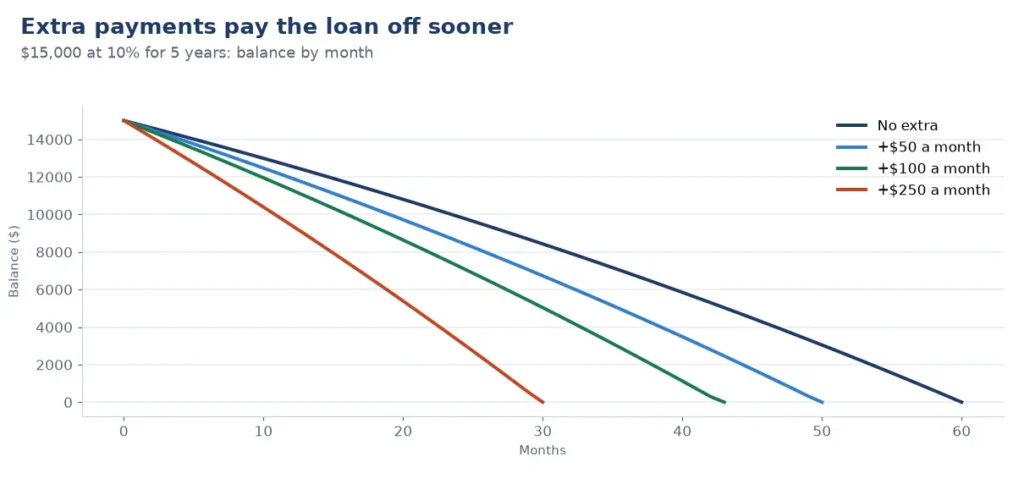
An extra payment goes entirely to principal, so it cuts the interest on every later month. The loan calculator with extra payments shows the effect. On the same $15,000 loan:
| Extra a month | You pay | Paid off in | Time saved | Total interest | Interest saved |
|---|---|---|---|---|---|
| None | $318.71 | 5 years | – | $4,122.34 | – |
| $25 | $343.71 | 4 years 7 months | 5 months | $3,722.96 | $399.38 |
| $50 | $368.71 | 4 years 2 months | 10 months | $3,395.33 | $727.01 |
| $100 | $418.71 | 3 years 7 months | 1 year 5 months | $2,890.74 | $1,231.60 |
| $250 | $568.71 | 2 years 6 months | 2 years 6 months | $2,009.11 | $2,113.23 |
Check that your lender applies the extra amount to principal and does not charge a prepayment penalty. Some loans charge one.
APR calculator: interest rate vs APR
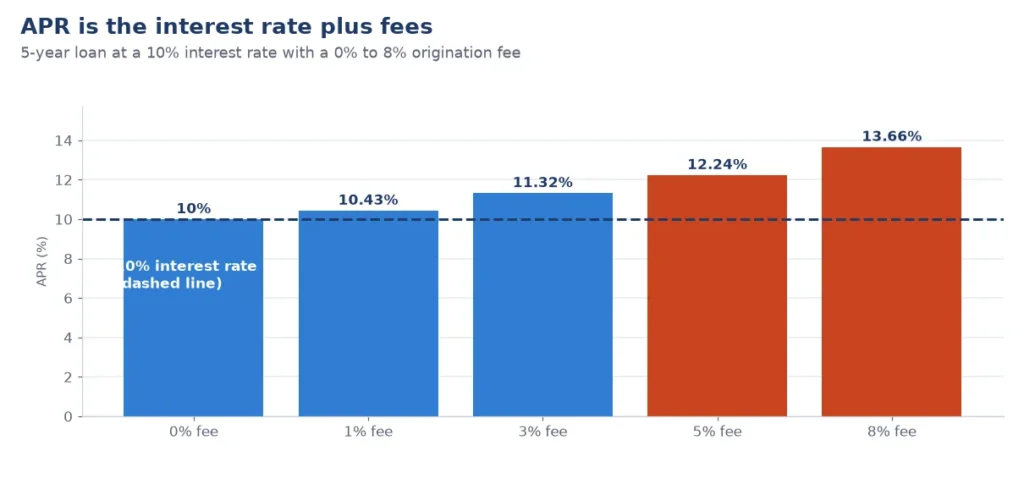
The interest rate is the cost of the money. The APR (annual percentage rate) also folds in fees, so it shows the full yearly cost. When a loan has an origination fee, the lender takes it out of the money you receive, but you still repay the whole amount. Enter the fee as a percent and this APR calculator finds the rate that matches what you actually get.
With a 5% fee on the $15,000 loan at 10% over 5 years, you receive $14,250 and still pay $318.71 a month. That works out to an APR of 12.24%. The table shows how the APR climbs with the fee.
| Origination fee | You receive | Monthly payment | APR |
|---|---|---|---|
| 0% | $15,000 | $318.71 | 10% |
| 1% | $14,850 | $318.71 | 10.43% |
| 3% | $14,550 | $318.71 | 11.32% |
| 5% | $14,250 | $318.71 | 12.24% |
| 8% | $13,800 | $318.71 | 13.66% |
Use the APR from the loan calculator, not the headline rate, to compare offers. In the US, lenders must disclose it; in Australia the comparison rate does the same job, and Moneysmart gives an example of a lender with the lower interest rate but the higher comparison rate. Read more in the personal loans guide. Wikipedia explains the annual percentage rate and its limits.
Personal loan calculator: what it costs
A personal loan is usually unsecured, with a fixed rate and a term of one to seven years. Because there is no collateral, rates are higher than on mortgages or car loans and depend on your credit and income. Use this personal loan calculator and the loan payment calculator to compare how the rate and term change the cost of borrowing $10,000:
| Rate | 2 years | 3 years | 5 years |
|---|---|---|---|
| 7% | $447.73 ($745 interest) | $308.77 ($1,116 interest) | $198.01 ($1,881 interest) |
| 10% | $461.45 ($1,075 interest) | $322.67 ($1,616 interest) | $212.47 ($2,748 interest) |
| 14% | $480.13 ($1,523 interest) | $341.78 ($2,304 interest) | $232.68 ($3,961 interest) |
| 20% | $508.96 ($2,215 interest) | $371.64 ($3,379 interest) | $264.94 ($5,896 interest) |
Debt consolidation works only if the new loan has a lower rate than the debts it replaces and you stop using the cleared cards. Compare the total interest, not just the monthly payment.
Student loan payments: federal and private
Student loans use the same formula. On a US federal loan made before July 1, 2026, the standard repayment plan is 10 years of equal payments. Loans made or consolidated on or after July 1, 2026 use a tiered standard plan of 10 to 25 years, set by the balance (under $25,000: 10 years; $25,000 to $49,999: 15; $50,000 to $99,999: 20; $100,000 or more: 25). The interest rate is fixed for the life of the loan. For $30,000 at 5.5% over 10 years the payment is $325.58 and the total interest is $9,069.46. Private student loans may have variable rates or different terms, and income-driven plans change the payment, so use this as a starting point.
| Student loan balance at 5.5% | 10-year payment | Total interest | 20-year payment | Total interest |
|---|---|---|---|---|
| $10,000 | $108.53 | $3,023 | $68.79 | $6,509 |
| $20,000 | $217.05 | $6,046 | $137.58 | $13,019 |
| $30,000 | $325.58 | $9,069 | $206.37 | $19,528 |
| $50,000 | $542.63 | $15,116 | $343.94 | $32,546 |
Loan interest calculator: total interest by term
The longer you borrow, the more interest you pay, even when the monthly payment looks smaller. This loan interest calculator view shows $10,000 at 8%:
| Term | Monthly payment | Total interest | Total repaid |
|---|---|---|---|
| 1 year | $869.88 | $438.61 | $10,438.61 |
| 2 years | $452.27 | $854.55 | $10,854.55 |
| 3 years | $313.36 | $1,281.09 | $11,281.09 |
| 5 years | $202.76 | $2,165.84 | $12,165.84 |
| 7 years | $155.86 | $3,092.42 | $13,092.42 |
| 10 years | $121.33 | $4,559.31 | $14,559.31 |
Amortizing loan vs simple interest
An amortizing loan charges interest on the balance each month and the balance falls with every payment. A simple interest calculation uses the original amount for the whole term, which gives a different answer; try the simple interest calculator to compare.
Loans in the US, Canada, UK and Australia
| Country | Typical rate disclosure | Notes |
|---|---|---|
| United States | APR | The calculator uses monthly interest on the declining balance, the usual method for installment loans |
| Canada | Cost of borrowing, shown as an APR | Consumer loans are usually paid monthly. Mortgages are different; see the mortgage calculator |
| United Kingdom | Representative APR | The advertised rate must be available to at least 51% of accepted applicants |
| Australia | Interest rate and comparison rate | Use the comparison rate to include most fees |
Use the currency box to switch to pounds, euros, rupees or another symbol. The math is identical, but local rules on fees and early repayment differ, so read your loan contract.
Loan calculator for different loan types
The same loan calculator works for any fixed-rate installment loan. What changes from one loan type to the next is the typical term, whether the loan is secured and which fees to look for. These are common patterns, not rules, so check your own offer.
| Loan type | Typical term | Secured? | What to watch |
|---|---|---|---|
| Personal loan | 1 to 7 years | Usually not | Origination fees and a rate that depends on your credit |
| Student loan (US federal) | 10 years on the standard plan | No | Fixed rate for the life of the loan; other plans change the payment |
| Car loan | 3 to 7 years | Yes, by the car | Long terms add interest; see the car loan calculator |
| Debt consolidation loan | 2 to 5 years | Usually not | Only helps if the rate is lower than the debts it replaces |
| Home improvement loan | 3 to 15 years | Sometimes | Compare with a home equity loan, which can have a lower rate |
Bi-weekly loan payments
Some lenders let you pay half the monthly payment every two weeks. That is 26 half payments, which equals 13 full payments a year, so one extra payment goes to principal. On the $15,000 loan, paying $159.35 every two weeks pays it off in about 4 years 6 months instead of 5 years and cuts the interest from $4,122.34 to $3,647.59.
Balloon payment loans
A balloon loan has smaller regular payments and a large final payment. Moneysmart warns that the lump sum is repaid with interest, so the total cost is generally higher, and you must be sure you can pay it when it is due. This loan calculator assumes equal payments and no balloon.
How much can I borrow for $200 to $1,000 a month?
This is the question the How much I can borrow mode answers. The table gives the loan size that a monthly payment supports at 10% interest, for three terms.
| Monthly payment | 3 years | 5 years | 7 years |
|---|---|---|---|
| $200 | $6,198 | $9,413 | $12,047 |
| $300 | $9,297 | $14,120 | $18,071 |
| $500 | $15,496 | $23,533 | $30,118 |
| $750 | $23,243 | $35,299 | $45,178 |
| $1,000 | $30,991 | $47,065 | $60,237 |
What sets your interest rate?
Lenders price a loan on risk. A higher credit score, steady income, a shorter term, a lower debt-to-income ratio and security such as a car all tend to lower the rate. Shopping around helps: ask several lenders for a quote that does not affect your credit score, then enter each rate in the loan calculator to compare the total cost.
Common loan mistakes and tips
- Comparing only the payment. A lower payment from a longer term can cost thousands more in interest.
- Ignoring fees. Origination, application and early repayment fees change the true cost; compare the APR.
- Not testing extra payments. Even $25 a month can shorten a loan.
- Borrowing at the limit. Keep the payment well inside your budget so one surprise bill does not cause a missed payment.
This loan calculator gives estimates for planning, not financial advice or a loan offer. Your lender sets the final figures.
Questions people ask about loan payments
How do I calculate a loan payment by hand?
Convert the yearly rate to a monthly rate, then use Payment = P × r ÷ (1 − (1 + r)^−n). For $15,000 at 10% over 60 months, r = 0.0083333 and the payment is $318.71.
How much is a $10,000 loan per month?
At 8% over 3 years a $10,000 loan costs $313.36 a month; over 5 years it costs $202.76. The table of payments per $1,000 scales to any amount.
Frequently asked questions
9 quick answers
How does a loan calculator work?
It uses the loan amount, yearly interest rate and term to compute the equal monthly payment with the amortization formula, then adds up the payments to give total interest.
How do I calculate monthly loan payments?
Use Payment = P × r ÷ (1 − (1 + r)^−n), with r the yearly rate ÷ 12 and n the number of months. For $15,000 at 10% over 5 years it is $318.71.
How much interest will I pay on a loan?
Total interest = payment × number of payments − loan amount. On $15,000 at 10% for 5 years that is $4,122.34.
What is the difference between APR and interest rate?
The interest rate is the cost of the borrowed money. The APR adds fees such as origination fees, so it is the better number for comparing loans.
Can the loan calculator work out how long a loan will take?
Yes. Choose How long it takes, then enter the amount, the rate and your monthly payment. The payment must be larger than the first month of interest.
How do extra payments affect a loan?
They go to principal, reduce the balance faster and cut the interest. $100 extra a month on a $15,000 loan at 10% saves about $1,232 and ends it 1 year 5 months sooner.
Is a longer loan term better?
It lowers the payment but raises total interest and keeps you in debt longer. Choose the shortest term whose payment you can comfortably afford.
Can I use this for a student loan or personal loan?
Yes. Any fixed-rate installment loan follows the same formula, including student, personal, car, boat and home improvement loans.
Does the loan calculator include fees?
It uses the origination fee to compute the APR. Late fees and prepayment penalties are not included.
Related calculators
- Mortgage calculator with taxes, insurance and PMI
- Car loan calculator with trade-in and sales tax
- Credit card payoff calculator
- Compound interest calculator
- Simple interest calculator
- Percentage calculator
- All calculators and money worksheets
Sources and further reading
- Moneysmart (Australian Government): personal loans
- Wikipedia: annual percentage rate
- Wikipedia: amortization schedule
- Federal Reserve: Consumer Credit (G.19)
Last updated: October 2026.