A calorie calculator estimates how many calories you burn in a day and how many to eat to maintain, lose or gain weight. This free calorie calculator uses the Mifflin-St Jeor equation for your BMR, multiplies it by your activity level to get maintenance calories, then adjusts for a goal and splits the result into protein, carbs and fat.
It works in pounds and inches or kilograms and centimeters, and it shows each step so you can check the math.
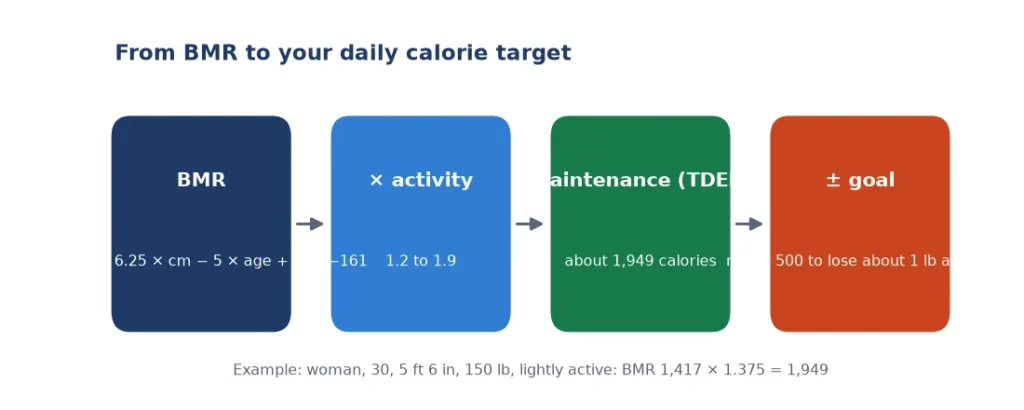
Quick answer: Maintenance calories (TDEE) = BMR × activity factor, and BMR = 10 × weight (kg) + 6.25 × height (cm) − 5 × age + 5 for men or − 161 for women. For example, a 30-year-old woman who is 5 ft 6 in, weighs 150 lb and is lightly active has a BMR of 1,417 and maintenance calories of 1,949 a day (BMR × 1.375). Eating 500 fewer is about 1 lb of loss a week.
General information, not medical advice: A calorie calculator gives an estimate, and real needs vary from person to person. It cannot diagnose anything or replace a visit with a doctor, midwife, pharmacist or registered dietitian. If you are worried about your health, or have a medical condition, are pregnant or take medication, ask a health professional first.
How to use this calorie calculator
Fill in the boxes and the calorie calculator updates as you type. The default example is a woman who is 30, 5 ft 6 in and 150 lb, and you can change any value.
- Choose Feet, inches, pounds or Centimeters, kilograms, then pick your sex (the equation uses it) and type your age, height and weight.
- Pick the activity level that matches a typical week. If you are between two levels, choose the lower one.
- Pick a goal: maintain, lose about 0.5 or 1 lb a week, or gain about 0.5 or 1 lb a week.
- Pick a macro split. Read the daily target, the macro grams and the working underneath.
| Result | What it shows |
|---|---|
| BMR | Calories your body uses at complete rest. |
| Maintenance (TDEE) | Calories to keep your weight steady at your activity level. |
| Daily target | Maintenance plus or minus your goal, with a safety floor. |
| Macro table | Protein, carbohydrate and fat in calories and grams a day. |
Mifflin St Jeor equation: the BMR calculator formula
BMR, the basal metabolic rate, is the energy your body needs just to stay alive at rest. The calorie calculator estimates it with the Mifflin St Jeor equation, published in 1990 in the American Journal of Clinical Nutrition: BMR = 10 × weight (kg) + 6.25 × height (cm) − 5 × age (years) + s, where s is +5 for men and −161 for women.
The study behind it measured healthy adults of normal weight and overweight, so it may fit less well for people who are underweight or very heavy. A BMR calculator is only the first half of the answer; the next section turns it into a daily total.
BMR by age and sex
BMR falls by 5 calories for every year of age in the Mifflin St Jeor equation, and it is 166 calories higher for a man than for a woman of the same age, height and weight. This table uses 5 ft 6 in and 150 lb for everyone, so only age and sex change.
| Age | Woman BMR | Man BMR | Woman, lightly active | Man, lightly active |
|---|---|---|---|---|
| 20 | 1,467 | 1,633 | 2,017 | 2,246 |
| 30 | 1,417 | 1,583 | 1,949 | 2,177 |
| 40 | 1,367 | 1,533 | 1,880 | 2,108 |
| 50 | 1,317 | 1,483 | 1,811 | 2,039 |
| 60 | 1,267 | 1,433 | 1,742 | 1,971 |
Worked example 1: woman, 30, 5 ft 6 in, 150 lb
Convert to metric: 150 lb × 0.45359237 = 68.04 kg, and 66 in × 2.54 = 167.6 cm. BMR = 10 × 68.04 + 6.25 × 167.6 − 5 × 30 − 161 = 1,417 calories. Lightly active means × 1.375, so maintenance is 1,949. A goal of minus 500 gives 1,449 calories a day.
Worked example 2: man, 45, 180 cm, 85 kg
BMR = 10 × 85 + 6.25 × 180 − 5 × 45 + 5 = 850 + 1,125 − 225 + 5 = 1,755. Moderately active means × 1.55, so maintenance is 2,720 calories. Minus 500 for the goal gives 2,220. Type the same numbers into the calorie calculator to confirm them.
Maintenance calories: the TDEE calculator step
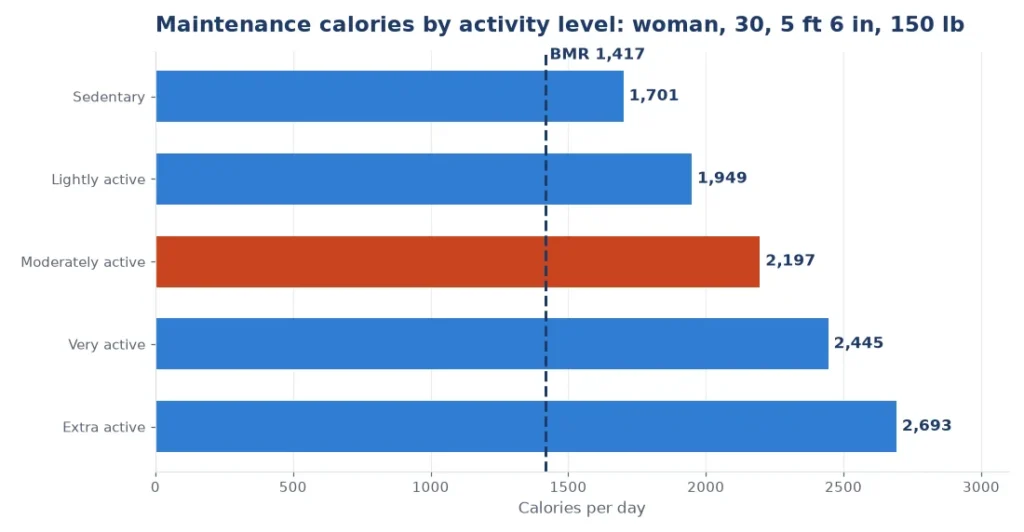
TDEE stands for total daily energy expenditure, the calories you burn in a whole day including movement. A TDEE calculator multiplies BMR by an activity factor, and these factors are a long-standing convention, not a measurement. Labels vary between sources, so treat the level as a starting guess and adjust it using your real weight trend.
| Activity level | Factor | Typical week | Example (BMR 1,417) |
|---|---|---|---|
| Sedentary | 1.2 | desk job, little or no exercise | 1,701 |
| Lightly active | 1.375 | light exercise 1 to 3 days a week | 1,949 |
| Moderately active | 1.55 | exercise 3 to 5 days a week | 2,197 |
| Very active | 1.725 | hard exercise 6 to 7 days a week | 2,445 |
| Extra active | 1.9 | very hard exercise and a physical job | 2,693 |
Maintenance calories by weight and activity
This table shows maintenance calories for a 30-year-old woman who is 5 ft 6 in, at four body weights. Each column multiplies the BMR by the factor in the header.
| Weight | BMR | x 1.2 | x 1.375 | x 1.55 | x 1.725 | x 1.9 |
|---|---|---|---|---|---|---|
| 120 lb | 1,281 | 1,537 | 1,761 | 1,986 | 2,210 | 2,434 |
| 150 lb | 1,417 | 1,701 | 1,949 | 2,197 | 2,445 | 2,693 |
| 180 lb | 1,553 | 1,864 | 2,136 | 2,407 | 2,679 | 2,951 |
| 210 lb | 1,689 | 2,027 | 2,323 | 2,618 | 2,914 | 3,210 |
Calorie deficit calculator: calories to lose weight
To lose weight you eat fewer calories than maintenance. The common rule of thumb is that about 3,500 calories equal one pound of body fat, so a deficit of 500 calories a day is about 3,500 a week, or roughly 1 lb. The CDC says people who lose weight at a gradual, steady pace of about 1 to 2 pounds a week are more likely to keep it off.
Treat 3,500 as an average, not a guarantee, because the body adapts and loss slows over time. The goals in this calorie deficit calculator use the same rule for the weekly change it displays.
| Goal | Change a day | Calories a day (example) | Weekly change |
|---|---|---|---|
| Lose about 1 lb a week | minus 500 | 1,449 | about 1 lb |
| Lose about 0.5 lb a week | minus 250 | 1,699 | about 0.5 lb |
| Maintain | 0 | 1,949 | 0 |
| Gain about 0.5 lb a week | plus 250 | 2,199 | about 0.5 lb |
| Gain about 1 lb a week | plus 500 | 2,449 | about 1 lb |
Safety floors: how low is too low?
The calorie calculator never sets a loss target below 1,200 calories for women or 1,500 for men. Harvard Health says intake should not fall below those levels except under the supervision of a health professional. If a goal would be lower, the tool holds the target at the floor and says so.
Very low-calorie diets of about 800 calories a day or less are a medical treatment, which the NIH describes as supervised by a health care professional. They are not a do-it-yourself plan. If your maintenance level is itself near the floor, a doctor or registered dietitian should guide any loss plan.
Adjusting your target after two weeks
Weigh yourself at the same time each morning and compare the weekly average. If your weight is not moving the way you planned after two to four weeks, change the daily intake by 100 to 200 calories, or move up or down one activity level. Small, repeated changes work better than a large one, and they keep your target above the safety floor.
Macro calculator: protein, carbs and fat in grams
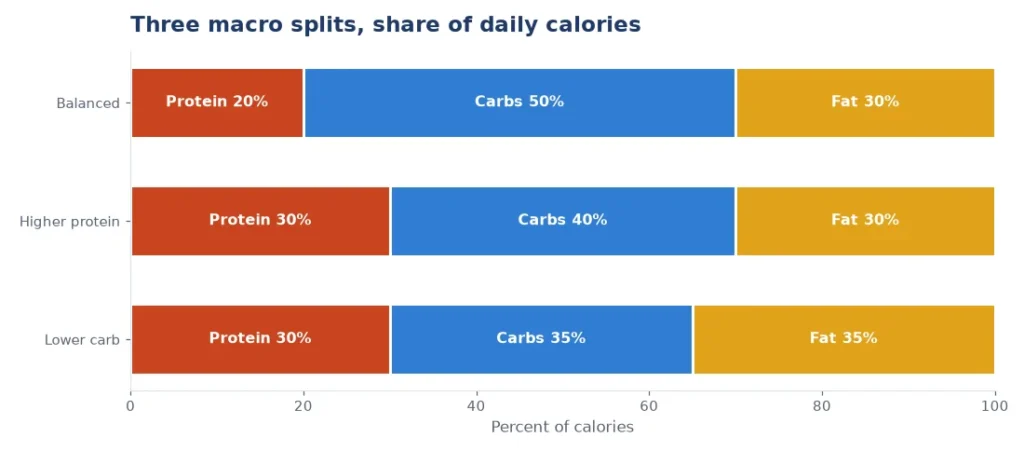
Macros are the three nutrients that supply calories: protein and carbohydrate give 4 calories per gram, and fat gives 9. The macro calculator splits your daily target by percent, then divides each share by its calories per gram. For 2,000 calories at 20% protein, that is 2,000 × 0.20 = 400 calories ÷ 4 = 100 g.
| Split | Carbs / protein / fat | Protein (2,000 kcal) | Carbs (2,000 kcal) | Fat (2,000 kcal) |
|---|---|---|---|---|
| Balanced | 50% / 20% / 30% | 100 g | 250 g | 67 g |
| Higher protein | 40% / 30% / 30% | 150 g | 200 g | 67 g |
| Lower carb | 35% / 30% / 35% | 150 g | 175 g | 78 g |
All three splits sit inside the adult acceptable macronutrient distribution ranges published with the US and Canadian Dietary Reference Intakes: carbohydrate 45 to 65% of calories, fat 20 to 35% and protein 10 to 35%. The split at the 2,000-calorie level above is only an example, and the macro calculator recomputes it for your own target.
The adult protein RDA is 0.8 g per kg of body weight. MedlinePlus, summarizing the 2025 to 2030 Dietary Guidelines for Americans, lists 1.2 to 1.6 g per kg a day. The tool shows your grams per kg so you can compare.
Calories around the world: US, UK, Australia and New Zealand
United States and Canada. Labels list “Calories”, which are kilocalories (kcal). MedlinePlus, summarizing the US Dietary Guidelines, says amounts depend on age, sex and activity level, which is exactly what the calorie calculator asks.
United Kingdom. The NHS gives general guides of about 2,500 calories a day for men and 2,000 for women, and says individual needs depend on age, weight, height and how active you are. The NHS weight loss plan uses lower daily targets, so follow it if your doctor recommends it.
Australia and New Zealand. Food energy is often labeled in kilojoules (kJ). One kcal is 4.184 kJ, so 2,000 kcal is 8,368 kJ. Divide a kJ figure by 4.184 to read it as calories.
Limits of a calorie calculator and who should not use it
- Teens and children. Needs change with growth. The tool only accepts ages 18 and over.
- Pregnancy and breastfeeding. Calorie needs rise and change by stage; ask a midwife or doctor.
- Medical conditions and medicines. Thyroid disease, diabetes and some drugs change energy needs.
- Eating disorders. Do not use calorie targets without a clinician if you have, or may have, an eating disorder.
- It is an estimate. Weigh yourself over two to four weeks and adjust the intake by 100 to 200 calories if your weight is not moving as expected.
Common mistakes with a calorie calculator
- Choosing too high an activity level. Exercise for one hour is not the same as a physical job.
- Cutting below the safety floor to lose faster. A bigger deficit mostly costs energy, muscle and mood.
- Using one weigh-in. Weight moves by a pound or two a day from water and food.
- Forgetting to recalculate after losing a lot of weight, because a lighter body burns fewer calories.
- Counting exercise twice. The activity level already includes your workouts, so do not add the calories from a fitness tracker on top of the target.
- Treating the macro grams as exact. Food labels are rounded, so aim for the right range across the week rather than perfect numbers each day.
Real-life uses for a calorie calculator
- Losing weight slowly. A 250-calorie cut from a 2,200-calorie maintenance gives a 1,950-calorie target and about half a pound a week.
- Building muscle. A plus-250 goal with a higher-protein split is a gentle starting point for a gain.
- Holding weight after a loss. Re-run the maintenance calories at your new weight.
- Planning meals. Divide the daily target by three meals and one or two snacks. For 1,800 calories that is roughly 500 per meal plus 150 to 300 in snacks.
Questions people ask about the calorie calculator
What is the difference between a BMR calculator and a TDEE calculator?
A BMR calculator gives calories burned at rest, while a TDEE calculator adds your activity. The BMR is always lower. This tool shows both, so you can see the BMR and the TDEE side by side.
How many calories should I eat to lose 1 lb a week?
Eat about 500 calories below your maintenance level. For the woman in the example that is 1,449 calories a day. Choose the minus 500 goal in the calculator for your own number.
Is a calorie calculator for women different from one for men?
The method is the same, but the Mifflin-St Jeor equation uses +5 for men and −161 for women, which makes the BMR of a man about 166 calories higher at the same age, height and weight.
Frequently asked questions
11 quick answers
How do you calculate calories per day?
Work out BMR with the Mifflin-St Jeor equation, then multiply by an activity factor from 1.2 to 1.9. The result is your maintenance calories, and you subtract or add calories for a weight goal.
What is maintenance calories?
Maintenance calories are the calories you eat to keep your weight steady. It is the same as TDEE, your total daily energy expenditure. For a 150 lb, 30-year-old woman who is lightly active it is about 1,949.
How many calories does a 500 calorie deficit burn?
A 500 calorie daily deficit is about 3,500 calories a week, which is roughly 1 lb of weight loss. The actual result varies from person to person and slows over time.
Is the Mifflin-St Jeor equation accurate?
It is among the most widely recommended equations for healthy adults, but it is still an estimate. Check it against your own weight trend over a few weeks and adjust.
What is the safest calorie level for weight loss?
Harvard Health says not to go below 1,200 calories a day for women or 1,500 for men without professional supervision. The CDC advises gradual loss of about 1 to 2 pounds a week.
How many calories should a woman eat a day?
The NHS gives about 2,000 calories a day as a general guide for women, but your own number depends on age, size and activity. Use the calorie calculator for a personal estimate.
How many calories should a man eat a day?
The NHS gives about 2,500 calories a day as a general guide for men. Use the calorie calculator for your own estimate.
How do I convert calories to kilojoules?
Multiply calories (kcal) by 4.184. For example, 2,000 kcal × 4.184 = 8,368 kJ.
What macro split should I use?
There is no single best split. Adult ranges are 45 to 65% carbs, 20 to 35% fat and 10 to 35% protein. The balanced split is 50% carbs, 20% protein and 30% fat.
Can I use the calorie calculator while pregnant or breastfeeding?
No. Calorie needs change in pregnancy and while breastfeeding, so ask a doctor or midwife for personal guidance.
Does the calorie calculator save my details?
No. The calculation runs in your browser and nothing you type is sent to a server.
Related calculators
- BMI calculator: BMI, category and healthy weight range
- Pace calculator: running pace, finish time and distance
- Due date calculator: pregnancy due date
- Unit converter: pounds to kilograms and inches to centimeters
- Percentage calculator for macro percentages and all calculators
- Printable worksheets for practicing percents and ratios
Sources and further reading
- Calorie counting made easy (Harvard Health)
- Daily calorie intake (NHS)
- Steps for losing weight (CDC)
- Very low-calorie diet (NIDDK)
- Basal metabolic rate and the Mifflin-St Jeor equation (Wikipedia)
- New dietary reference intakes for macronutrients (Canadian Family Physician)
- Dietary Guidelines for Americans 2025 to 2030 (MedlinePlus)
Last updated: October 2026.