Alphabet bingo is the friendliest first game for a child who is learning letters. You call a letter, each child searches a small card for it, and a bingo chip lands on the match. Twenty seconds later they are searching again. This page gives you free alphabet bingo cards with all 26 letters to start with, a simple way to change the set, plain-language advice for ages 3 to 6, and real numbers on how long each round takes.
In short: press Edit and print this card in the card maker above to open the full-screen editor with all 26 letters loaded. Pick a 3×3, 4×4 or 5×5 grid, choose 1 to 100 different cards, and download one PDF. It is free, needs no sign-up, and nothing you type leaves your browser.
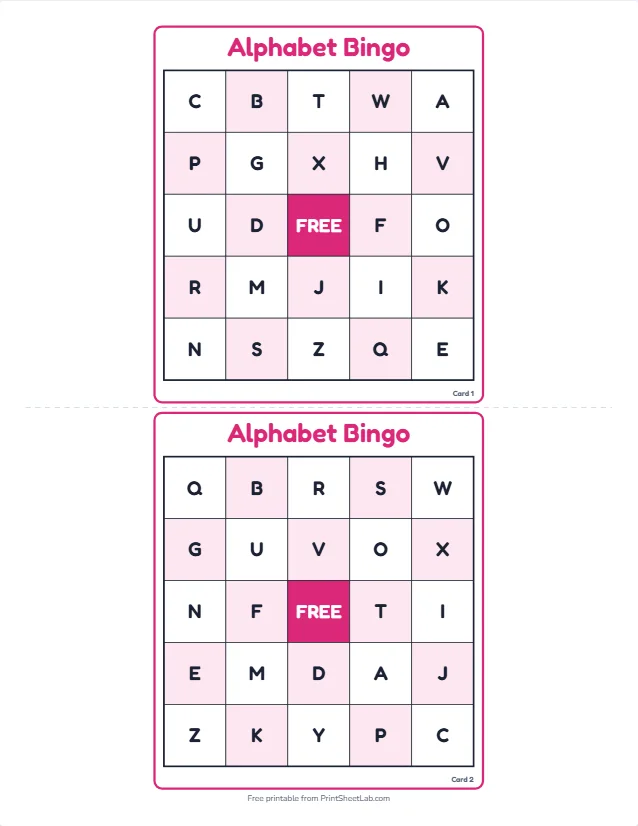
Why alphabet bingo works for beginners
Learning letters takes thousands of tiny encounters. Alphabet bingo packs many of them into a short, happy game, and each round of alphabet bingo works like this: the adult says a letter, the child scans a handful of squares, spots the shape and covers it. There is no worksheet to finish and no wrong answer to be embarrassed by, because the worst outcome of a missed call is that the letter comes around again.
The alphabet bingo format also suits the way very young children play. Rounds with a small card last a minute or two, so there is always another one to try. Every card is a different arrangement of the letters, so there is nothing to copy from a neighbor, and chance gives a quiet child as good an opening as a quick one.
For adults, alphabet bingo needs almost no setup: one print job and a bowl of chips. The sections below cover what is on the alphabet bingo cards, how to choose a size, how to call the letters, how long a round takes and how to print them well.
Alphabet bingo cards: what is on the template
The template in the card maker holds the whole alphabet, A to Z, in capital letters. That makes 26 squares for the card maker to deal from. A 3×3 card with a free center takes 8 of them, a 4×4 card takes 16, and a 5×5 card with a free center takes 24, so on every size some letters are left out of any one card and each card differs from the next.
| Group | Letters | How many |
|---|---|---|
| Vowels | A, E, I, O, U | 5 |
| Consonants, first half | B, C, D, F, G, H, J, K, L, M | 10 |
| Consonants, second half | N, P, Q, R, S, T, V, W, X, Y, Z | 11 |
| Whole alphabet | A to Z | 26 |
A note on Y: in the English alphabet, Y can act as a consonant (yes) or a vowel sound (gym, happy), so many teachers file it separately from the five vowel letters. In this alphabet bingo template Y sits with the consonants, as it does in most alphabet bingo sets. If you prefer the vowels grouped, you only need to move the letter in your own notes, because the cards do not label groups.
You are not locked into the capital letters either. The Items tab accepts any text, so you can type lowercase letters, a mix of both, or pairs such as Aa. The next section explains why that choice matters for the way a child learns.
ABC bingo: uppercase, lowercase and matching alphabet bingo games
Children usually meet capital letters first, on blocks, signs and names, and only later read the lowercase forms that fill most books. A good ABC bingo routine therefore changes the card, not the rules, as the child progresses. Our guide to uppercase versus lowercase letters explains which forms to teach first and why many teachers begin with the uppercase forms.
| Game mode | Letters on the card | What you say | Skill |
|---|---|---|---|
| Name it | Capital letters | The letter name: “B” | Recognizing letter shapes |
| Sound it | Capital letters | The sound: “buh” | Linking sound to letter |
| First sound | Capital letters | “Ball.” Children find B | Initial sounds |
| Match the case | Lowercase letters | The capital letter, or you hold up a capital card | Matching upper to lowercase |
| Both forms | Pairs such as Bb | Either form | Seeing that both forms are one letter |
| Letter in my name | Letters from the children’s names | A child’s name, letter by letter | Personal connection to letters |
The first row is the easiest alphabet bingo game of all: you say a letter and the child finds it. The second and third rows need a little more, because the child has to produce the letter from a sound. If you teach phonics, follow your own program’s order, because there are several. The picture to keep in mind is that the cards stay the same while the call changes, so a set of alphabet bingo cards you laminate in September stays useful all year.
The printable bingo cards hub has the whole family of card sets if you want other themes after letters.
Letter bingo for preschoolers: 3×3 or 4×4?
For letter bingo for preschoolers, the card should be small. A 3×3 card has 9 squares, and with a free center the card maker deals 8 letters onto it. That is a good number for children aged about three to four, who can compare a few shapes at once but get lost in a crowd. A 4×4 card needs 16 letters and suits children who already know many letters. The 5×5 card needs 24 and fits first grade, or any group that wants a longer game.
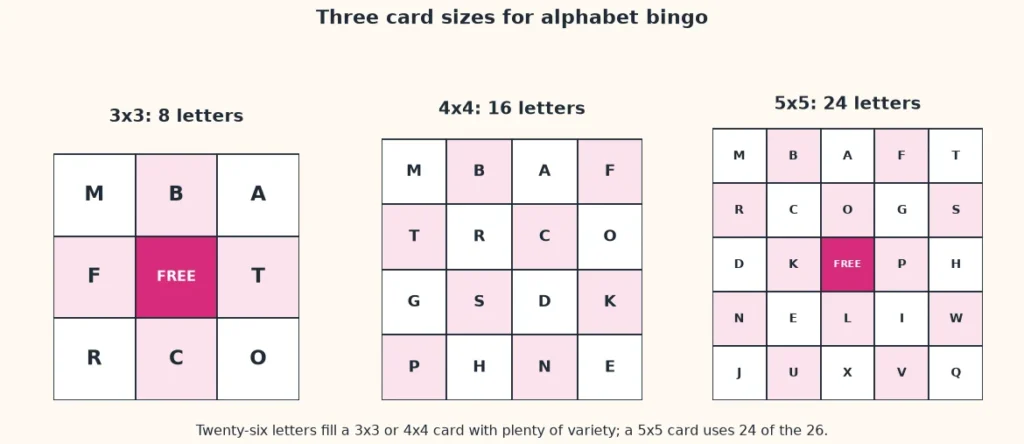
| Card size | Letters per card | Lines you can win | Good for |
|---|---|---|---|
| 3×3 with free center | 8 | 8 (3 rows, 3 columns, 2 diagonals) | Ages 3 to 4, a first game, one-to-one play |
| 3×3, no free space | 9 | 8 | Children who like to cover every square |
| 4×4, no free space | 16 | 10 (4 rows, 4 columns, 2 diagonals) | Ages 4 to 5, pre-K and kindergarten |
| 5×5 with free center | 24 | 12 (5 rows, 5 columns, 2 diagonals) | Kindergarten and first grade, longer games |
The ages above are a rough guide. A child who cannot yet name any letters can still play a game of “find the same shape”: you hold up a card with a letter and the child matches it to the card by shape alone. That is where letter learning begins, and it uses exactly the same printed cards.
Starter sets of letters
You do not have to begin alphabet bingo with all 26 letters. Fewer letters mean the child sees each one more often, and the game gets easier to win. Here are four starter lists that work with a 3×3 card, which needs 8 letters, so every list below fits.
| Starter set | Letters | Why use it |
|---|---|---|
| Child’s name plus friends | Letters from the names in the group | Letters they already care about |
| A common phonics first group | S, A, T, P, I, N, M, D | These letters make many simple words, so children can start blending quickly |
| Letters that look different | A, B, O, T, X, Z, M, S | Shapes that are hard to mix up |
| Look-alike pairs, for later | b, d, p, q, m, w, n, u | Practice for the letters that confuse almost everyone |
With exactly 8 letters, every alphabet bingo card contains the same eight letters in a different order, which is fine for a first game. With 10 or 12 letters, cards begin to hold different sets: there are 45 possible sets from 10 letters and 495 from 12. The computed section below explains how many cards the full alphabet can make.
Printable alphabet bingo: set up in five steps
This printable alphabet bingo is made in the card maker, so there is no file to download first. The steps also work for any other set of letters or symbols, so the same alphabet bingo cards can carry numbers or shapes.
- Open the template. Use the button above the article to open the editor with the 26 letters loaded. The tabs are Setup, Items, Design, Templates and Print.
- Choose the grid on the Setup tab: 3×3 for the youngest group, 4×4 for the next step, 5×5 for older children. The switch “Free space in the middle” sits in the same place.
- Change the letters on the Items tab. Delete the ones you are not teaching yet, or type lowercase letters, or add a picture or emoji beside each letter (an apple beside A, for example).
- Style it on the Design tab. Big, simple text and strong borders help small eyes. Choose a color theme and a title such as “Letter Hunt”.
- Print: set the number of different cards (one per child plus spares), choose 1, 2, 4 or 6 per page, Letter or A4, and turn on the caller sheet and calling cards if you want a pile of letters to draw from. Download the PDF or print directly.
The shareable link for your alphabet bingo set stores the letters only, so you can send it to a co-teacher or a parent and they can open the same set. If you want to try the same card as an online game, the Play online button in the print step links to a live version, and the play custom bingo online page explains how it works.
How to call the letters in an alphabet bingo game
In an alphabet bingo game the adult is the caller, and the call is what you are teaching. Choose one style for a round and change it in the next one. The Print tab gives you calling cards and a caller sheet with the letters from your list, so you can shuffle the cards and draw one at a time; setting each called card aside gives you a face-up pile to settle disputes.
| Call style | Example | Why it helps |
|---|---|---|
| Letter name | “This is M.” | Fastest game, easiest for beginners |
| Letter sound | “Mmm.” | Connects letters to reading |
| Starts with | “Mouse starts with…” | Children say the sound themselves |
| Show and say | Hold up the calling card and say the name | Matches shape to shape for the youngest |
| Mystery clue | “The letter after L.” | Reinforces alphabet order for older children |
| Child caller | A child draws and names the letter | Practice reading a letter aloud |
Repeat each letter at least twice in alphabet bingo. Say it, wait three or four seconds while the children search, and say it again. If a child is stuck, point at your own calling card so they can compare shapes. When someone shouts bingo, ask them to touch each covered letter in the line and say its name. The rest of the group can say them with the winner, which turns a win into one more round of practice.
Should you call the alphabet bingo letters in order?
You can, and children enjoy it, because they can sing along with the alphabet song. The odds do not change. Every card is a random arrangement, so a card has the same chance whether you call A, B, C, D or a shuffled order. We checked this by simulation.
With 10 players, the median first line came at call 4 on a 3×3 card whether the letters were called alphabetically or in random order, call 9 on a 4×4 card, and call 10 on a 5×5 card in both cases. Calling in order is a fair choice; shuffling is better when the group already knows the song and you want them to listen instead of sing.
The alphabet bingo game: how long does a round take?
We simulated the game so you can plan a lesson. In each run the 26 letters are called in random order, every player holds a random card (with a free center on 3×3 and 5×5), and the first line is any row, column or diagonal. We ran 8,000 games for each row and report the median call at which someone first has a line, so half of the games finish sooner and half later.
| Players | 3×3: first line | 4×4: first line | 5×5: first line |
|---|---|---|---|
| 1 | 10 (7 to 13) | 14 (12 to 17) | 15 (13 to 17) |
| 10 | 4 (3 to 5) | 9 (8 to 10) | 10 (9 to 11) |
| 20 | 3 (3 to 4) | 8 (7 to 9) | 9 (8 to 10) |
| 30 | 3 (2 to 4) | 7 (6 to 8) | 8 (7 to 9) |
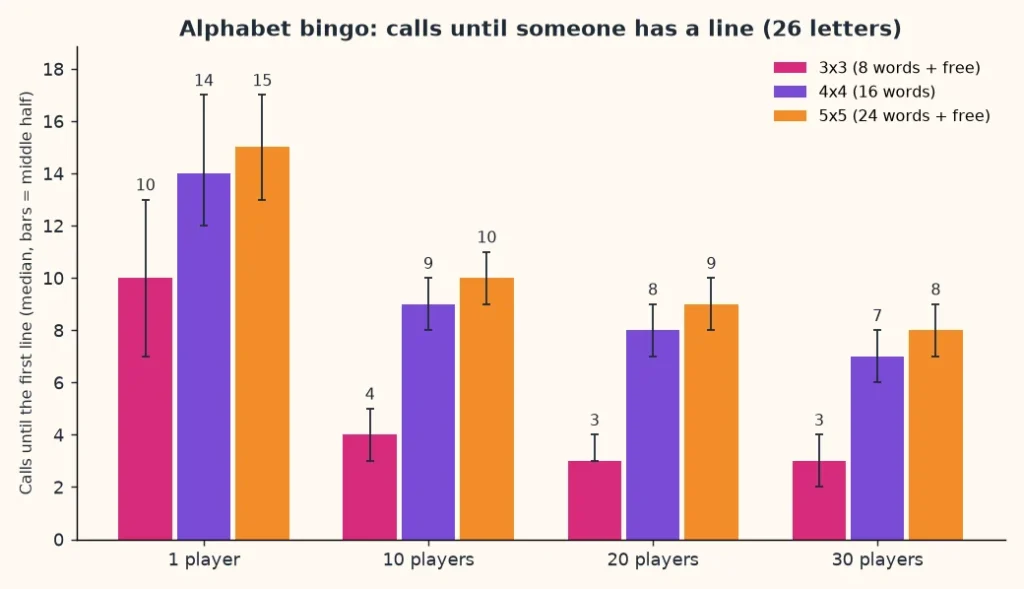
In a group of 20, a 3×3 card finishes after about 3 calls, a 4×4 card after 8 and a 5×5 card after 9. A round of alphabet bingo on a 3×3 card is over in under a minute, so plan on playing several in a row. With a single child, as at home with a parent, the first line takes about 10 calls on a 3×3 card, 14 on a 4×4 card and 15 on a 5×5 card.
The effect of adding players to alphabet bingo fades fast. On a 4×4 card the median drops from 14 calls for one player to 9 for ten, but from 20 to 30 players it improves by only about one call. If you wait for a full card (blackout), a group of 20 on 3×3 cards reaches it at a median of 19 calls, so nearly the whole alphabet has been called by then. Stopping alphabet bingo at the first line is a warm-up; playing to blackout is a complete alphabet review.
The 3×3 card without a free center, with 9 letters, is a different game: the median first line is at call 7 with 10 players and 6 with 20, because covering a line of three means finding three of nine letters and nothing is given for free. Use the free-center version to shorten a round and the no-free version to lengthen it.
One more number is useful when you call randomly. The alphabet has 5 vowel letters out of 26, so in the first 10 random calls you should expect about 1.9 vowels, and about 6 percent of games will have no vowel at all in their first ten calls. A game that seems to have no A or E in it is not rigged. It is just chance.
The simulation assumes everyone marks correctly and nobody misses a call. Real children are less tidy, so allow extra time and treat the numbers as a planning tool, not a promise.
How many different alphabet bingo cards can 26 letters make?
Two things decide how different the cards are: which letters land on a card and in what order. For a 3×3 card with a free center, 8 of the 26 letters are chosen and arranged in the 8 playable squares, which can be done in 26 x 25 x 24 x 23 x 22 x 21 x 20 x 19 = 6.3 x 10¹⁰ ways.
For a 4×4 card it is 1.1 x 10²⁰ ways, and a 5×5 card with a free center allows 2.0 x 1026. These counts are for the ordered arrangements; they are the number of different alphabet bingo cards the maker can produce.
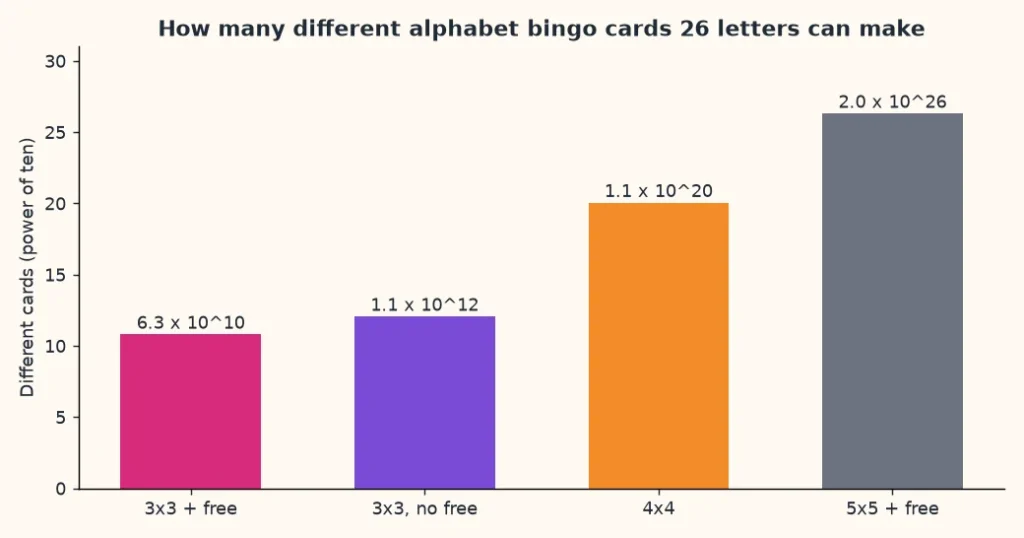
| Grid | Letters needed | Different sets of letters | Different cards (ordered) |
|---|---|---|---|
| 3×3 with free center | 8 | 1.6 x 10⁶ | 6.3 x 10¹⁰ |
| 3×3, no free space | 9 | 3.1 x 10⁶ | 1.1 x 10¹² |
| 4×4 | 16 | 5.3 x 10⁶ | 1.1 x 10²⁰ |
| 5×5 with free center | 24 | 325 | 2.0 x 1026 |
What does it mean in practice? In a class of 20 on 3×3 cards, the chance that any two children hold exactly the same card is about 190 divided by 6.3 x 10¹⁰, roughly 3 in a billion, so you can ignore it.
The 5×5 card has a different quirk: it uses 24 of the 26 letters, so there are only 325 sets of letters, and nearly every card holds nearly the same letters in a different layout. That is why younger children find a 5×5 alphabet bingo card repetitive, and why a smaller grid with a bigger gap between list and grid makes a better game.
Alphabet bingo free printable: laminating, chips and printing tips
This alphabet bingo free printable costs only paper, but some choices make a set of alphabet bingo cards last far longer and keep little hands happy.
- Print big. For ages 3 to 5, print two cards on a page. Large squares leave room for fat chips and unsteady fingers. Four per page is better for cutting into small cards.
- Laminate or sleeve. A laminating pouch or clear page protector means the cards survive spills and can be wiped clean. Cards then work with dry-erase markers as well as chips.
- Choose chips with care. Use large counters, flat plastic discs or torn paper. For children under three, avoid small pieces, because anything that fits through a toilet-paper tube can be a choking hazard. Check allergies before using cereal or candy.
- Dot markers and stickers. Bingo daubers and round stickers are good for children who struggle to place small chips, and they make paper cards a one-use game.
- Put names on cards. Turn on names in the Design tab so the cards find their owners.
- Use cut guides. Print the calling cards on cardstock, turn on cut guides and cut them once. A rubber band or small bag keeps them together.
- Make spares. Print two or three more cards than children, and you can swap cards between rounds.
Print one set on white paper and one on colored paper if you run two groups, so the cards do not get mixed up. Landscape or portrait both work; choose whichever makes the letters larger on your paper size.
Customize your alphabet bingo cards in the card maker
The alphabet bingo template is a base. The Items and Design tabs let you change what the cards say and how they look without any design skill.
- Letters, words and pictures. Type letters, add an emoji, or place your own picture on a square, such as a photo of a child whose name starts with that letter.
- Free space. On odd grids the center can be FREE or hold a letter, an emoji or a picture. A different “letter of the day” in the center turns each card into a lesson.
- Style. Choose a color theme, font, text size, ALL CAPS or not, border style (solid, double, dashed or none), rounded corners, alternating tint and backgrounds.
- Title and footer. Add a title as text or a picture, add a footer line, and print each child’s name on their card.
- Shuffle and undo. Shuffle re-deals the whole set, and Undo steps back if you change your mind.
For a bingo with a different list altogether, open the bingo card generator and start from a blank grid, or print the blank bingo cards and let the children write their own letters in.
What children practice with alphabet bingo
| Skill | How the game builds it |
|---|---|
| Letter recognition | Matching a heard letter to a printed shape, many times over |
| Letter-sound knowledge | Calling sounds or first sounds instead of names |
| Visual scanning | Looking across a grid, left to right and top to bottom |
| Listening and waiting | Staying quiet until the call, then acting |
| Fine motor control | Placing a chip or dot in the right square |
| Counting and patterns | Counting covered squares and spotting a line |
| Turn-taking | Handing the caller role to a friend |
Recognizing and naming all upper- and lowercase letters is a foundational kindergarten skill in the Common Core standards (RF.K.1.d). The goal of the game is not drill; it is to give a child many happy encounters with letters. If a child grows tired, stop and try again later.
More ways to play alphabet bingo with the same letters
Once a group knows the basics of alphabet bingo, change the win condition. Four corners and the letter X are quick rounds, and blackout takes the whole card. Try “find your name”, in which a child covers every letter in their own name as it is called. Try a team game, in which a pair shares one card. Try a scavenger twist on alphabet bingo by asking children to find an object in the room that starts with the letter that was called, then cover it.
When letters become easy, the next step is whole words, and our sight words bingo page offers the first 32 high-frequency words on cards of the same design. For children who cannot read at all, picture bingo for kids offers image-only cards. Teachers who run a whole-class review can look at classroom bingo, and the printable bingo cards hub lists every set. When children are ready for words on paper, the sight word worksheets are the natural next step.
Frequently asked questions
10 quick answers
What is alphabet bingo?
Alphabet bingo is a matching game in which the caller names a letter and each player covers that letter on a card. The first player to cover a full line, row, column or diagonal, calls bingo.
Are these alphabet bingo cards free?
Yes. You can create, edit, shuffle and print the cards without an account, and nothing you type is uploaded. You only need a printer or a way to save the PDF.
Which letters are on the alphabet bingo template?
All 26 capital letters, A to Z. You can delete letters, type lowercase ones, or add pictures in the Items tab.
What age is alphabet bingo for?
Alphabet bingo works for children of about three and up on a 3×3 card, in a game where an adult calls the letters and helps them find the shape. Four- and five-year-olds usually enjoy 3×3 or 4×4, and 5×5 suits kindergarten and first grade.
How many letters do I need for each card size?
A 3×3 card with a free center needs 8 letters, a 3×3 without it needs 9, a 4×4 card needs 16, and a 5×5 card with a free center needs 24.
Can I make lowercase alphabet bingo cards?
Yes. Type lowercase letters in the Items tab, or type pairs like Aa to show both forms on one square. The ALL CAPS option in the Design tab is also worth checking.
How many cards can I print at once?
From 1 to 100 different cards in one PDF, with 1, 2, 4 or 6 cards per page on Letter or A4 paper, in portrait or landscape.
How long does an alphabet bingo game take?
In our simulation with 20 players, a first line appears after about 3 calls on a 3×3 card, 8 on a 4×4 card and 9 on a 5×5 card, so a round takes one to three minutes.
Do I need to call the letters in alphabetical order in alphabet bingo?
No. Random order is fine and so is alphabetical order, because the cards are random arrangements. Our simulation shows the same median game length either way.
Can I play ABC bingo without printing?
Yes, alphabet bingo works on screens too. You can show the card on a tablet or screen, or set up a live game from the Play online button. For a very small child, a card on a screen with a finger to point is a gentle first step.