A compound interest calculator shows how a deposit grows when interest is added to the balance and then earns interest itself. Type your starting amount, a monthly or yearly contribution, the rate, how often it compounds and the number of years, and you get the final balance, the interest earned and a year-by-year table.
This free compound interest calculator shows every step of the working, so you can check the answer by hand or copy the method into a spreadsheet. It works for savings accounts, certificates of deposit, index fund projections and any other balance that earns a steady yearly rate.
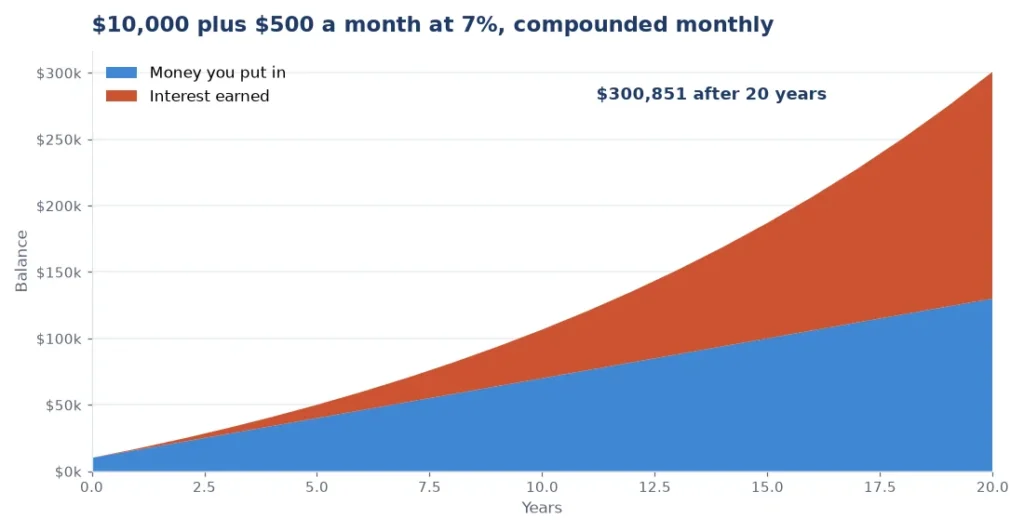
Quick answer: Compound interest is calculated with A = P(1 + r/n)nt, where P is the deposit, r the yearly rate as a decimal, n the compounding periods per year and t the years. For example, $10,000 at 7% compounded monthly for 20 years grows to $40,387.39 with no contributions. Adding $500 a month for 20 years brings the balance to $300,850.72.
How to use this compound interest calculator
The calculator updates as you type, so there is no Calculate button. Change one box at a time to see which input matters most, then press Copy result to paste the numbers, or Copy link to share your exact setup.
- Enter the initial deposit: the money you have today. Use 0 if you are starting from nothing.
- Enter the contribution and choose whether you add it every month or every year. Use 0 for a one-time deposit.
- Enter the interest rate per year and pick how often it compounds: daily, monthly, quarterly or annually.
- Enter the length of time in years. Tick the box if your contributions go in at the start of each period instead of the end.
- Read the final balance, the split between your money and interest, the APY and the year-by-year table.
| Input | What it means | Typical values |
|---|---|---|
| Initial deposit | The starting balance (principal) | $0 to $100,000 |
| Contribution | Money added each month or each year | $50 to $2,000 a month |
| Interest rate (APR) | The stated yearly rate before compounding | 1% to 5% savings, 5% to 10% long-term stock estimates |
| Compounding frequency | How often interest is added to the balance | Daily, monthly, quarterly or annually |
| Time | How long the money stays invested | 1 to 40 years |
The results include the APY (the real yearly growth after compounding) and two doubling times: the quick Rule of 72 estimate and the exact figure.
Compound interest formula
The compound interest formula for a single deposit is A = P × (1 + r/n)nt. A is the final amount, P the principal, r the annual rate as a decimal (7% is 0.07), n the number of times interest compounds per year and t the number of years. The interest earned is simply A − P.
When you add the same contribution C every period, each contribution grows for a different length of time. Adding them up gives a geometric series: FV = C × (gN − 1) ÷ (g − 1), where g is the growth per contribution period, g = (1 + r/n)n/m, m is the number of contributions per year and N = m × t is the number of contributions.
For deposits at the start of each period, multiply that result by g. Add it to the growth of the initial deposit and you have the full balance.
Worked example 1: a deposit with monthly contributions
Start with $10,000, add $500 a month, earn 7% compounded monthly and leave it for 20 years. This is the calculator’s default setting.
- Rate per month: 7% ÷ 12 = 0.583333%, so g = 1.00583333.
- Initial deposit: 10,000 × 1.00583333240 = $40,387.39.
- Contributions: 500 × (1.00583333240 − 1) ÷ 0.00583333 = $260,463.33.
- Balance: $40,387.39 + $260,463.33 = $300,850.72.
- You paid in $10,000 + $500 × 240 = $130,000, so the interest earned is $170,850.72, or 56.8% of the balance.
Worked example 2: one deposit, quarterly compounding
Put $5,000 in a certificate paying 4% compounded quarterly for 10 years. The rate per quarter is 4% ÷ 4 = 1%, and there are 4 × 10 = 40 quarters. A = 5,000 × 1.0140 = $7,444.32, so the interest is $2,444.32.
Compound interest formula in Excel and Google Sheets
Spreadsheets have the future value function built in. For example 10,000 starting, 500 added monthly, 7% compounded monthly for 20 years is =FV(0.07/12, 20*12, -500, -10000), which returns $300,850.72. The rate per period goes first, then the number of periods, then the payment and the starting balance, both entered as negative numbers because they leave your pocket.
Compound interest calculator with monthly contributions: what regular saving does
The surprising part of compounding is how much regular deposits matter. This table uses 7% compounded monthly and no starting balance. It shows the final balance, how much you contributed and how much is interest. Change the figures in the compound interest calculator with monthly contributions to match your own plan.
| Monthly deposit | 10 years | 20 years | 30 years | 40 years |
|---|---|---|---|---|
| $100 a month | $17,308 | $52,093 | $121,997 | $262,481 |
| $250 a month | $43,271 | $130,232 | $304,993 | $656,203 |
| $500 a month | $86,542 | $260,463 | $609,985 | $1,312,407 |
| $1,000 a month | $173,085 | $520,927 | $1,219,971 | $2,624,813 |
With $500 a month, you contribute $240,000 over 40 years and end with $1,312,407. More than 81% of that final balance is interest. In the first 10 years interest is only 31% of the balance, which is why compounding feels slow at first and fast later.
Compound interest calculator with yearly contributions
If you save once a year, for example a bonus or a tax refund, choose Yearly under contribution frequency. A yearly deposit of $6,000 at 7% compounded annually for 30 years grows to $566,765, against $180,000 paid in. Deposits made at the start of each year (tick the box) grow a little more, to $606,438.
Compound interest calculator daily: does compounding frequency matter?
Daily compounding earns slightly more than monthly, which earns slightly more than quarterly or annual compounding, but the gap is small. Use the daily setting of the compound interest calculator for savings accounts that credit interest every day. The table shows $10,000 at 5% for 10 years with no contributions.
| Compounding | Times per year | Balance after 10 years | APY |
|---|---|---|---|
| Annually | 1 | $16,288.95 | 5.000% |
| Quarterly | 4 | $16,436.19 | 5.095% |
| Monthly | 12 | $16,470.09 | 5.116% |
| Daily | 365 | $16,486.65 | 5.127% |
The difference between annual and daily compounding is $197.70 on $10,000 over a decade. Increasing the rate by one percentage point or adding years does far more than switching the compounding frequency.
Rule of 72: how long does money take to double?
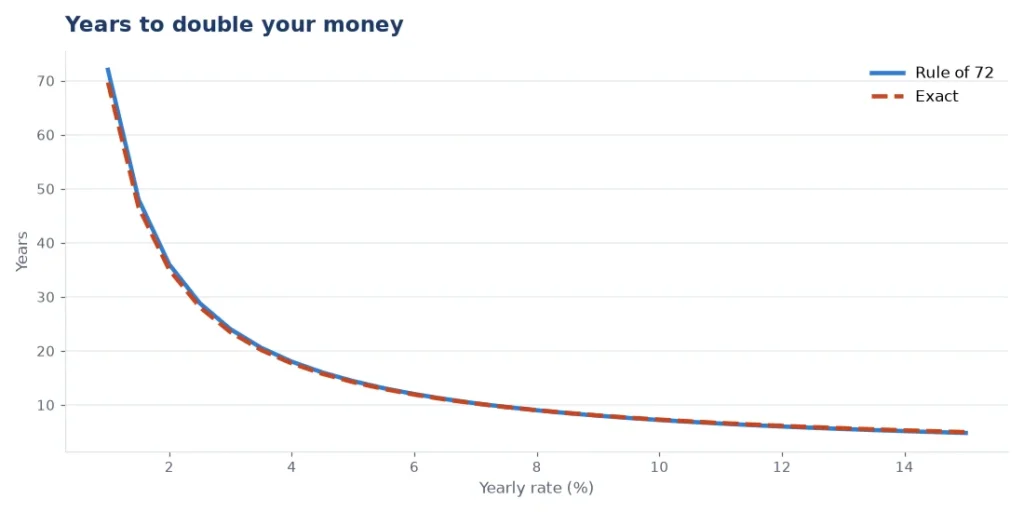
The Rule of 72 is a quick way to estimate doubling time: divide 72 by the yearly rate in percent. At 8% your money doubles in about 72 ÷ 8 = 9 years. It is a mental shortcut, and the calculator also shows the exact doubling time, ln(2) ÷ ln(1 + APY). The table compares them for annual compounding.
| Rate | Rule of 72 | Exact | Rule is off by |
|---|---|---|---|
| 2% | 36.0 years | 35.0 years | 2.8% |
| 3% | 24.0 years | 23.4 years | 2.3% |
| 4% | 18.0 years | 17.7 years | 1.9% |
| 5% | 14.4 years | 14.2 years | 1.4% |
| 6% | 12.0 years | 11.9 years | 0.9% |
| 7% | 10.3 years | 10.2 years | 0.4% |
| 8% | 9.0 years | 9.0 years | -0.1% |
| 10% | 7.2 years | 7.3 years | -1.0% |
| 12% | 6.0 years | 6.1 years | -1.9% |
The rule works best between about 6% and 10%. At low rates it slightly overestimates the time, and at very high rates it underestimates. The Rule of 72 article explains why 72 works so well.
APR vs APY: what is the difference?
APR vs APY comes down to compounding. The APR (annual percentage rate) is the stated rate. The APY (annual percentage yield) is what you actually earn in a year once compounding is included, so APY is higher than APR whenever interest compounds more than once a year. The calculator shows APY under the results.
The formula is APY = (1 + r/n)n − 1. At 7% compounded monthly, APY = (1 + 0.07/12)12 − 1 = 7.229%. When comparing savings accounts, compare APY with APY. When comparing loans, compare APR with APR, because the APR on a loan includes some fees and the APY on a loan is rarely quoted.
| APR | Annually | Quarterly | Monthly | Daily |
|---|---|---|---|---|
| 1% | 1.000% | 1.004% | 1.005% | 1.005% |
| 3% | 3.000% | 3.034% | 3.042% | 3.045% |
| 5% | 5.000% | 5.095% | 5.116% | 5.127% |
| 7% | 7.000% | 7.186% | 7.229% | 7.250% |
| 10% | 10.000% | 10.381% | 10.471% | 10.516% |
For more on the term, see the annual percentage yield article.
Compound interest vs simple interest
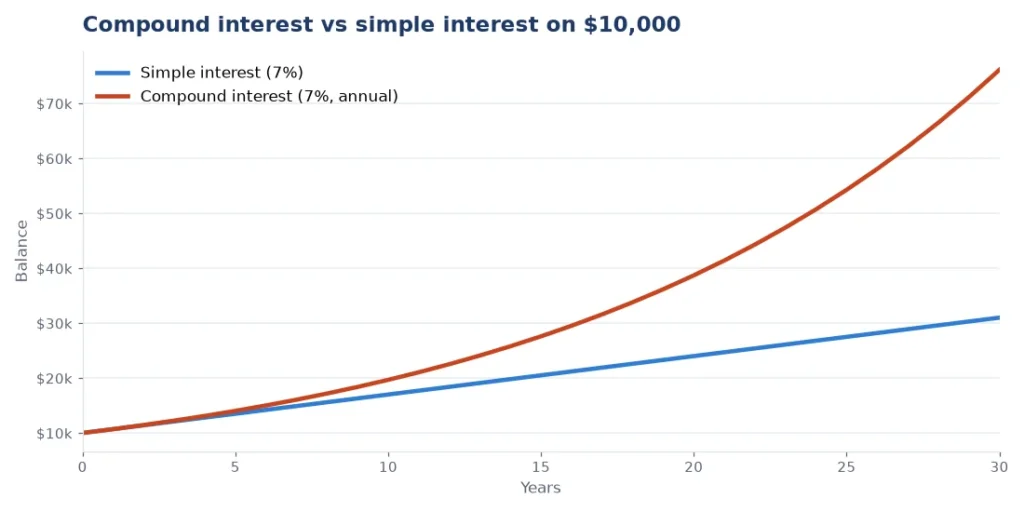
Compound interest vs simple interest is the difference between earning interest on the balance and earning it only on the original deposit. Simple interest is P × r × t, so $10,000 at 7% for 20 years earns $14,000 in simple interest. With compounding it earns $30,387, which is 2.2 times as much. Use the simple interest calculator when interest is not added to the balance, as with some short loans and bonds.
| Years | Simple interest | Compound interest (annual) | Extra from compounding |
|---|---|---|---|
| 1 | $700 | $700 | $0 |
| 5 | $3,500 | $4,026 | $526 |
| 10 | $7,000 | $9,672 | $2,672 |
| 20 | $14,000 | $28,697 | $14,697 |
| 30 | $21,000 | $66,123 | $45,123 |
Start early or save more? Time beats amount
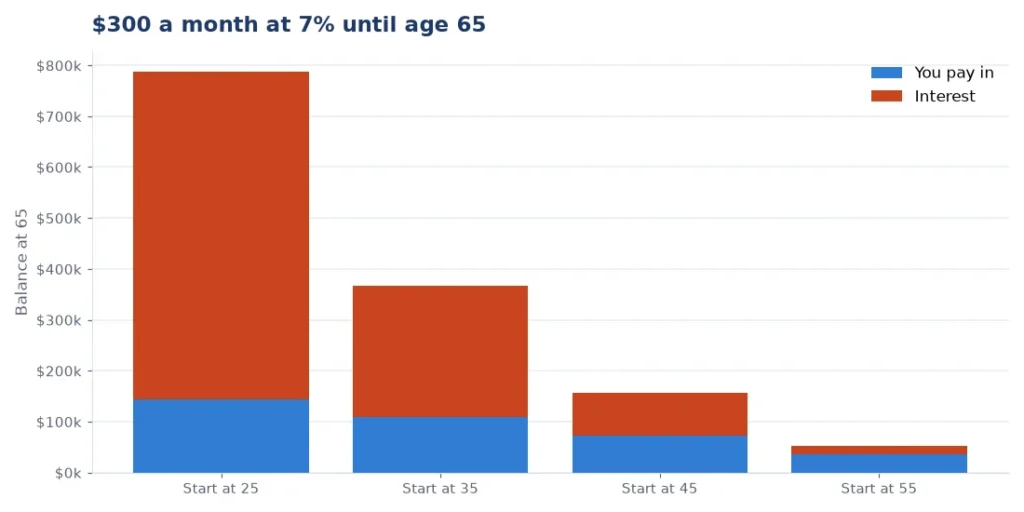
Time is the strongest input in the compound interest calculator. This table shows three savers who each deposit $300 a month at 7% compounded monthly until age 65, starting at different ages.
| Start age | Years saving | You pay in | Balance at 65 | Interest |
|---|---|---|---|---|
| 25 | 40 | $144,000 | $787,444 | $643,444 |
| 35 | 30 | $108,000 | $365,991 | $257,991 |
| 45 | 20 | $72,000 | $156,278 | $84,278 |
| 55 | 10 | $36,000 | $51,925 | $15,925 |
The person who starts at 25 pays in only $36,000 more than the person who starts at 35, yet finishes with $421,453 more. That is the compounding effect: the early deposits have the longest to grow.
Savings, retirement and other accounts
The calculator uses one steady rate, which suits most accounts as a planning estimate. Real accounts differ in what rate they pay, how often they credit it and how they are taxed. The notes below are general, so check the rules in your own country before you decide.
| Account type | How compounding usually works | Things to check |
|---|---|---|
| Savings account or high-yield savings | Interest credited daily or monthly at a variable rate | The rate can change; compare APY |
| Certificate of deposit or term deposit | Fixed rate for a fixed term, often compounded monthly or yearly | Early withdrawal penalties |
| 401(k) and IRA (United States) | Invested balance with no fixed rate; growth is usually tax-deferred or tax-free | Contribution limits, employer match and withdrawal rules |
| TFSA and RRSP (Canada) | Invested or savings balance; growth is tax-free or tax-deferred | Annual contribution room |
| ISA and workplace pension (UK) | Cash or investments; growth is sheltered from some taxes | Yearly allowances and pension access age |
| Superannuation (Australia) | Pooled investment with employer contributions | Fees and the age you can access it |
For investments in stocks or funds, returns are not guaranteed and vary every year. A steady 7% is a simplified average, so run the calculator at a lower and a higher rate as well. This page gives general information, not financial advice.
Common mistakes with a compound interest calculator
- Mixing APR and APY. Enter the stated rate (APR) and let the calculator work out the APY. If a bank quotes APY, enter the matching APR or accept a tiny difference.
- Forgetting inflation. $100,000 in 30 years buys less than $100,000 today. Subtract expected inflation from the rate to see growth in today’s purchasing power.
- Ignoring fees and taxes. A 1% yearly fee on a 7% return leaves 6%, which over 30 years reduces the balance of $500 a month by $107,728.
- Using a rate that is too high. A savings account rarely pays 7%. Pick a rate that matches the account, not the best year in the market.
Real-life uses with numbers
Saving for a down payment
Saving $800 a month in an account paying 4% compounded monthly for 5 years gives $53,039, of which $5,039 is interest. Use the compound interest calculator with a short time frame to see whether you reach your target date.
Questions people ask about compound interest calculators
Compound interest calculator with inflation
To see growth in today’s money, subtract inflation from your rate. A 7% return with 2.5% inflation is a real return of about 4.4%, found with (1.07 ÷ 1.025) − 1. Enter 4.4% in the calculator and the balance is in today’s purchasing power. The retirement calculator does this automatically.
Frequently asked questions
10 quick answers
How do you calculate compound interest?
Multiply the principal by (1 + r/n) raised to the power nt, then subtract the principal. For $10,000 at 5% compounded yearly for 10 years, 10,000 × 1.0510 = $16,288.95, so the interest is $6,288.95.
What is the compound interest formula?
The formula is A = P(1 + r/n)nt. A is the final balance, P the starting deposit, r the yearly rate as a decimal, n the compounding periods per year and t the years.
How much will $10,000 grow in 10 years?
At 7% compounded monthly, $10,000 grows to $20,096.61 in 10 years, which is $10,096.61 of interest. At 4% it grows to $14,908.33.
Is daily or monthly compounding better?
Daily compounding earns slightly more. At 5% for 10 years on $10,000, daily gives $16,486.65 and monthly gives $16,470.09, a difference of $16.55.
What is the Rule of 72?
The Rule of 72 estimates doubling time by dividing 72 by the yearly rate in percent. At 6% money doubles in about 12 years; the exact figure is 11.9 years.
What is the difference between APR and APY?
APR is the stated yearly rate. APY includes compounding, so it is higher when interest compounds more than once a year. At 5% compounded monthly the APY is 5.116%.
Does the calculator include taxes or fees?
No. It shows the pre-tax, pre-fee growth at a steady rate. Subtract fees from your rate and apply your own tax rules to the interest for a closer estimate.
Can I add monthly contributions?
Yes. Enter the amount, choose Monthly under contribution frequency and the calculator adds it every month. Tick the box if the deposit goes in at the start of the month.
How is compound interest different from simple interest?
Simple interest is paid only on the original deposit. Compound interest is paid on the deposit plus earlier interest, so growth speeds up over time.
How accurate is the compound interest calculator?
The math is exact for a fixed rate and regular deposits. Real accounts may credit interest on different dates or change the rate, so treat the result as a planning estimate.
Related calculators
- Simple interest calculator: interest on the original amount only
- Retirement calculator: projected savings, inflation and the 4% rule
- Credit card payoff calculator: when compounding works against you
- Loan calculator and mortgage calculator
- Percentage calculator and all calculators
- Money worksheets for practicing percents, interest and savings
Sources and further reading
- Compound interest (Investor.gov glossary)
- Compound interest (Wikipedia)
- Compound interest calculator (Investor.gov)
- Annual percentage yield (Wikipedia)
Last updated: October 2026.