Summer bingo turns a long school break into a checklist that kids actually want to finish. The template here has 30 squares, from a sunny day and a trip to the beach to a popsicle, a campfire and the Fourth of July fireworks. You print a card for each child, stick it on the fridge, and tick off a square every time that thing happens.
In short: press Edit and print this card in the card maker above to open the full editor with all 30 squares loaded. Choose the grid size and the number of cards, then download the PDF. Everything is free, runs in your browser and keeps your words private.
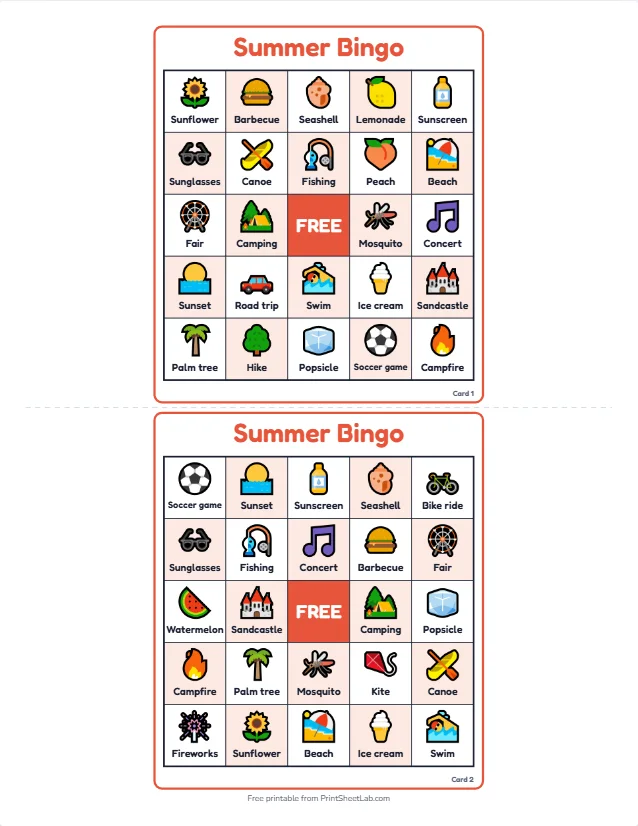
How to play summer bingo
This is not a one-afternoon game. A summer bingo card lives on the fridge, the car visor or the back of a bedroom door for weeks. Here is the simplest way to run summer bingo.
- Print one card per child and write each child’s name at the top. Every card has the same 30 squares in a different order.
- Pick the winning pattern on day one: one line for a small prize, four corners for a medium one, a full card for the big one.
- Tick squares as they happen. A square counts only if the child did or saw it that summer, and an adult or a sibling confirms.
- Call “bingo” at the fridge and show the line. Tape a second, fresh card next to it if you want to keep going.
- Celebrate at the end of the break with a family vote on the best square of the summer.
Summer bingo works because summer, unlike a school day, has no schedule. Without a list, the weeks blur together and kids say they did nothing. A square for the ice cream, the first swim and the sparkler gives them a record of what they actually did. It also gently nudges a family toward the squares that have not been ticked yet: nobody wants to be the one stuck on “Fishing” in late August.
Summer bingo cards: all 30 squares and how likely they are
The summer bingo cards in this template use 30 squares. A 5×5 card with a free center needs 24 of them, so every card leaves out six. The list mixes things that happen on any sunny weekday with things that need a plan, which is why the game lasts all summer instead of one week. The table sorts the 30 squares into four groups.
| Group | Squares | How they happen |
|---|---|---|
| Everyday | ☀️ Sunny day, 🕶️ Sunglasses, 🧴 Sunscreen, 🍦 Ice cream, 🏊 Swim, 🧊 Popsicle, 🦟 Mosquito, 🚲 Bike ride, 🍋 Lemonade | Done in the first week or two by almost every kid. These keep the card moving early. |
| Weekly | 🍉 Watermelon, 🌅 Sunset, 🍔 Barbecue, 🦋 Butterfly, 🍑 Peach, ⚽ Soccer game, 🌳 Hike | Take a few weeks of normal summer life. No special trip required. |
| Plan it | 🏖️ Beach, 🪁 Kite, 🌻 Sunflower, 🌴 Palm tree, 🔥 Campfire, 🐚 Seashell, 🏰 Sandcastle, 🎵 Concert, 🎣 Fishing, 🚗 Road trip, 🏕️ Camping, 🛶 Canoe, 🎡 Fair | Need a day out, a trip or a weekend away. These decide who finishes the card. |
| Date fixed | 🎆 Fireworks | Happens once, on a holiday. In the United States that is July 4. |
The chart ranks every square by how likely a child is to tick it by the end of a ten-week break, using the assumptions listed in the simulation section below. The everyday group is practically certain. The plan-it group is where families differ: living near a lake makes a canoe easy, while a city family may never see a palm tree unless they travel.
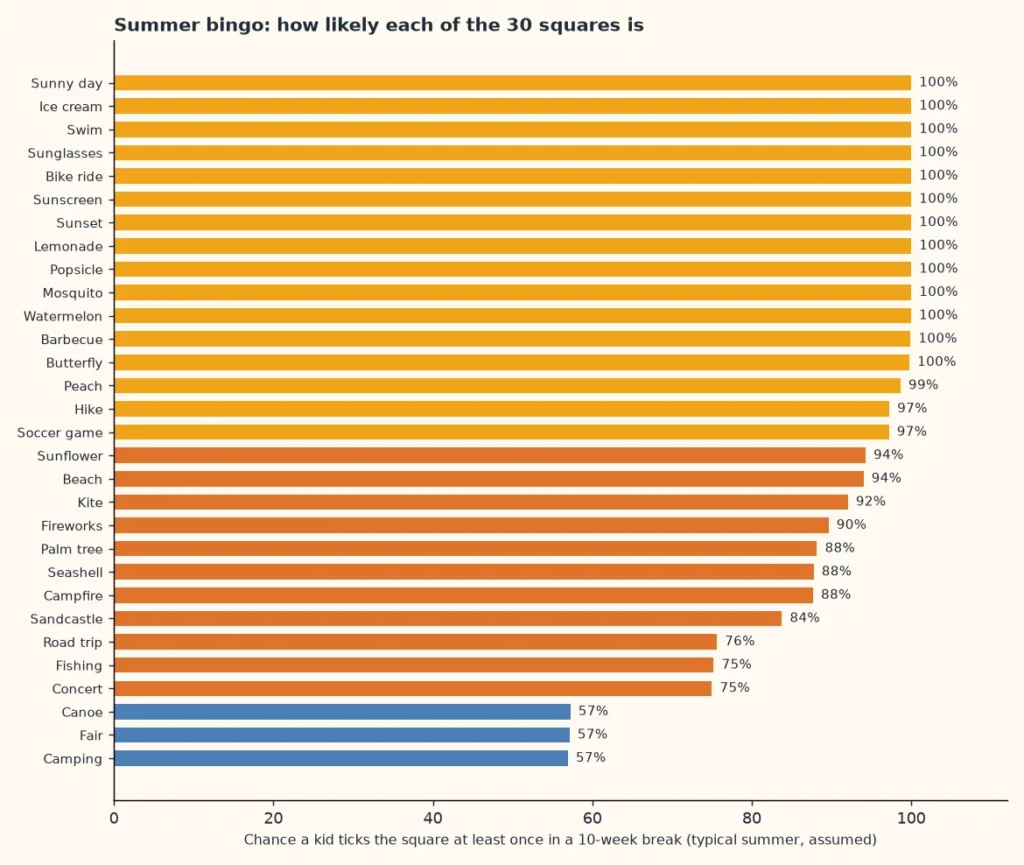
Take the lowest bars first. In a typical summer, the least likely squares are canoe (57%), fair (57%), camping (57%), fishing (75%). If a square would be hard for your family, replace it. A summer bingo card full of squares that cannot happen teaches kids to give up, and a card that is nearly all achievable teaches them to plan.
How many different cards can you print?
Thirty squares and 24 spaces give 30 choose 24 = 593,775 different sets of squares, each of which can be arranged many ways. For a 4×4 card (16 squares, no free space) there are 145,422,675 sets, and for a 3×3 card with a free center (8 squares) there are 5,852,925. Siblings never get the same summer bingo card by accident, which cuts down on arguments about who got the better square.
Summer break bingo: a ten-week plan
Summer break bingo works best with a small reward ladder instead of a single big prize at the end. A reward every couple of weeks keeps a child interested in summer bingo through the middle of the break, when the novelty has worn off. Here is a plan for a ten-week break that matches what our simulation shows is likely.
| Weeks | Goal on the card | Reward idea |
|---|---|---|
| 1 to 2 | First line (most kids get one here) | Pick the movie for family night |
| 3 to 4 | Four corners, plus the fireworks square | A trip for ice cream or a new pool toy |
| 5 to 6 | Two lines on the same card | A friend sleeps over |
| 7 to 8 | The “plan it” squares: beach, camping, fishing, canoe | Choose a day trip |
| 9 to 10 | Blackout, or as close as possible | A small certificate or a treat from a favorite shop |
The rewards are deliberately cheap. What kids remember is the moment of calling “bingo” and the extra bit of attention from a parent. If your break is shorter, six or eight weeks, squeeze the same ladder. If it is longer, add a second card halfway.
You do not need a calendar to run this plan, but a Sunday-evening check-in helps: sit down for five minutes, look at the card, and pick one square to aim for next week. That tiny planning habit is the real prize, and the card does the rest.
Three ways to play a summer bingo game
The fridge card is the main format of summer bingo, but the same template supports two more. Choose the one that fits the setting.
| Format | Where | Length | How you win |
|---|---|---|---|
| Fridge card | Home, all summer | 6 to 10 weeks | Tick squares as they happen; line, corners or blackout |
| Sprint day | Pool, beach or park | One day | Spot or do as many squares as you can before sunset |
| Calling game | Camp, class party or birthday | 15 to 20 minutes | A caller draws squares from a bowl; first line wins |
Format one: the fridge card
This is the summer bingo described above. The only extra rule worth adding is how to handle disagreements. A good one: any tick needs a witness, and the witness can be anyone who was there, including a grandparent on a phone call. Photo proof is an option for older kids; they love sending a picture of the sunset to a parent.
Format two: the sprint day
On a day at the pool, the beach or a park, the squares are limited to what the place offers, so use 3×3 or 4×4 summer bingo cards. Squares such as sunglasses, sunscreen, ice cream, swim, popsicle and sunset are all possible in one afternoon. Give every child a card, set a time (say, until the lifeguard whistle at 5 p.m.) and let the group run. The first child with a line gets to choose the snack stand order, and the summer bingo game is over by dinner.
Format three: the calling game for camp or a party
A summer bingo game with a caller is the right format for a day camp, a last-day classroom party or a birthday outdoors. In the Print tab you can print a caller sheet and calling cards to cut out. The caller draws a card and reads it aloud, and children with that square on their card mark it.
Because the 30 squares come out in a random order, every summer bingo game is fair. For an online version where guests join by link, use the play bingo online page. For more ideas, the birthday party games for kids guide lists games that pair well with a bingo round.
Printable summer bingo: print, post and protect
Printable summer bingo has to survive a summer: sticky fingers, damp swimsuits and a sunny refrigerator door. A little care when printing summer bingo helps a lot. In the Print tab you choose how many different cards to make (1 to 100), how many sit on a page (1, 2, 4 or 6), Letter or A4, and portrait or landscape. One card per page in landscape works well for a fridge. Two or four per page work for a camp group.
- Use a magnet clip or washi tape. A card on the fridge that falls down every morning will be abandoned within a week.
- Laminate or use a plastic sleeve. A dry-erase marker lets a child wipe the card and play again with the same printout.
- Keep a pencil or a sticker sheet next to it. If the marker is far away, the tick will not happen.
- Photograph the finished card. It makes a nice summer keepsake for the family album.
- Print a spare. Cards get lost at the pool; the Print tab can make extra different cards in the same PDF.
Teachers who send summer bingo cards home on the last day of school can print a class set in one PDF and add a footer such as “Have a great summer, Room 12.” For parents who like a tidy design, the Design tab can set a color theme, fonts and an alternate tint, and add a name to each card.
Summer bingo for kids by age
Summer bingo for kids works from preschool to the teen years if you change the card, not the idea. The younger the child, the shorter the list and the bigger the pictures.
| Age | Card | Tips |
|---|---|---|
| 3 to 5 | 3×3, pictures only | A parent reads the squares and sticks the stickers. A line is a big event, so celebrate it. |
| 6 to 8 | 4×4 or 5×5, words and pictures | Child writes the date on each square. Reward every line. |
| 9 to 12 | 5×5, mix of squares and their own | Add three or four squares they invent. Give a bonus for a square done with a friend. |
| 13 and up | 5×5 with a challenge twist | Swap in tougher squares: a sunrise, a new food, a day without screens, a swim somewhere new. |
With siblings of different ages, print each child a summer bingo card sized for them, and let them compete on percentage of squares ticked instead of on a first line. That keeps a four-year-old and a ten-year-old in the same game. A cooperative version works as well: the whole family shares one card, and the goal is a blackout by the last week of the break.
The simulation below shows that a 3×3 summer bingo card gets a first line in about a week in a typical summer, while a blackout on the 5×5 card is a long shot, so choose the card size to match the child’s patience.
Summer bingo free printable: what you get
Free and private
This summer bingo free printable costs nothing and needs no account. The card maker runs in your browser, so the summer bingo squares you write never leave your device, and when you close the tab nothing is stored on our side. There is no watermark on the PDF.
What you can change
The editor has five tabs: Setup, Items, Design, Templates and Print. On the Items tab each square can be reworded, given an emoji or a picture of your own, and the free space can carry its own text. Under Design you choose color themes, fonts, text size, ALL CAPS, borders, rounded corners and backgrounds, add a title and footer, and put names on cards. The Templates tab holds the other starter lists, and Print gives you the PDF, cut guides, a caller sheet and the shareable link, which carries only your words.
How long does a summer take? A real simulation
How fast does a summer bingo card fill up? To answer that with numbers, we simulated 8,000 summers of a ten-week break (70 days). Each square has a chance per day of being ticked.
In a typical summer an everyday square such as sunscreen has a chance of about 40% a day, a weekly square about 5 to 12% and a plan-it square 1 to 4%. The fireworks square is fixed on day 25 (July 4 falls about three and a half weeks into a break that starts in early June), and 90% of kids see them.
We also ran a mostly-at-home summer at half those rates and a very busy summer at nearly double. The first line is the first day on which a row, column or diagonal is complete; a blackout is every square ticked.
The first line
| 5×5 card | Median first line, 1 child | Line within 2 weeks | Line within 4 weeks | Median first line, 4 siblings |
|---|---|---|---|---|
| Mostly at home (half the activity) | day 25 (week 4) | 17% | 65% | day 15 (week 3) |
| Typical summer | day 13 (week 2) | 57% | 95% | day 7 (week 1) |
| Very busy summer (almost double) | day 7 (week 1) | 88% | 100% | day 4 (week 1) |
In a typical summer the median first line comes on day 13 (week 2), and about 95% of kids have a line within four weeks. When four siblings each play a card, the earliest line among them lands around day 7 (week 1). Even a quiet summer gets there: the mostly-at-home child has a line by week ten in about 98% of summers.
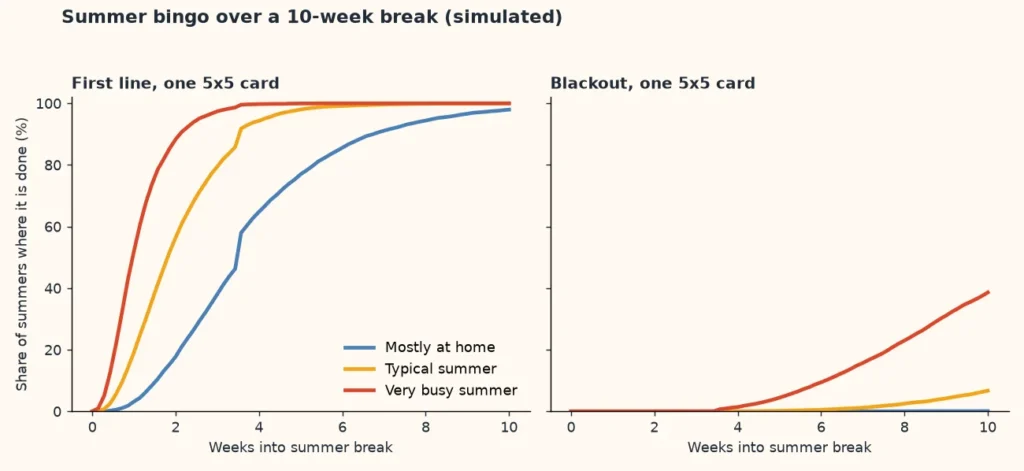
The kink in the left-hand curves around week 3 and a half is the fireworks square: it is the one square that is always ticked on the same day, so a lot of cards complete a line right then.
Blackout: the long game
| 5×5 card | Blackout by week 6, 1 child | Blackout by week 10, 1 child | Blackout by week 10, best of 4 siblings |
|---|---|---|---|
| Mostly at home | 0% | 0% | 0% |
| Typical summer | 0% | 7% | 15% |
| Very busy summer | 9% | 38% | 55% |
A full summer bingo card is a real accomplishment: only about 7% of children in a typical summer complete one by the end of the break, and almost none in a quiet summer. That is a feature, not a flaw. A blackout is the kind of prize that needs a family plan, such as one weekend away and a trip to a lake, and the story of how it was achieved is half the fun. If you want most children to finish, print a 4×4 or 3×3 card.
Card size and the break
| Typical summer, 1 child | Median first line | Line within 2 weeks | Blackout by week 6 | Blackout by week 10 |
|---|---|---|---|---|
| 3×3 with free center | day 6 (week 1) | 84% | 20% | 44% |
| 4×4 | day 12 (week 2) | 60% | 3% | 17% |
| 5×5 with free center | day 13 (week 2) | 57% | 0% | 7% |
So choose the summer bingo card to fit your goal. A 3×3 card is for young children and a six-week break: a first line within a couple of weeks and a blackout for about 20% of kids by week six. The 5×5 card is for older children who like a long project.
Assumptions, so you can judge the numbers: squares are ticked independently, day by day, with the rates above; all 30 squares are equally eligible for a card; a child ticks a square only once. Real summers are lumpier. A week at the grandparents can tick six squares in a single trip, and a rainy fortnight can tick none. If you live in the Southern Hemisphere, shift the fireworks square to a local holiday or replace it.
Customize your summer bingo cards in the card maker
Summer bingo is local. A family in Minnesota and a family in Arizona have very different summer bingo lists. The card maker lets you build a card that fits yours, and the template is only the starting point.
- Lake and woods: loon call, s’mores, dock jump, a night with a lantern, a rope swing.
- City summer: splash pad, street fair, rooftop sunset, library reading challenge, the corner ice cream truck.
- Desert and south: monsoon storm, cactus bloom, night swim, early-morning hike, a very cold watermelon.
- Grandparents and cousins: a card game with Grandpa, a long call, cousins meet, a family photo.
- Learning squares: read a chapter book, learn a new recipe, write a postcard, a day of volunteering.
A 5×5 card with a free center needs 24 squares. If you write more than 24, each card gets a different mix, which is useful when siblings will be comparing. If you write exactly 24, every card has the same words in a different order.
Use the Design tab for a bright color theme and a summer bingo title such as “Summer 2026,” and set the footer to the child’s name. Then press Print and download the PDF. When you want to clear everything and start with a blank card, the blank bingo cards page lets you fill the squares yourself, and the bingo card generator offers every other card type.
Sun, water and bug safety on summer squares
A few squares on the list are about safety as much as fun, and it is worth using them that way. “Sunscreen” is a good prompt to reapply every couple of hours, and “Sunglasses” is a reminder to pack them.
A “Swim” square should only be ticked when an adult is watching, and a “Mosquito” square is better as a joke than as a goal, so treat it as a reminder to use repellent at dusk. A summer bingo square never has to be completed at the cost of safety: if a canoe trip or a hike is not safe in the weather, the card can wait.
The longest day of the year, the summer solstice, falls around June 20 or 21 in the Northern Hemisphere, which is why so many of the squares on this list (sunset, kite, campfire, fireworks) are late-evening activities. If your summer is cooler or wetter than the card assumes, trade the sandcastle for a rainy-day puzzle.
More bingo for the season
When the beach week turns into a drive, print road trip bingo for the car, and pack camping bingo if the plan includes a tent. Both go well with summer bingo at home. Once the school year starts, a classroom bingo list is a good way to talk about the summer. You can browse every template on the printable bingo cards hub, and for a family that is far from relatives, play custom bingo online explains how to host a live game.
The guide to car games for kids is a handy companion for the long drives that often fill a summer.
Frequently asked questions
10 quick answers
What is summer bingo?
Summer bingo is a bingo variation whose squares name summer experiences, such as a trip to the beach, ice cream or fireworks. Children tick a square when it happens, and a full row, column or diagonal wins a small prize.
Is this summer bingo really free?
Yes. You can edit and print the cards without an account, a payment or an upload. The tool runs in your browser, and the PDF has no watermark.
How many squares are on the template?
The template has 30 squares. A 5×5 card with a free center uses 24 of them, a 4×4 card uses 16 and a 3×3 card with a free center uses 8, so each card is a different mix.
How long does a summer card take to finish?
In our simulation of a typical ten-week break, a 5×5 card has its first line at about day 13 (week 2) and only about 7% of children reach a full card by the end of the break.
Can I use summer bingo at camp or school?
Yes. Print a class set in one PDF and play the calling game: a caller draws squares from a bowl and children mark them. You can also send the card home on the last day of school as a break challenge.
What prizes work for a summer break bingo challenge?
Small experiences beat objects: choosing the movie, a friend sleeping over, a trip for ice cream, a day trip of the child’s choice. Reserve something bigger for a full card.
Can I change the squares for where I live?
Yes. Every square on the Items tab can be replaced with your own words, emoji or a picture. Local festivals, favorite parks and family traditions make the best squares.
What card size should I print for a four-year-old?
A 3×3 card with pictures. It has only eight squares plus a free center, so a first line comes within a couple of weeks and the child sees progress quickly.
Can several children share one card?
Yes. A shared family card turns summer bingo into a team project, and the whole family aims for a blackout by the last week of the break.
Can I play summer bingo online?
You can host a live game with a link on the play bingo online page, where cards mark themselves as squares are called. The printed fridge card is better for a whole-summer challenge.