



Date and time calculators answer calendar questions with exact numbers: what date is 90 days from today, how many days lie between two dates, how old someone is in years, months and days, how many hours were worked and what time it is in another city. These free date and time calculators show every step.
Quick answer: Use a date calculator to add or subtract days, a days between dates calculator to count the gap, a business days calculator to skip weekends and holidays, an age calculator for exact age, a work hours calculator for timesheets and a time zone converter for meetings. Example: 90 days from October 8, 2026 is Wednesday, January 6, 2027.
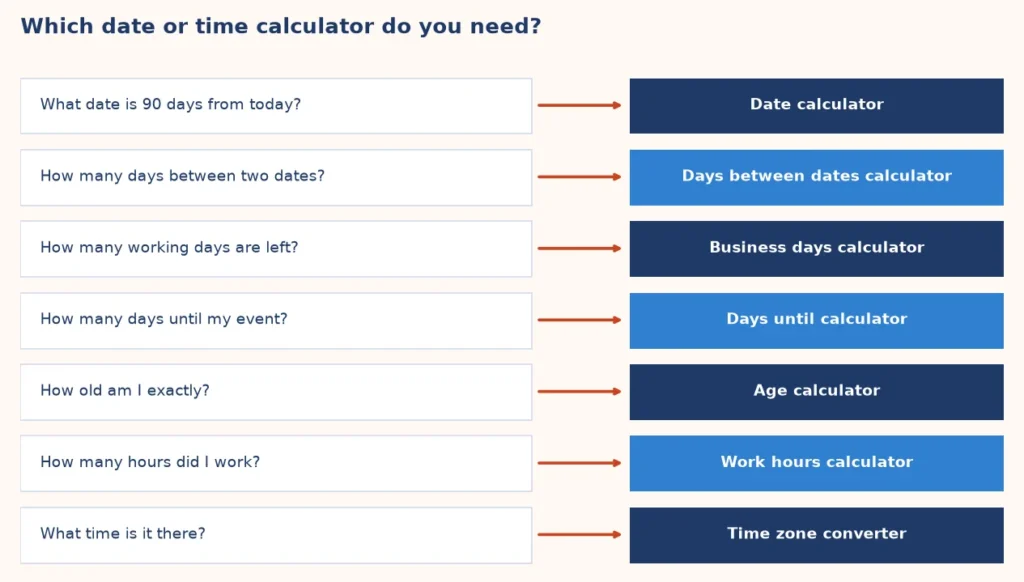
How to choose the right date and time calculator
Date and time calculators fall into two families. Date calculators work on whole days: adding, subtracting, counting and ageing. Time calculators work on hours and minutes: adding durations, totaling a shift and converting between zones. The table matches your question to the tool, and every one of these time and date calculators runs in your browser with no sign-up.
| If you want to… | Use this calculator | You get |
|---|---|---|
| Find the date 30, 90 or 180 days away | Date calculator | The new date and weekday, in days, weeks or months |
| Count the days between two dates | Days between dates calculator | Days, weeks, months and workdays |
| Skip weekends and public holidays | Business days calculator | Working days counted or added |
| Count down to a holiday or event | Days until calculator | Days, weeks and hours remaining |
| Find exact age or the next birthday | Age calculator | Years, months, days and total days |
| Add or subtract hours and minutes | Time calculator | A total or difference in hours and minutes |
| Total a timesheet with breaks | Work hours calculator | Daily and weekly hours, overtime and pay |
| Plan a call across countries | Time zone converter | The matching time in each city, with daylight saving |
| Count the weeks of a pregnancy | Due date calculator | Due date and week of pregnancy |
Date calculators: add and subtract days, weeks and months
Date calculators move a date forward or back by a number of days, weeks, months or years. Days and weeks are simple arithmetic, because a week is always 7 days. Months are harder because they have 28, 29, 30 or 31 days. Adding one month to January 31 has no exact answer, so most tools land on the last day of the shorter month, February 28 in 2026.
Here is what the date calculator gives for common offsets from Thursday, October 8, 2026. The weekday matters when you set a deadline, because a date that lands on a Saturday may need to move to Friday or Monday.
| Offset | Resulting date | Weekday |
|---|---|---|
| 30 days | November 7, 2026 | Saturday |
| 60 days | December 7, 2026 | Monday |
| 90 days | January 6, 2027 | Wednesday |
| 180 days | April 6, 2027 | Tuesday |
| 365 days | October 8, 2027 | Friday |
What date is 90 days from today?
Ninety days from October 8, 2026 is Wednesday, January 6, 2027. October has 23 days left after the 8th, November has 30 and December has 31, which makes 84, and 6 more days reach January 6. The same method works for any start date: count the days remaining in the month, then add whole months.
Counting calculators: days between dates, business days and countdowns
Counting date calculators subtract one date from another. The days between dates calculator uses the rule days = later date − earlier date, which counts the nights between the dates. January 1 to December 25, 2026 is 358 days, or 359 if you include both end dates. Always check whether a deadline counts the first day.
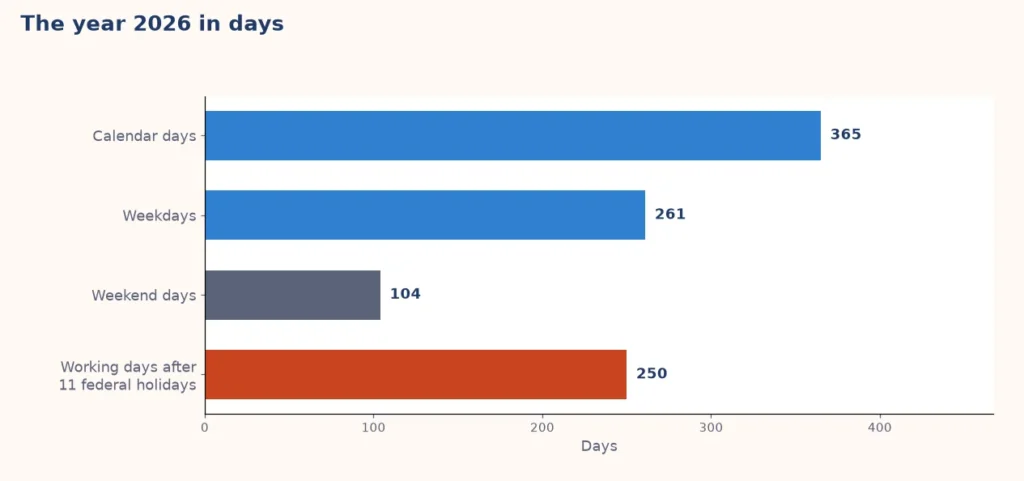
The business days calculator counts only Monday to Friday and can skip public holidays. A standard year has 52 weeks and one or two extra days. In 2026 there are 365 days, 261 weekdays and 104 weekend days. The US Office of Personnel Management lists 11 federal holidays for 2026, all on weekdays, which leaves 250 working days.
Business days: add 10 working days
Ten business days from Thursday, October 8, 2026 is Thursday, October 22, 2026, because two full work weeks pass and the weekends are skipped. Ten calendar days would only reach October 18. Business days calculators and other date calculators matter for shipping estimates, payment terms and legal notice periods, which are usually written in working days.
October 2026 has 22 weekdays. In the United Kingdom, England and Wales have 8 bank holidays in 2026, according to GOV.UK, so a UK working-day count differs from a US one. Check the holiday list for your country before relying on a result.
Days until Christmas, Thanksgiving and other events
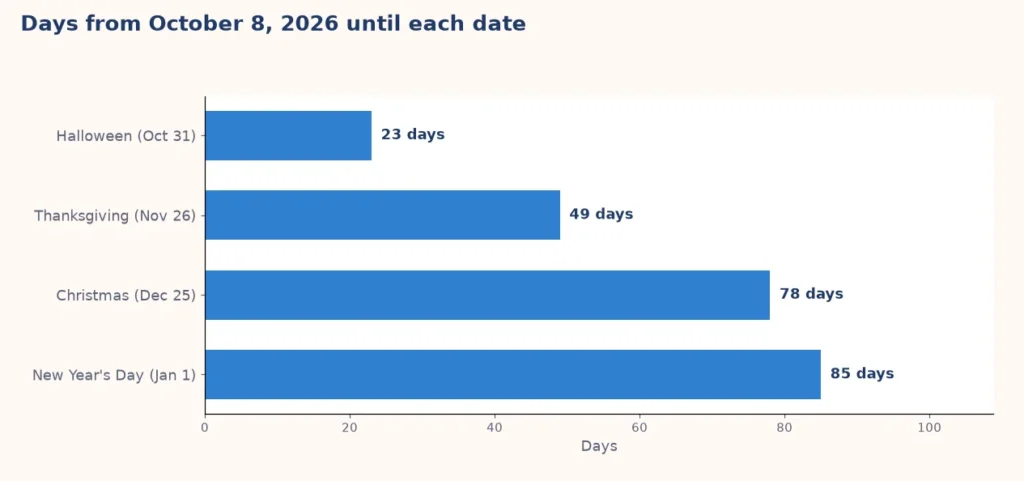
The days until calculator counts down to a holiday or any date you type. From October 8, 2026 there are 23 days until Halloween, 49 until Thanksgiving, 78 until Christmas Day and 85 until New Year’s Day. US Thanksgiving is the fourth Thursday of November, which is November 26 in 2026.
Age and countdown calculators: how old are you exactly?
An age calculator turns a birth date into years, months and days. The method is subtraction with borrowing: take the birth date from the target date part by part, and if the days go negative, borrow the length of the previous month. Someone born on May 15, 1990 is, on October 8, 2026, 36 years, 4 months and 23 days old, which is 13,295 days.
The steps are: years 2026 − 1990 = 36; months 10 − 5 = 5; days 8 − 15 = −7. Borrow September’s 30 days to make the days 23 and take one off the months, which gives 4. The age calculator does this in one click and also shows the next birthday and the weekday you were born. Age and countdown calculators share the same date arithmetic.
Leap-day birthdays are a special case. A person born on February 29 has a birthday only in leap years, which are years divisible by 4, except century years not divisible by 400. In other years the legal birthday differs by country, so check the local rule for legal purposes.
Time calculators: add hours, total a shift, convert minutes
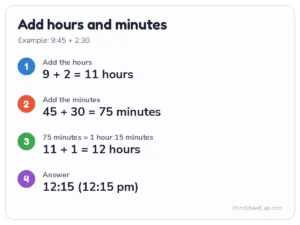
Time calculators and work hours calculators work in base 60, which is why 2 hours 45 minutes plus 1 hour 30 minutes is 4 hours 15 minutes and not 3.75 hours. Add the minutes first (45 + 30 = 75), carry 60 of them into one hour, then add the hours. The time calculator adds and subtracts durations, and the work hours calculator turns clock times into a weekly total.
A shift from 8:30 AM to 5:00 PM with a 30 minute unpaid break is 8 hours 30 minutes minus 30 minutes = 8 hours. Five such days make 40 hours, so any extra counts as overtime in most US workplaces. Payroll needs decimal hours, so convert minutes by dividing by 60.
| Minutes | Decimal hours | Example: 7 hours plus these minutes |
|---|---|---|
| 6 | 0.10 | 7.10 hours |
| 10 | 0.17 | 7.17 hours |
| 15 | 0.25 | 7.25 hours |
| 20 | 0.33 | 7.33 hours |
| 30 | 0.50 | 7.50 hours |
| 45 | 0.75 | 7.75 hours |
| 50 | 0.83 | 7.83 hours |
Work hours and time zone calculators: daylight saving time
Work hours and time zone calculators help distributed teams and travelers. A time zone converter finds the matching time in another place, using each city’s offset from Coordinated Universal Time (UTC) and its daylight saving rules. The offsets change twice a year, so an answer that is right in October can be an hour off in November. That is the main reason to use a calculator instead of remembering a fixed gap.
If it is 9:00 AM on Wednesday, October 14, 2026 in New York (EDT), it is 2:00 PM in London (BST), 3:00 PM in Paris (CEST), 6:30 PM in Mumbai, 10:00 PM in Tokyo and midnight, the start of Thursday, in Sydney (AEDT). Los Angeles is at 6:00 AM. The time zone converter adds a meeting planner for several cities at once.
| Region | Clocks go forward in 2026 | Clocks go back |
|---|---|---|
| United States and most of Canada | Sunday, March 8 | Sunday, November 1 |
| United Kingdom and the EU | Sunday, March 29 | Sunday, October 25 |
| Sydney, Melbourne and Canberra | Sunday, October 4 | Sunday, April 4, 2027 |
| India, Japan and most of Asia | No daylight saving | No daylight saving |
The gaps do not line up, so for one week in autumn the difference between New York and London is 4 hours rather than 5. On Wednesday, October 28, 2026, 9:00 AM in New York is 1:00 PM in London. Wikipedia’s article on daylight saving time explains the rules for each region.
Calendar calculators: how the calendar works
Calendar calculators all rest on a few facts. A common year has 365 days and a leap year has 366, with the extra day on February 29. The next leap years are 2028, 2032 and 2036. The Gregorian calendar adds a leap day every year divisible by 4, except years divisible by 100 that are not divisible by 400, so 2000 was a leap year and 1900 was not.
| Month | Days | Month | Days |
|---|---|---|---|
| January | 31 | July | 31 |
| February | 28 (29 in a leap year) | August | 31 |
| March | 31 | September | 30 |
| April | 30 | October | 31 |
| May | 31 | November | 30 |
| June | 30 | December | 31 |
Dates are also written differently around the world. The ISO 8601 standard uses year-month-day, so October 8, 2026 is 2026-10-08, which avoids confusion between US month-first and UK day-first dates and is the format the date fields in these tools use. Good date calculators and time calculators accept it and show the result in plain words as well.
Real-life uses of date and time calculators
Date and time calculators are most useful when a real deadline depends on the answer. These three cases show the tools working together.
A notice period. A tenant gives 60 days’ notice on October 8, 2026. A date calculator puts the last day at Monday, December 7, 2026. If the contract says business days, the business days calculator moves it to Thursday, December 31, 2026 before holidays, and the holidays you enter push it later still.
A project plan. A team starts on Monday, October 12 and has 15 working days. Time and date calculators that skip weekends give a finish on Friday, October 30, 2026. Counting calendar days instead would give October 27 and wrongly shorten the plan.
A global meeting. A manager in London wants a 4:00 PM call on October 14, 2026 with colleagues in New York and Sydney. The time zone converter shows 11:00 AM in New York and 2:00 AM the next morning in Sydney, so the call moves earlier. Work hours and time zone calculators prevent exactly this kind of mistake.
Questions people ask about date calculators
How many days are there between two dates?
Subtract the earlier date from the later one. Between October 8, 2026 and January 6, 2027 there are 90 days. Add one day if you count both the first and last date, which some legal and rental contracts do.
How many weeks are in 90 days?
Ninety days is 12 weeks and 6 days, because 90 ÷ 7 = 12 remainder 6. In months it is about 2.96 months using an average month of 30.44 days. Use weeks for pregnancy and project plans and days for contracts.
How do I count working days between two dates?
Count the full weeks and multiply by 5, then add the weekdays in the remaining days and subtract any holidays. October 1 to October 31, 2026 has 22 working days. A business days calculator does the weekday check for every date in the range.
Common mistakes with time and date calculators
- Counting the start day twice. Decide whether the first day is included before you compare answers.
- Forgetting leap years. February 2028 has 29 days, so a year that spans it has 366.
- Using calendar days for business deadlines. Working days skip weekends and holidays, so they stretch a deadline.
- Ignoring daylight saving time. The same meeting time shifts an hour for part of the year.
- Entering 7:30 as 7.30 hours. Minutes are base 60, so 7:30 is 7.5 hours.
Frequently asked questions
9 quick answers
What are date and time calculators?
Date and time calculators are free online tools that do calendar arithmetic: adding or subtracting days, counting days between dates, working out age, totaling hours and converting time zones. They remove counting mistakes and show the working.
How do I add days to a date?
Add the days to the day number, then carry over into the next month when you pass its last day. For example, October 8, 2026 plus 90 days is January 6, 2027. Date calculators also show the weekday.
How do I calculate the number of days between two dates?
Subtract the earlier date from the later date. January 1 to December 25, 2026 is 358 days, or 359 when you include both dates. A days between dates calculator handles months of different length for you.
What is the difference between calendar days and business days?
Calendar days count every day. Business days count only weekdays, and usually skip public holidays. Ten business days normally span two calendar weeks, so they are about 14 calendar days.
How is exact age calculated?
Subtract the birth date from today part by part: years, then months, then days, borrowing the length of the previous month when the days go negative. Someone born May 15, 1990 is 36 years, 4 months and 23 days old on October 8, 2026.
How do I convert minutes to decimal hours?
Divide the minutes by 60. Fifteen minutes is 0.25 hours, 30 minutes is 0.5 hours and 45 minutes is 0.75 hours, so 7 hours 45 minutes is 7.75 hours. Payroll systems and time calculators use this decimal form.
Why is the time zone difference sometimes an hour different?
Countries change their clocks on different dates. In 2026 the US moves its clocks back on November 1, but the UK does so on October 25, so for one week the gap between New York and London is 4 hours instead of 5.
Are leap years included in the calculators?
Yes. The tools use the Gregorian rule: a year divisible by 4 is a leap year unless it is divisible by 100 and not by 400. That makes 2028 a leap year and 2100 a common year.
Are these date and time calculators free?
Yes. They are free, need no account and run in your browser, so the dates you type stay on your device. Check official holiday lists for legal deadlines.
More calculator hubs
- All free online calculators with steps for every topic
- Financial calculators for loan dates, pay periods and tax
- Health and fitness calculators for due dates and pace
- Math calculators for percentages and ratios
- Conversion calculators for units and temperature
- Grade and GPA calculators for term dates and grades
Sources and further reading
- U.S. Office of Personnel Management: Federal holidays (the 2026 holiday schedule)
- GOV.UK: UK bank holidays (England, Wales, Scotland and Northern Ireland)
- Wikipedia: Leap year (the divisible by 4, 100 and 400 rule)
- Wikipedia: Daylight saving time (start and end rules by region)
Dates in this article were checked against the cited calendars. Last updated: October 2026.