Earth Day bingo turns the day the planet gets its own holiday into a game that anyone can play, from a four-year-old with a sticker to a green team at the office. The template on this page has 28 squares, each one a small, real thing you can spot or do: a seedling, a solar panel, a cloth bag, a bee on a flower, a bike ride, a sea turtle in a picture book. Pick a card size, press print, and every player gets a different card.
In short: open the card maker above and press Edit and print this card, choose how many cards you need and download one PDF. It is free, there is no account, and nothing you type leaves your browser. Every square can be rewritten, so a family walk, a classroom and a community cleanup can each get their own list.
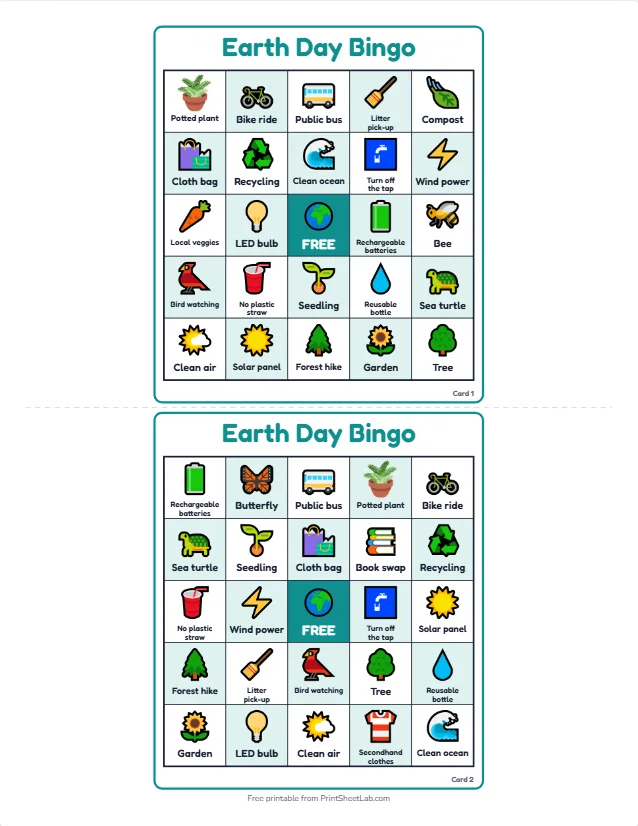
How to play Earth Day bingo
The rules are the bingo rules everyone already knows, with one change: nobody has to call numbers, because the day itself makes the calls. Each player holds a card and a pencil, and when one of the squares happens in front of them, they mark it. Five in a row, across, down or on a diagonal, wins. The globe in the center is already marked, so a first line needs only four more squares.
- Give every player a card and something to mark with. Pencils, crayons or small round stickers all work. Light cardstock or a clipboard helps on a walk.
- Agree on what counts. A square counts when you see it yourself or do it yourself, and it counts once. A clear photo, a poster or a toy counts for squares that are far away, such as the sea turtle.
- Mark squares as the day unfolds. The bottle is refilled, the tap is turned off, a bee lands on a flower: each of those is a square on an Earth Day bingo card.
- Announce a line out loud. The winner reads the five squares, a friend checks them, and the prize changes hands.
- Play another round. Switch to four corners, an X or a full card, or keep the same card going for the whole week.
The template splits neatly into two kinds of squares, and that split is what makes Earth Day bingo different from a plain nature scavenger hunt. Fourteen squares are things you spot, such as a tree, a bee or a wind turbine. The other fourteen are things you do, such as turning off the tap, refilling a bottle or picking up litter. A line on an Earth Day bingo card that mixes both kinds asks players to look at the world and to act in it, which is exactly what the day is about.
What Earth Day is, and why a game fits it
According to the Wikipedia article on Earth Day, it is an annual event on April 22 to show support for environmental protection. It was first held on April 22, 1970, when US senator Gaylord Nelson proposed a nationwide environmental teach-in and hired Denis Hayes as national coordinator, and the advertising writer Julian Koenig coined the name.
An estimated 20 million Americans took part in rallies, marches and teach-ins that first year, and more than 10,000 primary and secondary schools joined in, mostly with education and service actions such as beach clean-ups, tree planting and recycling.
Those first activities read like an Earth Day bingo card. Tree planting is a square, a clean-up is a square, recycling is a square. In 1990 Denis Hayes took the day international, with events in 141 nations, and on Earth Day 2020 over 100 million people observed the 50th anniversary.
The article describes the day as coordinated today through Earthday.org, with more than a billion people taking part in more than 190 countries. Games such as Earth Day bingo suit a day like this because it works best when people do small things together, and bingo gives everybody the same small to-do list.
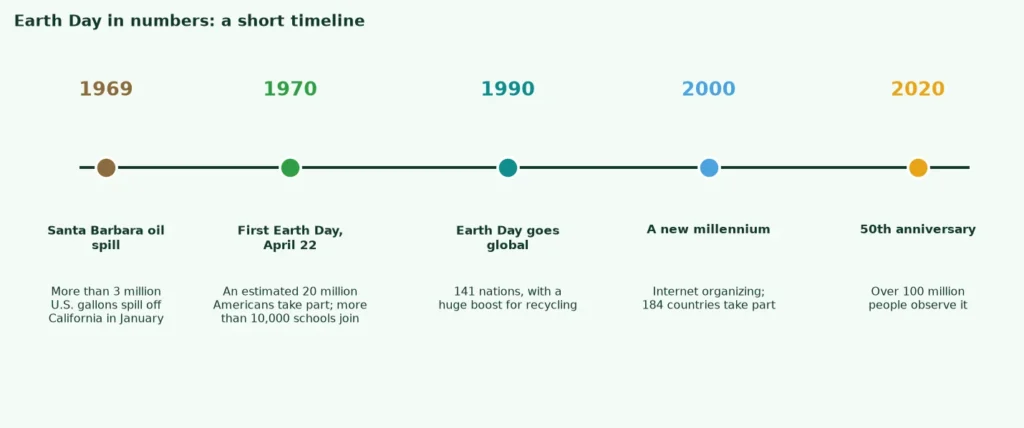
The article also lists what came before the first Earth Day: Rachel Carson’s 1962 book Silent Spring, the famous 1968 Earthrise photograph of the planet from the Moon, the 1969 Santa Barbara oil spill, and a river fire in Ohio the same year. The globe on the free center of every card is a small nod to that Earthrise picture. A short story like this is worth two minutes before a game, because players who know why the day exists fill in the squares more thoughtfully.
When is Earth Day? A date that never moves
Unlike lunar festivals, Earth Day stays on April 22 every year, so only the day of the week changes. That makes planning simple for a class or a club: pick the date, print the Earth Day bingo cards a week ahead, and check which weekday it falls on. For weekend years, a family nature walk is the obvious plan, and for school years a bingo round can open or close the day. The table gives the weekday for the next few years, calculated from the calendar.
| Year | April 22 falls on | A good plan for that year |
|---|---|---|
| 2027 | Thursday | A school day: a bingo round in homeroom, a schoolyard hunt at lunch, a take-home card for the evening. |
| 2028 | Saturday | A weekend: a family walk, a park cleanup or a street-wide Earth Day bingo game with the neighbors. |
| 2029 | Sunday | A family day: a picnic, a garden afternoon or a bike ride with a card in every basket. |
| 2030 | Monday | A fresh week: start Earth Week bingo the Tuesday before and finish on the day itself. |
Earth Day also has a yearly theme chosen by the organizers. The Wikipedia article lists “Green Cities” for 2014, “Invest in Our Planet” for 2022 and “Our Power, Our Planet” for 2025 and 2026, and notes the last one stresses collective action and the move to renewable energy. When a new theme is announced, you can rewrite a few squares on your card to match it, for example by swapping a square for something a community can do together.
Earth Day bingo cards: all 28 squares
These Earth Day bingo cards are made from a list of 28 squares. A standard 5×5 card with a free center needs 24 of them, so each card leaves out four, and the cards are not all the same. The table sorts the list into the groups a host usually thinks in, which makes it easy to decide which squares to keep and which to replace with something from your own street.
| Group | Squares on the list | Where you will find them |
|---|---|---|
| The big picture | 🌍 Planet Earth | A globe, a map, a poster or a logo. The easiest square on the card and the free center. |
| Plants and green space | 🌳 Tree, 🌱 Seedling, 🌻 Garden, 🪴 Potted plant | Streets, school grounds, balconies and windowsills. Seedlings appear in school gardens and plant nurseries. |
| Wildlife | 🐝 Bee, 🦋 Butterfly, 🐢 Sea turtle, 🐦 Bird watching | Flowers, hedges and feeders. The sea turtle is usually a picture, a toy or a video. |
| Water and air | 🌊 Clean ocean, 🌤️ Clean air, 💧 Reusable bottle, 🚰 Turn off the tap, 🥤 No plastic straw | The kitchen, the lunch table, a poster or a documentary clip, and a clear day outside. |
| Energy | ☀️ Solar panel, ⚡ Wind power, 💡 LED bulb, 🔋 Rechargeable batteries | Rooftops, lamps, calculators and a turbine on the horizon. An LED bulb is in nearly every home. |
| Getting around and outdoors | 🚲 Bike ride, 🚌 Public bus, 🌲 Forest hike | The commute, the school run and a trail on the weekend. |
| Reduce, reuse, recycle | ♻️ Recycling, 🛍️ Cloth bag, 🍃 Compost, 📚 Book swap, 👕 Secondhand clothes, 🧹 Litter pick-up | The bin, the shopping trip, the garden corner, the library and the thrift store. |
| Food | 🥕 Local veggies | A farmers market, a school garden or a neighbor’s vegetable patch. |
The Earth Day bingo list is balanced on purpose. Some squares fill in at almost every home, such as the LED bulb, recycling and the tap, so even a one-card player gets going quickly. Others need a little effort or luck: a butterfly, a book swap, a wind turbine, a forest hike. If every square on an Earth Day bingo card were as common as a tree, the first line would be over before the second player found a pencil.
How many different Earth Day bingo cards can you print?
With 28 squares and 24 places on a 5×5 card, the number of different sets of squares is 28 choose 24, which is 20,475. Each set can also be arranged in a huge number of orders, so a family of 12 and a school of 400 can both give every player a card of their own. Smaller grids use fewer squares and have even more possible sets, as the table shows.
| Card size | Squares used | Different sets from the 28 | Best for |
|---|---|---|---|
| 3×3 with free center | 8 | 3,108,105 | Ages 3 to 5, and a very short game |
| 4×4 | 16 | 30,421,755 | A quick round during a break |
| 5×5 with free center | 24 | 20,475 | The classic walk, afternoon or week-long game |
Spot it or do it: the two kinds of Earth Day bingo squares
Every square on the Earth Day bingo template belongs to one of two families. Seeing the families clearly helps you design a better game, because a card made only of spot squares plays like a nature hunt, a card made only of do squares plays like a pledge sheet, and the mix is more interesting than either.
| Spot it (14 squares) | Do it (14 squares) |
|---|---|
| 🌍 Planet Earth, 🌳 Tree, 🌱 Seedling, 🌻 Garden, 🪴 Potted plant | ♻️ Recycling, 💧 Reusable bottle, 🛍️ Cloth bag, 🍃 Compost |
| 🐝 Bee, 🦋 Butterfly, 🐢 Sea turtle, 🐦 Bird watching | 🚰 Turn off the tap, 🥤 No plastic straw, 🧹 Litter pick-up |
| ☀️ Solar panel, ⚡ Wind power, 🚌 Public bus | 💡 LED bulb, 🔋 Rechargeable batteries, 🥕 Local veggies |
| 🌊 Clean ocean, 🌤️ Clean air | 🚲 Bike ride, 🌲 Forest hike, 📚 Book swap, 👕 Secondhand clothes |
Earth Day bingo squares for a nature walk or a schoolyard hunt
Spot squares are the heart of an Earth Day bingo hunt. They are the ones a group can find together in 30 minutes outside: a tree, a bee, a bird, a garden bed, a solar panel on the school roof, a bus going past.
Walkers can take photos with a phone or a class camera instead of ticking, which also makes the result easy to check. Keep to public paths, stay with your group, and never chase an animal for a square. A bee that stays on its flower and a bird in a tree are both perfect.
Earth Day bingo squares for the kitchen, the classroom and the commute
Do squares live in everyday routines, and they are the ones that make an Earth Day bingo game more than a walk. A reusable bottle at lunch, a cloth bag on the way home, a tap turned off while brushing teeth, a bike ride instead of a car ride, a book swapped at the library: none of these needs a special day, and the card simply notices them. In a classroom you can give the do squares a calm, private feel by letting each child mark their own card on the honor system.
Three ways to play an Earth Day bingo game
One printed card supports three quite different games. Pick the Earth Day bingo game that fits your group, or run two in a row. The table compares them, and the sections below give rules and prizes.
| Game | Who calls | Length | Best for |
|---|---|---|---|
| The Earth Day bingo hunt | Nobody. The places you visit do. | 30 to 90 minutes | Classes, scout groups, family walks and park events |
| Earth Week at home | Nobody. Each day does. | Seven days, a few minutes a day | Families, households and classrooms that keep a card on the fridge |
| Calling cards | A host draws cut-out squares and reads a fact | 10 to 20 minutes | Assemblies, libraries, club meetings and video calls |
Game one: the Earth Day bingo hunt
Give each player or team a card and a pencil, set a time limit and send them out. The team with a line first, or the most squares at the whistle, wins. For younger children, play in pairs so that a reader and a looker work together. Good prizes for an outdoor Earth Day bingo game are small and green: a packet of seeds, a pencil made of recycled paper, a turn to water the class plant, or the honor of choosing the next walking route.
- Scavenger-hunt style: every square needs a photo, and the team shows the photo to claim it.
- Leave no trace: a square is only worth marking if the place looks the same when you leave. Do not pick flowers, move nests or lift logs.
- Bonus round: after the first line, everyone collects one piece of litter (with gloves, and with an adult) for a bonus square of their own invention.
- Rain plan: play indoors with posters, plants on windowsills and the school recycling bins.
Game two: Earth Week bingo at home
Earth Day is one day, but the habits on the card are daily ones, so a week of Earth Day bingo is a natural fit. Hand out the Earth Day bingo card on the Monday before and let players mark squares as they happen.
The simulation below shows that without a limit a player fills the card very quickly, because the do squares are so common at home. A daily allowance fixes this: mark at most two squares a day, and the game lasts until the end of the week. That also gives children a reason to choose carefully which action to count.
This is the version of Earth Day bingo for families who live apart. Send everyone the same PDF, let each household play at its own pace, and ask for a photo of the winning line on Earth Day itself.
Game three: Earth Day bingo with calling cards
When the group stays in a room, calling cards are easier. In the Print tab, switch on the calling cards and the caller sheet, cut the cards out and shuffle them in a bowl. The host draws one and reads it with a fun fact: “Tree.
A mature tree can shade a whole picnic table. Who has a tree?” Everyone with that square marks it. The play custom bingo online page explains how to run a live game with your own list, and the play bingo online page hosts the number game for guests who join by link.
The calling-card round also works on a video call. One person reads the squares, everyone has the same PDF, and the winners show their line to the camera. Because the squares are called out, the listening version of Earth Day bingo suits groups where nobody can walk around, such as an assembly or a senior center.
Earth Day bingo game: a real simulation
A host planning an Earth Day bingo game always asks how long it will take and whether anyone will win. To answer with numbers instead of a guess, we simulated three situations. Every square has an assumed chance of being marked, and we ran 8,000 games of Earth Day bingo for each.
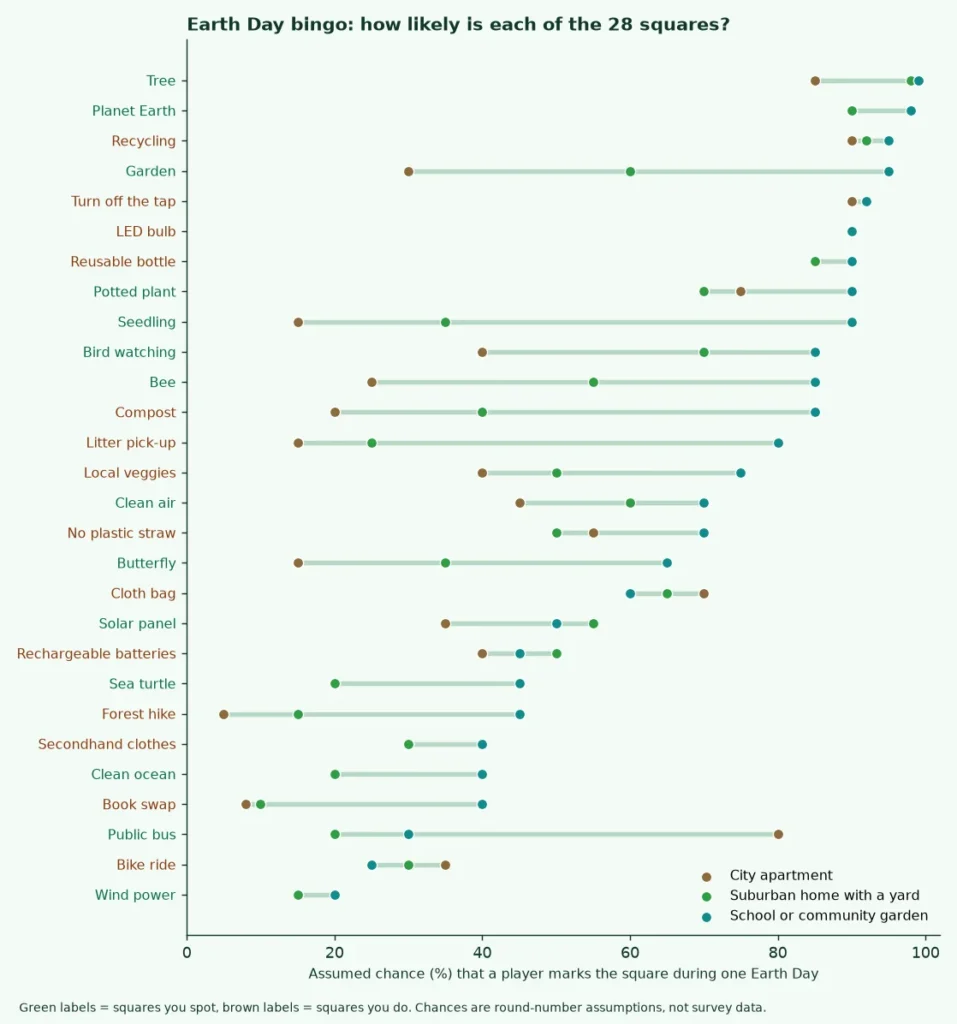
The chances are our assumptions, chosen to feel like a typical day. They are not survey data. For example, we assumed a tree is marked at 85% of city apartments and at 99% of school gardens, a bee at 25% and 85%, and a forest hike at only 5% and 45%.
One Earth Day, three kinds of place
We compared a city apartment, a suburban home with a yard and a school or community garden event. In a city apartment a player marks about 13 of the 28 squares in one day, at a suburban home about 14, and at a school event about 19. That is the difference between a game that is hard to win alone and one that is over in minutes.
| Place | Squares marked in a day (of 28) | 1 card gets a line | 6 cards | 12 cards | 25 cards |
|---|---|---|---|---|---|
| City apartment | 13 | 24% | 68% | 83% | 93% |
| Suburban home with a yard | 14 | 38% | 84% | 94% | 98% |
| School or community garden | 19 | 83% | more than 99% | more than 99% | more than 99% |
A single player at home has a line by the end of the day only 24% of the time in the city and 38% in the suburbs, but 83% at a school event that is built around the card.
Six players in the city reach a line 68% of the time, which is why a family of six is a comfortable size. A full card (all 24 squares) essentially never happens in one day: in our simulation it was under one in a hundred for every group, so plan a line, four corners or an X.
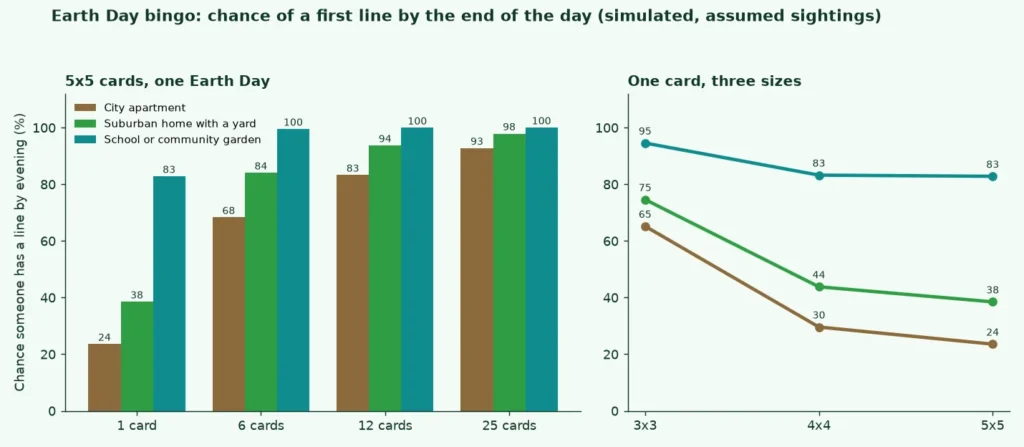
The right-hand chart shows the lever a host controls most easily: the grid. One 3×3 card gets a line in 65% of city days and a 4×4 card in 30%, while a 5×5 card manages 24%. For an Earth Day bingo game with young children or a short lesson, 3×3 is the safe choice. The caution is that these numbers assume nobody misses a square. A careful player does a little better, and a distracted one does worse, so treat the table as a planning guide and not a promise.
Earth Week with a limit on daily marks
For the week-long Earth Day bingo game we assumed a typical household and gave each square a daily chance. Weekend days boost outdoor squares such as the bike ride and the forest hike, and the final day, Earth Day itself, boosts the squares that events create: the litter pick-up, a seedling, a book swap and the globe. On average a player sees 16 of the 28 squares by the end of day 3, and 23 by day 7.
| Rule | Cards | Median day of a first line | Line by day 3 | Line by day 5 | Line by day 7 |
|---|---|---|---|---|---|
| No limit | 1 | Day 3 | 52% | 88% | 99% |
| No limit | 6 | Day 2 | 94% | 100% | more than 99% |
| 2 marks a day | 1 | Day 7 (55% have one) | 1% | 11% | 55% |
| 2 marks a day | 6 | Day 5 | 4% | 54% | 99% |
| 2 marks a day | 12 | Day 5 | 7% | 79% | 100% |
| 3 marks a day | 6 | Day 4 | 34% | 98% | more than 99% |
| 1 mark a day | 12 | Rarely (18% have one) | 0% | 2% | 18% |
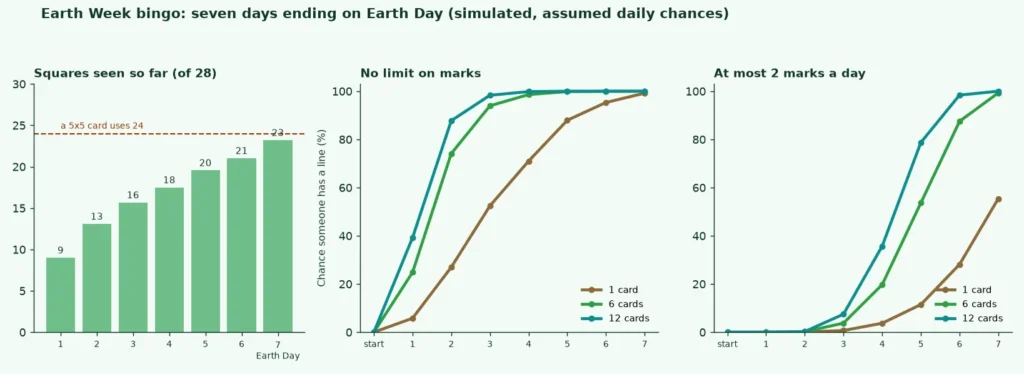
With no limit, one card has a line by day 3 at a median and six cards by day 2, so the game is finished by the middle of the week. Two marks a day moves the winner to the end: six cards produce a first line on day 5 at a median, and twelve cards also on day 5.
A limit of one mark a day is too tight, because only 18% of twelve-card groups ever reach a line, and a limit of three ends the game around day 4 for six cards and day 3 for twelve, which suits a classroom that wants a winner mid-week. Pick the limit that matches the day you want the game to end.
Calling cards: how many calls, and how often do players tie?
The calling-card version of Earth Day bingo is the most predictable. All 28 squares are called exactly once in random order, so we simulated 8,000 games for each group size to see when someone has a line and how often two players finish on the same call.
| Cards in play (5×5) | Calls to the first line (median) | Calls to a full card (median) | Games where 2 or more players tie | Average winners on that call |
|---|---|---|---|---|
| 1 card | 16 | 28 | not applicable | 1.00 |
| 4 cards | 13 | 28 | 14% | 1.16 |
| 8 cards | 11 | 27 | 18% | 1.21 |
| 15 cards | 10 | 27 | 21% | 1.27 |
| 25 cards | 9 | 27 | 24% | 1.31 |
| 50 cards | 8 | about 27 | 26% | 1.37 |
| 100 cards | 7 | about 27 | 30% | 1.45 |

A room of 15 players usually sees a first line after 10 calls, a little over a third of the way through the list, and 25 players after 9. Because the list has only 28 squares and each card uses 24 of them, cards are very similar, and ties are common: with 25 players there are two or more winners on the same call in 24% of games, and with 100 players in 30%. Decide the tie rule before the first call. The simplest is to split the prize or hold a one-square play-off.
For a quicker game, 4×4 cards with 8 players reach a first line at 10 calls and 3×3 cards with 8 players at 5. The assumptions: every call is equally likely at each step, cards are independent random draws from the list, and nobody misses a call.
Printable Earth Day bingo: print, cut and hand out
For printable Earth Day bingo, the Print tab has the controls you need and nothing you do not. Choose how many different cards to print, from 1 to 100, how many go on a page (1, 2, 4 or 6), Letter or A4 paper, and portrait or landscape. Cut guides are available for sheets that need trimming. For a class of 24, print 26 cards and keep two spares. For an outdoor walk, print one card per page so that the squares are big enough to read on the move.
- Print on paper that already has a past. A day about the planet is a good day to print on the back of a used sheet or on recycled paper, and cards survive better when they are glued to a piece of cereal-box card.
- Reuse the Earth Day bingo cards. A card slipped into a clear sleeve or laminated can be marked with a dry-erase marker, wiped and handed to the next class.
- Print names on the cards. The Design tab can put a name on each card, which settles whose card is whose.
- Use large squares for small hands. One card per page in portrait gives the biggest squares, which suits ages 3 to 5.
- Print the caller sheet and calling cards for the drawn-card game. They come out of the same Print tab.
- Pick green and teal. The Design tab holds color themes, and the teal Earth Day look is the default on this template.
Hosts of Earth Day bingo who are away from a printer can save the PDF to a phone or a USB stick and print it anywhere. The shareable link in the card maker keeps only your word list, with no names or photos, so you can send it to other classes and let everyone print their own.
Earth Day bingo for kids
Earth Day bingo for kids is a gentle way to turn a big, serious topic into something small enough to hold in a hand. Children who are looking for a bee are children who are standing still and noticing a flower. The pictures on every square let pre-readers play without help, and the squares teach the names of things adults take for granted: compost, a solar panel, a reusable bottle. The right setup depends on age.
| Age | Card | How to play |
|---|---|---|
| 3 to 4 | 3×3, one per page | A grown-up reads the pictures. Sticker dots, no pens. Everybody wins at the first line. Skip squares that need a bike or a bus. |
| 5 to 7 | 3×3 or 4×4 | Words with pictures. Kids spot and shout. Play for a line, then four corners. Let them draw the sea turtle if there is none to find. |
| 8 to 10 | 5×5 | Two marks a day for Earth Week, plus two squares they invent themselves, such as their own pet or street. |
| 11 and up | 5×5 with a custom list | Let them write the list for the school or the neighborhood, or add a rule that every do square needs a one-sentence story. |
Classrooms get a lot from Earth Day bingo. A round fits into the last half hour before an assembly, and it needs no preparation beyond printing. Pair it with the Earth Day worksheets for a full lesson, or with a few rounds of animal bingo and ocean animal bingo for the wildlife squares. If a child cannot join an outdoor hunt, let them hold the clipboard and check the squares, which is as important a job as spotting.
The squares of Earth Day bingo also invite small conversations that stay with children. Why does a bee sit on a flower? What happens to the banana peel in the compost? Where does the bus go? A teacher who asks one question per square gets a short science lesson out of a game, without a worksheet in sight. For a group that likes a challenge, give each table a different sub-list, such as only spot squares, and have them compare notes at the end.
Earth Day bingo for adults, offices and green teams
Earth Day bingo for adults works best when it is light. Grown-ups at a staff lunch or a community meeting already have plenty to carry, so the card should ask very little: a few squares marked over coffee, a prize for the first line, a laugh at the person who still has a plastic straw.
The best rule is that a square counts when someone else notices it. That turns Earth Day bingo into a way to talk to colleagues or neighbors you rarely speak to: “Did you cycle in today? That is a square for my card.”
Three tweaks make Earth Day bingo fit a workplace. First, change the list to your building: replace Sea turtle with “a plant on someone’s desk” and Public bus with “a colleague who took the train.” Second, use a 4×4 card with no free space so a round finishes in a single meeting.
Third, give prizes that match the theme, such as a houseplant cutting, a reusable bottle or a donation to a local cleanup in the winner’s name. For a team that works remotely, the Zoom bingo and meeting bingo pages show how to run a card on a call, and the office bingo guide covers the etiquette.
Libraries, senior centers and community groups can use the same Earth Day bingo cards with larger print and a slower pace. The bingo for seniors template shows how a 4×4 card with big squares works, and an Earth Day card built the same way, with squares such as Tree, Bird watching, Garden and Book swap, makes a pleasant hour with tea.
Earth Day bingo free printable: what you get
Free, private and nothing to install
This Earth Day bingo free printable does not ask for an email or an account, and nothing is added to your PDF but the card itself and a small footer. The editor runs in your browser, so your word list never goes to a server. You need only a printer or a PDF viewer, and you can print as many sets as you like.
What you can change
The card maker has five tabs: Setup, Items, Design, Templates and Print. On the Items tab you can rewrite any square, add an emoji or upload your own picture, and decide what the free space shows. The Design tab holds color themes, fonts, text size, ALL CAPS, borders, rounded corners, tiles or plain grids, and a card background that can be a color, a pattern or your own picture.
You can also add a title, a logo and a footer line, for example “Maple Street Earth Day 2027”. The Templates tab holds the other ready-made lists, and the Print tab holds the numbers: how many cards, which paper, which layout.
You do not have to start from this Earth Day bingo page. The bingo card generator offers every card type in one place, the blank bingo cards page gives you an empty grid to fill by hand, and the bingo card template page explains how the layouts work.
Customize the cards in the card maker
The best Earth Day bingo card names your own place. Open the Items tab and every square turns into a text box. Here is how a few common situations change the list.
- Your neighborhood. Swap Public bus for tram, metro or ferry, Sea turtle for the animal your region is known for, and add the name of your local park.
- A school garden day. Keep Seedling, Compost, Garden and Bee, and add “Someone waters a plant” and “A worm.”
- A very young group. Remove the squares that need a long trip (Forest hike, Wind power) and add friendly ones such as “A puddle” and “A leaf.”
- A workplace. Use “Colleague brings a lunch box,” “A recycling bin that is used correctly” and “Lights turned off in an empty room.”
- A language class. Write each square in two languages and let learners say the word aloud when they mark it.
When your list has more than 24 words, the card maker gives every card a different mix. With exactly 24, every card has the same words in a different order. The free space can say “Free” or show its own emoji, text or picture, so a class could use a photo of its own school as the free center. Shuffle re-deals the squares across all cards, Undo takes back your last change, and the preview lets you zoom in before you download.
If you rewrite more than a third of the list, check the balance of your Earth Day bingo card. Keep a handful of easy squares (a tree, a bottle) so that players get going, a few medium ones, and two or three long shots. A list made only of long shots is frustrating, and a list made only of easy squares ends the game before it starts.
Playing Earth Day bingo honestly and safely
Earth Day is a day about caring for shared places, and an Earth Day bingo game should be kind to people and to those places. A few habits make that easy. They apply to any outdoor game, not just this one.
- No shame, no scoreboard of virtue. Some families cannot choose a bike or a solar roof, and some classmates cannot afford new gear. Keep squares inviting and let players mark what they honestly saw or did.
- Be honest about what a game proves. Marking a square does not fix anything by itself. It is a starting point for a conversation, a habit or a project, so follow the game with one real action, such as a class cleanup.
- Stay safe on a cleanup. Use gloves, never touch sharp objects or anything unknown, keep away from roads and water, and make sure an adult supervises younger children.
- Respect wildlife. Watch bees, birds and butterflies from a distance. Do not pick flowers, touch animals or disturb nests for a square.
- Think about allergies. Bees matter on a card, but a child with an insect allergy should be told where the group is going and stay close to an adult.
- Plan for every body. Offer indoor squares such as a potted plant, a poster or a book swap for players who cannot walk far.
None of this is a rulebook. It is the kind of care a good host already takes, and an Earth Day bingo card works best when it is made together with the people who will play it. Ask a few of them to look over the list before you print.
More bingo cards for spring, nature and outdoor days
Earth Day bingo is one of a whole set of occasion lists in the card maker. For other outdoor seasons, try camping bingo, summer bingo and Easter bingo for the spring weekend. For a long drive to the trailhead, the road trip bingo card keeps the back seat busy, and the classroom bingo page has ideas for turning any list into a lesson. Later in the year, the same cards come back for Thanksgiving bingo and Christmas bingo.
Every template is gathered on the printable bingo cards hub. For the number game, the bingo caller draws the numbers and the how to play bingo guide explains the rules and patterns. Hosts who want to make a list from scratch can follow the how to make bingo cards guide, and larger events will find help in the bingo for large groups guide.
Frequently asked questions
10 quick answers
What is Earth Day bingo?
Earth Day bingo is a bingo variation in which every square names something you see or do for the planet, such as a tree, a bee, a reusable bottle or a litter pick-up. Players mark squares as they spot or do them, and the first to complete a line wins.
Are these Earth Day bingo cards really free?
Yes. You can make, edit and print the Earth Day bingo cards without an account or a payment. The editor runs in your browser, so the words and pictures you add never leave your device.
How many squares does the template have?
It has 28 squares. A 5×5 card with a free center uses 24 of them, a 4×4 card uses 16 and a 3×3 card with a free center uses 8. Because the list holds more words than a card has squares, cards differ from one another.
How many different cards can I print?
Up to 100 different cards in one PDF. There are 20,475 different sets of 24 squares to choose from, so a whole school can give every player a card of their own.
When is Earth Day?
Earth Day is on April 22 every year, so the date never moves. Only the weekday changes: it is a Thursday in 2027, a Saturday in 2028 and a Sunday in 2029. Print the Earth Day bingo cards about a week ahead.
Can I play Earth Day bingo over a whole week?
Yes. Earth Day bingo works best over a week with a daily allowance of two or three marks. In our simulation six cards with two marks a day produce a first line on day 5, and with three marks a day on day 4.
How do I run the calling-card version?
In the Print tab, add the calling cards and the caller sheet. Cut the cards out, shuffle them and draw one at a time. A game of Earth Day bingo with 15 players on 5×5 cards usually has a winner after about 10 calls, and ties are common, so agree a tie rule first.
Can I change the squares to match my school or neighborhood?
Yes. In the card maker, every Earth Day bingo square can be rewritten, given an emoji or a picture. Swap the sea turtle for a local animal, replace the bus with a tram, and use the free space for a photo of your school.
Is Earth Day bingo suitable for adults and workplaces?
Yes. Earth Day bingo for adults works well as a light staff-lunch game on a 4×4 card. Change a few squares to match the building, keep prizes simple and use the rule that a square counts when someone else notices it.
What size should I print for young children?
For young children, print a 3×3 Earth Day bingo card, one per page, with large pictures for ages 3 to 5. It has only eight squares plus a free center, so a first line comes quickly and the child stays interested.