Probability worksheets help students measure how likely an event is, from impossible (0) to certain (1). These free printable probability worksheets cover simple probability, complements, two dice, counting outcomes, predictions and independent events, with an answer key on every PDF and a maker for new problems.
Quick answer: Probability is the number of favorable outcomes divided by the number of possible outcomes. Rolling a 5 on a die has a probability of 1/6, and the probability of an event not happening is 1 minus the probability that it happens. This page has 7 free probability worksheets (PDF) with answer keys for grade 7, plus a maker. Updated October 2026.
Ready-to-print samples
A few of the ready PDFs on this page. The full list is under Ready-to-print worksheets, and the maker above makes new problems on demand.
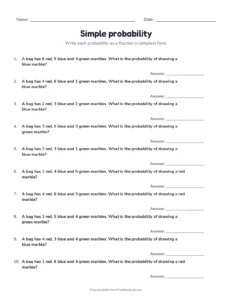
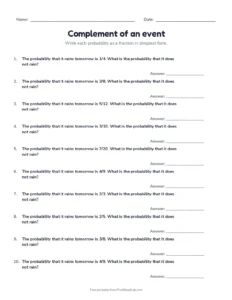
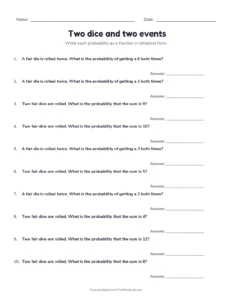
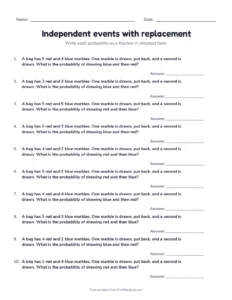
Simple probabilityLevel 1 with a full answer key.PDFComplement of an eventLevel 2 with a full answer key.PDFTwo dice and two eventsLevel 3 with a full answer key.PDFIndependent events with replacementLevel 6 with a full answer key.PDF
How to find a probability
Count the possible outcomes: everything that could happen.
Count the favorable outcomes: those that match the event.
Write the fraction favorable over possible, and simplify.
A probability of 0 means the event is impossible, 1 means it is certain, and 1/2 means it is equally likely to happen or not.
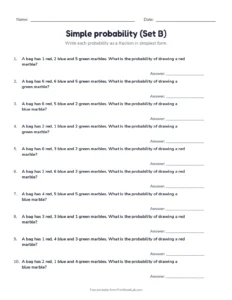
Simple probability worksheet: marbles in a bag
Here are six events for a bag holding 5 red, 3 blue and 2 green marbles, 10 in all:
Event (bag: 5 red, 3 blue, 2 green)
Favorable
Probability
Simplified
Draw a red marble
5
5/10
1/2
Draw a blue marble
3
3/10
3/10
Draw a green marble
2
2/10
1/5
Draw a red or green marble
7
7/10
7/10
Draw a yellow marble
0
0/10
0 (impossible)
Draw a marble that is not blue
7
7/10
7/10
Probability of two dice worksheet
Two dice have 36 equally likely outcomes. Sums near 7 are the most likely because more pairs make them:
Sum of two dice
Ways to roll it
Probability
Percent
2
1
1/36
2.8%
3
2
1/18
5.6%
4
3
1/12
8.3%
5
4
1/9
11.1%
6
5
5/36
13.9%
7
6
1/6
16.7%
8
5
5/36
13.9%
9
4
1/9
11.1%
10
3
1/12
8.3%
11
2
1/18
5.6%
12
1
1/36
2.8%
Independent events probability worksheet
Two events are independent when one does not affect the other. To find the probability of both, multiply the separate probabilities:
Independent events
P(first)
P(second)
P(both)
Heads, then heads
1/2
1/2
1/4
Roll a 6, then a 6
1/6
1/6
1/36
Heads, then roll an even number
1/2
1/2
1/4
Spinner red (1/4), then red again
1/4
1/4
1/16
Roll a 3, then draw a red (1/2) marble
1/6
1/2
1/12
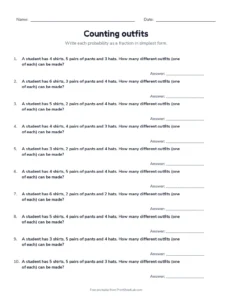
Counting outcomes: the fundamental counting principle
To count combinations, multiply the number of choices at each step:
Choices
Counting rule
Outcomes
3 shirts and 4 pairs of pants
3 × 4
12
2 sandwiches, 3 drinks and 2 desserts
2 × 3 × 2
12
4 colors and 3 sizes
4 × 3
12
Coin flipped 3 times
2 × 2 × 2
8
A 3-digit code using digits 0 to 9
10 × 10 × 10
1000
Try ten probability problems
Use these as a warm-up. Write each answer as a fraction in simplest form.
#
Problem
Answer
1
Roll a die. P(5)
1/6
2
Roll a die. P(even number)
1/2
3
Bag with 4 red and 6 blue. P(blue)
3/5
4
Spinner with 8 equal parts, 3 shaded. P(shaded)
3/8
5
P(not rolling a 6) on one die
5/6
6
Flip two coins. P(both heads)
1/4
7
Roll two dice. P(sum is 7)
1/6
8
3 shirts and 5 hats. How many outfits?
15
9
P(an event that is certain)
1
10
Predict: P(rain) = 0.3 over 20 days. Expected rainy days?
6
Probability word problems
Probability word problems describe a situation and ask how likely it is. Read the story, count the possible outcomes, and count the favorable ones:
Probability word problem
Favorable / possible
Answer
A jar has 6 red, 4 yellow and 10 green candies. What is the chance of picking yellow?
4/20
1/5
A class of 25 has 10 boys. One student is picked at random. What is the chance it is a girl?
15/25
3/5
A card is drawn from 52 cards. What is the chance it is a heart?
13/52
1/4
A spinner has 8 equal sections numbered 1 to 8. What is the chance of an even number?
4/8
1/2
Compound probability worksheet and probability practice
A compound probability worksheet asks about two or more events together, such as flipping a coin and rolling a die. Make a list or a tree diagram of every outcome, or multiply the probabilities when the events are independent. The levels at the end of this page work like a compound probability worksheet, and the maker can produce more of them.
For extra probability practice, roll dice or flip coins 50 times and compare the results with the probabilities worked out on paper. This kind of probability practice shows why predictions are never exact, but get closer to the theory as the number of trials grows.
How to use these probability worksheets
Use the probability worksheets in order. Start with simple probability, then complements, then two dice and counting outcomes, and finish with predictions and independent events. Every one of the probability worksheets has an answer key on the last page, so students can check their own work, and a good extension is a good source of quick retests.
Use dice, coins and spinners for hands-on probability experiments, then compare the results with the probabilities worked out on paper. Print a probability worksheet for homework and review it together the next day. Students who need more probability worksheets can generate a new set in the maker, and probability worksheets with fresh numbers make a reliable weekly check.
Probability vocabulary
Students answer questions faster when they know the words. These are the terms used on the worksheets and answer keys:
Understand that the probability of a chance event is a number between 0 and 1
Grade 7
7.SP.C.6
Approximate probability from frequencies and predict outcomes
Grade 7
7.SP.C.8
Find probabilities of compound events using lists, tables and tree diagrams
Common mistakes with probability
Mistake
Example
Fix
Writing a probability above 1
5 favorable out of 4 outcomes
Probability is always between 0 and 1
Using favorable ÷ unfavorable
3 red and 5 blue: P(red) = 3/5
Divide by all outcomes: 3/8
Adding instead of multiplying for “and”
P(heads then heads) = 1/2 + 1/2
Multiply independent events: 1/4
Not simplifying
4/8 left as the answer
1/2
Thinking past results change the next one
After 3 heads, tails is due
Each flip is independent: still 1/2
Real-life uses of probability
Probability helps people make decisions under uncertainty:
Situation
Probability
Meaning
A 30 percent chance of rain
0.3
About 3 in 10 days like this are rainy
A raffle with 200 tickets, you hold 4
4/200 = 1/50
A 2 percent chance of winning
A fair coin flipped twice
P(2 heads) = 1/4
One outcome in four
A spinner with 5 equal sections, 2 red
2/5
40 percent chance of red
Two dice rolled for a total of 7
1/6
The most likely sum
Which probability worksheet should you start with?
Start with simple probability, then add complements and counting. Move to independent events last. Set B gives a retest of level 1.
Level
Skill
Best for
Level 1
Simple probability
Grade 7, first lesson
Level 2
Complement of an event
Grade 7
Level 3
Two dice and two events
Grade 7
Level 4
Counting outfits
Grade 7
Level 5
Predictions from probability
Grade 7
Level 6
Independent events with replacement
Grade 7, extension
A weekly plan for probability
Day
Focus
Suggested block
Monday
Simple probability
15 min
Tuesday
Complement and counting outcomes
15 min
Wednesday
Two dice and predictions
15 min
Thursday
Independent events
15 min
Weekly total
Four short sessions
60 min
Frequently asked questions
5 quick answers
Where can I download free probability worksheets?
Open any worksheet in the Ready-to-print list on this page, choose US Letter or A4, then print or save the PDF. They are free, with answer keys, and no account is needed.
How do you find a probability?
Divide the number of favorable outcomes by the number of possible outcomes. Rolling an even number on a die is 3/6 = 1/2.
What is the probability of an impossible or certain event?
An impossible event has probability 0 and a certain event has probability 1.
How do you find the probability of two independent events?
Multiply the separate probabilities. Two heads in a row is 1/2 × 1/2 = 1/4.
What grade learns probability?
Probability is taught in grade 7 under 7.SP.C, with earlier introduction through likelihood in grades 3 to 5.