A place value chart is a table with one column for each place in a number, so you can see what every digit is worth. Build one with the generator above: a free printable place value chart from ones up to billions, a place value chart with decimals down to millionths, or an Indian place value chart with lakhs and crores. Print a blank place value chart, a chart with your own number filled in, or a practice worksheet with an answer key, in color or black and white, on US Letter or A4.
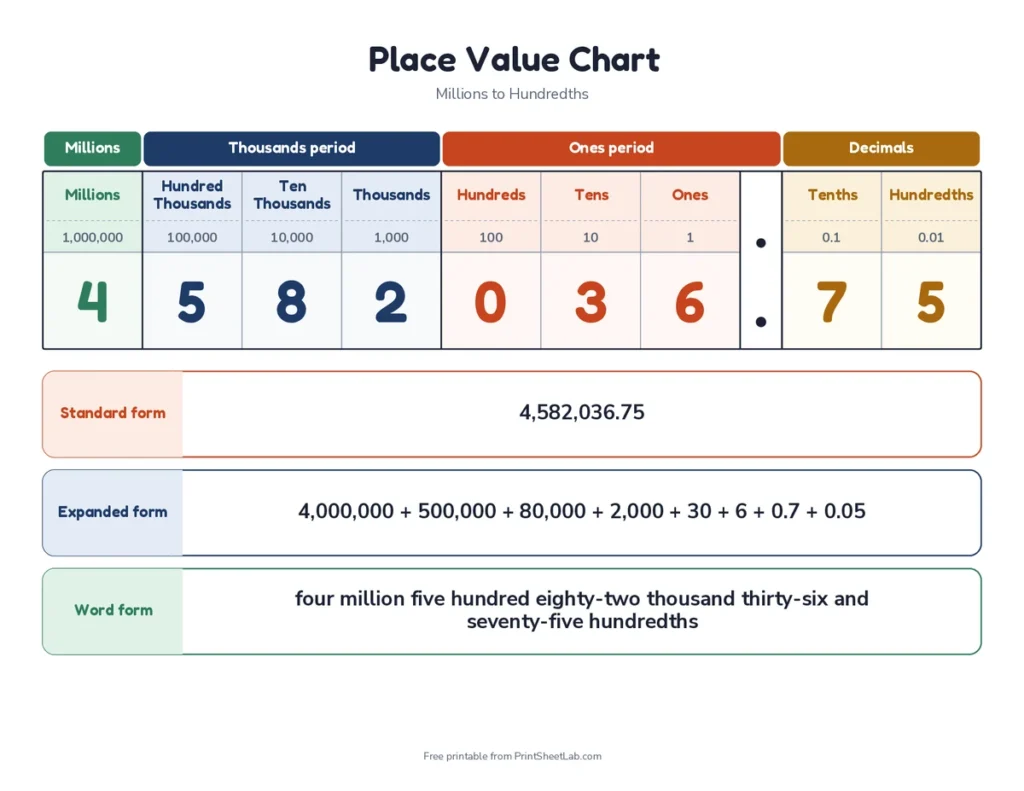
New: see each place as real shapes with printable base ten blocks and a place value mat.
Quick answer: A place value chart is a table with one column for each place in a number, such as ones, tens, hundreds and thousands, and each place is worth 10 times the place to its right. This page has 7 free printable place value charts (PDF): blank, with decimals to thousandths and millionths, the Indian system with lakhs and crores, desk strips, and a classroom anchor chart. Updated October 2026.
Try it: put any number in a place value chart
Type a number below and every digit drops into its place. You also get the number in standard form, expanded form and word form, and the value of each digit. Press × 10 or ÷ 10 to watch the digits slide one place left or right.
Ready-to-print place value charts (PDF)
Short on time? Every card below is a finished PDF. Use Customize to load the same chart in the generator and change the places, colors or paper size.
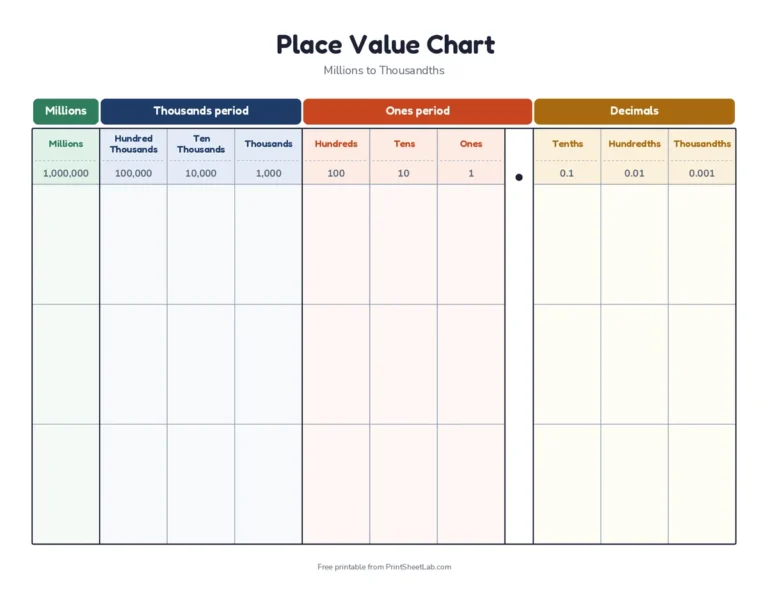

What is a place value chart?
A place value chart splits a number into columns called places: ones, tens, hundreds, thousands and so on. The digit in a column tells you how many of that place the number has. In 4,782 the 7 sits in the hundreds column, so it is worth 7 hundreds, or 700.
The key idea behind every place value chart: each place is worth 10 times the place to its right, and one tenth of the place to its left. That is why our number system is called base ten, and why only ten digits (0 to 9) are needed to write any number.
- Digit: the symbol itself, 0 to 9.
- Place: the column the digit sits in.
- Value: digit × place. A 5 in the ten thousands place has a value of 50,000.
How to read a place value chart
- Start at the ones. Line up the last whole-number digit in the ones column (or, for decimals, put the decimal point on the dot line).
- Fill in one digit per column, moving left for whole numbers and right for decimals. Empty places inside a number get a 0.
- Read one period at a time. Read the digits in a period as a number up to 999, then say the period name: 36,205 is “thirty-six thousand, two hundred five”.
- Say “and” only at the decimal point: 4.25 is “four and twenty-five hundredths”.
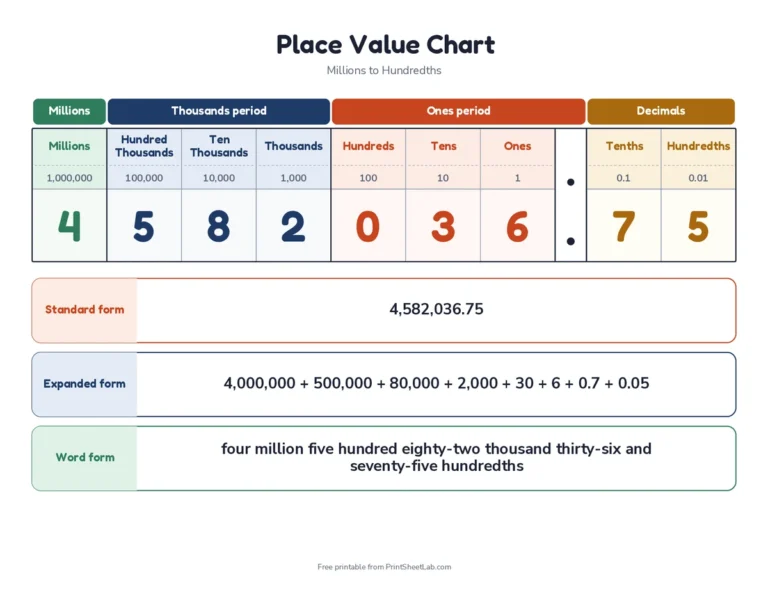
Worked example: in 4,582,036.75 the 4 is 4 millions (4,000,000), the 8 is 8 ten thousands (80,000), the 0 holds the hundreds place, and the 5 after the point is 5 hundredths (0.05). Its expanded form is 4,000,000 + 500,000 + 80,000 + 2,000 + 30 + 6 + 0.7 + 0.05.
Place value chart with periods: ones, thousands, millions and billions
Big numbers are easier to read in groups of three places called periods. The commas in 7,305,000,000 mark where one period ends and the next begins. Every period repeats the same pattern: ones, tens, hundreds.
| Period | Places (right to left) | Smallest number with a digit here | Zeros |
|---|---|---|---|
| Ones | ones, tens, hundreds | 1 | 0 |
| Thousands | thousands, ten thousands, hundred thousands | 1,000 | 3 |
| Millions | millions, ten millions, hundred millions | 1,000,000 | 6 |
| Billions | billions, ten billions, hundred billions | 1,000,000,000 | 9 |
The generator above draws these periods as colored bands, so children can see the pattern repeat. Switch on Short (H T O) place names for a compact chart, or add a row of values or powers of ten (10³, 10², 10¹) for older students.
Place value chart with decimals
To the right of the decimal point the places keep shrinking by ten: tenths, hundredths, thousandths and beyond. A decimal place value chart shows both sides, so students see that 0.4 is four tenths and 0.04 is four hundredths.
| Place | As a decimal | As a fraction | Example digit 3 |
|---|---|---|---|
| Tenths | 0.1 | 1/10 | 0.3 |
| Hundredths | 0.01 | 1/100 | 0.03 |
| Thousandths | 0.001 | 1/1,000 | 0.003 |
| Ten thousandths | 0.0001 | 1/10,000 | 0.0003 |
| Hundred thousandths | 0.00001 | 1/100,000 | 0.00003 |
| Millionths | 0.000001 | 1/1,000,000 | 0.000003 |
Notice that the chart is symmetrical around the ones place, not around the decimal point: tens mirror tenths, hundreds mirror hundredths. That is why there is no “oneths” place. For a place value chart with decimals in fraction form, choose Numbers with fractions for decimals in the value row.
Indian place value chart: lakhs and crores
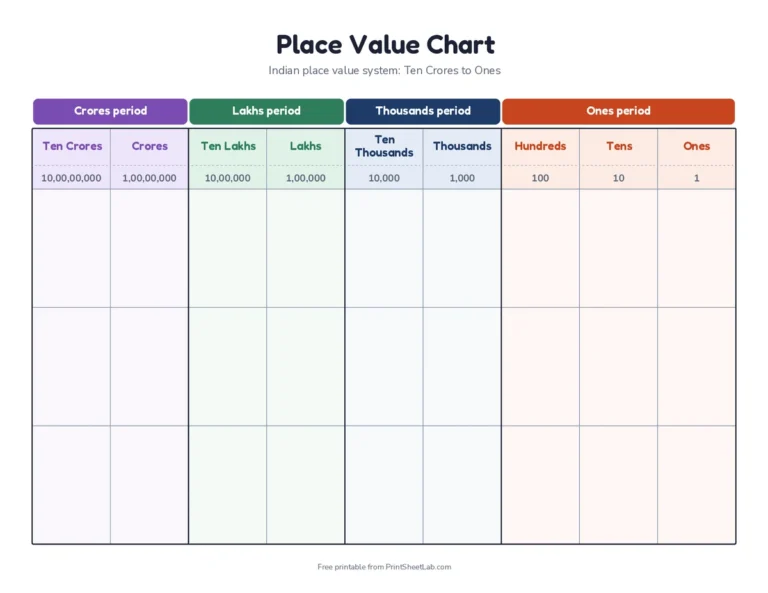
In India, Pakistan, Bangladesh and Nepal, large numbers are grouped differently. After the first three digits, commas come every two digits, and the periods are thousands, lakhs, crores and arab. The same amount is written 45,82,036 in the Indian system and 4,582,036 in the international system. Pick Indian (lakh, crore) in the generator or the explorer to switch. The Indian numbering system article on Wikipedia explains where these names come from.
| Indian system | Written as | International system | Written as |
|---|---|---|---|
| One thousand | 1,000 | One thousand | 1,000 |
| One lakh | 1,00,000 | One hundred thousand | 100,000 |
| Ten lakh | 10,00,000 | One million | 1,000,000 |
| One crore | 1,00,00,000 | Ten million | 10,000,000 |
| Ten crore | 10,00,00,000 | One hundred million | 100,000,000 |
| One arab | 1,00,00,00,000 | One billion | 1,000,000,000 |
Only the grouping and the names change. The places themselves are the same, so a digit is worth exactly the same amount in both charts.
Which place value chart for which grade?
Use the smallest chart that fits the numbers your child is working with. Fewer columns means bigger boxes and less to read. The grade guide below follows the Common Core State Standards for math.
| Grade | What they learn | Chart to print |
|---|---|---|
| Grade 1 | Two-digit numbers as tens and ones (1.NBT.B.2) | Tens and ones with base-ten blocks |
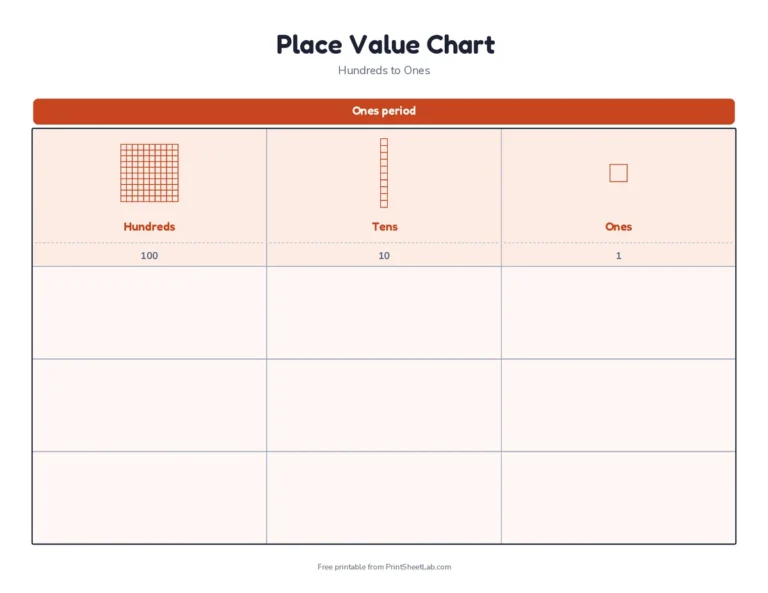
| Grade 2 | Three-digit numbers as hundreds, tens and ones (2.NBT.A.1) | Hundreds, tens and ones |
| Grade 3 | Rounding and adding within 1,000 | Place value chart to thousands |
| Grade 4 | Multi-digit whole numbers up to 1,000,000 (4.NBT.A.1, 4.NBT.A.2) | Place value chart to the millions |
| Grade 5 | Decimals to thousandths and the ×10 pattern (5.NBT.A.1, 5.NBT.A.3) | Place value chart with decimals |
| Grade 6+ | Large numbers, decimals and powers of ten | Billions to millionths |
Five kinds of place value printables in one generator
- Labeled chart with blank rows: the classic place value chart printable. Laminate it and use it with a dry-erase marker for years.
- Chart with your number: a poster that shows one number in the chart plus its standard, expanded and word form. Great for a “number of the day” wall.
- Practice worksheet with answer key: random numbers to write in the chart and a digit to find the value of. Press New numbers for a fresh sheet.
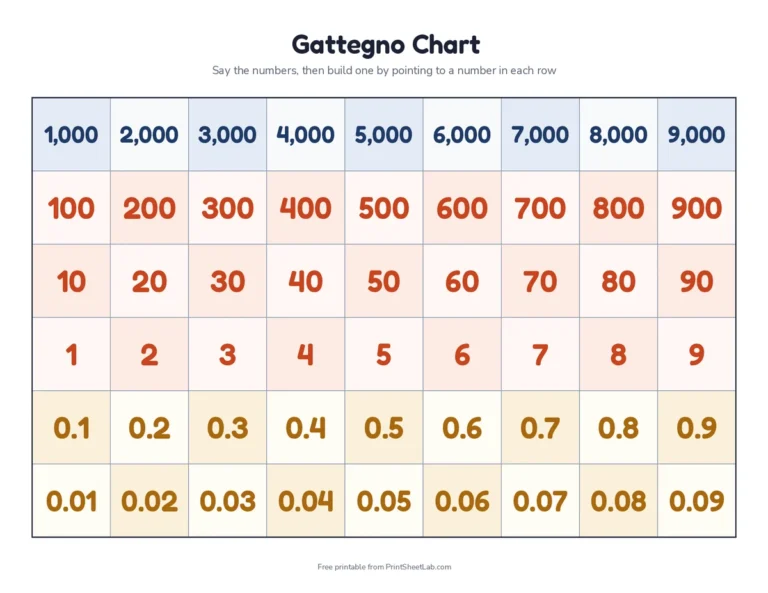
- Gattegno chart: rows of 1 to 9, 10 to 90, 100 to 900 and beyond (and decimals), for pointing and saying numbers out loud.
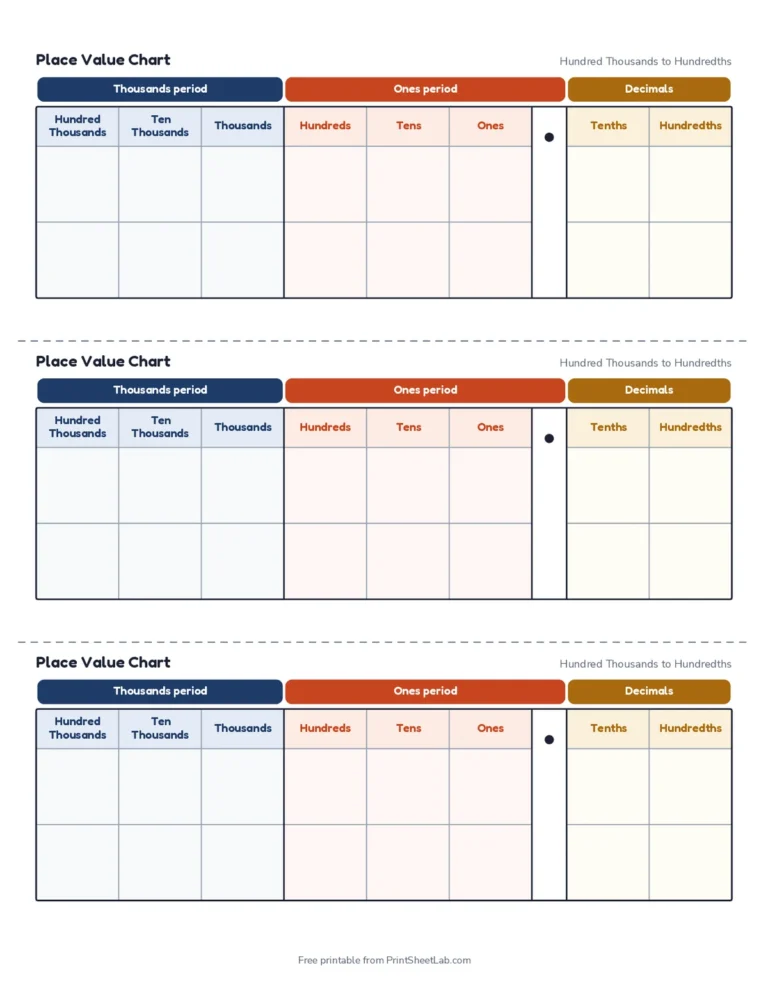
- Desk strips: three small charts per page to cut out and tape to desks or glue into math notebooks.
7 place value activities to try with your chart
- Roll and place. Roll a die once per column and write the digit where you choose. Whoever builds the biggest number wins. Then try for the smallest.
- Zap the digit. On a calculator, type 6,473. Can you make the 4 disappear in one subtraction? (Subtract 400.) The chart shows why.
- Slide show. Write 3.52 on a chart and multiply by 10, then 100. Every digit moves one place left each time; the decimal point stays put.
- Mystery number. Give clues: “I have 4 thousands, no hundreds, 7 tens, and 2 more ones than tens.” Children fill the chart to find 4,079.
- Money match. Hundreds, tens and ones become $100, $10 and $1 bills; tenths and hundredths become dimes and pennies.
- Number of the day. Print the “chart with your number” version each morning and ask for the value of one digit, the number 10 more, and the number 100 less.
- Read it the Indian way. Take 2,500,000 and write it on both charts: 25 lakh and two and a half million are the same amount.
Common place value mistakes and quick fixes
- Forgetting the zero placeholder. “Four thousand thirty” becomes 430. Fix: write one digit in every column between the first digit and the ones, and fill gaps with 0.
- Thinking longer decimals are bigger. 0.125 is less than 0.5. Fix: line both up on a decimal chart and compare the tenths first.
- Mixing up digit and value. The digit in 3,812 is 8, but its value is 800. Fix: say “8 hundreds” before writing the value.
- Looking for a “oneths” place. Fix: fold a decimal chart at the ones column to show that tens pair with tenths.
Printing tips
- Set the print dialog to 100% rather than Fit to page, so each box keeps the size it was drawn at.
- Landscape suits wide charts; portrait works well for practice sheets and desk strips.
- Black and white saves ink. Color helps children see periods and decimals at a glance.
- Slip a printed chart into a sheet protector and it becomes a reusable dry-erase board.
Free printable place value chart: PDF, blank and ready to print
You will find this page searched as place value chart printable, printable place value chart, free printable place value chart, place value charts printable, place value chart pdf, place value chart to print and print place value chart. All of those lead to the seven PDFs above. Every chart is free to print on US Letter or A4, in color or black and white, with no account. For a free place value chart printable with your own numbers, use Customize on any card to change the places, then press print or save as PDF. The same chart works as a place value chart worksheet when you leave the rows blank for children to fill in.
Place value chart with numbers: three examples
This is what a place value chart with numbers looks like when the digits are in their columns. An empty column means the number has nothing in that place, and a 0 is written when a place inside the number is empty. The picture at the top of this page shows a finished chart for 4,582,036.75; here are three more:
| Number | Millions | Hundred thousands | Ten thousands | Thousands | Hundreds | Tens | Ones | Tenths | Hundredths |
|---|---|---|---|---|---|---|---|---|---|
| 2,408,516.3 | 2 | 4 | 0 | 8 | 5 | 1 | 6 | 3 | |
| 70,052.09 | 7 | 0 | 0 | 5 | 2 | 0 | 9 | ||
| 905.4 | 9 | 0 | 5 | 4 |
In 70,052.09 the 7 is in the ten thousands, the zeros in the thousands, hundreds and tenths hold their places, the 5 is in the tens, the 2 is in the ones and the 9 is in the hundredths. Place value charts with numbers make these zeros easy to see.
Place value anchor chart for the classroom
A place value anchor chart is a poster that stays on the wall while a class learns a topic, so children can look back at it when they get stuck. A useful place value anchor chart has four parts: the places in order with the pattern that each place is 10 times the one to its right, one worked example number in standard, expanded and word form, a picture of base-ten blocks, and one reminder line such as a zero holds an empty place. Print the color chart with a number (the second card above) and glue it to chart paper, then add your class’s own examples with markers.
Place value anchor charts for younger grades only need ones, tens and hundreds, so use the base-ten blocks card or the base ten blocks. Make several place value anchor charts through the year: one for tens and ones, one for thousands, and one for decimals.
Decimal place value worksheets and decimals and place value worksheets
Decimal place value worksheets work on the places to the right of the decimal point: tenths, hundredths and thousandths. The rule is the same as for whole numbers, each place is 10 times the place to its right, so a tenth is 10 hundredths. Decimals and place value worksheet pages ask children to write the value of one digit, as in this table for 3,456.789:
| Digit | Place | Value of that digit |
|---|---|---|
| 6 | ones | 6 |
| 5 | tens | 50 |
| 4 | hundreds | 400 |
| 3 | thousands | 3,000 |
| 7 | tenths | 0.7 |
| 8 | hundredths | 0.08 |
| 9 | thousandths | 0.009 |
Print the practice card above with decimals turned on for a decimal place value worksheet with an answer key, and use our decimals worksheets for more practice. Decimal place value worksheet topics are normally taught in grades 4 and 5, with decimals to thousandths in grade 5 (5.NBT.A.3).
Place value chart for kindergarten
A place value chart for kindergarten only needs two columns: tens and ones. Kindergarten children work with numbers to 20, where the standard asks them to see a teen number as ten ones and some more ones (K.NBT.A.1). Use the hundreds, tens and ones card with the hundreds column covered, or build the teen numbers with counters on a ten frame.
Frequently asked questions
17 quick answers
What is a place value chart?
A place value chart is a table with a column for each place in a number (ones, tens, hundreds and so on, plus tenths and hundredths for decimals). Writing one digit per column shows what each digit is worth.
What are the places in a place value chart, in order?
From right to left for whole numbers: ones, tens, hundreds, thousands, ten thousands, hundred thousands, millions, ten millions, hundred millions, billions. After the decimal point, from left to right: tenths, hundredths, thousandths, ten thousandths, hundred thousandths, millionths.
How do you put a number in a place value chart?
Put the ones digit in the ones column, then write the other digits one per column moving left. For decimals, line up the decimal point with the dot on the chart and write digits to the right of it. Fill any empty places inside the number with 0.
What comes after hundred thousands?
Millions. 999,999 plus one is 1,000,000, one million, which starts the millions period. In the Indian system, one hundred thousand is called one lakh, and the next place is ten lakh.
How many zeros are in a million, a billion, a lakh and a crore?
A million has 6 zeros (1,000,000), a billion has 9 (1,000,000,000), a lakh has 5 (1,00,000) and a crore has 7 (1,00,00,000).
What is the difference between place value and face value?
Face value is the digit itself. Place value is what the digit is worth where it sits. In 5,639 the face value of 6 is 6 and its place value is 600.
What is a period in place value?
A period is a group of three places that share a name: the ones period, the thousands period, the millions period and so on. Commas separate periods, which makes large numbers easier to read aloud.
Why is there no oneths place?
Place value is symmetrical around the ones place. Tens mirror tenths and hundreds mirror hundredths, so the ones place has no partner on the decimal side.
How is the Indian place value chart different?
It uses the same places but different groups and names: after the hundreds, commas come every two digits and the periods are thousands, lakhs, crores and arab. 1,00,000 (one lakh) equals 100,000 (one hundred thousand).
What grade learns place value to the millions?
Under the Common Core standards, grade 4 students read, write and compare whole numbers up to 1,000,000, and grade 5 extends place value to decimals to the thousandths.
What is a Gattegno chart?
A Gattegno chart is a grid with rows of 1 to 9, 10 to 90, 100 to 900 (and decimal rows like 0.1 to 0.9). Children build numbers by pointing to one number in each row, which makes the pattern of place value easy to hear and see.
How do you use base-ten blocks with a place value chart?
Put unit cubes in the ones column, rods in the tens and flats in the hundreds. When a column reaches ten, trade them for one block in the next column to the left. Turn on base-ten block pictures in the generator to show them in the chart header.
Can I print a blank place value chart?
Yes. Choose the labeled chart, pick the places and number of blank rows you want, and download the PDF. For a completely empty template, turn off the period names and the value row.
Is this place value chart free to print on A4?
Yes. Pick A4 (or Letter) under Paper size before you download, and the columns are measured to fill that sheet. All place value charts are free, and you may copy them for a whole class.
Where can I download a free printable place value chart?
Open any card in the PDF section above, choose US Letter or A4, then print or save the PDF. All seven charts are free and need no account.
What is a place value anchor chart?
A place value anchor chart is a classroom poster that shows the places in order, the pattern that each place is 10 times the one to its right, and one worked example. Teachers keep it on the wall while a class learns place value.
Is there a place value chart with decimals?
Yes. Use the millions to thousandths chart or the billions to millionths chart above, or Customize any chart and set the number of decimal places.
More place value practice
- Place Value Anchor Chart: How to Make One, With 6 Examples: the full guide behind this page
- Place value worksheets with answer keys, from tens and ones to large numbers.
- Tens and ones worksheets with base-ten blocks for grade 1.
- Hundreds, tens and ones worksheets and expanded form for grade 2.
- Place value worksheets for large numbers: word form and the value of a digit.
- Decimal place value worksheets for tenths, hundredths and thousandths.
- Rounding worksheets and comparing numbers worksheets that build on place value.
- Hundreds chart worksheets for counting to 100 and 120.