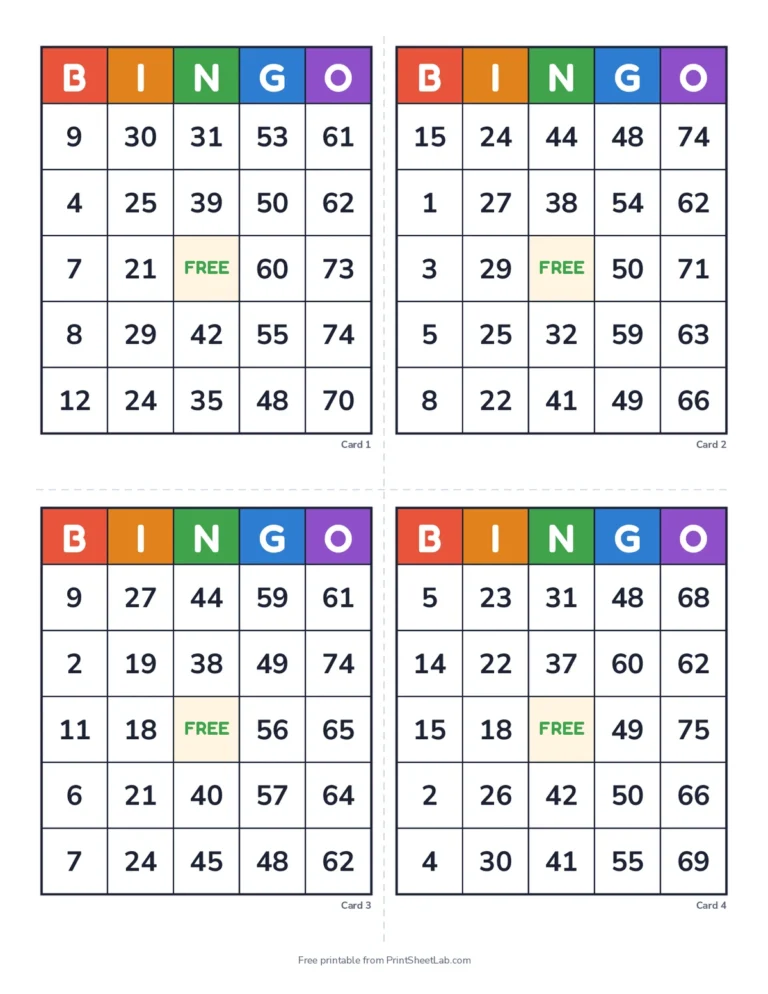
Use this free bingo card generator to make printable bingo cards in seconds for a classroom, a baby shower or a party night. Pick classic 1-75 bingo cards with B-I-N-G-O columns, junior 1-30 cards for little ones, cards with your own words, or a ready-made topic such as animals, food or a road trip. Print up to 100 different cards as one PDF, 1, 2 or 4 to a page, with a caller sheet and cut-out calling cards. It is free, with no sign-up.
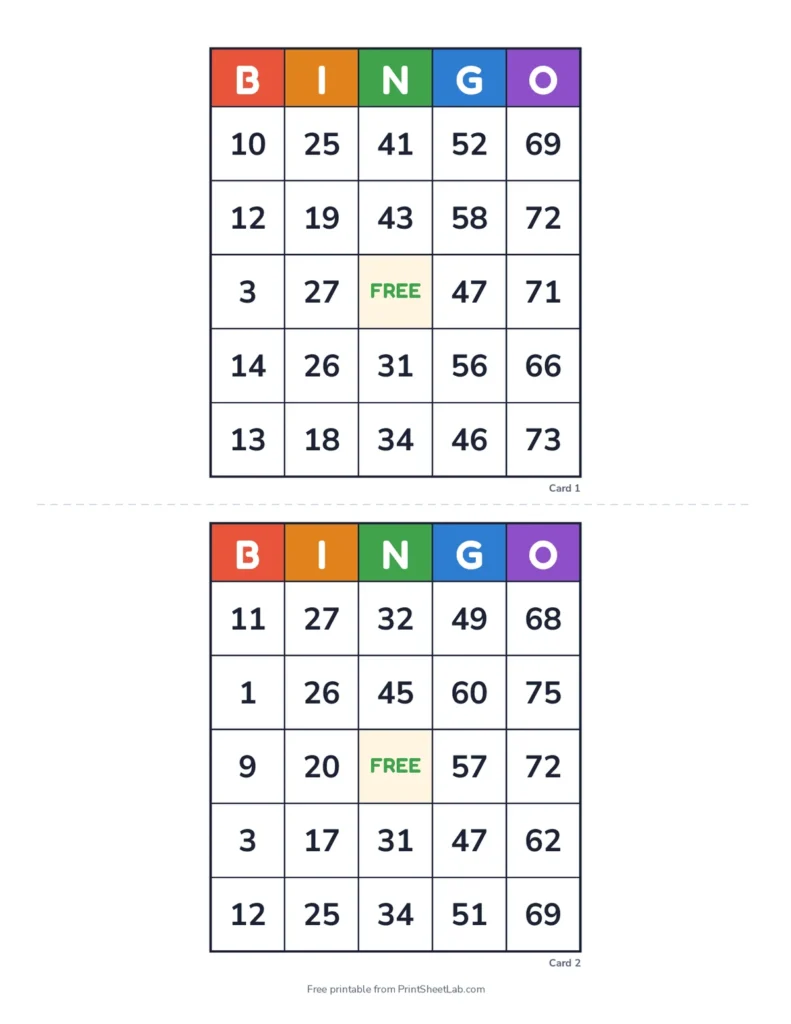
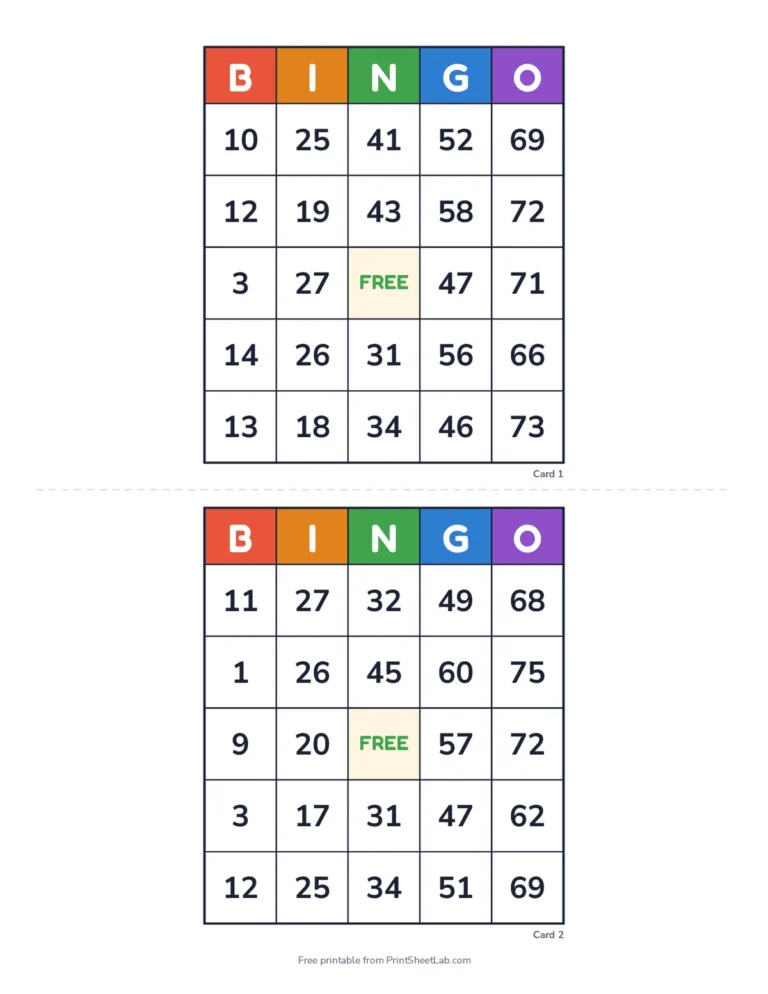
In short: every card gets its own random arrangement, so no two cards in a set of up to 100 are the same. Choose numbers or words, download one PDF with the caller sheet, and press New cards whenever you want a fresh set.
Online bingo caller
Run your game from any phone, tablet or laptop. Press Call next number (or turn on auto call), and the caller shows the ball, reads it aloud and marks the board so you can check a winning card in seconds.
Ready-to-print bingo card sets (PDF)
Each set below is a ready-made PDF. Download one and print it straight away, or press Customize to open the generator with that set loaded and change the words, the number of cards or the colors.
What the free bingo card generator gives you
No sign-up, no watermark
The generator needs no account, adds no watermark and sets no limit on how many sets you make. You can generate a new set, print it, and generate another as often as you like, which makes it a good fit for a classroom that plays every Friday or a club that runs a bingo night each month. Every PDF carries only the cards, the caller sheet and the calling cards, so you can print it exactly as it comes out.
Works on any device
The free printable bingo cards work for any group size. A set holds up to 100 different cards, which is enough for a school assembly, a fundraiser or a large family party. If you need more players than that, press New cards to build a second set; because each set is random, cards from different sets almost never match. Small groups can print just 6 to 10 cards and keep the rest of the paper for next time.
Because the tool runs in your browser, the cards appear as soon as you change a setting. There is no waiting for an email or a download link, and the same generator works on a laptop, a tablet or a phone. If you want to see a game played on screen instead of paper, the online bingo page deals every guest a card on their own phone.
Which kind of bingo should I make?
| Bingo type | Best for |
|---|---|
| Classic 1-75 number bingo | Family game night, seniors, fundraisers and parties. B has 1-15, I has 16-30, N has 31-45, G has 46-60 and O has 61-75. |
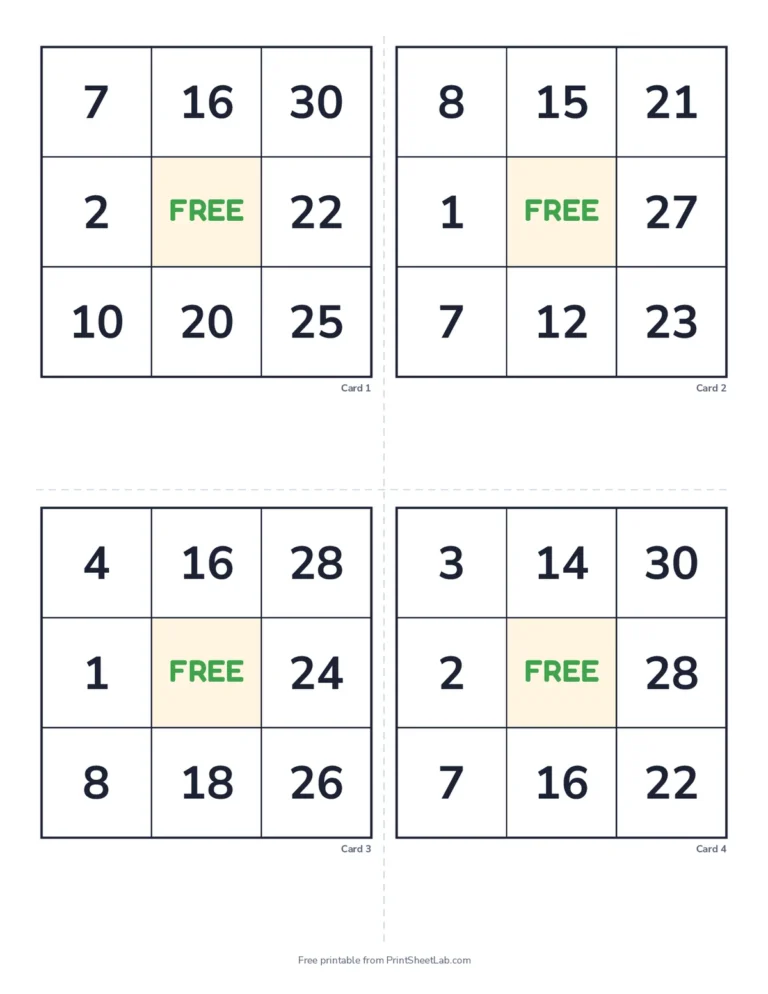
| Junior 1-30 bingo | Young children learning numbers, on quick 3 by 3 cards. |
| Custom word bingo | Spelling and vocabulary review, sight words, foreign language words, events and icebreakers. |
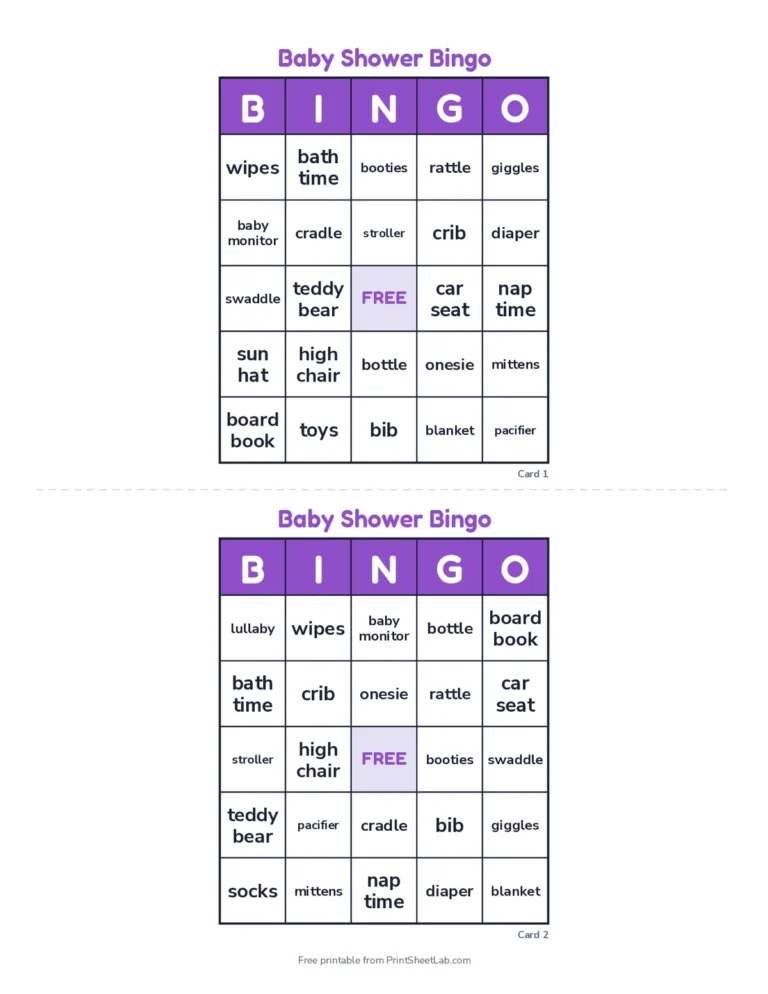
| Baby shower bingo | Guests mark gifts as they are opened. |
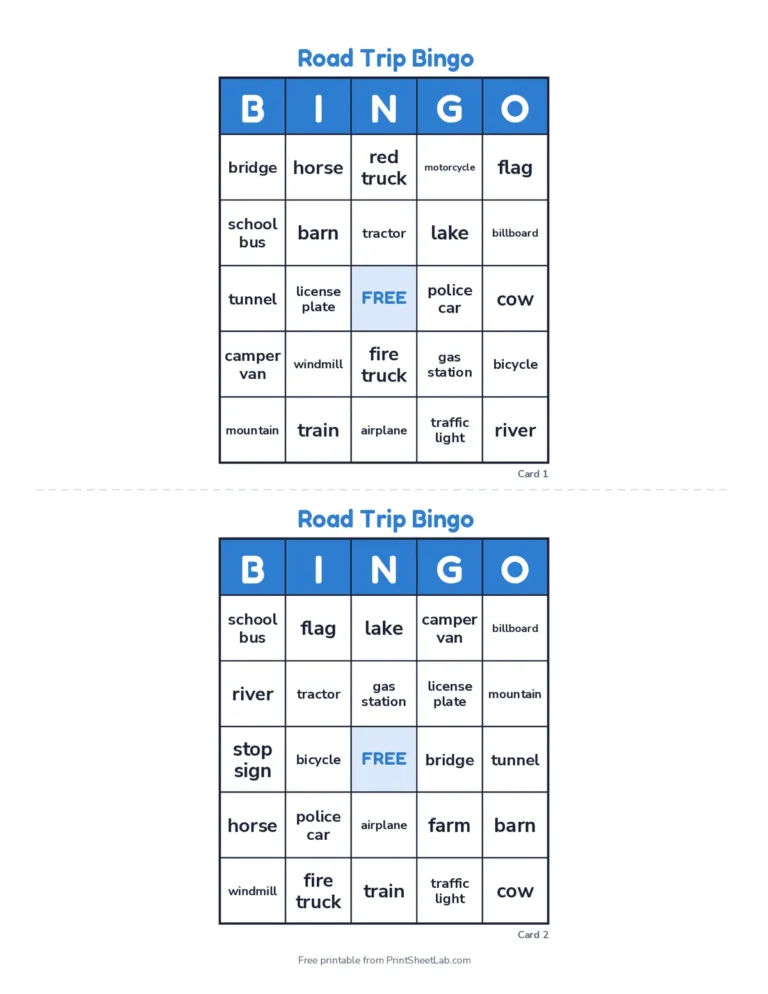
| Road trip bingo | Spot a school bus, windmill or license plate from the car window. |
| Classroom bingo | A back-to-school icebreaker with classroom objects. |
Bingo cards 1-75: how the numbers are laid out
Classic 1-75 bingo cards use a 5 by 5 grid. Each column has its own range, which is why the five letters across the top matter: a caller who says “G 52” tells players which column to look in. The generator keeps every number in its correct column and gives the center square to everyone as a free space.
| Column | Numbers | Squares |
|---|---|---|
| B | 1 to 15 | 5 numbers |
| I | 16 to 30 | 5 numbers |
| N | 31 to 45 | 4 numbers and the free space |
| G | 46 to 60 | 5 numbers |
| O | 61 to 75 | 5 numbers |
How many different cards exist?
Number cards feel interchangeable, but the number of possible cards is huge. Each of the B, I, G and O columns can hold 5 of its 15 numbers in any order (360,360 ways) and the N column holds 4 of 15 (32,760 ways). Multiplying them gives about 5.5 x 1026 different 1-75 cards, or roughly 1.1 x 10¹⁷ if you only count which numbers are on a card and ignore where they sit. The generator checks every card in a set against the others, so even with 100 players nobody ever holds a copy of someone else’s card.
For younger players, the same generator makes cards with numbers from 1 to 30 on a small 3 by 3 grid. There are far fewer of those, but a set of 20 cards is still all different.
Custom bingo cards: title, colors and free space
The settings that matter
The settings panel above lets you shape the cards before you print. Everything updates in the preview straight away, so you can try a different color theme or a bigger card size and compare. These are the settings that matter most:
| Setting | What it does |
|---|---|
| Bingo type | 1-75 numbers, junior 1-30, your own words, or a ready-made topic. |
| Number of cards | 1 to 100 different cards in one set. |
| Cards per page | 1 (large), 2 or 4 (saves paper). |
| Card title | Up to 40 characters, such as a class name, a party name or “Family Game Night”. |
| Free space | Turn the center square on or off and change its text, for example “FREE” or “BONUS”. |
| Colors | Rainbow, blue, red, green or purple, or black and white to save ink. |
| Paper size | Letter or A4. |
| Number each card | Prints “Card 1”, “Card 2” and so on, which makes winning cards easy to check. |
| Caller sheet and calling cards | Adds a checklist of every call and a page of cut-out calling cards. |
Custom bingo cards are most useful when the title and free space match the event. A teacher might print “Spelling Bingo” cards in a single color, while a baby shower host chooses purple with a free space that says “Cheers”. Because all settings stay in the web address, you can bookmark the page or send the link to a colleague and they will see the same cards.
Pages, paper and printing
The PDF is built from the preview you see above. It holds your cards, then (if you keep the box ticked) a caller sheet and a few pages of calling cards you cut apart and draw from a bag. The page count depends on how many cards you ask for and how many fit on a page, so you can plan the paper before you press print. These counts come straight from the generator, including the caller pages:
| Cards | Per page | Pages in the PDF | Notes |
|---|---|---|---|
| 10 (1-75) | 2 | 9 | 5 card pages and 4 caller pages. |
| 20 (1-75) | 4 | 9 | The least paper for a small group. |
| 30 (1-75) | 2 | 19 | 15 card pages and 4 caller pages. |
| 50 (1-75) | 4 | 17 | 13 card pages and 4 caller pages. |
| 100 (1-75) | 4 | 29 | Large events and fundraisers. |
| 12 (junior 1-30) | 4 | 5 | 3 card pages and 2 caller pages. |
Printing tips for bingo cards
- Choose the paper size first. Letter and A4 both work, but pick the one your printer uses so nothing is cut off.
- Print one page to test. Check the numbers are easy to read from where players sit, then print the full set.
- Use black and white for big sets. The black and white option saves color ink and the cards are just as easy to play.
- Print the caller pages on card stock. Calling cards cut and fold more neatly when they are thicker than normal paper.
- Keep the PDF. A saved printable bingo cards PDF can be reprinted for the next game without making new cards.
How to play bingo
- Give each player a card and some markers, like beans, coins or a crayon.
- The caller draws a calling card from a bag, or uses the online caller, and reads it out.
- Players mark the square if the call is on their card. The free space counts for everyone.
- The first player to complete a line across, down or diagonally shouts “Bingo!”
- Check the card against the caller sheet. For longer games, play for four corners, an X or a full card.
Tips for a great bingo game
- Use the card numbers to keep track of cards and spot duplicates quickly.
- Print 2 per page for large, easy-to-read cards, or 4 per page to save paper.
- Laminate cards or slip them into page protectors and use dry-erase markers to play again and again.
- For classrooms, make word bingo with your spelling or vocabulary list so review feels like a game.
Bingo patterns to play
A single line is quick, but changing the winning pattern keeps a long game interesting. Announce the pattern before each round:
| Pattern | What wins | Good for |
|---|---|---|
| Single line | Any full row, column or diagonal | Fast rounds and young players |
| Four corners | The four corner squares | A quick second prize |
| Letter X | Both diagonals, crossing at the free space | A medium-length round |
| Picture frame | Every square around the outside edge | A longer round with more suspense |
| Blackout | Every square on the card | The final big prize of the night |
Bingo cards with your own words
Word bingo turns any list into a game. Type or paste one word or phrase per line (or separate them with commas), choose a 3 by 3, 4 by 4 or 5 by 5 grid, and the generator shuffles your list into as many different cards as you need. Typical uses are spelling and vocabulary review, sight words, times table answers, foreign language vocabulary, and icebreakers for meetings, where each square is something a guest might say or do.
How many words do you need?
Each card needs enough words to fill every square, and the more extra words you add, the more different the cards become. A 5 by 5 card with a free space holds 24 words. If your list has exactly 24 words every card holds the same words in a different order, which is fine for learning but easier to win. A longer list spreads the words across cards unevenly, so players win at different times.
| Words in your list | Different sets of 24 words | What it means |
|---|---|---|
| 24 | 1 | Every card has the same words, shuffled. |
| 30 | 593,775 | Good for a class of 20 to 30. |
| 40 | 62,852,101,650 | Plenty of variety for large groups. |
| 60 | 36,052,387,482,172,425 | Every card is very different. |
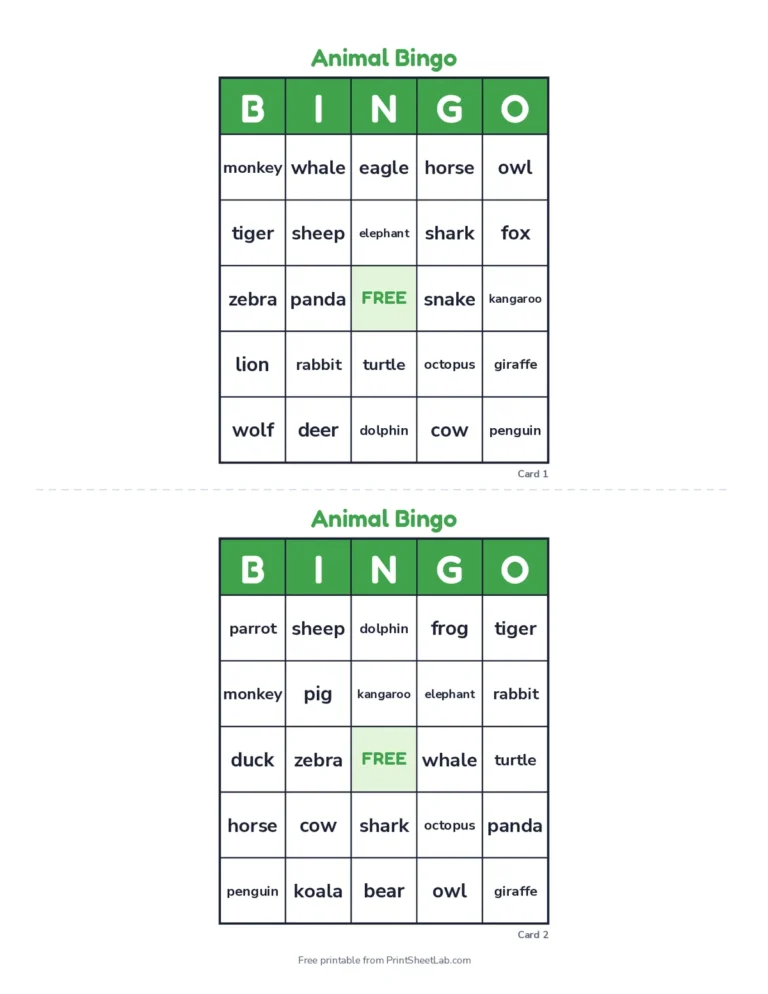
For 4 by 4 cards you need 16 words, and for 3 by 3 cards you need 8 (with a free space) or 9. If you pick a topic instead of typing a list, the generator fills in about 30 words for you, which is exactly why topic cards play well for a quick game.
Printable bingo cards for kids
For children who are still learning numbers, junior 1-30 bingo uses small 3 by 3 cards so a game lasts only a few minutes. Teachers can turn any word list into a game: spelling words, sight words, times table answers or new vocabulary in another language all work. For children who cannot read yet, try the picture bingo cards, which read each call aloud, or emoji bingo.
Cards for kids work best when the card size matches the age of the group. These are good starting points, and you can always change them once you see how the first game goes:
| Age | Card to print | Why it works |
|---|---|---|
| 3 to 5 | Junior 1-30 numbers, 3 by 3, 1 or 2 cards per page | Large squares, only 9 numbers to find and a short game. |
| 5 to 7 | Sight words or picture bingo, 3 by 3 or 4 by 4 | Reading practice with a friendly goal. Call each word slowly and show it. |
| 7 to 10 | Spelling or math facts, 4 by 4 or 5 by 5 | Players check their own cards and call “Bingo” themselves. |
| 10 and up | Bingo cards 1-75 or topic bingo, 5 by 5 | The classic game, with patterns like four corners or an X. |
A good tip for a classroom is to print 2 cards per page, cut them apart, and let each child keep a card in a plastic sleeve so it can be wiped and reused. The same cards can be played in teams, with one child per team marking a shared card on the board.
How long does a bingo game last?
The number of calls before somebody wins depends on the pattern and on how many cards are in play. We simulated thousands of games of 75-ball bingo with the same random cards the generator produces, with a free center, and recorded the call on which the first card completed each pattern. The table shows the median number of calls, with the middle half of games in brackets:
| Pattern | 1 card | 10 cards | 30 cards | 100 cards |
|---|---|---|---|---|
| Single line | 41 (34 to 48) | 26 (22 to 30) | 21 (17 to 23) | 15 (13 to 18) |
| Four corners | 64 (54 to 70) | 40 (32 to 47) | 33 (26 to 39) | 24 (19 to 29) |
| Letter X | 70 (65 to 73) | 55 (50 to 59) | 48 (44 to 53) | 42 (39 to 46) |
| Blackout | 74 (72 to 75) | 69 (67 to 70) | 66 (64 to 68) | 64 (62 to 65) |
With a call every 15 seconds, a single line with 30 cards in play usually finishes after about 21 calls, a little over 5 minutes, while a blackout with the same group takes about 66 calls, close to 17 minutes. That makes the pattern the easiest way to plan an evening: use a single line or four corners for quick rounds and keep blackout as the final prize. More players do not make a blackout much faster, because it needs 60 or more calls however many cards you print, so plan on about 4 rounds an hour at most.
75-ball, 90-ball or picture bingo?
The cards on this page use the American 75-ball format on a 5 by 5 grid with a free center. British and Indian games use 90 balls on 3 by 9 tickets instead; for those, use the 90-ball bingo cards or the tambola ticket generator. Mexican Loteria swaps numbers for 54 picture cards. If you want the rules and history of the American game, the American version of bingo is a good place to start.
Frequently asked questions
13 quick answers
Is this bingo card generator free?
Yes. Make and print as many cards as you like for family nights, classrooms and community events, with no sign-up and no watermark.
Are all the cards different?
Yes. The generator checks every card and never repeats one, up to 100 cards per set. Press New cards for a completely new set.
How many words do I need for word bingo?
For 5 by 5 cards with a free space you need at least 24 words; 30 or more gives more variety between cards. For 4 by 4 cards you need 16, and for 3 by 3 cards you need 8 (with a free space) or 9.
What numbers go in each column of 1-75 bingo?
B has 1 to 15, I has 16 to 30, N has 31 to 45, G has 46 to 60 and O has 61 to 75. The center square is free.
Can I make bingo cards with pictures?
This generator makes number and word cards. For picture cards, use picture bingo for kids, emoji bingo or Loteria, which all have pictures built in.
Can I print bingo cards as a PDF?
Yes. The printable bingo cards PDF holds the cards, a caller sheet and cut-apart calling cards, on Letter or A4 paper. Press Download PDF under the preview to save it.
What is a bingo card maker?
A bingo card maker is a tool that builds random bingo cards for you. This one runs in your browser: pick the type, the number of cards and the look, then print or save the PDF.
Can I make custom bingo cards with my own title?
Yes. Type your own card title, rename the free space and choose a color theme. Custom bingo cards with a class name or event name on top look better on the wall and are easier to tell apart from other games.
How many bingo cards do I need?
Print one card per player and a few spares. For a group of 30 you will get a winner on a single line after roughly 21 calls (see the table above), so there is no benefit from giving each player several cards unless you want a faster game.
Can I print the bingo cards double-sided?
The cards are made to print on one side. You can print the calling cards on the back of spare card pages if you like, but keep the front of each bingo card clear so the numbers are easy to read.
Can I use the caller without printing?
Yes. The online caller works on its own. It draws numbers in random order, reads them aloud and shows every number called so far.
How do I use the bingo card generator with words from a spelling list?
Type or paste one word or phrase per line, or separate them with commas, then choose a 3 by 3, 4 by 4 or 5 by 5 grid.
Can I make bingo cards with numbers for young children?
Yes. Choose junior bingo and the generator makes cards with numbers from 1 to 30 on a small 3 by 3 grid. There are far fewer possible cards than in 1-75 bingo, but a set of 20 is still all different.
More games and puzzles
- Holiday bingo and activity packs.
- Sight word bingo.
- Word search maker.
- Printable sudoku.
- All puzzles and games.
- Dot to dot printables with 10 to 100 dots, skip counting or A to Z.
Play bingo on phones
Want everyone to play on their own phone? Host 75-ball bingo online: share a single link so each player receives a card that marks itself. For picture cards see picture bingo for kids, emoji bingo and Loteria; for 90-ball tickets see 90-ball bingo and tambola.
Did you like this?
Last updated: