This subtraction within 20 game helps first graders learn take-away facts that cross ten, such as 15 − 7 and 13 − 8, by playing: pop balloons, flip memory cards, race cars or sprint through true and false sentences. Each question subtracts a number from a start of 8 to 20, so children practice subtracting from the teens until the answers come without counting back. It is free, needs no sign-up, works on phones and tablets, and comes with a printable subtraction chart and three strategies for the teens.
Subtraction within 20 game: see how it plays
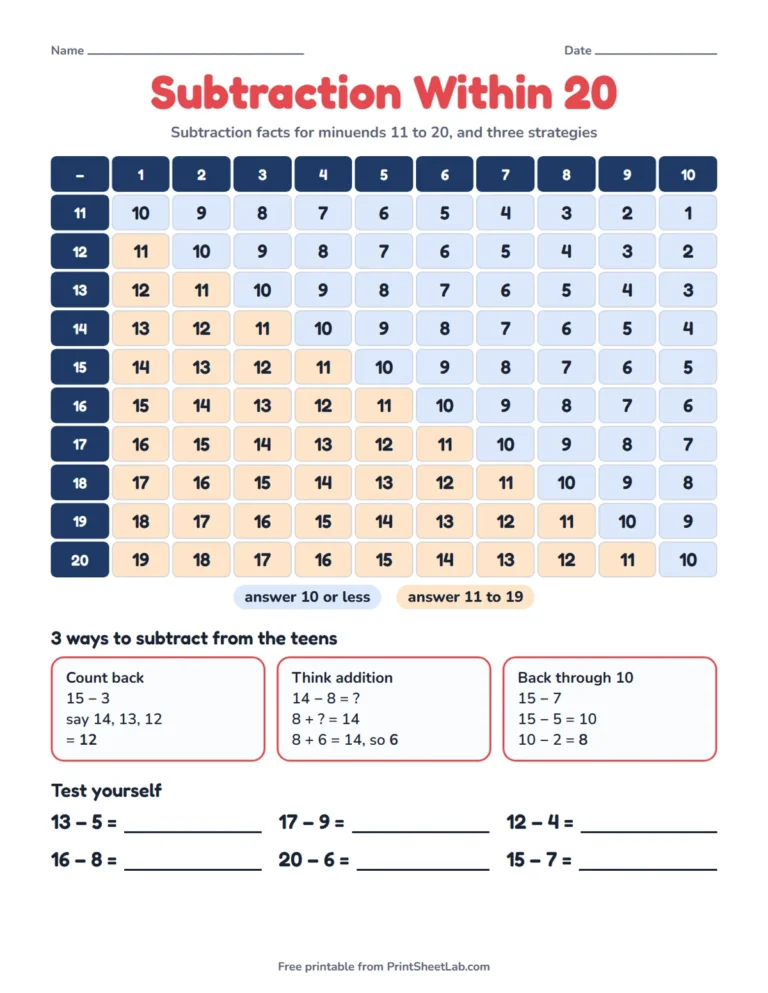
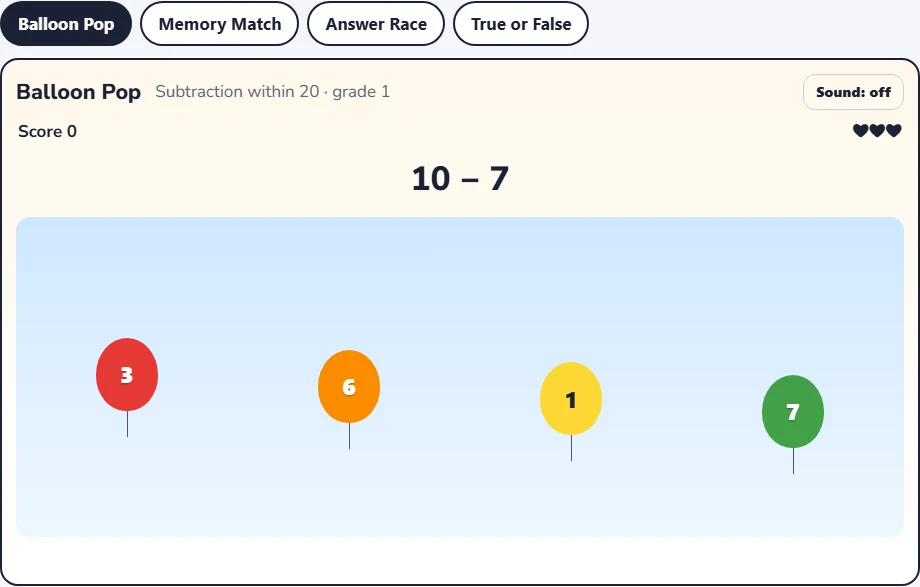
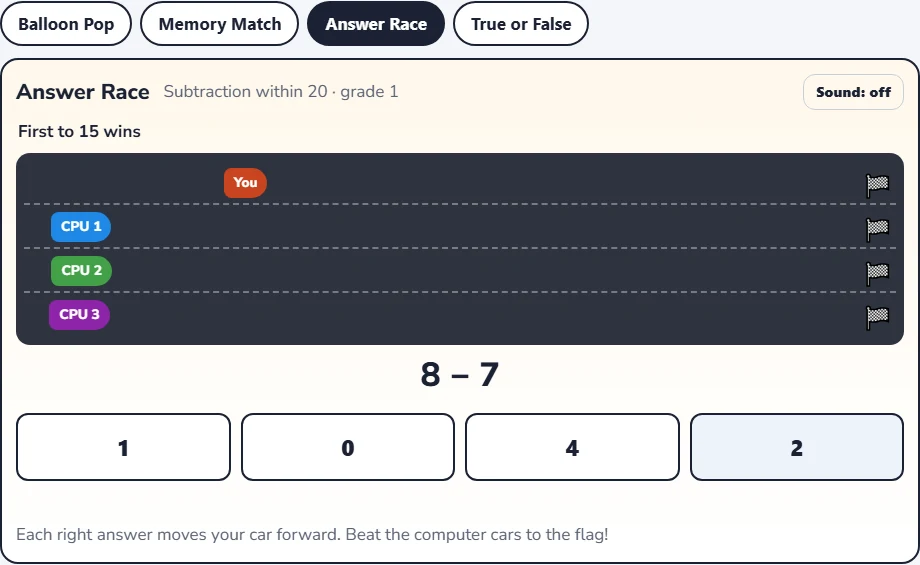
The subtraction within 20 game below has four modes, and every question subtracts within 20. The printable chart shows the facts for 11 to 20 in a grid, with the three main strategies and a short test, and the pictures show Balloon Pop, Answer Race and Memory Match on this page.

How the subtraction within 20 game works
- Balloon Pop: answers float up on balloons, and you pop the right one before it drifts off the top. The wrong balloons are within 4 of the right answer, so children must work out the difference rather than choose the odd one out. The game speeds up as your score climbs, and three misses ends the round.
- Answer Race: every right answer moves your car forward, and you race three computer cars to the finish flag. The first to 15 wins, and wrong taps cost time, not places.
- Memory Match: twelve face-down cards hide six subtraction facts such as 15 − 7 and their six answers. Flip two at a time and match each one to its answer in as few moves as you can.
- True or False: sixty seconds on the clock. Decide whether each sentence, such as 14 − 6 = 8, is right or wrong. A streak of five or more scores double.
Subtracting from 20: how many facts are in the subtraction within 20 game?
A question starts at a number from 8 to 20 and takes away any number from 1 up to the start, so the answer is always 0 or more. That gives 182 different facts. Of these, 100 need children to cross ten, such as 13 − 5, where the answer is below 10 but the start is in the teens, and 55 stay in the teens, such as 17 − 3. Crossing ten is the step children find hardest, and it gets the most attention below.
Subtraction facts to 20: crossing through ten
The most reliable method for the hard facts is to go back to 10 first, then take away what is left. To work out 15 − 7, take 5 off to reach 10, then take 2 more:
| Question | Step 1: go back to 10 | Step 2: take the rest |
|---|---|---|
| 15 − 7 | 15 − 5 = 10 | 10 − 2 = 8 |
| 13 − 8 | 13 − 3 = 10 | 10 − 5 = 5 |
| 16 − 9 | 16 − 6 = 10 | 10 − 3 = 7 |
| 12 − 5 | 12 − 2 = 10 | 10 − 3 = 7 |
| 18 − 9 | 18 − 8 = 10 | 10 − 1 = 9 |
| 14 − 6 | 14 − 4 = 10 | 10 − 2 = 8 |
This is the same make-ten idea as in addition, run backward, and children who know their number bonds to 10 find it natural. A child who knows 10 − 2 = 8 only has to do the first step.
Subtraction facts game: think addition for the teens
Another way to find 14 − 8 is to ask what to add to 8 to reach 14. Because 8 + 6 = 14, the answer is 6. This works well with the facts a child already knows from addition:
| Subtraction | Ask yourself | Known addition fact |
|---|---|---|
| 15 − 8 | 8 + ? = 15 | 8 + 7 = 15 |
| 15 − 6 | 6 + ? = 15 | 6 + 9 = 15 |
| 13 − 5 | 5 + ? = 13 | 5 + 8 = 13 |
| 18 − 9 | 9 + ? = 18 | 9 + 9 = 18 |
| 13 − 7 | 7 + ? = 13 | 7 + 6 = 13 |
| 13 − 4 | 4 + ? = 13 | 4 + 9 = 13 |
Children who know the doubles can use them too: 16 − 8 is 8 because 8 + 8 = 16. The doubles facts game practices those anchors.
Subtracting through ten and two other strategies
- Count back when taking away 1, 2 or 3, such as 17 − 2.
- Go back through ten when the answer is below 10, such as 15 − 7.
- Think addition when the two numbers are close, such as 14 − 12, where you ask how far it is from 12 to 14.
Let children pick the method that suits each question in the subtraction within 20 game, and talk about why. Our addition strategies for kids guide shows the same make-ten idea in the other direction, and the ten frame printables help draw it.
Subtraction within 20 chart for the grade 1 subtraction game
The subtraction within 20 chart on the printable shows the facts for starts of 11 to 20 in a grid, with answers of 10 or less in blue. Keep it beside the grade 1 subtraction game as a check: when a child is unsure, they look up the row and column, say the answer, and then try the question again without the chart. Over a few weeks, children use the chart less and the subtraction within 20 game more, which is exactly the goal.
If a child finds the subtraction within 20 game too fast, slow it down by playing Memory Match first, where there is no timer, and then move to Answer Race. A few minutes a day for two weeks is usually enough to turn the slow facts into quick ones, and the printable chart shows exactly which rows still need attention.
Subtraction within 20 word problems
- There are 15 apples on a tree, and 7 fall off. How many are still on the tree? Answer: 8.
- A bus carries 18 children, and 9 get off. How many stay on? Answer: 9.
- Mia has 13 stickers and gives away 5. How many does she keep? Answer: 8.
- A book has 20 pages, and Sam has read 12. How many pages are left? Answer: 8.
Where subtraction within 20 fits at school
| Level | What children are expected to do |
|---|---|
| Grade 1 (US) | Add and subtract within 20, using strategies such as counting on and making ten (1.OA.C.6) |
| Grade 2 (US) | Fluently add and subtract within 20 using mental strategies (2.OA.B.2) |
| Year 2 (England) | Recall and use addition and subtraction facts to 20 fluently |
The Common Core grade 1 operations and algebraic thinking standards set these goals. Practice on paper with the subtraction worksheets.
Subtraction within 20 game: frequently asked questions
What grade is the subtraction within 20 game for?
Grade 1 in the United States and Year 2 in England, usually ages 6 and 7.
What is the easiest way to subtract from the teens?
Go back to 10 first. For 14 − 6, take 4 to reach 10, then take 2 more to get 8.
How many subtraction facts are there within 20?
There are 182 facts in the subtraction within 20 game, from 8 − 1 up to 20 − 20.
Does this game have regrouping?
There is no written regrouping, but crossing ten is the same idea in a mental form and prepares children for two-digit subtraction.
Is the subtraction within 20 game free, and do kids need an account?
Yes, it is free, and no account is needed. Best scores are saved only in the browser on this device.
Does it work on phones and tablets?
Yes. Every game is built for touch first and also works with a mouse on a computer.