
Home improvement calculators turn a job into a shopping list: how many cubic yards of concrete, gallons of paint, boxes of flooring or bags of mulch to buy, how big a room is and what an appliance costs to run. These free home improvement calculators show the formula, the waste allowance and the rounding.
Quick answer: Measure the area, then pick the calculator for the material. Concrete is length × width × thickness, paint is wall area × coats ÷ coverage, flooring is area plus 5% to 15% waste, and mulch is area × depth. Example: a 10 × 10 ft slab 4 inches thick needs 1.36 cubic yards, or 62 bags of 80 lb mix, with 10% waste.
How to choose the right home improvement calculator
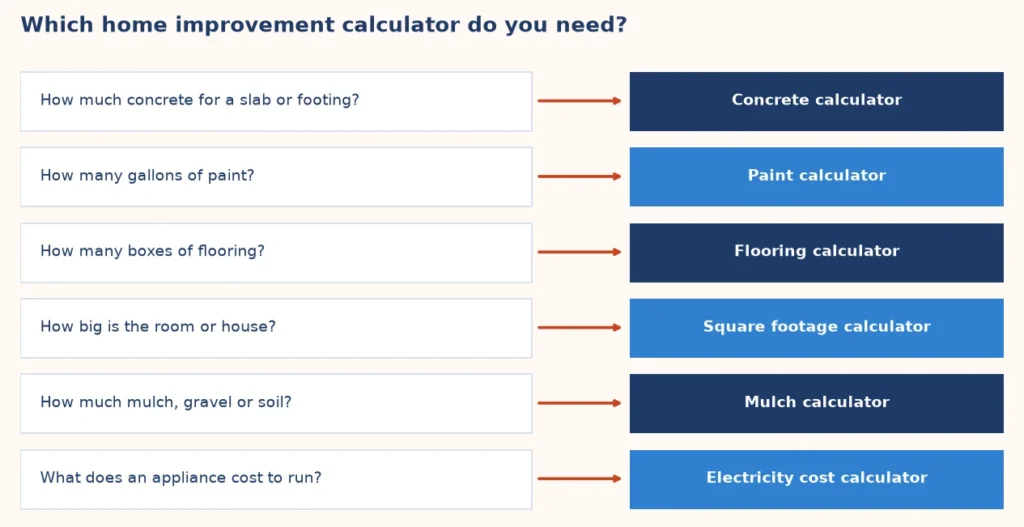
Home improvement calculators all start with a measurement and end with something you can buy. The table matches the job to the tool and shows what you get back. Measure twice, type the numbers in feet or meters and the calculator handles the conversions, the waste and the rounding up to whole bags, boxes or gallons.
| If you want to… | Use this calculator | You get |
|---|---|---|
| Pour a slab, footing, wall or column | Concrete calculator | Cubic yards or meters, bags and ready-mix |
| Paint walls, ceilings, trim or doors | Paint calculator | Gallons or liters and cost for each coat |
| Lay planks, laminate, vinyl or tile | Flooring calculator | Boxes or tiles with waste included |
| Add up the area of several rooms | Square footage calculator | Total square feet and cost per square foot |
| Cover beds with mulch, gravel or soil | Mulch calculator | Cubic yards, bags and weight |
| Find the cost of running an appliance | Electricity cost calculator | kWh and cost per day, month and year |
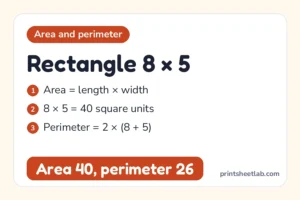
| Find the area or perimeter of one shape | Perimeter and area calculator | Area and perimeter of six shapes |
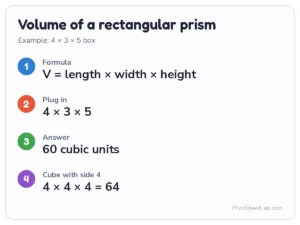
| Find the volume of a tank or box | Volume calculator | Volume of six shapes |
| Convert feet to meters or gallons to liters | Unit converter | Any length, area or volume unit |
Concrete and construction calculators: slabs, footings and bags
Construction calculators for concrete work in volume. A slab is length × width × thickness, with thickness in feet, so 4 inches is 4 ÷ 12 = 0.333 ft. A 10 × 10 ft slab at 4 inches is 33.33 cubic feet, which is 33.33 ÷ 27 = 1.23 cubic yards. Add 10% for waste and uneven ground and you order 1.36 cubic yards. The concrete calculator also covers footings, walls and round columns.
For small jobs, buy bagged mix. An 80 lb bag yields about 0.6 cubic feet, so 36.67 cubic feet needs 61.1 bags, which rounds up to 62. Smaller bags yield less: a 60 lb bag gives about 0.45 cubic feet and a 40 lb bag about 0.30. Above roughly 1 to 2 cubic yards, ready-mix delivery is usually easier and cheaper than mixing by hand.
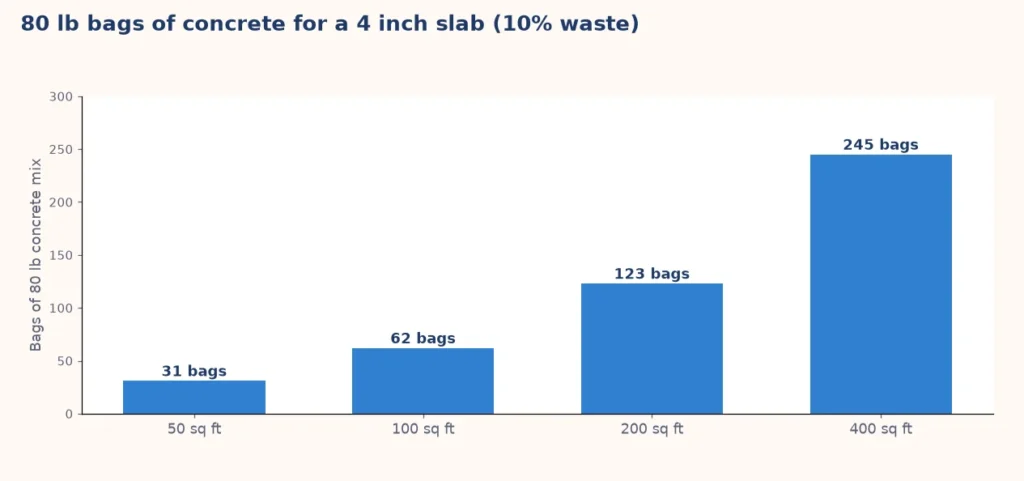
| Slab area | Cubic yards (4 in) | With 10% waste | 80 lb bags | Cubic yards at 6 in, with waste |
|---|---|---|---|---|
| 50 sq ft | 0.62 | 0.68 | 31 | 1.02 |
| 100 sq ft | 1.23 | 1.36 | 62 | 2.04 |
| 200 sq ft | 2.47 | 2.72 | 123 | 4.07 |
| 400 sq ft | 4.94 | 5.43 | 245 | 8.15 |
Wikipedia’s article on concrete explains the mix of cement, water and aggregate. Building codes set the thickness and reinforcement for structural work, so use a calculator for the quantity and a professional for the design.
Paint and renovation calculators: gallons, coats and coverage
Renovation calculators for paint work in area. Wall area is the room perimeter times the ceiling height, minus doors and windows. A 12 × 14 ft room with 8 ft ceilings has a perimeter of 52 ft and a gross wall area of 416 sq ft. Taking off one door and two windows (50 sq ft) leaves 366 sq ft. At two coats and 350 sq ft per gallon with 10% extra, you need 366 × 2 ÷ 350 × 1.1 = 2.3 gallons, so you buy 3 gallons.
| Room | Wall area to paint | Gallons for 2 coats | Gallons to buy |
|---|---|---|---|
| 10 × 10 ft | 270 sq ft | 1.7 | 2 |
| 12 × 12 ft | 334 sq ft | 2.1 | 3 |
| 12 × 14 ft | 366 sq ft | 2.3 | 3 |
| 14 × 16 ft | 430 sq ft | 2.7 | 3 |
| 16 × 20 ft | 526 sq ft | 3.3 | 4 |
The table assumes 8 ft ceilings, 50 sq ft of openings, 350 sq ft per gallon and 10% extra. The paint calculator lets you change the coats and coverage, add ceilings, trim and doors, and enter the price per gallon. Check the label on the can, because primer, dark colors and rough walls cover less.
Flooring and square footage calculators
Flooring starts with square footage. The square footage calculator adds up rooms and shapes, so a 14 × 12 ft room is 168 sq ft and an example house of seven spaces comes to 792.3 sq ft, or 73.6 m². Cost per square foot then turns the area into a budget.
The flooring calculator then adds waste for cuts and mistakes. For 168 sq ft with 10% waste you need 184.8 sq ft. In boxes of 20 sq ft that is 9.24, so you buy 10 boxes and keep 32 sq ft spare for repairs.
| Layout | Typical waste | Area to buy for 168 sq ft | Boxes of 20 sq ft |
|---|---|---|---|
| Straight lay in a simple room | 5% | 176.4 sq ft | 9 |
| Standard allowance | 10% | 184.8 sq ft | 10 |
| Diagonal, herringbone or many cuts | 15% | 193.2 sq ft | 10 |
Landscaping calculators: mulch, gravel and topsoil
Landscaping calculators work in cubic yards. The mulch calculator uses the shortcut cubic yards = square feet × inches ÷ 324. A 200 sq ft bed at 3 inches deep needs 200 × 3 ÷ 324 = 1.85 cubic yards, or 25 two-cubic-foot bags. The same tool handles gravel, topsoil, sand and compost and shows weight, since a yard of gravel weighs about 2,565 pounds and a yard of mulch about 440.
Clemson Cooperative Extension advises keeping fine mulch to 2 or 3 inches deep and clear of plant stems and building walls. Use the depth guidance before you order, because the depth changes the volume more than anything else.
Electricity cost calculators for the home
Not every home project is a purchase. The electricity cost calculator shows what existing appliances cost to run. Energy is power times time: kWh = watts × hours ÷ 1,000, and cost = kWh × price per kWh. A 1,000 W window air conditioner running 8 hours uses 8 kWh a day, which costs $1.44 at 18 cents per kWh, $43.20 for 30 days and $172.80 over a four-month summer.
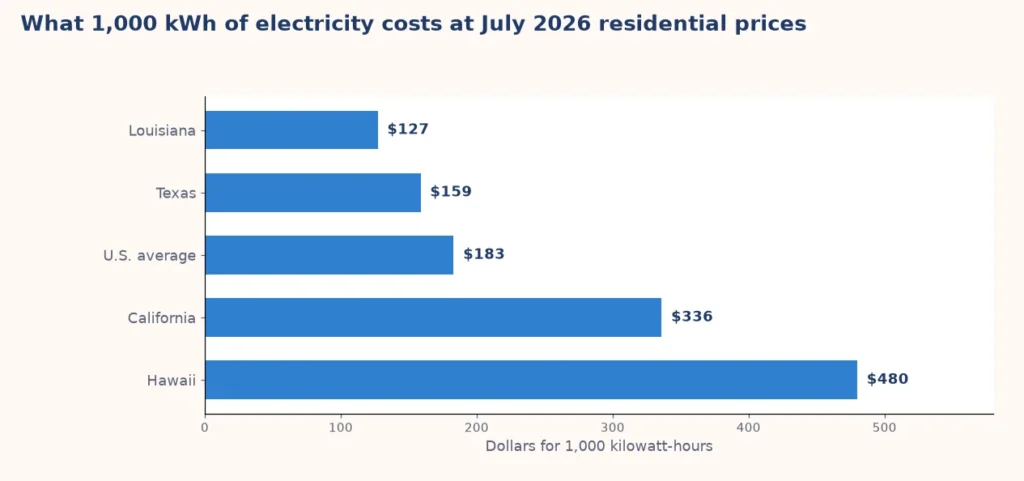
The price matters as much as the wattage. The US Energy Information Administration reported an average residential price of 18.31 cents per kWh for July 2026, but state prices ranged from 12.72 cents in Louisiana to 48.00 cents in Hawaii, so the same appliance costs very different amounts to run.
| Appliance (typical) | Watts | Hours a day | kWh per month | Cost per month at 18.31 cents |
|---|---|---|---|---|
| LED bulb | 10 | 5 | 1.5 | $0.27 |
| Ceiling fan | 75 | 8 | 18.0 | $3.30 |
| Laptop | 50 | 8 | 12.0 | $2.20 |
| Television | 100 | 5 | 15.0 | $2.75 |
| Window air conditioner | 1000 | 8 | 240.0 | $43.94 |
| Space heater | 1500 | 8 | 360.0 | $65.92 |
Wattages are typical figures, so read the label on your own appliance. Heating and cooling devices dominate a bill, which is why a space heater costs about 30 times as much to run as a laptop.
Building material calculators: how much waste to add
Building material calculators give the exact amount, but real projects need a little more. Waste covers cuts, breakage, spills and uneven surfaces. Order too little and you may not match a batch or color later; order too much and you pay for unused material. These starting points are common in the trade.
| Material | Typical waste to add | Why |
|---|---|---|
| Concrete | 5% to 10% | Uneven ground and spillage |
| Paint | 10% | Roller loss and touch-ups |
| Flooring (straight lay) | 5% to 10% | Cuts at the walls |
| Flooring (diagonal or pattern) | 15% | More cut-offs |
| Mulch, gravel and soil | 5% to 10% | Settling and uneven beds |
Home improvement calculators by country
Home improvement calculators have to match the units you buy in. In the United States, concrete and mulch are sold in cubic yards, paint in gallons and flooring in square feet. In Canada, builders mix feet and inches with metric. In the UK, Australia and New Zealand, concrete and soil are ordered in cubic meters, paint in liters and flooring in square meters, so switch the units before you type. Electricity is priced per kWh everywhere, in cents in the US, Canada and Australia and in pence in the UK.
| Material | United States | Canada | UK and Australia |
|---|---|---|---|
| Concrete | Cubic yards, 80 lb bags | Cubic yards or meters, 30 kg bags | Cubic meters, 20 to 25 kg bags |
| Paint | Gallons (3.785 L) | Liters or gallons | Liters |
| Flooring | Square feet | Square feet | Square meters |
| Mulch and soil | Cubic yards, cubic feet bags | Cubic yards | Cubic meters, liter bags |
Real-life uses of DIY calculators
A bedroom refresh. A 12 × 14 ft bedroom needs 3 gallons of paint (about $120 at $40 a gallon) and 10 boxes of flooring (about $700 at $3.50 per sq ft). That is $820 before tools, and adding a 10% contingency gives $902.
A backyard patio. A 10 × 12 ft patio slab at 4 inches is 120 sq ft. The concrete calculator gives 1.63 cubic yards with waste, which is a ready-mix order rather than bags.
A summer power bill. A window air conditioner for 4 months at 8 hours a day costs $172.80 at 18 cents per kWh. Switching to a fan for part of the day saves a share of that.
Home and DIY calculators: planning a project from start to finish
Home and DIY calculators work best in a sequence. Start with the square footage calculator to measure each room, then use paint calculators and flooring calculators for finishes, concrete or landscaping calculators for outdoor work and the electricity cost calculator for the running costs afterwards. Each answer feeds the next one, and the same measurements are reused.
Write every result in one list with the quantity, the unit and the waste you added. Renovation calculators and construction calculators cannot replace a quote, but a list built from DIY calculators lets you compare suppliers on the same numbers and spot a quote that is far off. Keep a contingency of 10% in the budget for the surprises that every project has.
Questions people ask about DIY calculators
How do I calculate how much concrete I need?
Multiply length by width by thickness, all in feet, to get cubic feet, then divide by 27 for cubic yards. A 10 × 10 ft slab at 4 inches is 33.33 cubic feet, or 1.23 cubic yards. Add 5% to 10% for waste.
How many gallons of paint do I need for a room?
Find the wall area, subtract doors and windows, multiply by the coats and divide by the coverage per gallon, usually about 350 square feet. A 12 × 14 ft room with 8 ft walls needs about 2.3 gallons for two coats, so buy 3.
How much extra flooring should I buy?
Buy 5% to 10% extra for a simple layout and 15% for diagonal or patterned installs. For 168 sq ft that is 176 to 193 sq ft, and rounding up to full boxes covers it.
Common mistakes with home improvement calculators
Most errors with DIY calculators and other building material calculators come from units and rounding, not from the formulas.
- Mixing inches and feet. Convert thickness to feet (divide inches by 12) before multiplying.
- Forgetting waste. Exact quantities leave no room for cuts or uneven ground.
- Not subtracting openings. Doors and windows do not need paint, so count them out of the wall area.
- Ignoring bag or box sizes. You buy whole bags and boxes, so always round up.
- Using the wrong electricity price. Type your own rate from your bill instead of an example.
Frequently asked questions
9 quick answers
What are home improvement calculators?
Home improvement calculators and other DIY calculators are free tools that estimate the materials or costs of a DIY or renovation job, such as concrete, paint, flooring, mulch and electricity. They take your measurements and return quantities, usually with a waste allowance.
How many bags of concrete make a cubic yard?
About 45 bags of 80 lb mix make a cubic yard, because one bag yields about 0.6 cubic feet and a cubic yard is 27 cubic feet. For 60 lb bags it is about 60 bags, and for 40 lb bags about 90.
How much paint covers 100 square feet?
A gallon of paint covers about 350 square feet per coat, so 100 square feet needs about 0.29 gallons for one coat or 0.57 gallons for two coats. Round up to the next quart or gallon.
How do I calculate the square footage of a room?
Multiply the length by the width in feet. A room 14 ft by 12 ft is 168 square feet. For an L-shaped room split it into rectangles, calculate each and add the areas together.
How much does it cost to run an appliance?
Multiply the watts by the hours used, divide by 1,000 to get kWh, and multiply by your price per kWh. A 1,500 W heater for 8 hours uses 12 kWh, which costs $2.20 at 18.31 cents per kWh.
How much extra material should I buy?
Add about 10% for most jobs, 5% for simple flooring layouts and 15% for diagonal patterns. Round up to whole bags, boxes or gallons, and keep the leftovers for repairs.
How many cubic yards of mulch do I need?
Multiply the area in square feet by the depth in inches and divide by 324. A 200 sq ft bed at 3 inches needs 1.85 cubic yards. Landscaping calculators such as the mulch calculator also give the number of bags.
Do the calculators work in meters and liters?
Yes. Switch the units to meters, liters or kilograms and the calculators give cubic meters, liters and kilograms, which is how materials are sold in the UK, Australia and New Zealand.
Are these home improvement calculators free?
Yes. They are free, need no account and run in your browser. The results are planning estimates, so confirm quantities with your supplier and follow local building rules.
More calculator hubs
- All free online calculators with steps for every topic
- Conversion calculators for feet, meters, gallons and liters
- Math calculators for area, volume and the Pythagorean theorem
- Financial calculators for loans, markup and tax on projects
- Date and time calculators for project timelines and business days
- Health and fitness calculators for fitness and energy needs
Sources and further reading
- Clemson Cooperative Extension: Mulch (depth and distance from stems and walls)
- U.S. EPA: Standard volume-to-weight conversion factors (weights per cubic yard)
- U.S. Energy Information Administration: Average price of electricity by state (July 2026)
- Wikipedia: Concrete (ingredients and use)
Quantities and prices are planning estimates, not quotes; confirm with your supplier and follow local building codes. Last updated: October 2026.