Calligraphy practice paper is ruled in nib widths, not in inches, so the letters you draw have the right proportions for your pen. This free printable calligraphy practice paper draws the ascender, x-height and descender lines for nibs from 1 to 5 mm, with a nib-width ladder at the start of each line and optional slant lines for italic, copperplate or Spencerian hands.
Calligraphy practice paper to print (PDF)
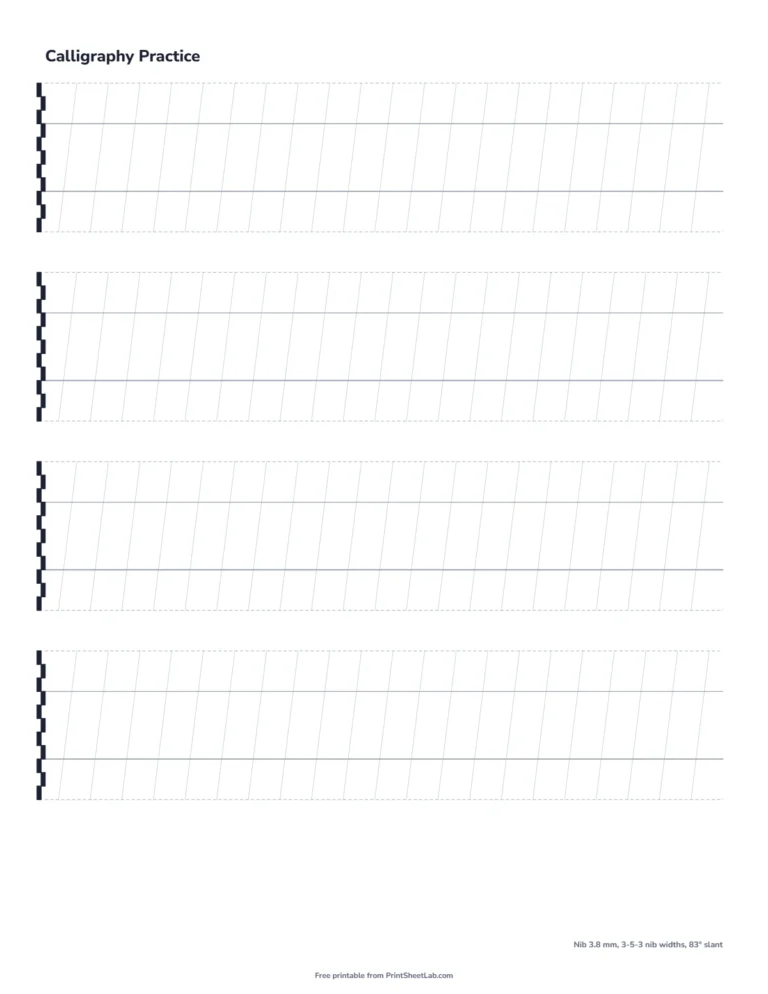
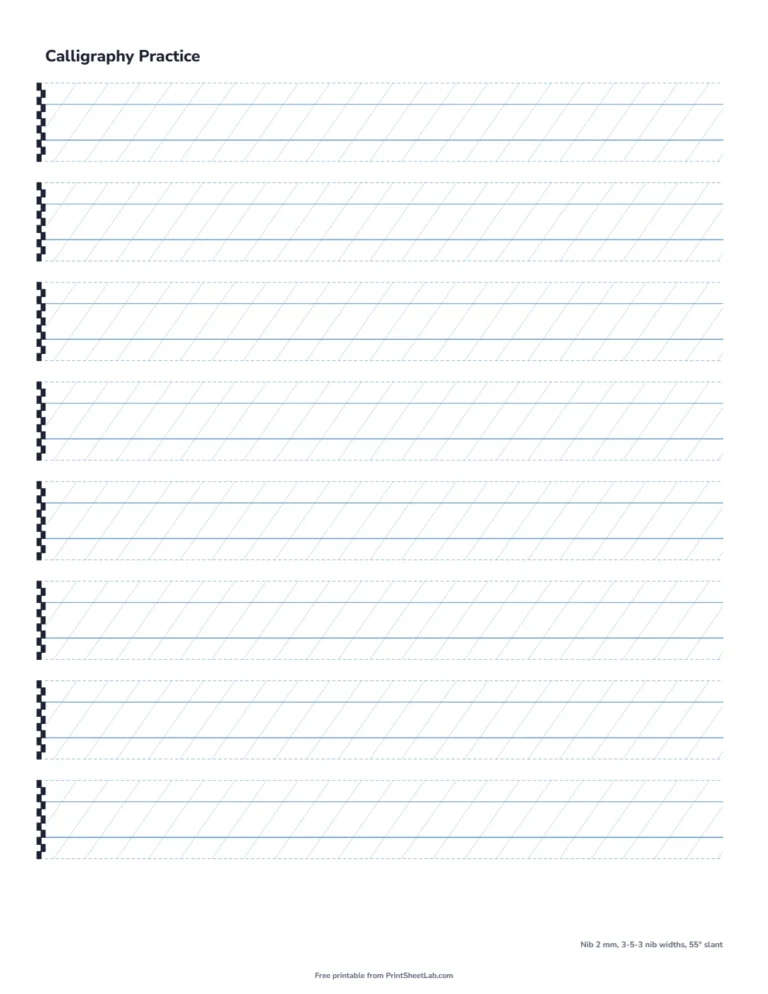
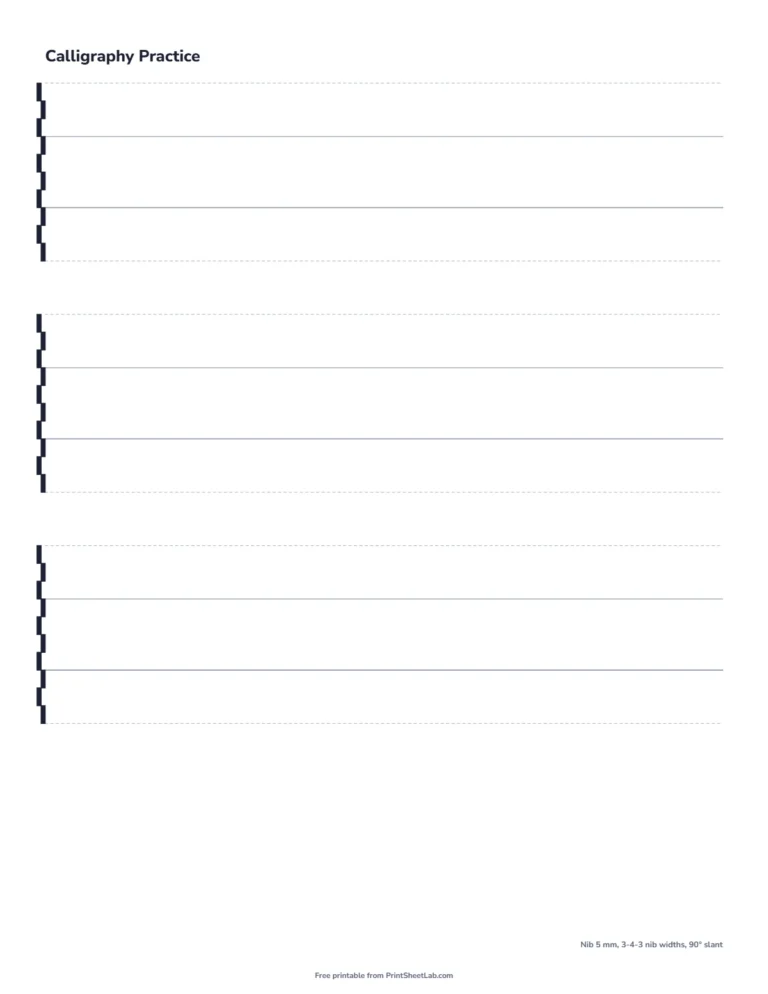
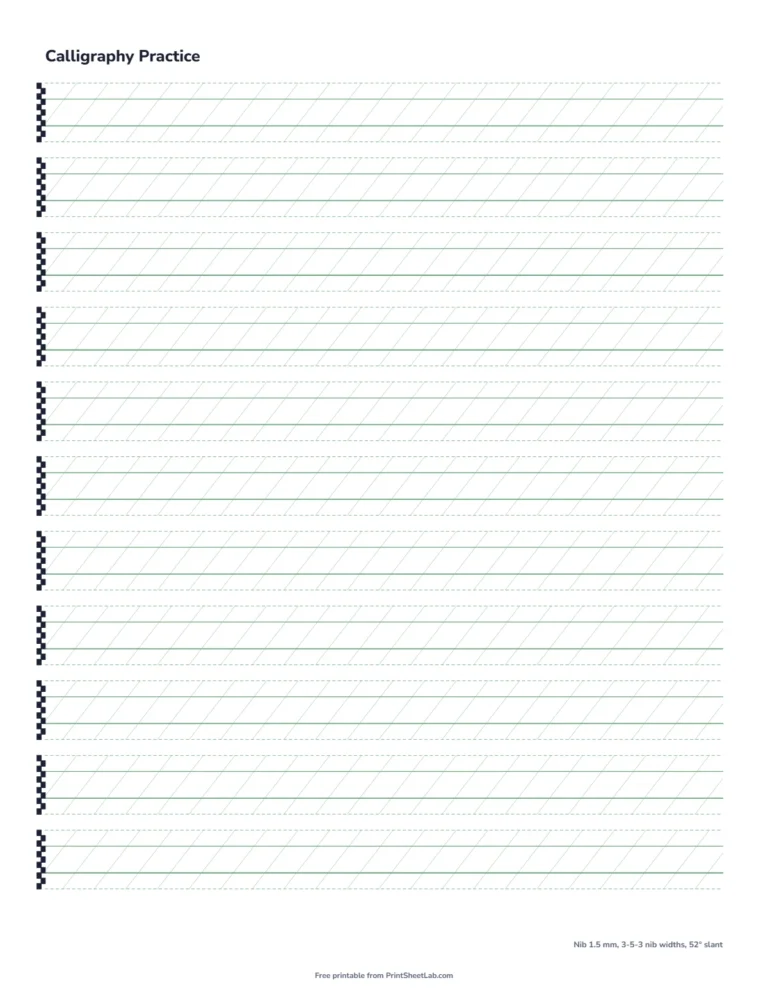
These four pages show the choices: an italic sheet for a 3.8 mm nib, a copperplate sheet for a 2 mm nib, a foundational hand sheet for a 5 mm nib with no slant lines, and a Spencerian sheet for a 1.5 mm nib. Click a picture for the PDF, or use the generator above to set the nib width, the line heights, the slant and the color.
How calligraphy guide sheets are measured
Each row on the sheet has four horizontal lines: a dashed line at the top of the ascenders, a solid line at the x-height, a thicker baseline and a dashed line at the bottom of the descenders. The distance between them is a whole number of nib widths. You choose 2, 3 or 4 nib widths for the ascender, 4, 5 or 6 for the x-height and 2, 3 or 4 for the descender. The sheet shows a default of 3, 5 and 3. Because the rows scale with the nib, a copy that is made for a 3.8 mm nib has exactly the same proportions as one for a 1 mm nib, only larger.
Calligraphy paper printable: how many rows fit on a page?
A larger nib needs taller rows, so fewer rows fit on a Letter page. There is also a gap of 3 nib widths between rows. This table is from the real generator output with the default 3-5-3 setting:
| Nib width | Row height (3-5-3 nib widths) | Rows on a US Letter page | Suits |
|---|---|---|---|
| 1 mm | 11 mm (0.43 in) | 17 | Fine pointed-style writing and small hands |
| 1.5 mm | 16.5 mm (0.65 in) | 11 | Everyday italic and envelope addressing |
| 2 mm | 22 mm (0.87 in) | 8 | Italic and copperplate practice |
| 3 mm | 33 mm (1.30 in) | 5 | Learning the letter shapes |
| 3.8 mm | 41.8 mm (1.65 in) | 4 | First lessons with a broad marker or parallel pen |
| 5 mm | 55 mm (2.17 in) | 3 | Very large letters, posters and children |
The x-height changes the row count as well. With a 2 mm nib and a 3 and 3 ascender and descender, the number of rows is:
| x-height | Rows on a page with a 2 mm nib (3 and 3 for ascender and descender) | Row height |
|---|---|---|
| 4 | 9 | 20 mm (0.79 in) |
| 5 | 8 | 22 mm (0.87 in) |
| 6 | 8 | 24 mm (0.94 in) |
Nib width guide: how to find the width of your pen
The nib width is the width of the flat edge of the pen. To find it, make a ladder: hold the nib at your pen angle and make a short horizontal stroke, then move straight down and make another touching the first, and keep going. Each block is one nib width tall. If your ladder does not match the printed one, choose the nearest setting. The printed ladder at the start of every row is a quick check: if your x-height is five of your own blocks, it also fits the sheet.
Many pens give the width on the label. Metric nib sizes such as 1.5, 3.8 and 5 mm are common, and the sheet offers 1, 1.5, 2, 3, 3.8 and 5 mm.
Italic calligraphy guidelines and copperplate calligraphy paper
For copperplate calligraphy paper, the slant lines on the sheet follow the style you are practicing. Angles are measured from the baseline, so 90° is straight up and a smaller number leans further over. The generator offers 83°, 60°, 55°, 52° and no slant lines:
| Style | Slant setting | x-height | Pen |
|---|---|---|---|
| Foundational hand | No slant lines (90°) | 4 nib widths | Broad-edged nib held at about 30° |
| Italic | 83° (7° from vertical) | 5 nib widths | Broad-edged nib held at about 45° |
| Copperplate | 55° | Set by the writer, often with short ascenders and descenders | Flexible pointed nib |
| Spencerian | 52° | Set by the writer | Flexible pointed nib |
For the history of the scripts, see Wikipedia’s calligraphy article. The slant lines are drawn about every 0.35 inch along the row, so they are close enough to guide a letter without crowding it.
A simple practice plan for calligraphy guide sheets
- Warm up with ladders and lines. Fill a row with vertical strokes, then diagonals, then ovals, keeping them all the same height.
- Learn letters in families. In italic, start with the oval letters (a, c, d, e, g, o, q), then the arch letters (n, m, h, r), then the stroke letters (i, j, l, t, u, y).
- Check the x-height. Compare each letter to the x-height line, and keep ascenders and descenders on their dashed lines.
- Write words. Space the letters so that the gaps look equal, and the gaps between words about the size of an o.
- Print a fresh sheet each time, and keep the pages in order to see your progress.
Tips for better calligraphy practice paper
- Use smooth paper that does not feather. Thin printer paper is fine for drills, and a heavier smooth paper is better for ink.
- Place a plain sheet under your hand to keep the oil from your skin off the page.
- Print the guides in light gray if you plan to trace the finished work over a light box.
- Slow down. Consistent pressure and a fixed pen angle matter more than speed.
For everyday writing practice see handwriting paper or the lined paper page.
Printing tip
Print at 100% or “Actual size” and turn off “Fit to page”, so every measurement on the sheet is exact. Choose Letter or A4 paper in the generator before you download the PDF.
Calligraphy practice paper: frequently asked questions
What does the ladder at the start of each line show?
Alternating blocks, each one nib width tall, so you can check the proportions of your letters against your own nib.
Which slant should I choose for italic calligraphy?
Choose 83°, which is about 7 degrees from vertical. Copperplate uses a steeper 55° slant, and Spencerian uses about 52°.
How many nib widths should the x-height be?
Foundational hand uses 4 and italic uses 5. The generator lets you choose 4, 5 or 6.
Can I print calligraphy guide sheets for a nib that is not on the list?
Yes. Choose the closest nib width. The proportions stay the same, so the letters will be a little larger or smaller than the ideal.
Is this calligraphy practice paper free?
Yes. It is free to print for home and classroom use, with no sign-up.
More printable paper
- Specialty paper generator with every layout on this site
- Paper generator for lined, graph, dot grid, isometric and handwriting paper
- Graph paper, lined paper and dot grid paper