A percentage calculator finds a percent of a number, works out what percent one number is of another and measures percent change, with every step shown. This free percentage calculator also adds or subtracts a percent, finds the whole from a part, compares two numbers by percentage difference and undoes a percent change.
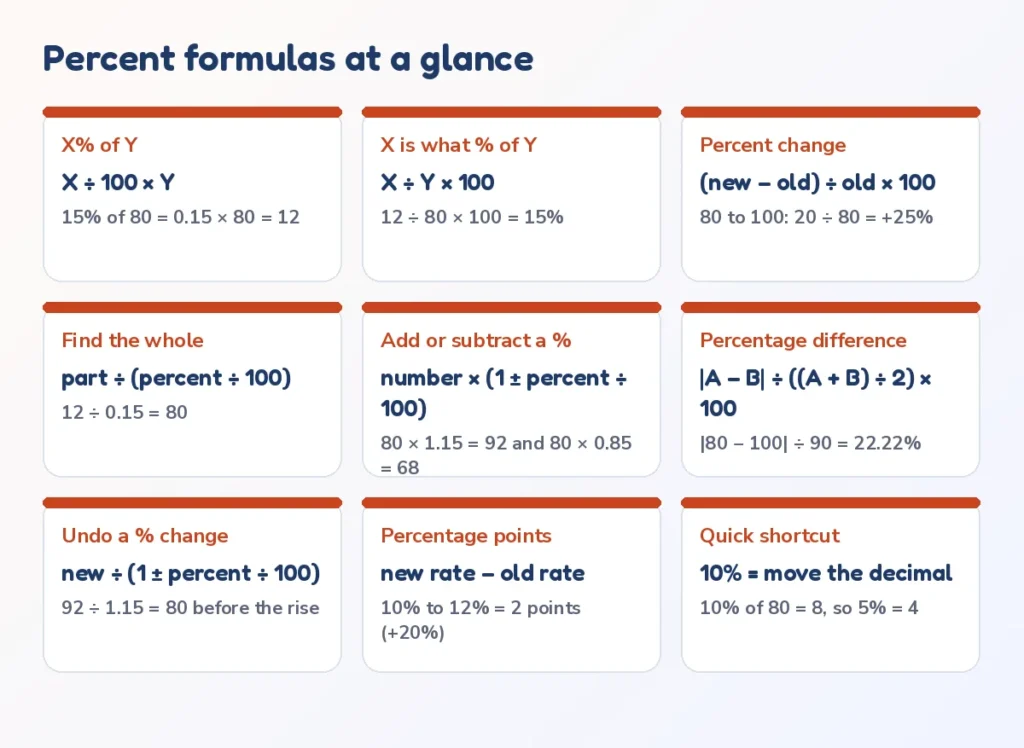
Quick answer: To find X% of Y, multiply Y by X ÷ 100: 15% of 80 = 0.15 × 80 = 12. To find what percent A is of B, divide A by B and multiply by 100: 12 ÷ 80 × 100 = 15%. For percent change, use (new − old) ÷ old × 100: going from 80 to 100 is a rise of 20 ÷ 80 = +25%.
How to use the percentage calculator
Pick a question from the buttons above the boxes, type your numbers and read the answer, which updates as you type. The working appears under How it works. Percent boxes already include the % sign, so type 15 for 15%, and tap a quick button such as 10% or 25% for common values. Copy result and Copy link share the answer or the exact numbers.
| Button | You type | Example | Answer |
|---|---|---|---|
| X% of Y | the percent and the number | 15% of 80 | 12 |
| X is what % of Y | the part and the whole | 12 out of 80 | 15% |
| % change | the old and the new value | 80 to 100 | +25% |
| Find the whole | the part and its percent | 12 is 15% of what | 80 |
| Add or subtract % | a number and a percent | 80 plus 15% | 92 |
| % difference | two numbers, no clear start | 80 and 100 | 22.22% |
| Undo a % change | the new value and the percent | 92 after a 15% rise | 80 |
Percent examples and a printable cheat sheet
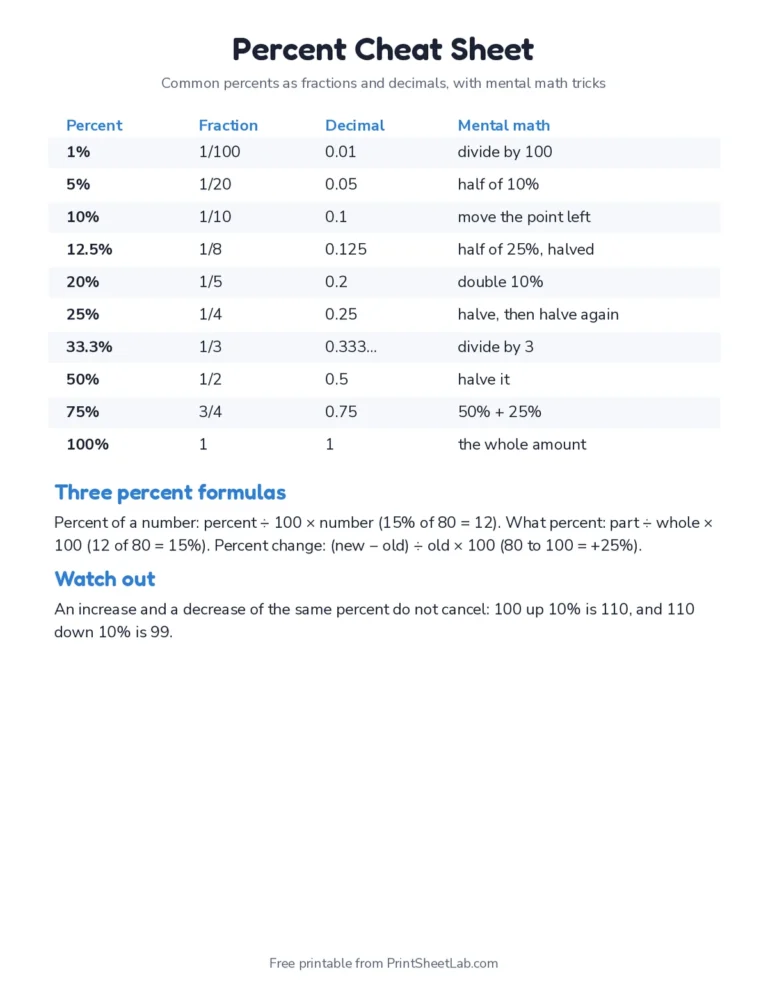
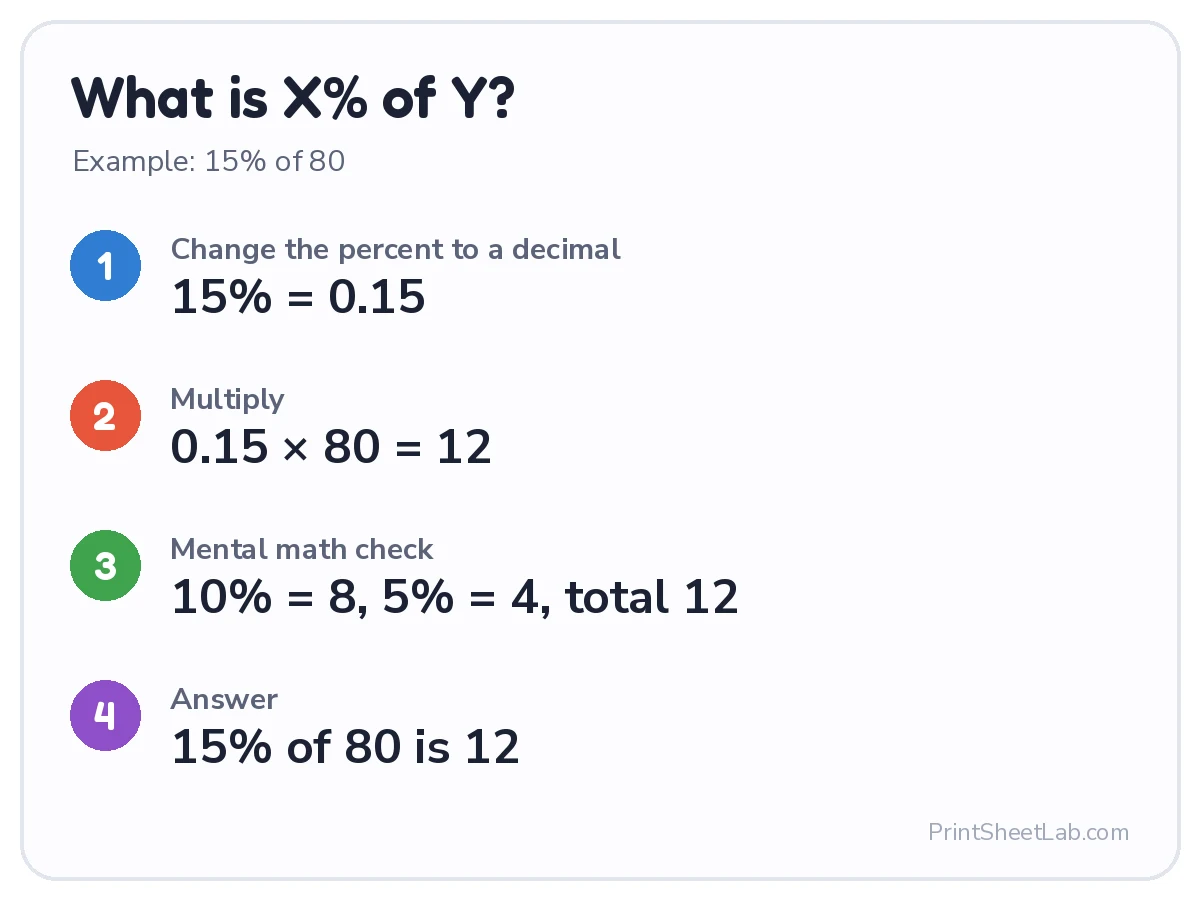
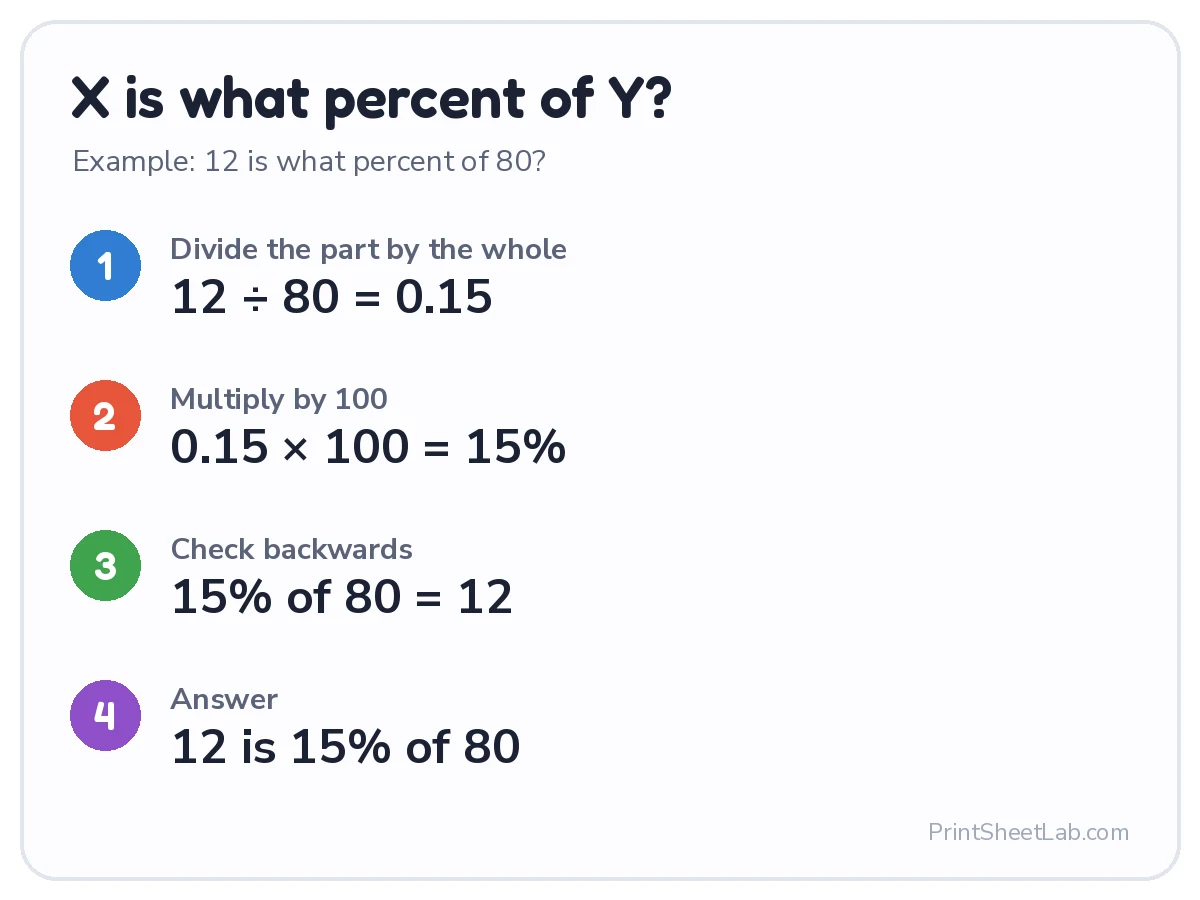
The cards walk through three of the questions with the same numbers, so you can see how they connect. The printable percent cheat sheet lists common percents as fractions and decimals, with a mental math trick for each.
How the percentage formulas work
Every percent problem has three ingredients: a part, a whole and a percent. The percentage calculator rearranges one relationship, part = whole × percent ÷ 100, to solve for whichever piece is missing.
Worked example 1. A sales rep earns a 12.5% commission on a $2,400 sale. Turn 12.5% into a decimal: 12.5 ÷ 100 = 0.125. Multiply by the sale: 0.125 × 2,400 = $300.
Worked example 2. A loaf of bread rises from $3.20 to $3.68. The change is 3.68 − 3.20 = 0.48. Divide by the old price: 0.48 ÷ 3.20 = 0.15. Multiply by 100 and the percent change is +15%.
Percent calculator: what is X% of a number?
Percent means “out of 100”, so 15% is 15 ÷ 100 = 0.15. To find 15% of 80, multiply: 0.15 × 80 = 12. This is the question behind discounts, tips, tax, commissions and test scores, and the table gives common answers.
| Percent | of 20 | of 50 | of 80 | of 200 | of 500 | of 1,000 |
|---|---|---|---|---|---|---|
| 5% | 1 | 2.5 | 4 | 10 | 25 | 50 |
| 10% | 2 | 5 | 8 | 20 | 50 | 100 |
| 15% | 3 | 7.5 | 12 | 30 | 75 | 150 |
| 20% | 4 | 10 | 16 | 40 | 100 | 200 |
| 25% | 5 | 12.5 | 20 | 50 | 125 | 250 |
| 30% | 6 | 15 | 24 | 60 | 150 | 300 |
| 50% | 10 | 25 | 40 | 100 | 250 | 500 |
| 75% | 15 | 37.5 | 60 | 150 | 375 | 750 |
For mental math, 10% of any number is the number with the decimal point moved one place left, so 10% of 80 is 8. Then 5% is half of that (4), 20% is double (16) and 15% is 10% + 5% (12). X% of Y is also Y% of X, so 8% of 50 equals 50% of 8, which is 4.
What percent of a number is another?
To find what percent of a whole a part is, divide the part by the whole and multiply by 100. 12 out of 80 is 12 ÷ 80 = 0.15, so 12 is 15% of 80. The answer can top 100% when the part is bigger than the whole: 120 is 150% of 80. Check backwards: 15% of 80 gives 12 again.
Number out of number as a percentage
Test scores work the same way: 42 out of 50 is 42 ÷ 50 × 100 = 84%, and 17 out of 20 is 85%. For scores and letter grades together, use the grade calculator.
Percent change calculator and percent increase calculator
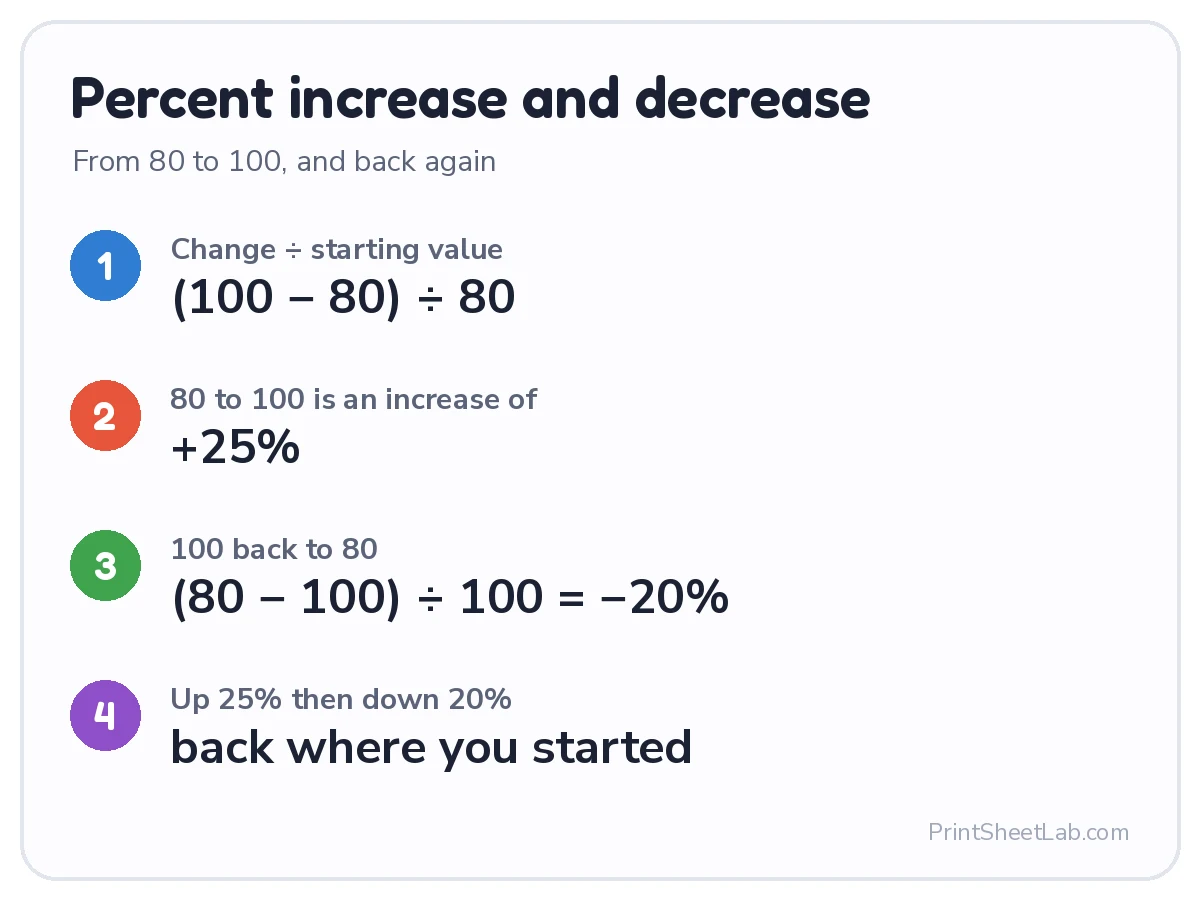
Percent change compares a new value to an old one: (new − old) ÷ old × 100. From 80 to 100 the change is 20, and 20 ÷ 80 = 0.25, so the percentage calculator gives +25%. From 100 down to 80 the change is −20, and −20 ÷ 100 = −0.2, a decrease of 20%. Always divide by the original, older value.
| Example | Old | New | Percent change |
|---|---|---|---|
| Bread price | 3.2 | 3.68 | +15% |
| Monthly rent | 1,200 | 1,260 | +5% |
| Hourly pay | 18 | 19.35 | +7.5% |
| Test score | 62 | 78 | +25.81% |
| Weight in kg | 80 | 72 | -10% |
| Website visits | 12,500 | 9,000 | -28% |
Percentage increase calculator: from one number to another
A percentage increase calculator answers how much bigger the new number is as a share of the old one. Type the starting number first and the ending number second. A rent rise from $1,200 to $1,260 is 60 ÷ 1,200 = 5%.
Percentage decrease calculator: finding a percent drop
A percentage decrease calculator uses the same formula and returns a negative number. Weight falling from 80 kg to 72 kg is (72 − 80) ÷ 80 = −0.1, so it is down 10%.
How much must it rise to recover a fall?
A fall needs a bigger percent rise to get back to the start, because the rise is measured on a smaller number. Going up 10% and then down 10% leaves 100 × 1.1 × 0.9 = 99, not 100.
| If it rises by | it must fall by | If it falls by | it must rise by |
|---|---|---|---|
| 10% | 9.09% | 10% | 11.11% |
| 20% | 16.67% | 20% | 25% |
| 25% | 20% | 25% | 33.33% |
| 50% | 33.33% | 50% | 100% |
Percent change with negative numbers
When the old value is negative, the calculator divides by its size, so going from −50 to −40 is +10 ÷ 50 = +20%, an improvement. Quote the plain difference too, because percent change is hard to read near zero.
Year over year percentage change and pay raises
Year over year change is (this year − last year) ÷ last year × 100. A salary that moves from $52,000 to $54,600 has risen 5%. For several years, multiply the multipliers: two 5% rises make 1.05 × 1.05 = 1.1025, which is 10.25%, not 10%.
Percentage difference calculator: comparing two numbers
Use a percentage difference calculator when neither number is the starting value, such as two stores or two lab readings. The formula divides the gap by the average of the two numbers: |A − B| ÷ ((A + B) ÷ 2) × 100. For 80 and 100 the gap is 20, the average is 90 and the difference is 22.22%. In the percentage calculator, choose the % difference button and type both numbers in any order.
This is the answer to many percentage calculator between two numbers searches, but it is not percent change. From 80 to 100 the change is +25%, from 100 to 80 it is −20%, yet the percentage difference is 22.22% both ways. To compare a measured value with a true value, use the percent error calculator.
Add or subtract a percentage from a number
To add a percent, multiply by 1 plus the percent as a decimal. To subtract it, multiply by 1 minus the decimal. Adding 15% to 80 is 80 × 1.15 = 92 and subtracting 15% is 80 × 0.85 = 68. The percentage calculator shows the multiplier and a lookup table for other percents.
| Percent | Add: multiply by | Subtract: multiply by | 200 plus | 200 minus |
|---|---|---|---|---|
| 5% | 1.05 | 0.95 | 210 | 190 |
| 10% | 1.1 | 0.9 | 220 | 180 |
| 15% | 1.15 | 0.85 | 230 | 170 |
| 20% | 1.2 | 0.8 | 240 | 160 |
| 25% | 1.25 | 0.75 | 250 | 150 |
For shopping, the tip, discount and sales tax calculator adds the tax and splits the bill.
Reverse percentages: finding the original number
If a jacket costs $48 after a 20% discount, $48 is 80% of the original price, so divide: 48 ÷ 0.8 = $60. If a price is $66 after a 10% increase, the original was 66 ÷ 1.1 = $60. The same reverse step removes sales tax from a receipt total, and the percentage calculator does it in one click.
Reverse percentage calculator: undo a percent change
A reverse percentage calculator divides by the multiplier. Choose Undo a % change, type 92, 15% and “It went up”, and it returns 80, because 80 × 1.15 = 92. Do not subtract 15% from 92 (that gives 78.2), because the 15% was measured on the original number.
Find the whole from a part and a percent
If 12 students are 15% of a group, the whole group is 12 ÷ 0.15 = 80 students. The Find the whole button does the division and checks it by taking the percent of the answer.
Percent, fraction and decimal
| Percent | Fraction | Decimal |
|---|---|---|
| 1% | 1/100 | 0.01 |
| 10% | 1/10 | 0.1 |
| 12.5% | 1/8 | 0.125 |
| 20% | 1/5 | 0.2 |
| 25% | 1/4 | 0.25 |
| 33.3% | 1/3 | 0.333… |
| 37.5% | 3/8 | 0.375 |
| 50% | 1/2 | 0.5 |
| 66.7% | 2/3 | 0.667… |
| 75% | 3/4 | 0.75 |
To turn a decimal into a percent, multiply by 100; to turn a percent into a decimal, divide by 100. The decimal to fraction calculator and the fraction calculator help with the rest. Wikipedia’s percentage article covers the history of the % sign.
Percent vs percentage points
A percent describes a share or a relative change. A percentage point is the plain gap between two percentages. If a rate rises from 10% to 12%, it has risen by 2 percentage points, but the percent change is 2 ÷ 10 = 20%.
| Rate changes from | Percentage points | Percent change |
|---|---|---|
| 10% to 12% | +2 | +20% |
| 4% to 5% | +1 | +25% |
| 50% to 55% | +5 | +10% |
| 20% to 10% | −10 | −50% |
The % change button adds a percentage points note when both numbers are between 0 and 100. See the Wikipedia percentage point page for the definition.
Percentage calculator for shopping, grades and science
- Shopping: a $40 sweater at 30% off saves 30% of 40 = $12, so it costs $28.
- Grades: 34 right out of 40 is 34 ÷ 40 = 85%.
- Science: a seedling that grows from 4 cm to 7 cm has increased by 75%.
- Work: a $22.00 hourly wage with a 4% raise becomes 22 × 1.04 = $22.88.
- Health: losing 6 pounds from 200 pounds is a 3% drop in body weight.
Each of these is one question in the percentage calculator, so you can check the working and the answer together.
How to calculate percentage of marks, scores and totals
To turn marks into a percentage, divide the marks you got by the total marks and multiply by 100. A student with 68 out of 80 has 68 ÷ 80 × 100 = 85%. For several tests, add the marks and the totals first: 68 + 42 = 110 out of 80 + 50 = 130, which is 84.62%, not the average of 85% and 84%. Use the percentage calculator for each test, then the grade calculator for the letter grade.
The same method turns any count into a share of a total: 9 red marbles in a bag of 40 is 22.5%, and 18 absent days out of 180 is 10% absence.
How to calculate percentage in Excel and Google Sheets
Spreadsheets store a percent as a decimal and show the % sign when the cell is formatted as Percent. These formulas give the same answers as the percentage calculator buttons, so use the calculator to check a spreadsheet.
| Question | Formula | Result |
|---|---|---|
| X% of Y (A2 = 15%, B2 = 80) | =A2*B2 | 12 |
| What percent (A2 = 12, B2 = 80) | =A2/B2 | 15% |
| Percent change (A2 = 80, B2 = 100) | =(B2-A2)/ABS(A2) | 25% |
| Add a percent (A2 = 80, B2 = 15%) | =A2*(1+B2) | 92 |
| Percentage difference (80 and 100) | =ABS(A2-B2)/AVERAGE(A2,B2) | 22.22% |
Percent or per cent: spelling and terms around the world
Americans write percent, while British, Australian and New Zealand writers often write per cent. The math is identical. A raise in the US is a pay rise in the UK and Australia. Taxes are percentages too: the standard UK VAT rate is 20% (GOV.UK), so a price of 120 with VAT added is 120 × 1.2 = 144, and 144 ÷ 1.2 takes it back to 120. Check your local tax office before relying on a rate.
Common percentage mistakes to avoid
- Dividing by the wrong number. Percent change divides by the old value, and “what percent” divides by the whole.
- Adding percents with different bases. A 20% rise then a 20% fall gives 100 × 1.2 × 0.8 = 96, not 100.
- Typing 0.15 in a percent box. Type 15 for 15%.
- Rounding too early. Keep the full number until the last step; the percentage calculator rounds only the answer it displays.
Percentage questions people ask
How do I calculate percentage backwards?
Divide the final number by the multiplier. If a bill is $54 after adding 8%, the original was 54 ÷ 1.08 = $50. The Undo a % change button shows the check.
How do I add a percentage to a number?
Multiply the number by 1 plus the percent as a decimal. To add 8% to 250, multiply 250 by 1.08 to get 270.
Can I calculate a percentage of a percentage?
Yes. Multiply the decimals: 20% of 50% is 0.2 × 0.5 = 0.1, which is 10%. Two stacked 20% coupons take 36% off, not 40%.
Percentage calculator: frequently asked questions
How do I calculate a percentage of a number?
Divide the percent by 100 and multiply by the number. 30% of 250 is 0.3 × 250 = 75. The percentage calculator does this on its first button.
How do I work out what percent of a number something is?
Divide the part by the whole and multiply by 100. 45 out of 60 is 75%.
What is the difference between percent change and percentage points?
If a rate goes from 10% to 12%, it rose by 2 percentage points, but the percent change is 20%, because 2 ÷ 10 = 0.2.
Can percent change be more than 100%?
Yes. Going from 50 to 150 is a 200% increase, and the percentage calculator shows it as +200%. A decrease can never be more than 100%.
Why can’t the starting value be zero?
Percent change divides by the starting value, and you cannot divide by zero.
What is 20% of 50?
10. Multiply 50 by 0.2, or take 10% (5) and double it. The percentage calculator gives any such answer with the steps.
How do I find 1% of a number?
Divide it by 100. 1% of 8,450 is 84.5.
How do I find a discount or a tip?
Use the What is X% of Y question, or the tip, discount and sales tax calculator.
Is 0.5 the same as 0.5%?
No. 0.5 is 50%, while 0.5% is 0.005. Type 0.5 into the percent box of the percentage calculator for 0.5%.
Related calculators
- How to Calculate Percentages in Your Head (Discounts, Tips and Marks): the full guide behind this page
- Tip, discount and sales tax calculator
- Percent error calculator
- Grade calculator
- Ratio calculator
- Rounding calculator
- Decimals worksheets
- All calculators
Sources and further reading
- Percentage (Wikipedia)
- Relative change (Wikipedia)
- Common Core 6th grade ratios and proportional relationships
Last updated: October 2026.