Pick one of five sizes and the maker opens with empty squares, so these blank bingo cards are ready for your own words, pictures or numbers. Use the five buttons above for a 5×5, 4×4, 3×3, 6×6 or 7×7 grid, type what you want in the squares, or print the cards empty and write on them by hand. Everything is free, runs in your browser and needs no sign-up.
In short: a blank card is just a grid. Choose the size that fits your group (3×3 for little ones, 5×5 for almost everyone), keep a free space in the middle of odd grids if you like, then fill the squares on screen or print the cards empty. One PDF can hold up to 100 cards, 1, 2, 4 or 6 to a page.
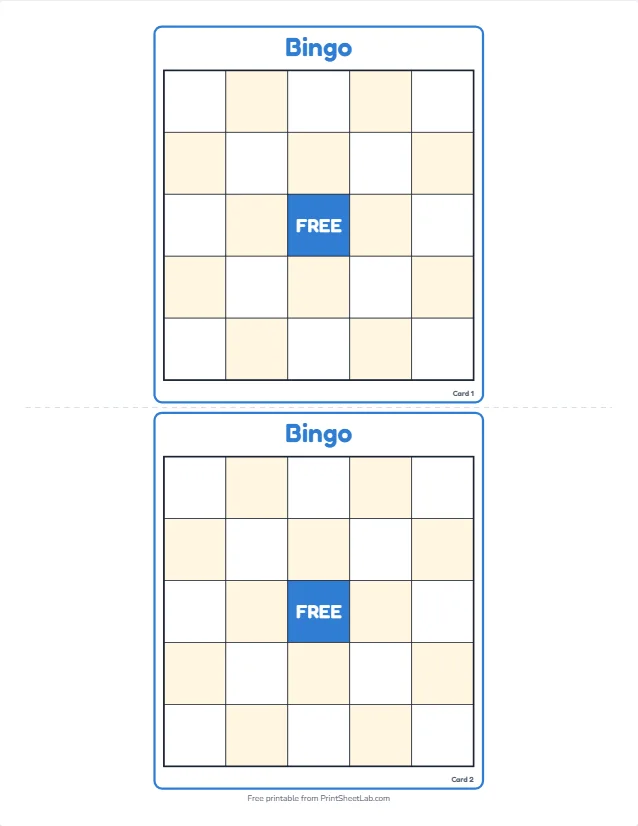
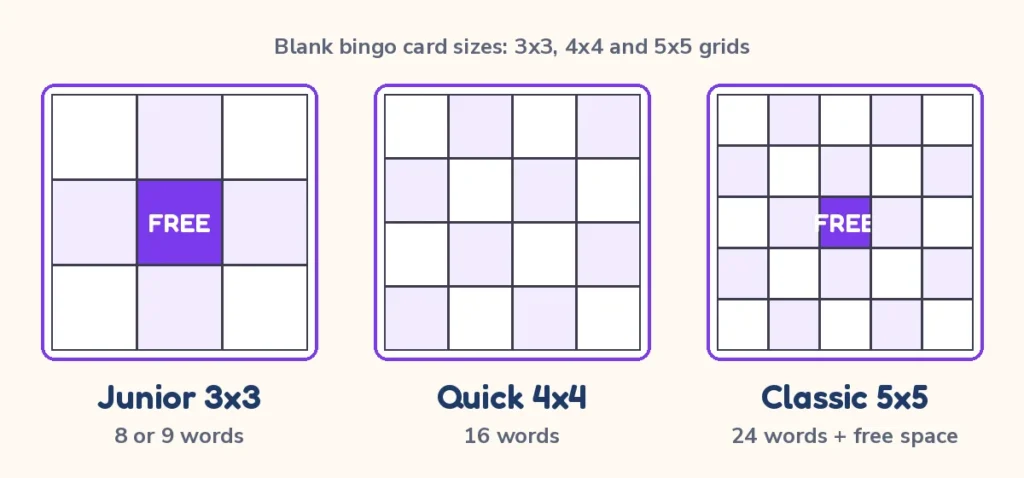
Blank bingo cards: the five sizes at a glance
The size of the grid decides how many words your blank bingo cards need, how long a game lasts and who can play. The table shows all five sizes the card maker offers. The word counts are exact: a card needs one word for every square that is not the free space, and a game works best when your list is a little longer than a single card.
| Grid | Squares | Words needed (with free space) | Words needed (no free space) | Best for | Typical first line* |
|---|---|---|---|---|---|
| 3×3 | 9 | 8 | 9 | Ages 3 to 6, picture and letter games | about 6 calls (1 card) |
| 4×4 | 16 | no middle square | 16 | Ages 6 to 8, quick classroom rounds | about 13 calls |
| 5×5 | 25 | 24 | 25 | Everyone from age 8, parties, classes, teams | about 17 to 23 calls |
| 6×6 | 36 | no middle square | 36 | Older students, longer rounds | about 30 calls |
| 7×7 | 49 | 48 | 49 | Large groups, review games, long events | about 45 calls |
*The last column is the median from a computer simulation of one card against a call list of 16, 24, 30 to 40, 48 and 70 words. With more cards in the room the first line arrives sooner, as the game-length section below shows. A free space in the middle is only possible on odd grids (3×3, 5×5 and 7×7), because even grids have no single center square.
5×5 blank bingo card: the classic grid
The 5×5 blank bingo card is the grid people picture when they hear the word bingo: five rows, five columns and a free space in the middle, which leaves 24 squares to fill. This blank bingo card has 12 winning lines (5 rows, 5 columns and 2 diagonals), so a first line comes quickly, and it is small enough for a child to read and large enough to hold a short word or a small picture.
Choose these blank bingo cards for birthday parties, baby showers, classroom review, team events and family nights. For a topic game you need at least 24 different words; 30 to 40 is better, because then every card holds a different mix and no two players finish at the same moment. The classic B-I-N-G-O number version uses the same grid, and you can read how the letters are used in this Wikipedia article on bingo.
4×4 blank bingo card: quick rounds
A 4×4 blank bingo card has 16 squares and no free space, because an even grid has no middle. That makes it the fastest of the popular sizes: with 24 words in the bag, one card finishes its first line after about 13 calls, and with 10 cards in the room the median drops to 9. These blank bingo cards are a good fit for first and second graders who tire of long games, for a five-minute warm-up and for short breaks in a lesson.
You need 16 words for one card, and a list of 20 to 24 words gives every player a slightly different card. The number of different word sets grows quickly: 20 words give 4,845 possible sets, and 24 words give 735,471. The order of the words inside the grid multiplies that again, so two players are very unlikely to hold the same card.
3×3 blank bingo card: the first bingo game
The 3×3 blank bingo card has nine squares and suits ages three to six. It works for letters, numbers up to 20, colors, shapes, animal pictures and sight words. With a free space in the middle only eight squares are left to fill, so a child can complete a card in a minute, and with a list of 16 words a single card wins its first line after about six calls.
On blank bingo cards for toddlers, keep the squares large and the words short, or use a picture in every square: the card maker accepts emoji and your own pictures as well as text. If the group is very young, skip the free space; nine easy words is a nicer first game than eight. Ready-made picture sets for this age are on the picture bingo for kids page.
6×6 and 7×7 grids for longer games
A 6×6 card has 36 squares and no free space, and a 7×7 card has 49 squares with a free space in the middle, so it needs 48 words. These large blank bingo cards suit older students, review games before an exam and big events where the game should last twenty minutes or more. With 70 words and ten cards in play, the median first line comes at call 33, and a full card (blackout) needs nearly every word to be called.
Because the squares are small, use short words, numbers or single pictures, and print one or two cards per page rather than six. Players need time to scan a 7×7 card, so call a little slower than you would for a 5×5 game.
How to fill in blank bingo cards
There are two ways to fill blank bingo cards, and you can mix them. The first happens on screen, in the card maker that opens when you press one of the size buttons; the second happens at the table with a pen. Both give you a printable PDF.
On screen in the card maker
- Press the button for the grid you want. The maker opens with that size and empty squares.
- On the Setup tab, check the grid size, the title and whether the free space is on.
- Open the Items tab and type your words, one per line. Emoji and your own pictures work too.
- Open the Design tab to choose colors, fonts, borders and a logo.
- On the Print tab choose how many cards you need and how many go on a page, then download the PDF or print.
Every card gets its own random arrangement of your list, so a set of 30 blank bingo cards, once filled, does not repeat. A 5×5 card with a free space needs 24 words; if you type more words than squares, different cards use different words. Press Shuffle for a new arrangement and Undo if you change your mind.
By hand on printed cards
If you want players to write their own words, print the blank bingo cards empty. A classroom can hand each student a card and a word bank, and a party host can give guests a pen and ask them to fill the squares from a list on the wall. Filling the card is part of the fun, and it also makes a nice spelling or vocabulary exercise. The next section explains how that game, often called fill-in bingo, is run.
Blank bingo card template: three ways to use blank bingo cards
A blank bingo card template is useful in three different situations, and the right choice depends on who prepares the words.
1. Players fill their own cards (fill-in bingo)
With blank bingo cards, write 25 to 40 words on the board, or show them on a screen. Each player copies 24 of them into random squares, leaving the middle free. Because everybody chooses a different order, the cards are all different and nobody needs a printed set. This is the cheapest option and an excellent warm-up for spelling words, state names, or vocabulary: a learner who copies a word has to read it twice.
2. Teacher-made cards
Type the list once in the Items tab and print one PDF of blank bingo cards, filled in, for the whole class. A teacher gains control (the words are correct and age-appropriate) and saves time compared with copying by hand. Use the same list for the calling cards the maker can print and cut out, so the caller never has to read from a separate sheet.
3. Event bingo
With blank bingo cards for a baby shower, bridal shower, office party or family reunion, fill the squares with moments and items: “someone cries”, “a toast is given”, “the cake is cut”. Guests mark a square when it happens, so no caller is needed at all. Ready-made lists live on the baby shower bingo and bridal shower bingo pages, and you can edit every one of them.
Blank bingo board: the master list and the call sheet
A blank bingo board is the caller’s copy of the game: one big grid or list that holds every word that can be called. In a number game it is the 1 to 75 chart; in a word game it is simply your list. The caller crosses off each item as it is drawn, so that a winning card can be checked against the board in seconds.
Along with your blank bingo cards, the card maker can print a caller sheet and calling cards you cut out and draw from a bowl. If you prefer a screen, the bingo caller keeps the board for numbers 1 to 75 for you, with spoken calls and a list of what was called so far. For a word game with guests on their phones, use play custom bingo online, which has its own board that marks calls as they happen.
One rule makes checking easy: when a player shouts bingo, read their squares aloud and compare them with the board before you announce a winner. Do not accept a card without checking, however confident the player sounds.
How many different cards can one word list make?
The number of different word sets on a card is a combination: C(N, k) is the number of ways to choose k words from a list of N. For a 5×5 card with a free space k is 24. The table shows how fast the possibilities grow when you add words, which is why a list of 30 or 40 words is plenty for a class and 60 is more than a large party needs.
| Words in your list | 3×3, 8 words per card | 4×4, 16 words per card | 5×5, 24 words per card |
|---|---|---|---|
| exactly the card size | 1 | 1 | 1 |
| one more word | 9 | 17 | 25 |
| 20 words | 125,970 | 4,845 | not enough words |
| 24 words | 735,471 | 735,471 | 1 |
| 30 words | 5,852,925 | 145,422,675 | 593,775 |
| 40 words | 76,904,685 | 62,852,101,650 | 62,852,101,650 |
| 60 words | 2,558,620,845 | 149,608,375,854,525 | 36,052,387,482,172,425 |
These figures count the sets of words, not their positions. Each set can be laid out in 24! different orders on a 5×5 card, which is about 6.2 x 10²³, so in practice every card the maker prints is unique. The only way to get identical blank bingo cards, once filled, is a list with exactly 24 words, because then every card holds the same set, only in a different order. Add a few spare words and the problem disappears.
A related fact about blank bingo cards: with a larger list the game lasts longer, because fewer calls hit any one card. A 5×5 game with 30 words gives a first line after about 17 calls for a single card, but with 60 words the same card needs about 34.
How long does a game last?
The simulation below plays thousands of games with blank bingo cards filled from your list with random cards and a random call order, and reports the median call at which the first player completes a line. A card with a free space is used for the odd grids. At one call every 15 seconds, the times are comfortable for a classroom.
| Grid and list | 1 card | 10 cards | 30 cards | Time at 15 seconds per call (10 cards) |
|---|---|---|---|---|
| 3×3, 16 words | 6 | 3 | 2 | under 1 minute |
| 4×4, 24 words | 13 | 9 | 7 | about 2 minutes |
| 5×5, 30 words | 17 | 11 | 9 | about 3 minutes |
| 5×5, 40 words | 23 | 14 | 12 | about 3.5 minutes |
| 6×6, 48 words | 30 | 22 | 19 | about 5.5 minutes |
| 7×7, 70 words | 45 | 33 | 28 | about 8 minutes |
Plan a session of blank bingo cards as several short games rather than one long one. If a round is too quick, add words to the list or switch to four corners or a full card; if it drags, remove words or add a second winner per round.
Free space options on blank bingo cards
On odd grids the middle square can be free, and the maker lets you decide what it shows. Keep the classic word FREE, replace it with your own text, or put an emoji or a picture such as a logo or a school mascot in it. Switch the free space off and the middle square becomes an ordinary square that needs a word of its own, which makes the list one word longer.
- Free space on: a 5×5 card needs 24 words, a 3×3 card 8 and a 7×7 card 48.
- Free space off: a 5×5 card needs 25 words, a 3×3 card 9 and a 7×7 card 49.
- Even grids (4×4 and 6×6): no free space is possible, so they need 16 and 36 words.
- Own text or picture: a school crest, a baby photo or “Hooray!” instead of FREE.
Blank bingo cards printable: pages, paper and ink
For blank bingo cards printable on a home printer, the Print tab offers 1 to 100 cards, with 1, 2, 4 or 6 cards per page, Letter or A4 paper, portrait or landscape and optional cut guides. The page count follows from the number of cards, so you can see the size of the job before you print. The table and the picture show how many sheets a group of 30 players needs.
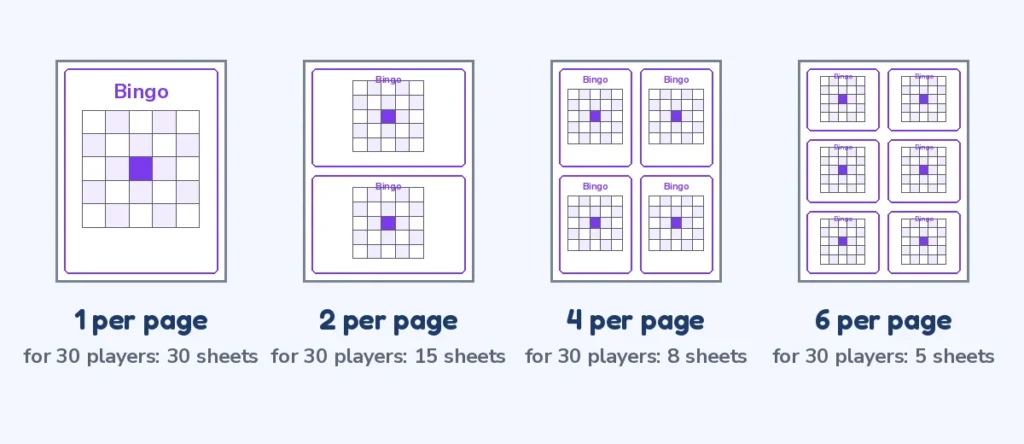
| Cards per page | Sheets for 30 cards | Best for |
|---|---|---|
| 1 | 30 | Large print, very young players, laminated mats |
| 2 | 15 | Classroom sets and 5×5 cards that need room to write |
| 4 | 8 | Party cards that you cut into quarters |
| 6 | 5 | Small 3×3 and 4×4 cards, or a quick game with spare paper |
Four tips for printing blank bingo cards that work: print one test page first and check that a pen fits in the squares; choose the plain square style and no page background to save ink; use cut guides and a paper trimmer for even edges; and print a few spare cards for latecomers.
Laminating and reusing cards
Blank bingo cards are made for reuse. Laminate them (or slip them into plastic sleeves), and players can write with a dry-erase marker and wipe the card for the next game. Use bingo chips, small candies or coins as markers. For classroom sets of blank bingo cards, print on card stock, laminate once, and use the same cards all year with a new list every week.
Free printable bingo cards on paper you already have
If you only need a plain grid, ordinary paper works too: print a single card from the blank bingo cards, copy it, and cut. A rule of thumb for pens: markers bleed through thin paper, so use pencils or fine-tip pens on 20 lb copy paper, and anything you like on card stock. For other grids and lines, see the printable paper hub.
Design your blank bingo cards
The Design tab changes how all your blank bingo cards look without touching the words. You can choose a color theme and a font, set the text size, switch on ALL CAPS, pick solid, double, dashed or no borders, round the corners, and select a grid, tile or plain square style. An alternate tint makes rows easier to follow, and you can set the card and page backgrounds to a color, a pattern or your own picture.
Add a logo and a title of your own, either as text or as a picture, and use the footer for a school name, a date or a short rule such as “mark with a dot”. For a clean card that saves ink, keep the white background and a thin border; for a party, choose a bold color and a themed title.
Blank bingo cards for specific themes
If you do not want to write a list for your blank bingo cards from scratch, start from a theme. Each page below opens the same card maker with a ready word list that you can edit, which is faster than a fully blank card but still lets you change every square.
- Baby shower bingo: mark each gift as it is opened.
- Christmas bingo: a holiday favorite for family and class.
- Road trip bingo: spot it from the car window.
- Classroom bingo: a back-to-school icebreaker with classroom objects.
- Bridal shower bingo: a game for the guests while the bride opens gifts.
The printable bingo cards hub lists all of the templates, and you can also browse picture games for children, such as animal bingo. All of them share one card maker, so everything you learn about printing and designing here applies to each.
Sight word classes can build their own cards from a list; see what are sight words for the usual lists and sight word worksheets for practice sheets to go with the game.
Number bingo: blank cards for 1 to 75
If your game uses numbers rather than words, blank bingo cards are only half of the job. Number cards have a rule: the B column holds 1 to 15, I holds 16 to 30, N holds 31 to 45, G holds 46 to 60 and O holds 61 to 75, and no number appears twice on a card. Filling that in by hand on blank bingo cards for 30 players is slow, so for number games use the bingo card generator, which creates a different valid 1-75 card for every player.
Then call the numbers for your blank bingo cards with the bingo caller: it draws every number once in random order, reads it aloud and keeps the call board. If the guests are not in the same room, the same words and numbers can be played live on play bingo online, where each guest gets a self-marking card on their phone.
Common mistakes with blank bingo cards
- Too few words. With exactly 24 words every 5×5 card holds the same set, so several players win at once. Add six or more spare words.
- Repeated words. A word that appears twice in your list can show up in a way that confuses players, so keep every entry different.
- Words that are too long. A 7×7 square holds one short word, so shorten the entries or use pictures.
- No call sheet. Keep a copy of your list so you can verify a winning card. A caller sheet is one click in the maker.
- Printing at the wrong scale. When you print blank bingo cards, choose “actual size” in the print dialog, otherwise the cards shrink.
Frequently asked questions
10 quick answers
Are these blank bingo cards really free?
Yes. The blank bingo cards and the card maker are free, needs no sign-up and runs in your browser, so your words are not uploaded. You can print as many cards as you like.
What sizes of blank bingo card can I make?
Five: 3×3, 4×4, 5×5, 6×6 and 7×7. The buttons at the top of the page open the maker with that grid already selected.
How many words do I need for a 5×5 card?
Twenty-four with a free space and 25 without. For a game with many players, use 30 to 40 words so that the cards differ.
Can I print blank bingo cards empty and write on them?
Yes. Leave the Items list empty, and the squares stay blank. Print the PDF, hand out pens, and let players write their own words.
How many blank bingo cards fit on one page?
You can print 1, 2, 4 or 6 cards per page on Letter or A4 paper, in portrait or landscape. Two per page is the usual choice for 5×5 cards.
Can I keep a free space in the middle?
On odd grids (3×3, 5×5 and 7×7) the middle square can be free. You can change its text or put an emoji or picture in it, or switch it off.
Can I use my own pictures or a logo?
Yes. Squares can hold your own words, emoji and pictures, and the Design tab accepts a logo and a title picture.
Is there a blank bingo card for numbers 1 to 75?
Use the bingo card generator for that. It creates 1-75 cards in which every column follows the B-I-N-G-O ranges, and the bingo caller reads the numbers.
Can I play with blank cards online?
Yes. Type your words into the custom online game, share one link, and every guest receives a different card that marks itself.
How do I reuse blank bingo cards?
Laminate the printed blank bingo cards and play with dry-erase markers or chips. Wipe clean and use them again with a new list.