This division facts game helps third graders learn to divide within 100 by playing: match division facts to their answers, pop balloons, race cars or sprint through true and false sentences. Every question divides a number up to 100 by a number from 2 to 10, such as 56 ÷ 8 or 90 ÷ 10, and the answer is always a whole number with no remainder. It is free, needs no sign-up, works on phones and tablets, and comes with a printable division facts chart.
Division facts game: see how it plays
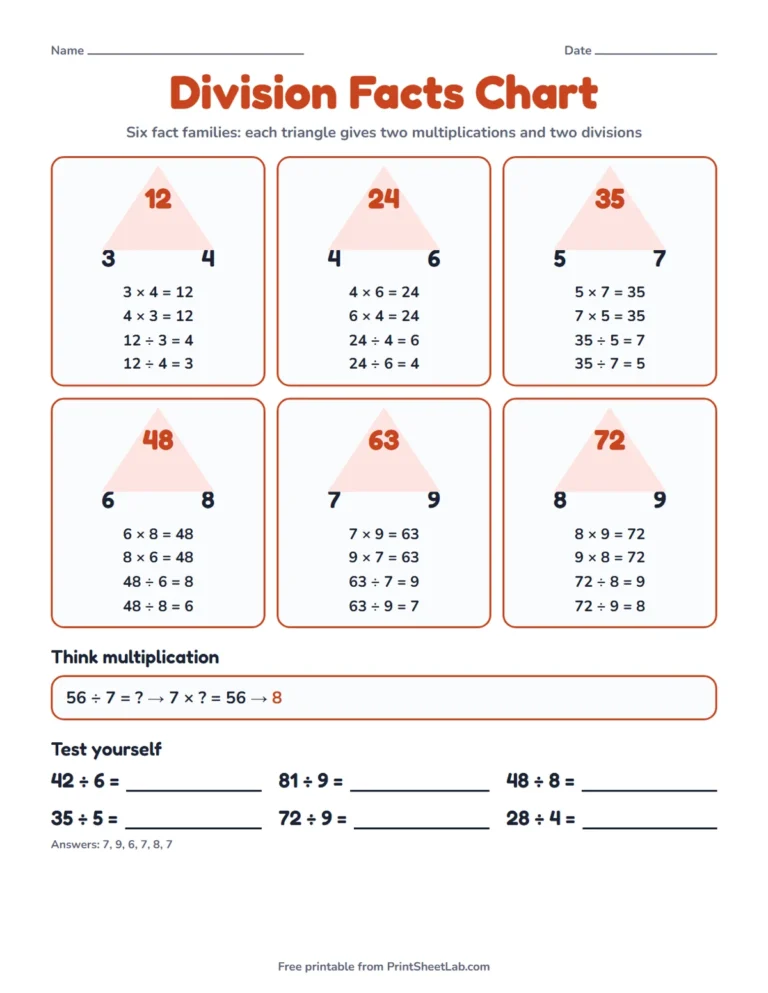
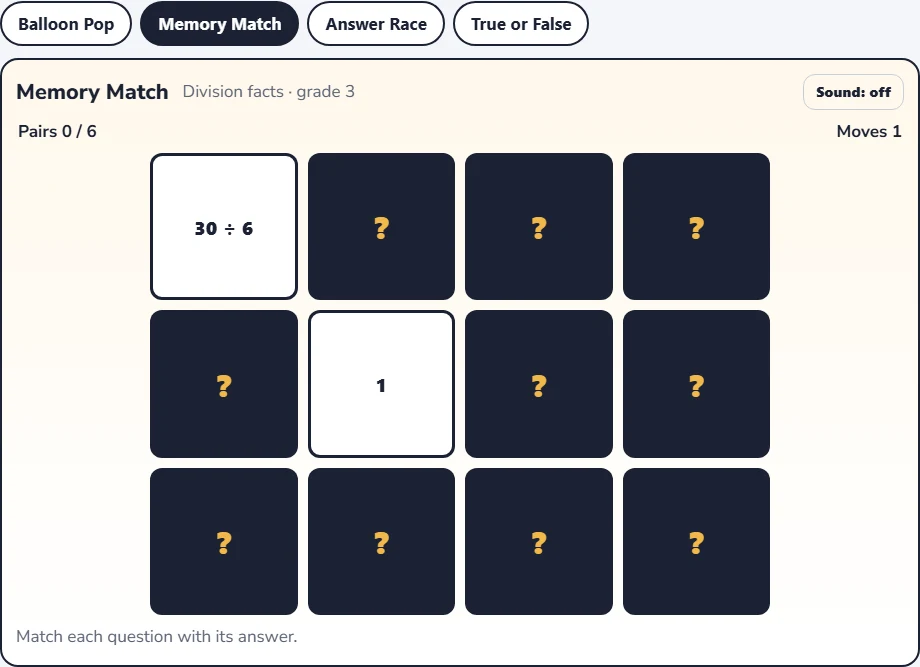
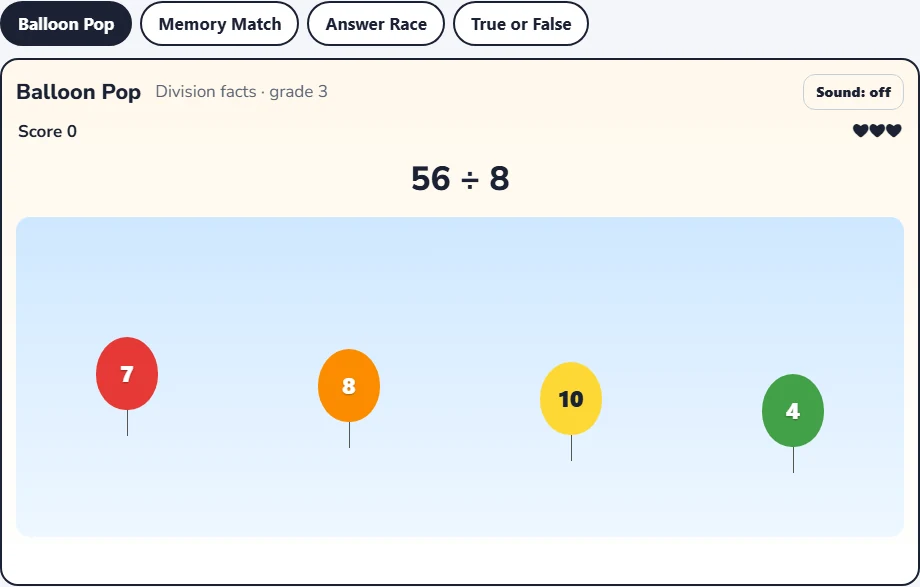
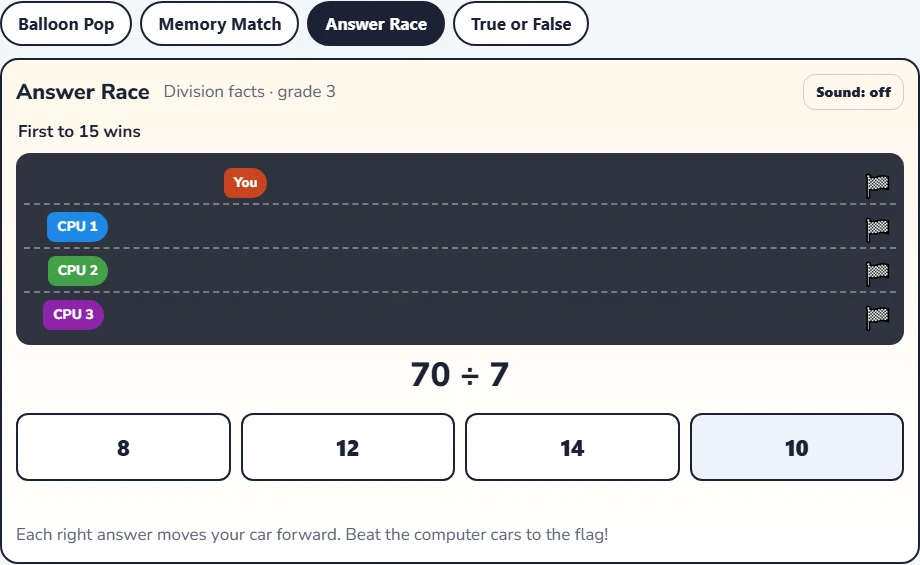
The game below has four modes, and each one asks only division within 100 questions. The printable chart shows six fact families as number triangles, and the pictures show Memory Match, Balloon Pop and Answer Race on this page.
How the division facts game works
- Memory Match: twelve face-down cards hide six division facts, such as 30 ÷ 6, and their six answers. Flip two at a time and match each one to its answer in as few moves as you can.
- Balloon Pop: answers float up on balloons, and you pop the right one before it drifts off the top. The wrong balloons sit within 4 of the right answer, so children must know the fact and not just find the odd one out. The game speeds up as your score climbs, and three misses ends the round.
- Answer Race: every right answer moves your car forward, and you race three computer cars to the finish flag. The first to 15 wins, and wrong taps cost time, not places.
- True or False: sixty seconds on the clock. Decide whether each sentence, such as 72 ÷ 9 = 8, is right or wrong. A streak of five or more scores double.
Divide within 100: the idea behind every fact
Division answers one of two questions: how many are in each group when you share equally, or how many groups can you make. 24 ÷ 4 = 6 means 24 shared among 4 people gives 6 each, or 24 split into groups of 4 makes 6 groups. Because division is the opposite of multiplication, every division fact comes from a multiplication fact, and children who know their times tables already know most of the division facts. Wikipedia’s division article explains the two meanings.
Division fact families: division is multiplication backwards
A fact family is a set of three numbers that make four facts. The three numbers 6, 8 and 48 give two multiplications and two divisions. These families are printed as triangles on the chart, with the product at the top:
| Multiplication | Division | Division the other way |
|---|---|---|
| 3 × 4 = 12 | 12 ÷ 3 = 4 | 12 ÷ 4 = 3 |
| 4 × 6 = 24 | 24 ÷ 4 = 6 | 24 ÷ 6 = 4 |
| 5 × 7 = 35 | 35 ÷ 5 = 7 | 35 ÷ 7 = 5 |
| 6 × 8 = 48 | 48 ÷ 6 = 8 | 48 ÷ 8 = 6 |
| 7 × 9 = 63 | 63 ÷ 7 = 9 | 63 ÷ 9 = 7 |
| 8 × 9 = 72 | 72 ÷ 8 = 9 | 72 ÷ 9 = 8 |
To solve 48 ÷ 6, ask “6 times what makes 48?” and think 6 × 8 = 48, so the answer is 8. Children who use this “think multiplication” move rarely need to count in groups. Our times table games are the best way to build the multiplication facts that division depends on.
Division games for kids and division practice: strategies by divisor
- Divide by 2: halve the number. 18 ÷ 2 = 9.
- Divide by 5 and 10: think of skip counting by 5s and 10s. 40 ÷ 5 = 8 and 40 ÷ 10 = 4.
- Divide by 4: halve and halve again. 36 ÷ 4 is half of 18, which is 9.
- Divide by 9: use the 9 times table and its digit pattern. 63 ÷ 9 = 7, because 7 × 9 = 63 and 6 + 3 = 9.
- Divide by 3, 6, 7 and 8: use the matching times table, and check by multiplying the answer back.
The division facts game rewards this habit, because wrong balloons are close to the right answer. Any answer can be checked by multiplication: if 56 ÷ 7 = 8, then 8 × 7 must equal 56. Teach children this check from the start.
Division with no remainders and zero
The facts in this game divide exactly, so there are no remainders. Division with remainders, such as 17 ÷ 5 = 3 remainder 2, comes later, and our division with remainders worksheets cover it. Two special facts are worth discussing: any number divided by 1 is itself, and zero divided by any number is zero. Dividing by zero is not allowed, and the game never asks it.
Division facts word problems
- 24 stickers are shared equally among 6 friends. How many does each friend get? Answer: 4.
- A baker packs 63 muffins into boxes of 9. How many boxes does she fill? Answer: 7.
- There are 40 children and 5 teams. How many children are on each team? Answer: 8.
- A ribbon 72 inches long is cut into 8 equal pieces. How long is each piece? Answer: 9 inches.
Grade 3 division game: where division within 100 fits at school
| Level | What children are expected to do |
|---|---|
| Grade 3 (US) | Divide within 100 using the relationship between multiplication and division (3.OA.B.6 and 3.OA.C.7) |
| Year 3 and 4 (England) | Recall and use division facts for the 3, 4 and 8 tables, then all tables up to 12 × 12 |
The division facts game supports this goal. The Common Core grade 3 operations and algebraic thinking standards set the goal of knowing all products and quotients within 100 from memory. For paper practice, print the division facts to 100 worksheets.
Division facts game: frequently asked questions
What grade is the division facts game for?
Grade 3 in the United States, and Years 3 and 4 in England, when children learn the times tables.
What is the easiest way to learn division facts?
Learn the times tables first, then use fact families to turn each multiplication fact into division. Practice both directions together.
Are there remainders in the division facts game?
No. Every question divides exactly, such as 54 ÷ 6 = 9. Remainders are taught as a separate step.
What is the largest number in the division facts game?
The dividend can reach 100, as in 100 ÷ 10 = 10. The divisor is from 2 to 10 and the answer is from 1 to 10.
Is the division facts game free, and do kids need an account?
Yes, it is free, and no account is needed. Best scores are saved only in the browser on this device.
Does the division facts game work on phones and tablets?
Yes. Every game is built for touch first and also works with a mouse on a computer.
A 5-minute routine for the division facts game
- Warm up (1 minute): say three multiplication facts aloud, such as 6 × 7 = 42, and then turn each into division: 42 ÷ 6 = 7 and 42 ÷ 7 = 6.
- Play (3 minutes): one round of Memory Match, then one round of Answer Race in the division facts game, saying each answer before you tap.
- Review (1 minute): write down the two facts you missed and say their fact families. Try those again tomorrow.
A routine like this practices both directions of every fact, which is what builds fluency within 100.