This free fraction calculator adds, subtracts, multiplies, divides and compares fractions, mixed numbers and whole numbers, then shows the answer in simplest form with every step of the working. Type two numbers, pick an operation, and the answer, the mixed number, the decimal and a picture of the bars appear at once.
How to type fractions: use a slash for fractions (5/8) and a space between the whole number and the fraction for mixed numbers (1 3/4). Negative numbers start with a minus sign (-2/5). Decimals such as 0.75 and whole numbers such as 3 work too.
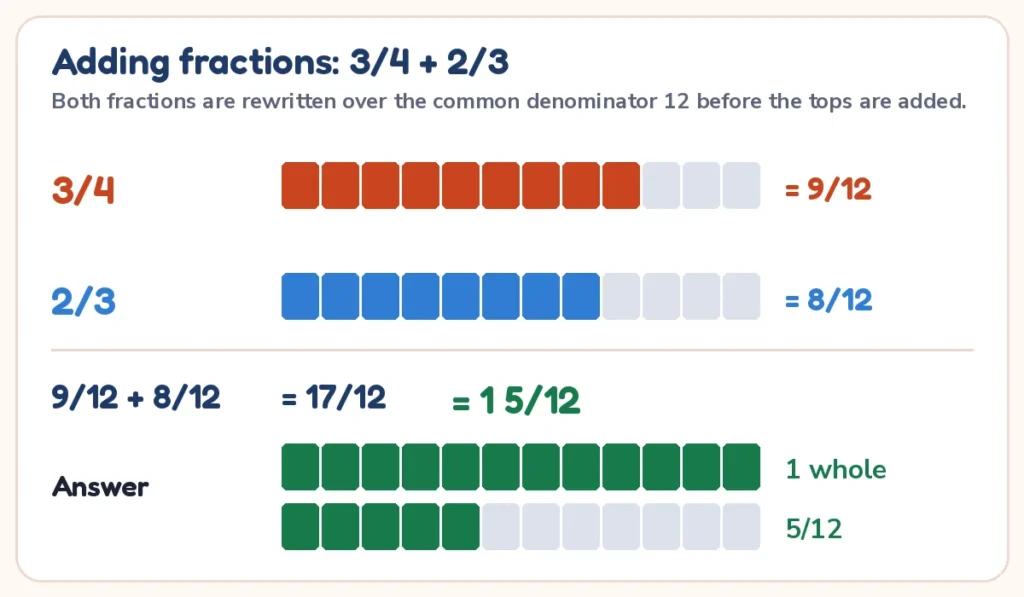
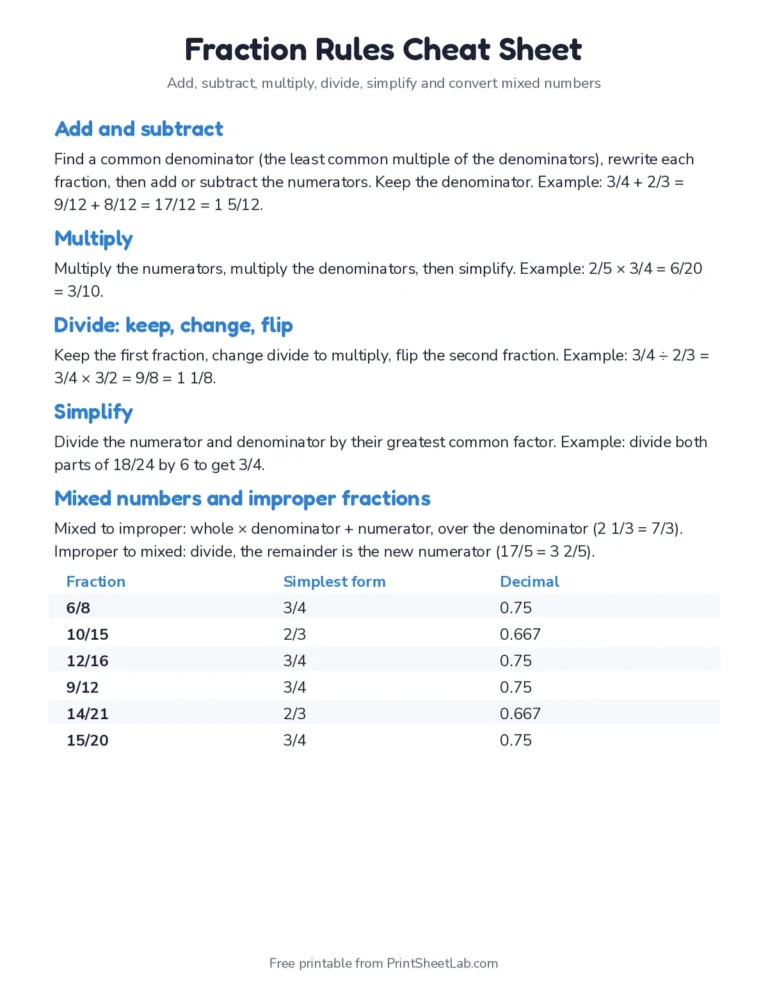
Quick answer: to add fractions, give them a common denominator, add the tops and simplify: 3/4 + 2/3 = 9/12 + 8/12 = 17/12 = 1 5/12. To multiply, multiply the tops and the bottoms: 2/5 × 3/4 = 6/20 = 3/10. To divide, flip the second fraction and multiply: 3/4 ÷ 2/3 = 3/4 × 3/2 = 9/8 = 1 1/8.
How to use the fraction calculator
- Type the first fraction, mixed number, whole number or decimal in the top box, or tap a quick pick such as 1/2 or 1 1/2.
- Choose an operation: add, subtract, multiply, divide or compare.
- Type the second number. The answer updates as you type, so there is no Calculate button to press.
- Read the answer in simplest form, then open the working underneath, and use Copy result or Copy link to share the numbers.
The panel shows the same answer in several forms, because different classes and jobs ask for different ones. This table explains each line of the result.
| You see | What it means | Example for 3/4 + 2/3 |
|---|---|---|
| Big answer | The result in simplest form (a mixed number when you typed mixed numbers) | 17/12 |
| Mixed number | The same value as whole units plus a fraction, shown when the answer is above 1 | 1 5/12 |
| Decimal | The value as a decimal, marked with ≈ when the digits never end | ≈ 1.416667 |
| Percent | The value times 100 | ≈ 141.6667% |
| Picture it | Bars with the shaded parts for the first number, the second number and the answer | Two bars: one full, one 5/12 shaded |
| How it works | Numbered working: common denominator, the operation, simplifying, mixed number and a decimal check | 5 steps |
Fraction examples and a printable cheat sheet
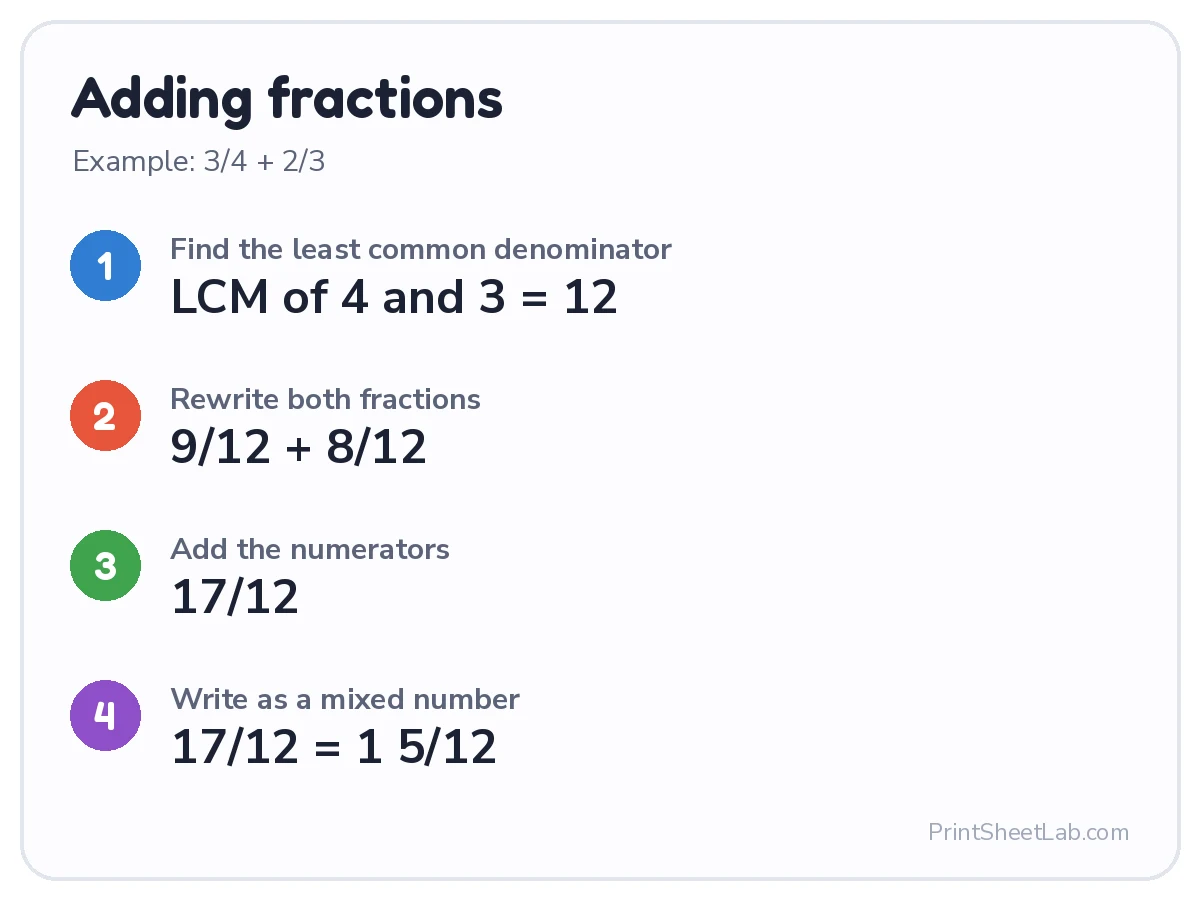
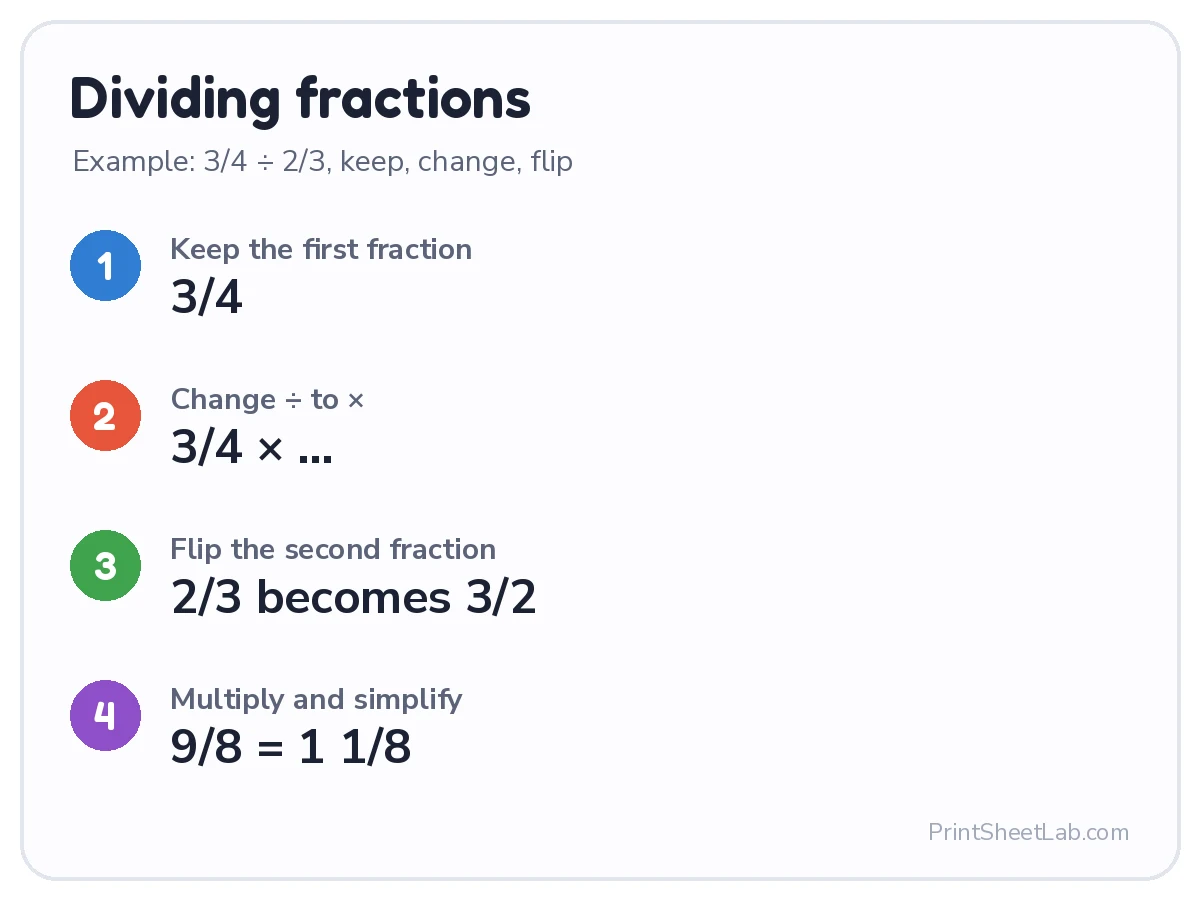
Each card walks through one fraction problem from start to finish. The printable cheat sheet puts all four operations, simplifying and mixed number conversion on one page, with a short table of equivalent fractions.
Fraction calculator with steps: what the working shows
A fraction calculator with steps does more than print a number: it writes the same working a teacher expects in a notebook. Every answer lists the conversions, the common denominator, the operation itself, the simplifying step and a decimal check, so you can copy the method as well as the result.
| Operation | Steps shown | Example |
|---|---|---|
| Add | Common denominator, rewrite both, add the tops | 3/4 + 2/3 = 9/12 + 8/12 = 17/12 |
| Subtract | Common denominator, rewrite both, subtract the tops | 5/6 − 1/4 = 10/12 − 3/12 = 7/12 |
| Multiply | Tops times tops, bottoms times bottoms, simplify | 2/5 × 3/4 = 6/20 = 3/10 |
| Divide | Keep, change, flip, then multiply | 3/4 ÷ 2/3 = 3/4 × 3/2 = 9/8 |
| Compare | Common denominator, then compare the tops (and cross-multiply as a check) | 5/8 vs 3/5 = 25/40 vs 24/40 |
When you type a mixed number such as 1 1/2, the first line of the working converts it to an improper fraction: (1 × 2 + 1) / 2 = 3/2. When you type a decimal such as 0.75, it is written as 75/100 first. All the arithmetic uses exact whole numbers, so there is never a rounding error in the fraction itself.
Adding fractions calculator: unlike denominators
Fractions can only be added when their denominators match, so the first job is finding a common denominator. The adding fractions calculator uses the least common multiple of the two denominators, which keeps the numbers as small as possible. For 3/4 + 2/3, the least common multiple of 4 and 3 is 12, so 3/4 becomes 9/12 and 2/3 becomes 8/12. Add the numerators: 9 + 8 = 17, giving 17/12, which is 1 5/12 as a mixed number.
If the denominators already match, as in 2/9 + 5/9, skip straight to adding the numerators: 7/9. The bottom number never changes when the denominators are equal, because you are still counting ninths.
The least common denominator for common pairs
This table shows the least common denominator for denominator pairs that come up most often in homework and recipes, together with the sum of the two unit fractions. Use it to check the first step of the adding fractions calculator.
| Denominators | Least common denominator | Example | Sum |
|---|---|---|---|
| 2 and 3 | 6 | 1/2 + 1/3 | 5/6 |
| 2 and 5 | 10 | 1/2 + 1/5 | 7/10 |
| 3 and 4 | 12 | 1/3 + 1/4 | 7/12 |
| 3 and 5 | 15 | 1/3 + 1/5 | 8/15 |
| 4 and 6 | 12 | 1/4 + 1/6 | 5/12 |
| 4 and 5 | 20 | 1/4 + 1/5 | 9/20 |
| 5 and 6 | 30 | 1/5 + 1/6 | 11/30 |
| 6 and 8 | 24 | 1/6 + 1/8 | 7/24 |
| 8 and 12 | 24 | 1/8 + 1/12 | 5/24 |
| 9 and 12 | 36 | 1/9 + 1/12 | 7/36 |
| 10 and 15 | 30 | 1/10 + 1/15 | 1/6 |
| 12 and 18 | 36 | 1/12 + 1/18 | 5/36 |
| 16 and 24 | 48 | 1/16 + 1/24 | 5/48 |
The butterfly method as a shortcut
Some classes teach the butterfly method: multiply across the “wings” and add. The rule is a/b + c/d = (a × d + c × b) / (b × d). For 3/4 + 2/3 that is (3 × 3 + 2 × 4) / (4 × 3) = 17/12. It always works, but it can give a bigger denominator than the least common multiple, so the answer may need simplifying. The Common Core standards state the same rule for grade 5, and the fraction calculator reaches the same simplest form either way.
Subtracting fractions calculator: no borrowing needed
The subtracting fractions calculator follows the same path as addition. For 5/6 − 1/4, the common denominator is 12, so the problem becomes 10/12 − 3/12 = 7/12. With mixed numbers, convert first: 3 1/4 − 1 5/6 becomes 13/4 − 11/6 = 39/12 − 22/12 = 17/12, which is 1 5/12. Converting to improper fractions avoids the borrowing step that makes mixed number subtraction slow on paper.
| Subtraction | Simplest fraction | Mixed number | Decimal |
|---|---|---|---|
| 7/8 − 1/2 | 3/8 | 3/8 | 0.375 |
| 5/6 − 1/4 | 7/12 | 7/12 | 0.5833 |
| 2 1/3 − 1 3/4 | 7/12 | 7/12 | 0.5833 |
| 1/5 − 2/3 | -7/15 | -7/15 | -0.4667 |
| 4 − 1 3/8 | 21/8 | 2 5/8 | 2.625 |
A negative answer is fine. 1/5 − 2/3 gives -7/15, and the calculator keeps the minus sign on the top number.
Mixed number calculator: multiplying fractions and mixed numbers
Multiplication is the easiest operation: multiply the numerators, multiply the denominators, then simplify. 2/5 × 3/4 = 6/20 = 3/10. No common denominator is needed. The multiplying fractions calculator also cancels common factors for you through the simplify step, so you can leave the big numbers alone.
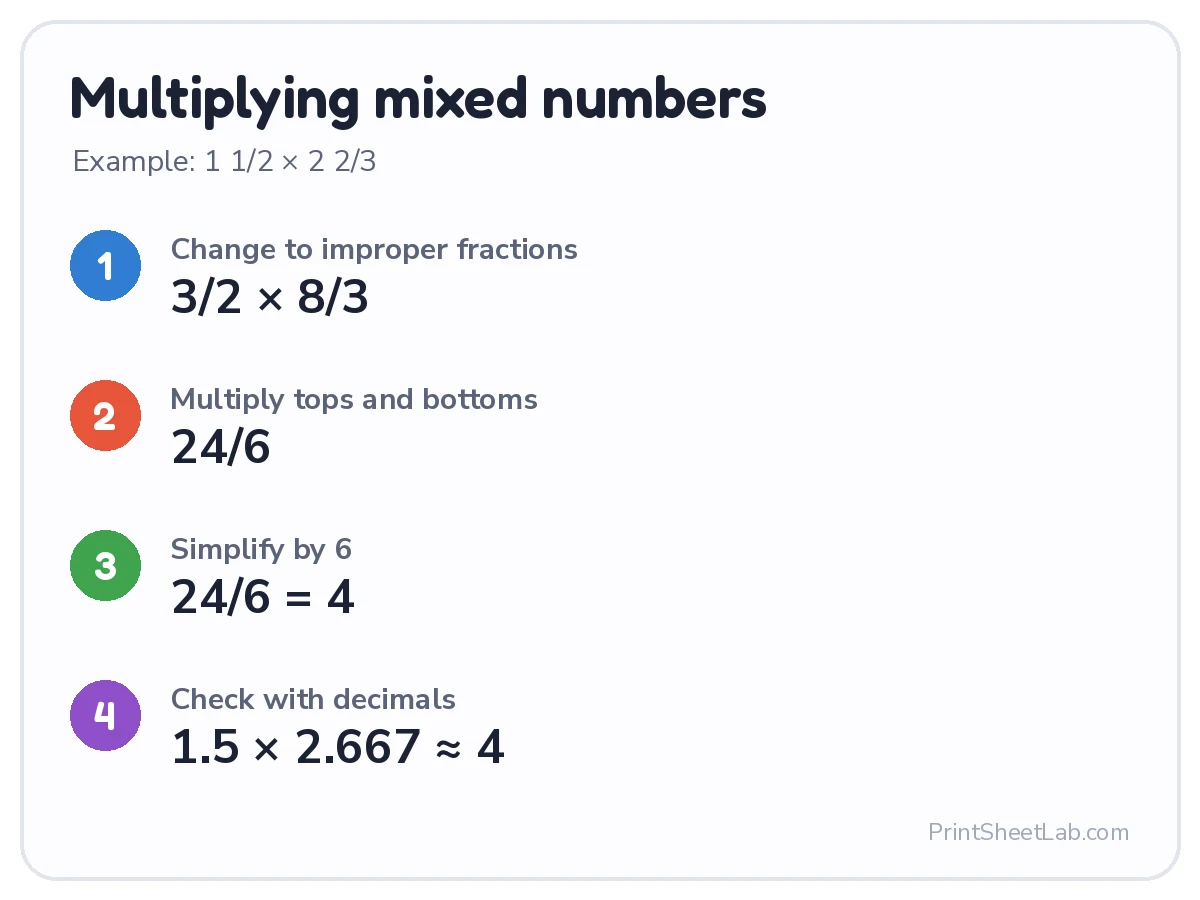
A mixed number calculator has to convert first. Change each mixed number to an improper fraction by multiplying the whole number by the denominator and adding the numerator: 1 1/2 becomes 3/2 and 2 2/3 becomes 8/3. Then multiply: 3/2 × 8/3 = 24/6, which simplifies to 4. A quick decimal check (1.5 × 2.667 ≈ 4) confirms the answer is sensible.
Multiplying fractions calculator: answers to common products
| Multiplication | Simplest fraction | Mixed number |
|---|---|---|
| 2/3 × 3/4 | 1/2 | 1/2 |
| 7/8 × 2/7 | 1/4 | 1/4 |
| 2 1/4 × 1 1/3 | 3 | 3 |
| 3 × 2/9 | 2/3 | 2/3 |
Dividing fractions calculator: keep, change, flip
To divide by a fraction, multiply by its reciprocal. Many classes remember it as “keep, change, flip”: keep the first fraction, change the division sign to multiplication and flip the second fraction upside down. The dividing fractions calculator shows exactly this. For 3/4 ÷ 2/3: keep 3/4, change ÷ to ×, flip 2/3 to 3/2, then multiply to get 9/8 = 1 1/8.
Dividing by a fraction smaller than 1 makes the answer bigger, which surprises many students. 6 ÷ 1/2 = 12, because there are twelve halves in six. Dividing by zero is not allowed, and the calculator tells you if you try. Dividing by a whole number works the same way: 3/4 ÷ 3 = 3/4 × 1/3 = 1/4.
| Division | Reciprocal of the second number | Simplest fraction | Mixed number |
|---|---|---|---|
| 3/4 ÷ 2/3 | 3/2 | 9/8 | 1 1/8 |
| 6 ÷ 1/2 | 2 | 12 | 12 |
| 5/8 ÷ 5/16 | 16/5 | 2 | 2 |
| 2 1/2 ÷ 3/4 | 4/3 | 10/3 | 3 1/3 |
| 1/3 ÷ 4 | 1/4 | 1/12 | 1/12 |
| 7/9 ÷ 1 1/6 | 6/7 | 2/3 | 2/3 |
Simplifying the answer
A fraction is in simplest form when the numerator and denominator share no common factor except 1. To simplify, divide both by their greatest common factor: 18/24 ÷ 6 gives 3/4. The fraction calculator always simplifies the final answer, and the step list shows the number it divided by. For practice with just this step, use the simplify fractions calculator, and for a visual way to see equal fractions, try the printable fraction strips.
Comparing and ordering fractions
To compare two fractions, give them a common denominator or turn them into decimals. Which is bigger, 5/8 or 3/5? With a common denominator of 40, 5/8 = 25/40 and 3/5 = 24/40, so 5/8 is just a little bigger. As decimals, 0.625 is more than 0.6. Another quick test is cross-multiplying: 5 × 5 = 25 and 3 × 8 = 24, and the larger product belongs to the larger fraction.
Compare fractions calculator: greater than, less than or equal
Choose Compare in the operation row and the compare fractions calculator answers “greater than, less than or equal” in one line, with the difference between the two numbers and bars to show it. Subtracting 3/5 from 5/8 gives 1/40, which tells you how close they are. Here are some pairs that are easy to get wrong.
| Comparison | Cross products | Difference | Decimals |
|---|---|---|---|
| 5/8 > 3/5 | 25 vs 24 | 1/40 | 0.625 vs 0.6 |
| 7/12 > 4/7 | 49 vs 48 | 1/84 | 0.5833 vs 0.5714 |
| 2/3 > 3/5 | 10 vs 9 | 1/15 | 0.6667 vs 0.6 |
| 3/4 > 7/10 | 30 vs 28 | 1/20 | 0.75 vs 0.7 |
| 4/9 < 1/2 | 8 vs 9 | 1/18 | 0.4444 vs 0.5 |
| 5/6 < 7/8 | 40 vs 42 | 1/24 | 0.8333 vs 0.875 |
| 1/3 = 2/6 | 3 vs 3 | 0 | 0.3333 vs 0.3333 |
Adding three or more fractions
The calculator takes two numbers at a time, and longer sums are done in a chain: add the first two, then add the third to the answer. For 1/2 + 1/3 + 1/6, the first two give 5/6, and 5/6 + 1/6 = 1. Or find one common denominator first, here 6, and add the tops once: 3/6 + 2/6 + 1/6 = 6/6 = 1.
Fraction calculator for inches, recipes and woodworking
Fractions show up in recipes, woodworking and sewing. Doubling a recipe that needs 3/4 cup of flour gives 3/4 × 2 = 1 1/2 cups, and halving 2/3 cup gives 1/3 cup. A board 5 1/2 feet long cut into pieces 3/4 foot long gives 5 1/2 ÷ 3/4 = 7 1/3, so you get 7 full pieces. Inch measurements use halves, quarters, eighths and sixteenths, and the fraction calculator adds them without converting to decimals: 2 3/8 + 1 5/16 = 3 11/16 inches.
To turn a decimal reading from a caliper into a fraction of an inch, use the decimal to fraction calculator, which has a nearest-ruler-mark mode for sixteenths and thirty-seconds.
Common fraction mistakes
| Mistake | Why it is wrong | Correct working |
|---|---|---|
| 1/2 + 1/3 = 2/5 | The denominators were added | 3/6 + 2/6 = 5/6 |
| 3/4 ÷ 2/3 = 2/3 × 3/4 | The wrong fraction was flipped | 3/4 × 3/2 = 9/8 |
| 1 1/2 × 2 2/3 = 2 2/6 | Whole numbers and fractions were multiplied separately | 3/2 × 8/3 = 4 |
| 6/8 as a final answer | It is not in simplest form | 6/8 = 3/4 |
| 2/5 + 1/2 = 3/7 | Tops and bottoms were both added; the sum is less than 1/2, which cannot be right | 4/10 + 5/10 = 9/10 |
Practice all four operations with the free fractions worksheets and the equivalent fractions worksheets, each with an answer key. Wikipedia’s fraction article covers the history and the other notations used around the world.
Where the fraction calculator helps outside school
Cooks scale recipes, carpenters add lengths in sixteenths and quilters cut fabric in eighths of a yard. The working is always the same four operations. For example, how many 3/4-cup servings fit in 4 1/2 cups? 4 1/2 ÷ 3/4 = 6.
Fractions in school: grade levels and local terms
In the United States, adding and subtracting fractions with unlike denominators is a grade 5 skill in the Common Core standards for fractions, and multiplying and dividing fractions is covered in grades 5 and 6. Other countries order the topic differently, so check your own syllabus. Many classes in the UK, India and Australia say “mixed fraction” for a mixed number.
Questions people ask about fraction calculators
How do I use a fraction calculator with whole numbers?
Type the whole number on its own, such as 3, and the calculator treats it as 3/1. So 3 × 2/9 = 6/9 = 2/3, and 4 − 1 3/8 = 2 5/8. You can also type a mixed number with a space between the whole number and the fraction.
Can a fraction calculator do exponents?
This one multiplies, so use repeated multiplication. To square a fraction, raise the top and the bottom to the power: (2/3)3 = 8/27, or multiply 2/3 × 2/3 and then × 2/3 again. Negative exponents flip the fraction first: (2/3)-2 = (3/2)2 = 9/4.
Fraction calculator: frequently asked questions
How do I enter a mixed number?
Type the whole number, a space and then the fraction, such as 3 1/2. Negative mixed numbers start with a minus sign, such as -1 1/4.
Is this a fraction calculator with steps?
Yes. Every answer comes with the working: the common denominator, the rewritten fractions, the multiplication or reciprocal, the simplifying step and a decimal check.
Can I add a whole number and a fraction?
Yes. Type the whole number on its own, such as 2, and the calculator treats it as 2/1. For example, 2 + 3/4 = 2 3/4.
Why is my answer shown as an improper fraction and a mixed number?
Both are correct. Teachers often ask for mixed numbers in final answers, while improper fractions are easier to use in the next step of a calculation.
Can I use decimals?
Yes, type a decimal such as 0.5 and it is converted to a fraction first. For full conversions, use the decimal to fraction calculator.
How do I compare two fractions?
Choose Compare, type both numbers and read the greater-than, less-than or equal sign. The working uses a common denominator and a cross-multiplication check.
How do I divide fractions?
Keep the first fraction, change the division sign to multiplication and flip the second fraction. For 3/4 ÷ 2/3 that gives 3/4 × 3/2 = 9/8 = 1 1/8.
Does it work for negative fractions?
Yes. -3/4 + 1/2 = -1/4. The minus sign stays on the top number in every step, and the answer keeps its sign.
What is the butterfly method for adding fractions?
It is a shortcut: multiply across the wings and add, (a × d + c × b) / (b × d). The calculator reaches the same simplest form with a smaller denominator.
Is the fraction calculator free?
Yes, it is free with no sign-up, and the cheat sheet PDF is free to print.
More calculators
- Simplify fractions calculator: reduce any fraction to lowest terms
- Decimal to fraction calculator: including repeating decimals and ruler fractions
- GCF and LCM calculator: find common denominators fast
- Percentage calculator: turn fractions into percents
- Ratio calculator: scale and compare quantities
- All calculators
Sources and further reading
- Common Core State Standards: Grade 5, Number and Operations in Fractions
- Wikipedia: Fraction
- Wikipedia: Least common multiple
Last updated: October 2026.