Diwali tambola is the game for the long, bright evenings of the festival of lights. Print up to 600 unique Diwali tambola tickets in warm orange with a diya on every ticket, then call the numbers and give prizes such as the Phuljhadi, the Diya Line and the Laxmi Full House. The pack has a caller sheet, a prize list and a rules page, and you can also play Diwali tambola live on phones.
Diwali tambola to print (PDF)
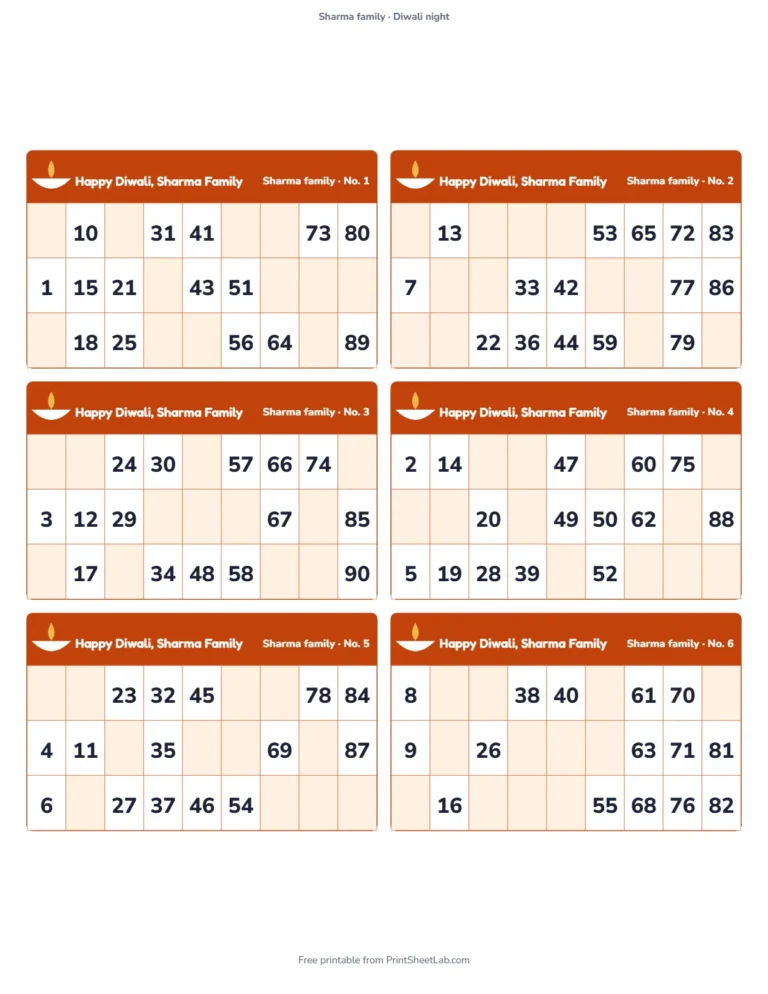
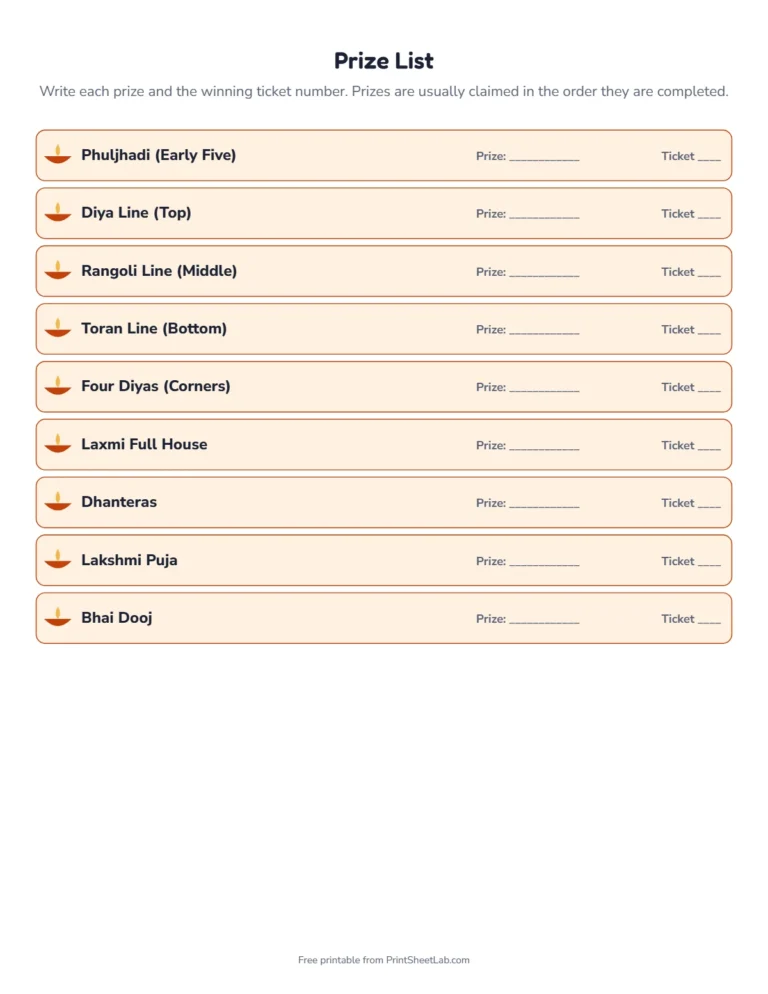
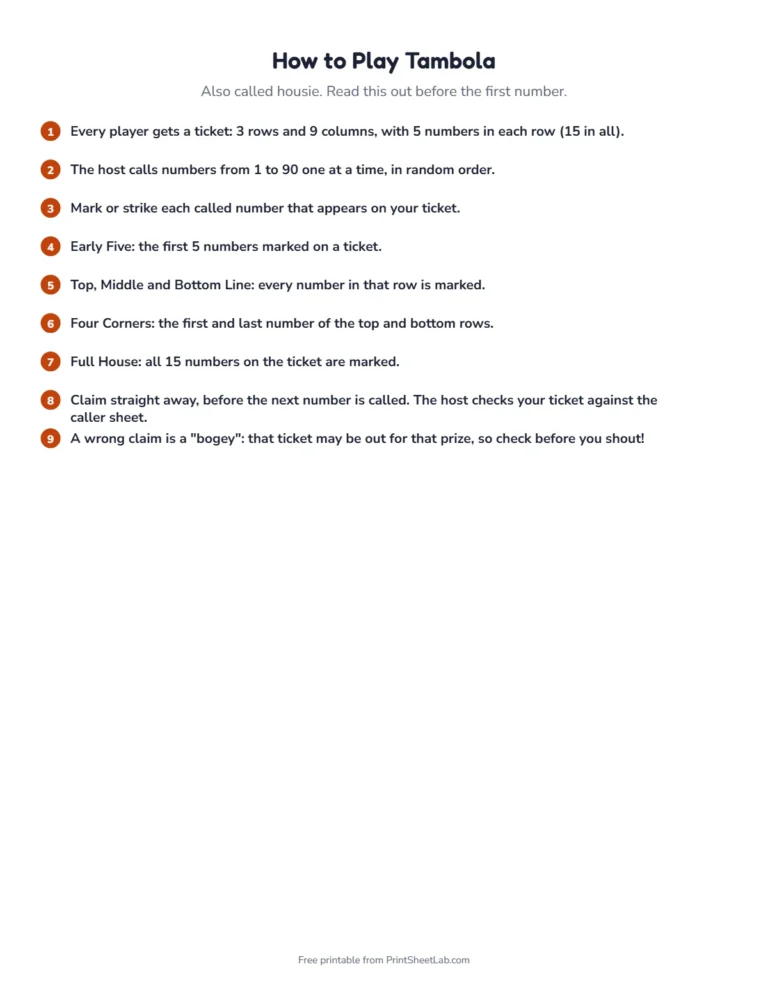
These four pages show a Diwali tambola set: a page of tickets with “Happy Diwali, Sharma Family” on every one, the 1 to 90 caller sheet, the prize list with the themed prize names, and the one-page rules. Click a picture for the PDF, or use the generator at the top of the page to change the greeting, the date, the paper size and the number of tickets.

What is in the Diwali tambola pack
Everything below is made in your browser, and nothing you type is uploaded. Put your family name, building name or office name in the title box so every ticket is personal.
| Page | What you get | Details |
|---|---|---|
| Tickets | Real strips of six: each strip uses every number from 1 to 90 exactly once | Up to 600 tickets, burnt orange with a diya motif and gold trim, with your title and the family name on every ticket |
| Caller sheet | A 1 to 90 grid to cross off as you call | Keep it to check every winning claim |
| Prize list | The six Diwali prizes, from Phuljhadi to Laxmi Full House | Space to write each prize and the winning ticket number |
| Rules page | A one-page script to read out before the first number | Covers claims and what happens after a wrong one |
Diwali tambola prizes and what they mean
The Diwali theme gives each prize the name of something from the festival, so reading the list sounds like a walk through the celebration. Here is what each prize means and how to win it:
| Prize | How to win | Diwali link |
|---|---|---|
| Phuljhadi | Early Five: the first five numbers marked on a ticket | A phuljhadi is a sparkler, and a quick burst of light is a good start |
| Diya Line | Top Line: all five numbers on the top row | Diyas, small clay lamps, are the heart of the festival |
| Rangoli Line | Middle Line: all five numbers on the middle row | Rangoli patterns of colored powder decorate the floor at the doorstep |
| Toran Line | Bottom Line: all five numbers on the bottom row | A toran is a door hanging of marigolds or mango leaves |
| Four Diyas | Corners: the first and last number of the top and bottom rows | One lamp in each corner of the ticket |
| Laxmi Full House | Full House: all fifteen numbers marked | Goddess Lakshmi is worshipped on Diwali night, so the full house is the blessing |
Number calls for your Diwali tambola
Diwali has plenty of numbers hiding in its story. Use these calls to turn a plain number into a small lesson about the festival.
| Number | Call it | Why |
|---|---|---|
| 1 | One diya | The first lamp lit on Diwali evening |
| 5 | Five days of Diwali | The festival runs for five days, from Dhanteras to Bhai Dooj |
| 10 | Ten heads of Ravana | The demon king was defeated on Dussehra, about twenty days before Diwali |
| 14 | Rama’s fourteen years | Rama spent fourteen years in exile before the people of Ayodhya welcomed him home with lamps |
| 15 | Amavasya, the new moon | Diwali falls on the darkest night of the month, which is why the lamps matter |
| 13 | Dhanteras | The first day of the festival, on the thirteenth lunar day, when people buy a little gold, silver or a new utensil |
| 88 | Two fat ladies | A traditional bingo call that suits two lines of diyas |
How long does a Diwali tambola game last?
A Diwali tambola should fit between the aarti and the dinner, so it helps to know how long the game will run. The table shows when each prize is usually won and how many minutes the whole game takes at the default speed of 10 seconds a call.
| Tickets | Typical crowd | Early Five | First full line | Full House | Time at 10 s a call |
|---|---|---|---|---|---|
| 12 tickets | a family evening | call 14 (12 to 17) | call 43 (36 to 49) | call 76 (71 to 78) | 13 min |
| 30 tickets | a building or society get-together | call 12 (10 to 14) | call 36 (31 to 41) | call 72 (69 to 75) | 12 min |
| 48 tickets | a community hall | call 11 (10 to 13) | call 32 (27 to 37) | call 70 (67 to 73) | 12 min |
| 90 tickets | a company or club Diwali party | call 10 (9 to 11) | call 29 (25 to 33) | call 68 (64 to 70) | 11 min |
The numbers come from real simulations of this generator: 300 games for each ticket count, with the typical call number and the middle half of results in brackets. More tickets mean the first prizes arrive sooner, but with 12 to 90 tickets the Full House still comes around call 68 to 76, because someone must complete all fifteen numbers. For a big hall, choose 8 seconds a call, and have a helper walk round to check claims so the host can keep the numbers moving.
Diwali party games for families and neighbors
Diwali party games have a long history. Playing cards and dice are part of the festival in many homes, and tambola is a gentle, family-friendly cousin of that tradition: there is no money on the table, only small prizes and bragging rights. It suits a group of neighbors in a society courtyard or relatives home for the holiday, because everyone has a ticket and everyone is in the game from the first number to the last.
Diwali housie for kitty groups and offices
Diwali housie is the name many people use for the same game. A kitty group can play it at the Diwali meeting, and an office can run it at the Diwali lunch, with sweet boxes or dry fruit as prizes. If your colleagues are in different cities, host the live game and share the link: everyone plays on a phone, and the numbers are read out in English or Hindi.
Deepavali games for children
Deepavali games should keep children busy while the grown-ups talk. Give every child a ticket with a large number size (3 tickets per page) and a few candies as markers. Children who are learning to read numbers practice 1 to 90 without noticing, and the prizes can be small, safe items such as stickers, chocolates and colored pencils.
How to run a Diwali tambola in six steps
- Two weeks before Diwali: count the families or guests, then decide on six prizes, one for each tambola prize.
- One week before: type the family or society name into the generator, set the date to Diwali night and print the tickets.
- On the day: arrange seating in a circle so that everyone can hear the numbers, and place a small diya near the caller.
- Before the first number: read the prize list aloud and explain each Diwali name, so that children learn the words.
- During the game: call a number every 10 seconds, read the Diwali call if there is one, and tick it off the caller sheet.
- After the game: check the winning tickets, hand out the prizes and keep the tickets as a Diwali souvenir.
Prize ideas for a Diwali tambola
- A small box of sweets, such as laddoo or barfi, for the Phuljhadi
- A decorated clay diya for each of the Diya Line, Rangoli Line and Toran Line winners
- Dry fruit or a jar of nuts for the Four Diyas
- A silver coin, a puja thali or a candle set for the Laxmi Full House
- A pack of rangoli colors or stickers for children
Type any of these into the “Extra fun prizes” box and they print on the prize list:
- Dhanteras: the first guest to mark the number 13, the thirteenth lunar day
- Lakshmi Puja: the first to mark the number 15, the night of the new moon
- Bhai Dooj: the first to mark the number 5, the fifth day of the festival
- Sparkler Special: the first to mark three numbers that end in 5, such as 5, 25 and 45
Host tips for a smooth game
- Keep the noise down for children and elders by calling the numbers through a small speaker, not a loud microphone.
- Use dried beans, small stones or wrapped candies as markers instead of crossing numbers off.
- Pair the game with a quiet snack table so players do not leave their seats during the game.
- Print a few extra tickets with a large number size for elders who prefer larger print.
Wikipedia’s Diwali article describes the five days of the festival and how it is celebrated in different parts of India and the world.
Play Diwali tambola live on phones
Away from home for Diwali? Host the same game on your phone or a TV and share the link with family in other cities. Guests open the link, type the ticket number you give them and their e-ticket marks itself as each number is called. Numbers are called automatically at the speed you choose, read aloud in English or Hindi if you like, and you can check any winning claim by ticket number. No app and no sign-up.
Diwali tambola: frequently asked questions
What Diwali party games work for a big group?
Tambola works for any group size, because every guest has a ticket and plays from the first number to the last. Print one ticket per person, add the themed prizes and play for 10 to 15 minutes.
Is Diwali tambola the same as housie?
Yes. Tambola, housie and 90-ball bingo are the same game: 90 numbers, tickets with 3 rows and 9 columns, and prizes for lines and a full house. Diwali housie simply uses the Diwali prize names.
Can I print Diwali tambola tickets in black and white?
Yes. Choose Black and white in the generator to save color ink. The numbers and the prize names stay the same, and the tickets are easy to read on any printer.
How many tickets can I print?
From 1 to 600 in one go, with 3, 6, 8 or 12 tickets per page. Press New tickets for a completely different set, and choose Letter or A4 paper, in color or black and white.
Are the diwali tambola tickets free?
Yes. The tickets, caller sheet, prize list, rules page and live game are all free for home, club and classroom use, with no sign-up.