A GPA calculator turns your letter grades and credit hours into one grade point average: GPA = total quality points ÷ total credits. This free GPA calculator works for college and high school, handles weighted and unweighted GPAs on the 4.0 scale, and shows the working for every course.

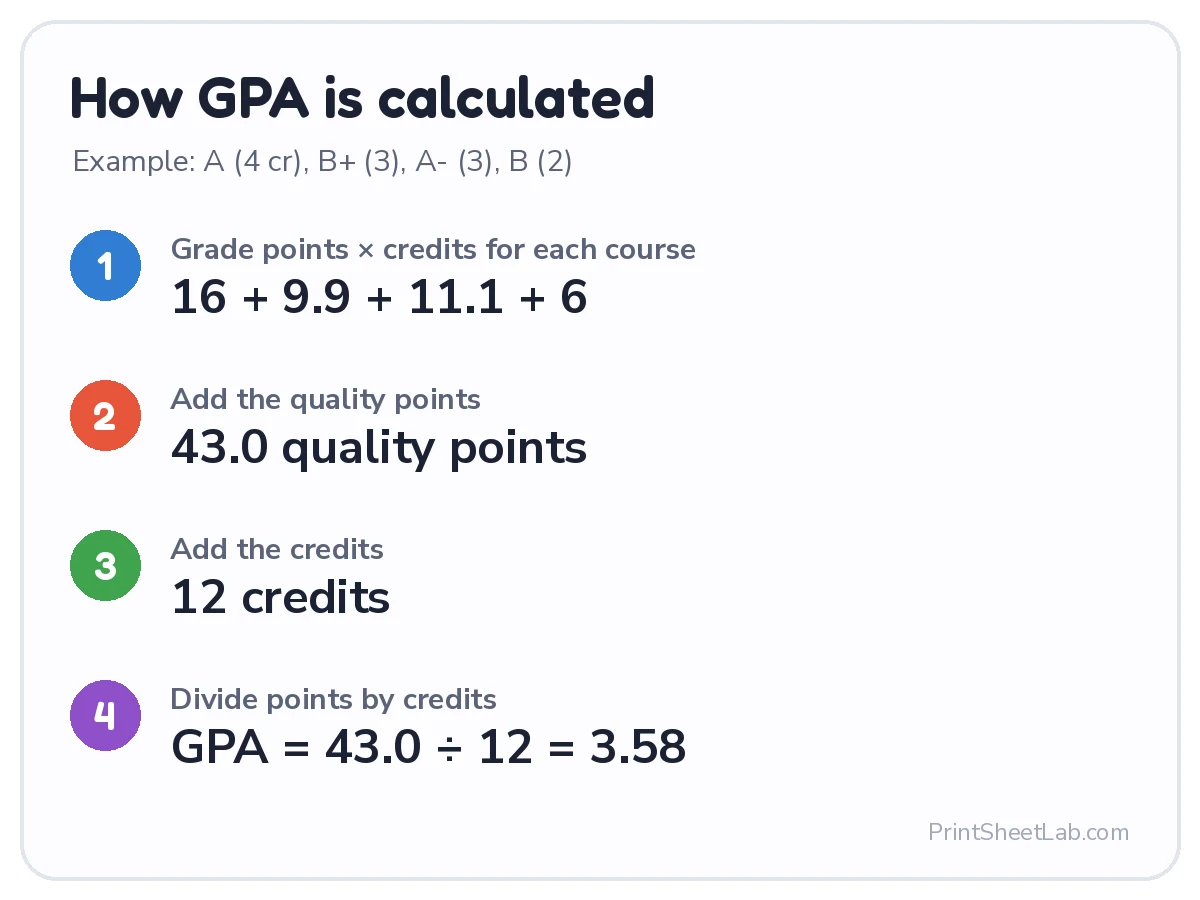
Quick answer: multiply each grade’s points by the course credits, add the results, and divide by the total credits. An A in a 4-credit course, a B+ in 3 credits, an A− in 3 credits and a B in 2 credits give (16 + 9.9 + 11.1 + 6) ÷ 12 = 43.0 ÷ 12 = 3.58.
How to use the GPA calculator
Type one course per line in the box: the grade, a space, then the credits. The GPA calculator updates as you type and lists the quality points for each class.
- Write each course as a grade and its credits, for example
B+ 3. You can add a course name in front, such asBiology A 4. - Use letters A+ to F, or a percent such as
92 3, which the calculator converts with common grade bands. - For a weighted GPA, choose Weighted and add
honorsorAPto the line. For a high school GPA where every class counts the same, leave the credits out and each class counts 1. - To include earlier terms, fill in your previous GPA and credits completed. Add a target GPA to see what you need this term.
| Box | What to enter | Example |
|---|---|---|
| Courses | grade, credits, optional honors or AP tag | A- 3 honors |
| GPA type | unweighted, or weighted with honors and AP bonus points | Weighted: honors +0.5, AP +1.0 |
| Grade point scale | 4.0 with plus and minus, 4.3, whole letters or the Australian 7-point scale | 4.0 scale, plus and minus |
| Previous GPA and credits | optional, for a cumulative GPA | 3.20 over 45 credits |
| GPA I want | optional target for the cumulative GPA | 3.30 |
GPA examples, the 4.0 scale and a printable planner
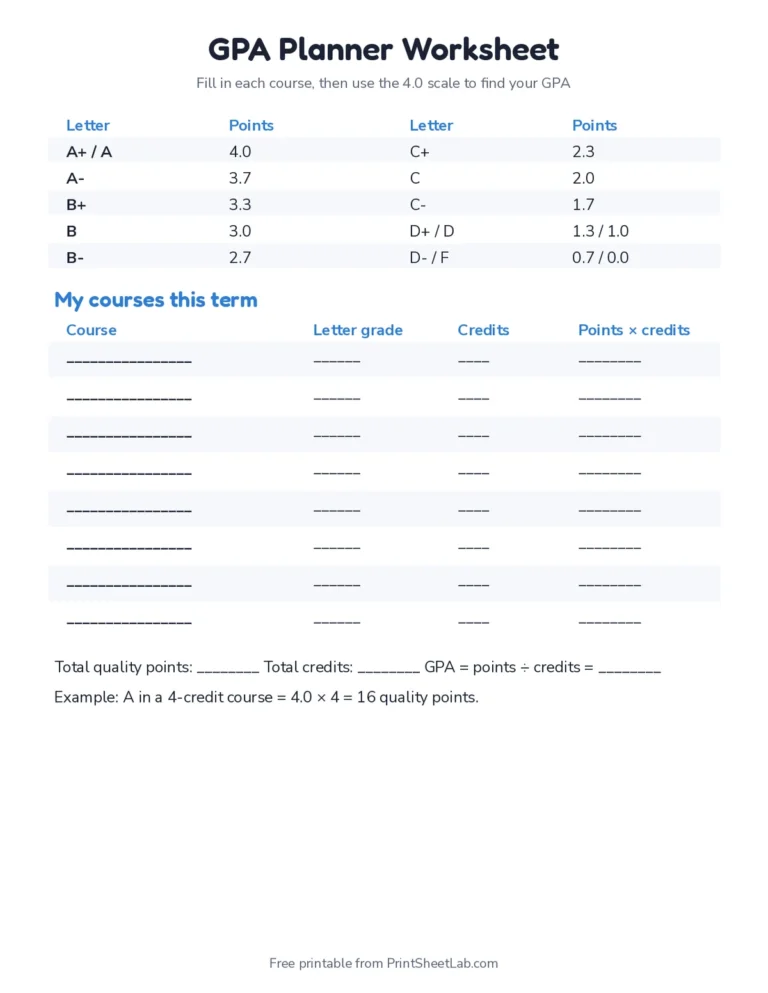
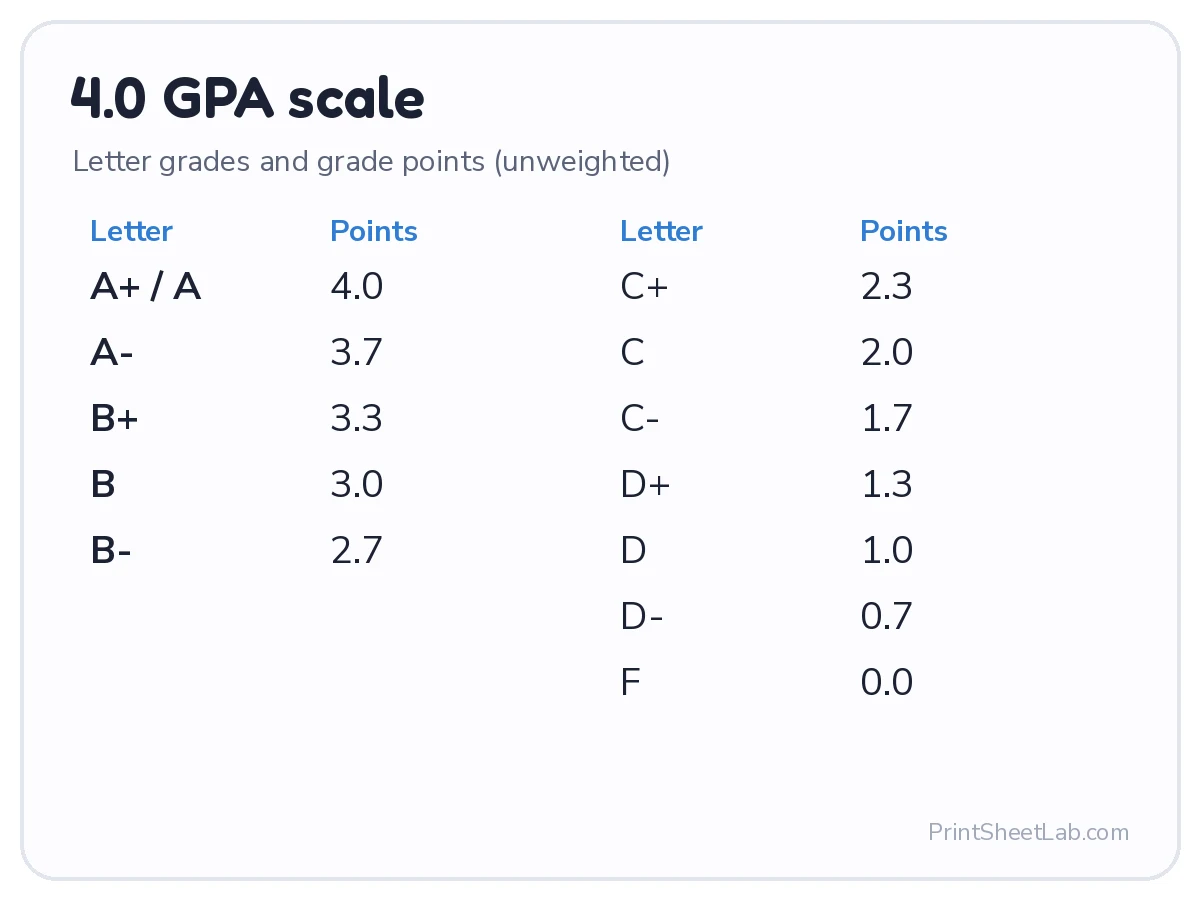
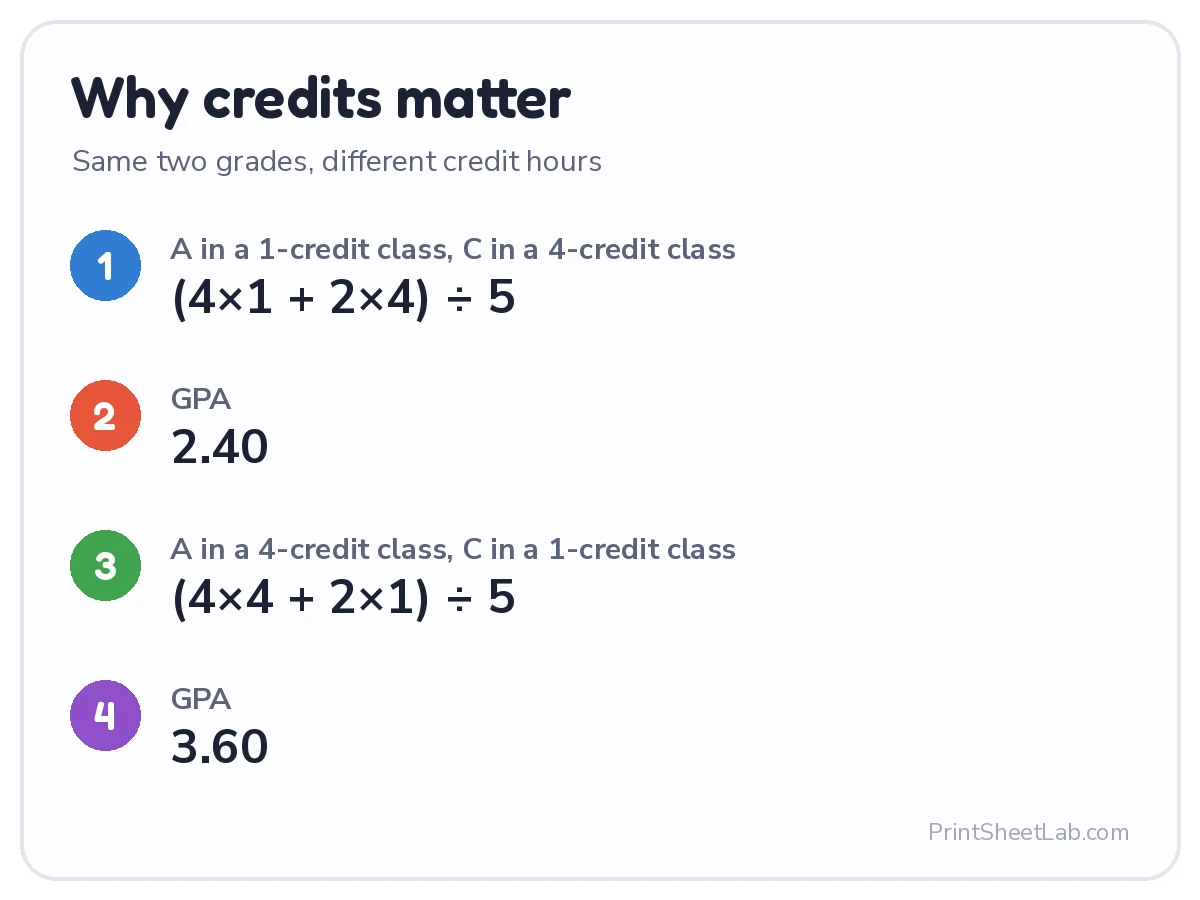
The cards show a full GPA calculation, the 4.0 GPA scale and why credit hours matter. The printable GPA planner has the scale at the top and space for eight courses, handy for planning next term on paper.
How to calculate GPA step by step
A grade point average turns letter grades into one number. Each letter has a point value, each course is weighted by its credits, and the total is divided by the total credits:
GPA = Σ (grade points × credits) ÷ Σ credits
The product of grade points and credits is called quality points. Here is how to calculate GPA for a typical semester, which is exactly what the GPA calculator shows in its How it works panel.
| Course | Grade | Grade points | Credits | Quality points |
|---|---|---|---|---|
| Course 1 | A | 4.0 | 4 | 16.0 |
| Course 2 | B+ | 3.3 | 3 | 9.9 |
| Course 3 | A− | 3.7 | 3 | 11.1 |
| Course 4 | B | 3.0 | 2 | 6.0 |
| Total | 12 | 43.0 |
Divide the quality points by the credits: 43.0 ÷ 12 = 3.5833, which rounds to 3.58. A GPA calculator keeps the full decimals and rounds only at the end, because rounding each course first can change the second decimal. If every course has the same number of credits, the GPA is simply the average of the grade points.
Example: a GPA from percent grades
Many people ask for a GPA calculator from percentage. First convert each percent to a letter with your school’s table, then to grade points. On the common US bands, 92% is an A− (3.7), 85% is a B (3.0) and 78% is a C+ (2.3). With 4, 3 and 3 credits, the quality points are 14.8, 9.0 and 6.9, a total of 30.7 over 10 credits: a GPA of 3.07.
4.0 GPA scale: letter grades to grade points
The 4.0 GPA scale is the one most US colleges and many high schools use. A top grade is 4.0 and each step down loses about a third of a point when plus and minus grades are used. The percent column shows a common set of cut-offs, and schools differ, so treat it as a guide.
| Letter grade | Common percent | 4.0 scale | 4.3 scale | Whole letters |
|---|---|---|---|---|
| A+ | 97–100 | 4.0 | 4.3 | 4 |
| A | 93–96 | 4.0 | 4.0 | 4 |
| A− | 90–92 | 3.7 | 3.7 | 4 |
| B+ | 87–89 | 3.3 | 3.3 | 3 |
| B | 83–86 | 3.0 | 3.0 | 3 |
| B− | 80–82 | 2.7 | 2.7 | 3 |
| C+ | 77–79 | 2.3 | 2.3 | 2 |
| C | 73–76 | 2.0 | 2.0 | 2 |
| C− | 70–72 | 1.7 | 1.7 | 2 |
| D+ | 67–69 | 1.3 | 1.3 | 1 |
| D | 63–66 | 1.0 | 1.0 | 1 |
| D− | 60–62 | 0.7 | 0.7 | 1 |
| F | below 60 | 0.0 | 0.0 | 0 |
The scale menu in the GPA calculator switches between these columns. The 4.3 scale gives an A+ extra credit and is used by a few schools. The whole-letter column is for schools that do not use plus and minus grades. Wikipedia’s grade point average article compares systems around the world. Check your handbook if the result matters for a scholarship or an application.
College GPA calculator: why credit hours matter
A college GPA calculator has to weight by credit hours, because a 4-credit course pulls your average four times harder than a 1-credit lab. The same two grades can give very different results: an A in a 1-credit class and a C in a 4-credit class average 2.40, while the A in the 4-credit class and the C in the 1-credit class average 3.60.
| Case | Quality points | Credits | GPA |
|---|---|---|---|
| A in 1 credit, C in 4 credits | 4.0 × 1 + 2.0 × 4 = 12.0 | 5 | 2.40 |
| A in 4 credits, C in 1 credit | 4.0 × 4 + 2.0 × 1 = 18.0 | 5 | 3.60 |
A good GPA calculator makes this visible. When you plan a semester, put your best study time into the courses with the most credits. A pass/fail course usually has no grade points and is left out of the GPA, so leave it off the list. A repeated course follows your school’s policy: some replace the old grade and some average both.
College GPA calculator for the quarter system
Schools on the quarter system give fewer credits per course. A quarter credit is worth two thirds of a semester credit, so 3 semester credits equal 4.5 quarter credits. For a GPA you do not need to convert anything: enter the credits your school uses for every course, and the weights stay in proportion. Convert only if you combine semester and quarter records into one GPA.
Cumulative GPA calculator: combine terms and set a target
A cumulative GPA is the credit-weighted average of every term. To find it, add up all the quality points and divide by all the credits. If you only know your earlier GPA and credits, multiply them to get the earlier quality points. A GPA calculator with current GPA does the same: enter the previous GPA and credits in the optional boxes.
For example, 45 credits at a 3.20 GPA is 144 quality points. Add a 15-credit term at 3.60 (54 quality points) and the cumulative GPA is 198 ÷ 60 = 3.30. If the new term is an A, an A− and a B+ in three 5-credit courses (55 quality points over 15 credits, a 3.67 term GPA), the new total is (144 + 55) ÷ 60 = 3.32.
What GPA do I need this term?
To reach a goal, rearrange the formula: term GPA needed = (goal × total credits − earlier quality points) ÷ term credits. To lift 45 credits at 3.20 to a 3.30 cumulative GPA with 15 new credits, you need (3.30 × 60 − 144) ÷ 15 = 54 ÷ 15 = 3.60 this term. Type 3.30 in the target box and the calculator shows that number and warns you when the goal is above what the courses can give.
| Earlier GPA (45 credits) | Goal | Term credits | Term GPA needed |
|---|---|---|---|
| 3.20 | 3.30 | 15 | 3.60 |
| 3.20 | 3.50 | 15 | 4.40 (above 4.0, not possible in one term) |
| 3.20 | 3.50 | 30 | 3.95 |
| 3.00 | 3.25 | 15 | 4.00 (all A grades) |
| 2.80 | 3.00 | 15 | 3.60 |
The cumulative GPA moves slowly as credits pile up. After 90 credits, one 15-credit term at 4.0 lifts a 3.00 GPA only to 3.14. Early terms move it the most, so a strong start matters.
High school GPA calculator: weighted and unweighted
Most high schools report an unweighted GPA on the 4.0 scale, where an A is 4.0 in every class. Many also report a weighted GPA, which adds bonus points for honors, AP or IB courses. A high school GPA calculator should therefore show both, and this GPA calculator does. If every class counts the same, enter no credits and each line counts 1.
Weighted GPA calculator: honors and AP bonus points
The weighted GPA calculator inside this GPA calculator adds your chosen bonus to the grade points before it averages. Common schemes add 0.5 for honors and 1.0 for AP or IB, so an A in AP Biology counts as 5.0. Take five one-credit classes: AP Biology A, honors English B+, chemistry A−, algebra B and Spanish A.
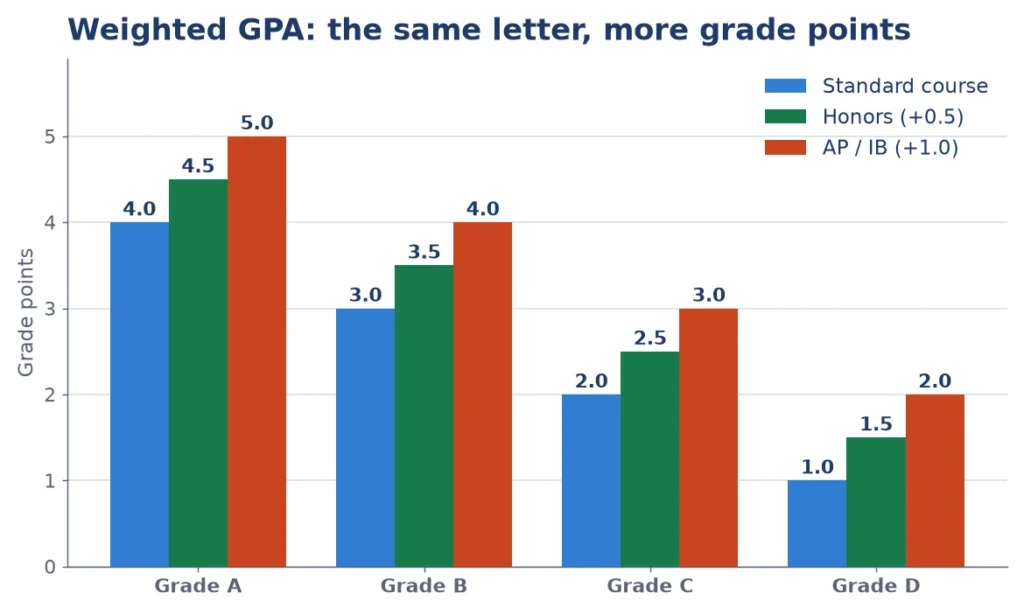
| Class | Grade | Type | Grade points | Weighted points |
|---|---|---|---|---|
| AP Biology | A | AP | 4.0 | 5.0 |
| English | B+ | honors | 3.3 | 3.8 |
| Chemistry | A− | standard | 3.7 | 3.7 |
| Algebra | B | standard | 3.0 | 3.0 |
| Spanish | A | standard | 4.0 | 4.0 |
| Total | 18.0 → 3.60 unweighted | 19.5 → 3.90 weighted |
The unweighted GPA is 18.0 ÷ 5 = 3.60 and the weighted GPA is 19.5 ÷ 5 = 3.90. Schools differ a lot. Some give the bonus only for a C or better, some use a 5.0 scale for AP only, and some cap the number of weighted courses. Ask your counselor for the exact rules.
The University of California is a useful example of an official method. It converts A, B, C and D to 4, 3, 2 and 1 with no plus or minus, gives one extra point per semester of approved honors-level work up to a maximum of 8, and does not give the extra point for a D or F, according to the UC admissions GPA page. That is why a college’s own GPA can differ from your school’s weighted number.
Middle school GPA calculator
A middle school GPA calculator works the same way. Most middle schools use the unweighted 4.0 scale with one credit per class, and some report only a percent average. Enter each class with its letter, leave the credits out, and read the average.
GPA calculator from percentage: converting percent grades
No single percent-to-GPA table is official. The bands below are the common US pattern the calculator uses when you type a percent. If your school publishes its own table, convert to letters yourself and enter the letters.
| Percent | Letter | Grade points | Percent | Letter | Grade points |
|---|---|---|---|---|---|
| 97–100 | A+ | 4.0 | 77–79 | C+ | 2.3 |
| 93–96 | A | 4.0 | 73–76 | C | 2.0 |
| 90–92 | A− | 3.7 | 70–72 | C− | 1.7 |
| 87–89 | B+ | 3.3 | 67–69 | D+ | 1.3 |
| 83–86 | B | 3.0 | 63–66 | D | 1.0 |
| 80–82 | B− | 2.7 | 60–62 | D− | 0.7 |
GPA in Canada, the UK and Australia
The GPA idea travels, but the scales do not. Here is how the main English-speaking systems compare. Cut-offs are set by each school, so use these as a guide and check your own handbook.
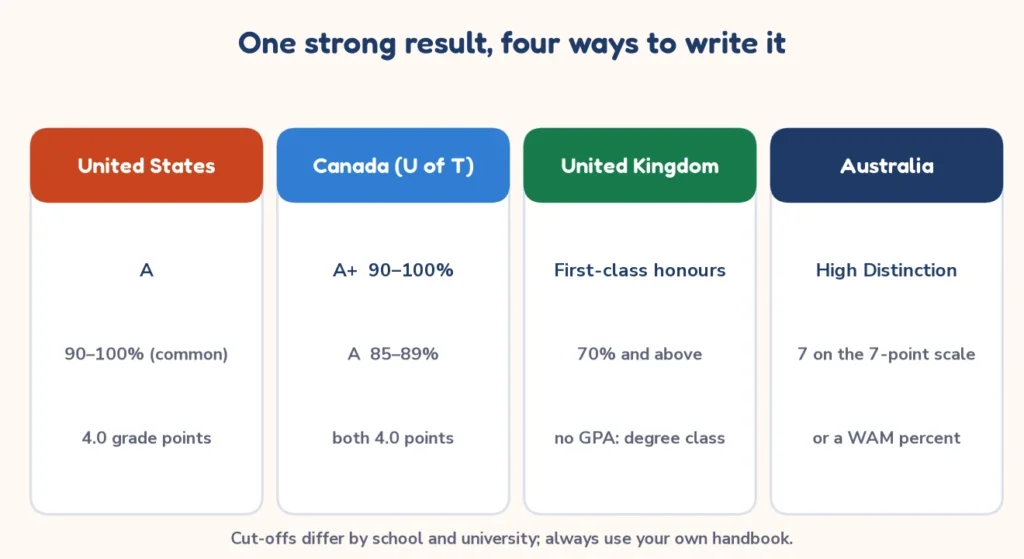
Canada
Canada has no single GPA scale. High schools report percents, and each province and university maps them to letters. As of 2026, the University of Toronto’s Arts and Science grading scale gives A+ at 90–100% and A at 85–89% (both 4.0), A− at 80–84% (3.7), B+ at 77–79% (3.3), B at 73–76% (3.0), B− at 70–72% (2.7) and C+ at 67–69% (2.3). Alberta schools commonly use A+ at 90–100%, while British Columbia high schools use A for 86–100% and B for 73–85%.
Ontario’s Ministry of Education groups secondary percent grades into four levels: Level 1 is 50–59%, Level 2 60–69%, Level 3 70–79% and Level 4 80–100%, from its Growing Success policy. For a Canadian university GPA calculator, use this GPA calculator: enter the letter grades your university uses and pick the 4.0 scale, or the 4.3 scale if your school gives an A+ 4.3.
United Kingdom and Europe
UK universities do not use a GPA. They award degree classes from weighted averages of marks: first-class honors at 70% and above, upper second (2:1) at 60–69%, lower second (2:2) at 50–59% and third at 40–49%, as conventional values that each university can adjust. Schools in England grade GCSEs from 9 to 1, a scale in use since 2017 according to Ofqual’s GCSE 9 to 1 guide. US admissions offices convert UK marks themselves, so there is no standard GPA for a UK degree.
Australia and New Zealand
Australian schools do not use GPAs, but many universities do, usually on a 7-point scale where High Distinction = 7, Distinction = 6, Credit = 5 and Pass = 4. Queensland University of Technology, for example, sets 85–100% as a 7, 75–84% as a 6, 65–74% as a 5 and 50–64% as a 4 in its grading policy. Other universities use a 4-point scale, and some, including Melbourne, UNSW and Sydney, report a weighted average mark (WAM) instead.
Choose the Australia 7-point option in the scale menu and type grades such as HD 6, D 6, C 6 and P 12: the quality points are 42 + 36 + 30 + 48 = 156 over 30 credit points, a GPA of 5.20.
Plan next term with a GPA calculator
The best use of a GPA calculator is a what-if test before the term starts. List the courses you plan to take with the grades you hope for, then change one grade at a time. Seeing that a B+ instead of an A− in a 4-credit course costs 1.6 quality points makes it easy to decide where to spend your study hours.
Run the GPA calculator three times: a realistic case, a best case and a worst case. If the worst case still clears a scholarship or program minimum, you have room to breathe. If not, the GPA calculator shows which course to protect first.
Ways to raise your GPA
- Put the most effort into high-credit courses, which move the average the most.
- Check the final grade calculator to see what you need on an exam to move up a letter.
- Use the grade calculator to turn test scores into percents and letters during the term, and the weighted grade calculator when categories have different weights.
- Look up your school’s grade replacement policy before retaking a course, because some schools replace the old grade and others average both.
- Plan study time with a printable homework planner.
Quick GPA calculator examples
- All B grades, any credits: 3.0, because every course earns 3.0 points.
- An A, a B and a C in courses with equal credits: (4.0 + 3.0 + 2.0) ÷ 3 = 3.0.
- Two A− grades and a B+ in 3-credit courses: (3.7 + 3.7 + 3.3) ÷ 3 = 3.57.
- One F in a 3-credit course alongside four A grades in 3-credit courses: 48 ÷ 15 = 3.2.
- A 4-credit A, 4-credit B, 3-credit B, 3-credit C and 2-credit A: 51 ÷ 16 = 3.19.
Type any of these into the GPA calculator to see the same answers with the quality points listed.
Common GPA mistakes
- Averaging the letters. A plain average of grade points ignores credits and is wrong when courses differ in size; a GPA calculator weights each course for you.
- Leaving out an F. An F is worth 0 points, but its credits still count and pull the GPA down.
- Mixing scales. A weighted 4.5 and an unweighted 3.7 cannot be averaged together.
- Counting pass/fail courses. Most schools leave them out of the GPA entirely.
- Rounding early. Keep full decimals until the final answer, then round to two places.
Frequently asked questions
10 quick answers
What is a good GPA?
On the 4.0 scale a 3.0 is a B average and a 3.5 or higher is often considered strong. Colleges, scholarships and employers set their own cut-offs, so check the requirement for your goal.
How do I calculate my GPA?
Multiply each course’s grade points by its credits, add the results, and divide by the total credits. A 4-credit A and a 3-credit B give (16 + 9) ÷ 7 = 3.57.
How do I calculate a cumulative GPA?
Add all quality points from every term and divide by all credits. With a previous GPA, multiply it by the earlier credits first, add this term’s quality points, then divide by the new total credits.
What is the difference between weighted and unweighted GPA?
An unweighted GPA gives every A the same 4.0. A weighted GPA adds bonus points for honors, AP or IB classes, often 0.5 or 1.0, so an A can count as 4.5 or 5.0.
How do I convert a percent to GPA?
Convert the percent to a letter with your school’s table, then to grade points. On common US bands, 92% is an A− (3.7) and 85% is a B (3.0). Type the percent and the calculator does it.
Does an F count in my GPA?
Yes. An F is worth 0 grade points but its credits still count, which pulls the average down. Some schools replace the grade if you retake the course.
Is an A+ worth more than an A?
On the standard 4.0 scale both are 4.0. Some schools use a 4.3 scale where an A+ is worth 4.3. Pick the 4.3 scale in the calculator if yours does.
Can I use decimal credits?
Yes. Credits such as 1.5 or 0.5 work. The calculator weights each course by exactly the number you enter.
Does the GPA calculator work for Canada, the UK or Australia?
The GPA calculator works for any school that reports grade points. Canadian schools can use the 4.0 or 4.3 scale, and Australian 7-point GPAs have their own option. The UK uses degree classes instead of a GPA.
Does the GPA calculator save my courses?
No, nothing is stored. Copy your list somewhere safe, use Copy link to share the setup, or print the GPA planner worksheet.
Related calculators and worksheets
- Test grade calculator and final grade calculator
- Weighted grade calculator for course categories and target grades
- Percentage calculator and mean, median and mode calculator
- Homework planner printable, free printable worksheets and all calculators
Sources and further reading
- Grade point average (Wikipedia): how GPA systems compare worldwide
- University of California GPA requirement: an official honors-point method
- University of Toronto grading scale: Canadian percent, letter and grade points
- QUT grading policy: an Australian 7-point scale
- GCSE 9 to 1 grade scale explained (Ofqual)
This GPA calculator gives an estimate for planning; your school or university decides the official GPA. Last updated: October 2026.