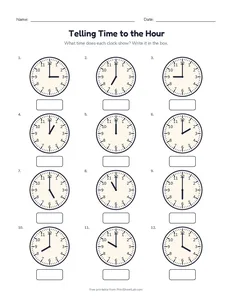
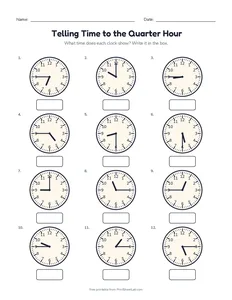
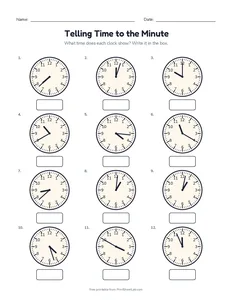
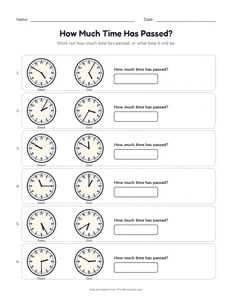
New: print a learning clock with cut-out hands or blank clock faces, and practice with the interactive clock.
Telling time worksheets to print (PDF)
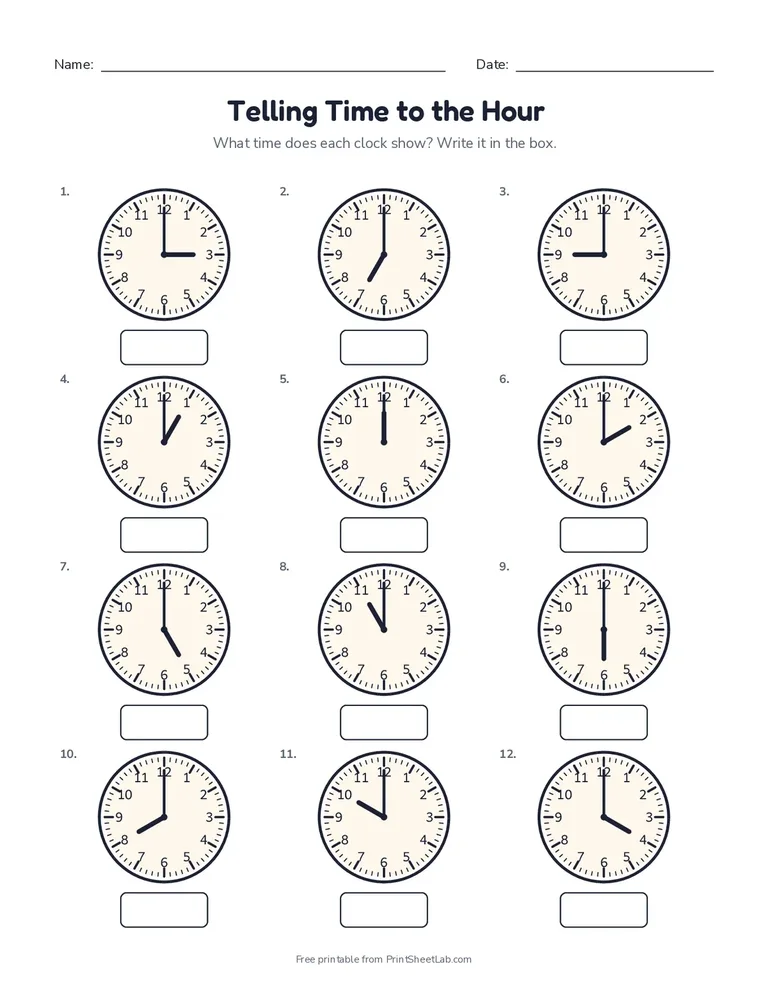
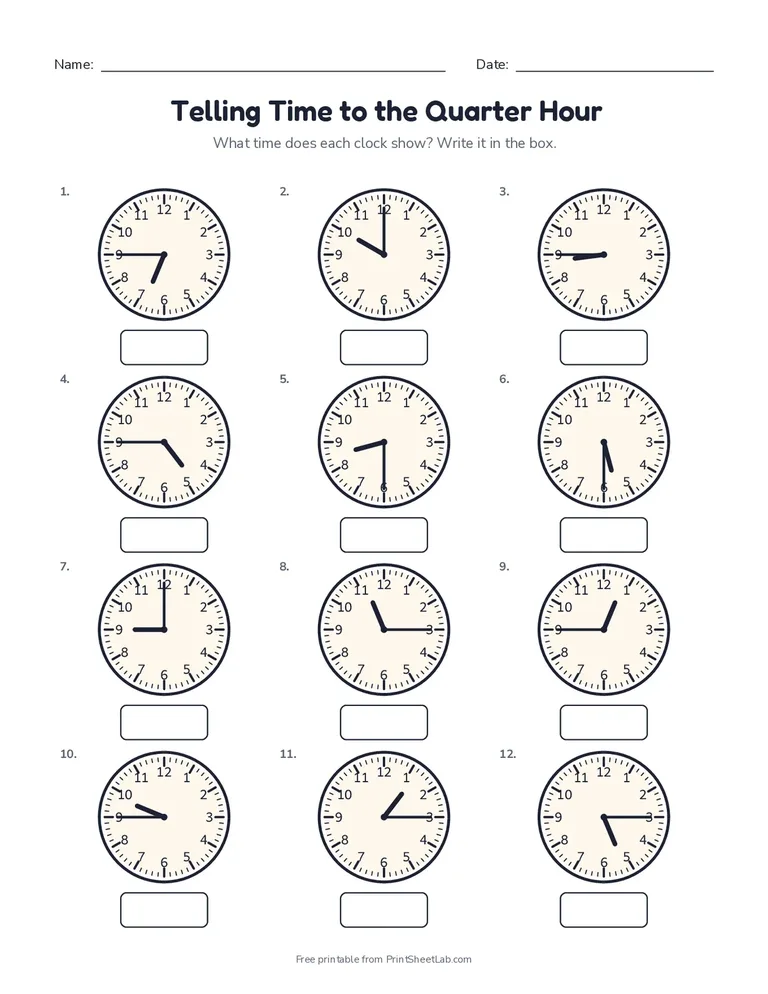
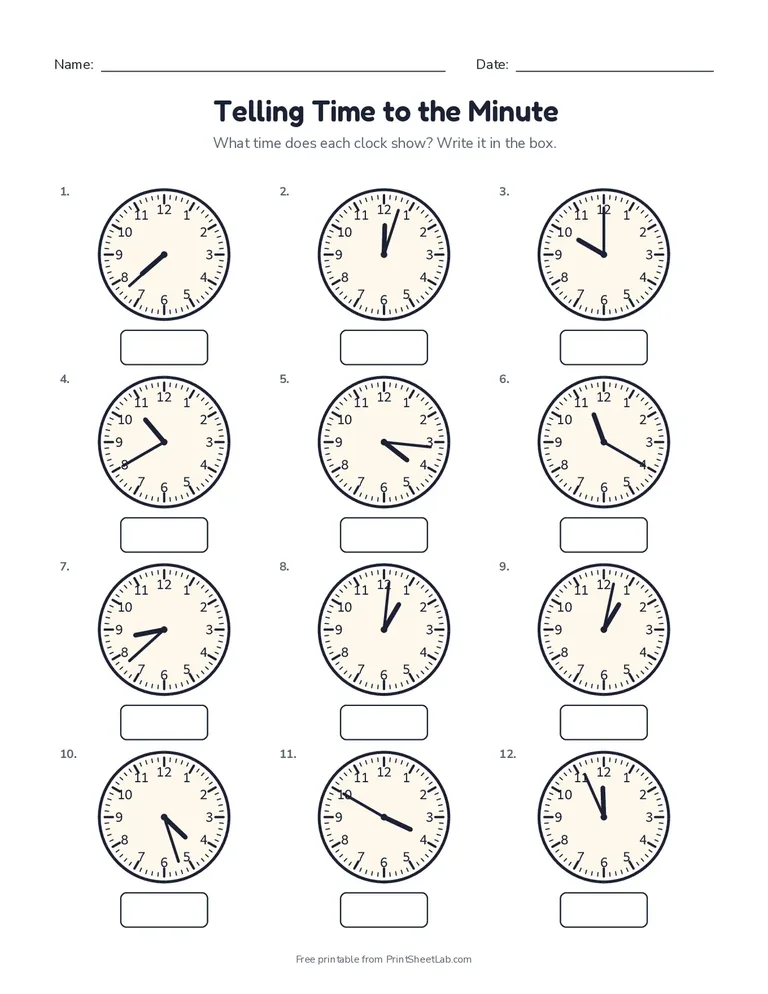
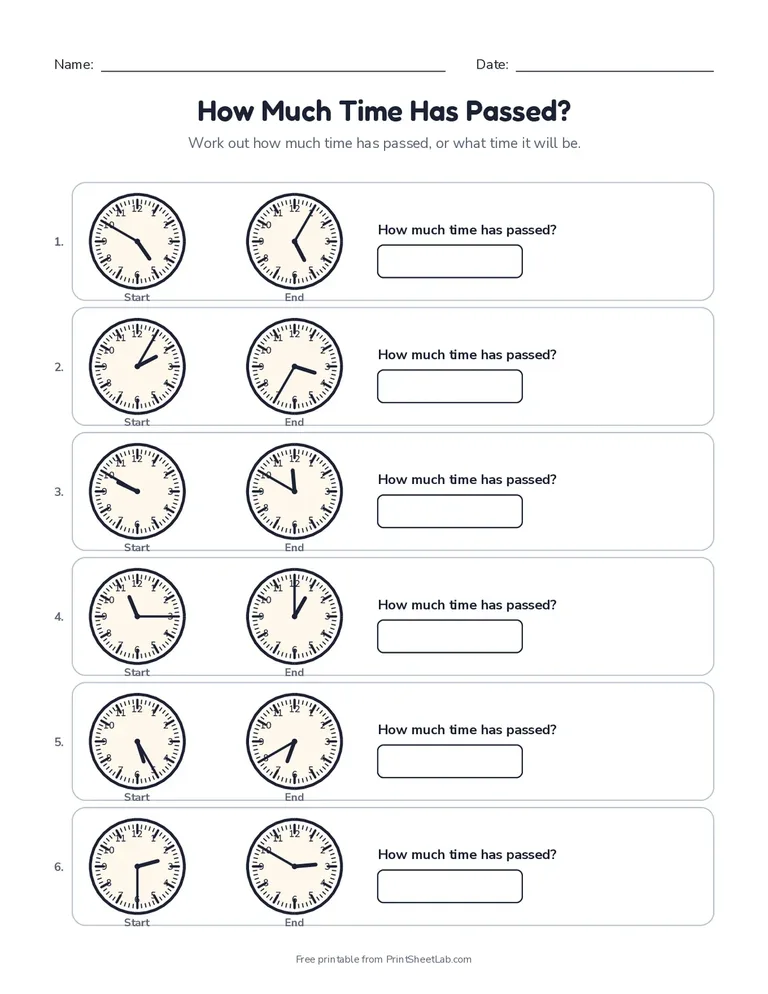
These telling time worksheets are a sample of the 20 printable PDFs in this section, from the hour to elapsed time. Click a picture for the PDF, or open one of the sets below.
Two hands, two jobs
An analog clock is really two number lines bent into circles. The short hand points to the hour and moves slowly from one number to the next. The long hand counts minutes, and each number it passes is 5 more minutes. Most mistakes come from mixing the hands up, so our clocks draw the hour hand clearly shorter and thicker, and the “draw the hands” worksheets ask children to think about both.
A good order to learn
- Hours: the long hand points straight up at 12, the short hand shows the hour (grade 1).
- Half hours: the long hand points down at 6 and the short hand is halfway between two numbers (grade 1, 1.MD.B.3).
- Quarter hours and 5 minutes: count by 5s around the clock (grade 2, 2.MD.C.7).
- To the minute and elapsed time: count the small marks, and work out how much time has passed (grade 3, 3.MD.A.1).
A common mix-up
At 2:45 the hour hand is almost at 3, so many children read it as 3:45. Remind them that the hour hand only reaches the next number when the minute hand gets back to 12.
What is in the telling time worksheets
There are 20 telling time worksheets in four sets, each with an answer key:
- Time to the hour and half hour (6 worksheets)
- Time to the quarter hour and 5 minutes (7 worksheets)
- Time to the nearest minute (3 worksheets)
- Elapsed time (4 worksheets)
Clock worksheets: how many different times can a clock show?
Each skill in the clock worksheets makes the number of possible times bigger. This table counts the times on a 12-hour clock face, which shows why telling time to the minute is so much harder than telling time to the hour:
| Skill | Times on a 12-hour clock face | Why |
|---|---|---|
| Hours | 12 | 12 hours, minute hand at 12 |
| Half hours | 24 | 12 hours, two positions each |
| Quarter hours | 48 | 12 hours, four positions each |
| Five minutes | 144 | 12 hours, 12 positions each |
| Nearest minute | 720 | 12 hours, 60 positions each |
A child who has learned to read the 12 hours has seen 1 in 60 of the times that they will eventually need. This is why the worksheets move in small steps, and why each set has its own practice before the next skill starts.
Telling time to the half hour
For telling time to the half hour, the minute hand points straight down at the 6 and the hour hand is halfway between two numbers. Children should say “half past”, and then say the time as a digital time such as 4:30 (1.MD.B.3). The two hands turn at different speeds, so their angle changes through the day. In this table, the angle is worked out from the speed of each hand: the minute hand turns 6° every minute, and the hour hand turns 0.5° every minute:
| Time | Hour hand has turned | Minute hand has turned | Angle between the hands |
|---|---|---|---|
| 3:00 | 90° | 0° | 90° |
| 6:00 | 180° | 0° | 180° |
| 12:30 | 15° | 180° | 165° |
| 2:30 | 75° | 180° | 105° |
| 4:15 | 127.5° | 90° | 37.5° |
| 9:45 | 292.5° | 270° | 22.5° |
| 10:10 | 305° | 60° | 115° |
| 1:50 | 55° | 300° | 115° |
At 3:00 the hands make a right angle, and at 6:00 they are in a straight line. At 12:30 the hour hand is halfway between the 12 and the 1, which is 15°, so the hands are 165° apart. Children who use a learning clock with movable hands, such as the printable learning clock, can see this for themselves.
Telling time to 5 minutes: counting around the clock
Telling time to 5 minutes is skip counting by 5s around the clock face (2.MD.C.7). Each number the minute hand points to stands for five times that number of minutes. After the 6 the child counts the minutes to the next hour, which is how “quarter to” is read:
| Minute hand points at | Minutes past the hour | Minutes to the next hour |
|---|---|---|
| 0 | 0 | 60 |
| 1 | 5 | 55 |
| 2 | 10 | 50 |
| 3 | 15 | 45 |
| 4 | 20 | 40 |
| 5 | 25 | 35 |
| 6 | 30 | 30 |
| 7 | 35 | 25 |
| 8 | 40 | 20 |
| 9 | 45 | 15 |
| 10 | 50 | 10 |
| 11 | 55 | 5 |
Children can read the telling time to 5 minutes worksheets by saying “5, 10, 15…” with their finger on each number. The skip counting practice on the counting worksheets page helps with this.
When do the clock hands overlap?
This is a puzzle for older children. The minute hand turns 12 times faster than the hour hand, so it catches up with it once every 65 minutes and 27 seconds. In 12 hours they overlap 11 times, not 12, because the overlap at the end of the 12 hours is the same as the one at the start. These are the times:
| Overlap number | Time the hands overlap |
|---|---|
| 1 | 12:00:00 |
| 2 | 1:05:27 |
| 3 | 2:10:55 |
| 4 | 3:16:22 |
| 5 | 4:21:49 |
| 6 | 5:27:16 |
| 7 | 6:32:44 |
| 8 | 7:38:11 |
| 9 | 8:43:38 |
| 10 | 9:49:05 |
| 11 | 10:54:33 |
Overlaps are not at the whole minute, apart from at 12:00, so a child can see that the hands are almost together at 1:05, but not quite.
Elapsed time worksheets: jump to the next hour
Elapsed time worksheets ask how much time has passed between a start time and an end time (3.MD.A.1). The easiest method is to jump: first jump to the next whole hour, then add whole hours, and then add the last minutes. These four examples show the jumps:
| Start | End | Jump to the next hour, then on | Time that passed |
|---|---|---|---|
| 3:45 pm | 6:20 pm | 15 min to 4:00, then 2 h and 20 min | 2 h 35 min |
| 8:10 am | 11:05 am | 50 min to 9:00, then 2 h and 5 min | 2 h 55 min |
| 11:40 am | 2:15 pm | 20 min to 12:00, then 2 h and 15 min | 2 h 35 min |
| 9:05 am | 9:50 am | 45 min | 45 min |
Children can also use a number line with hour marks, as in the number line tool, or a clock with movable hands. Wikipedia’s article on the 12-hour clock explains why times are written with am and pm.
Am, pm and the 24-hour clock
Telling time worksheets for grade 3 and 4 use am and pm. The 24-hour clock is used in schools in many countries, and the conversion is easy: add 12 to every pm hour, except noon:
| 12-hour time | 24-hour time |
|---|---|
| 12:00 am (midnight) | 00:00 |
| 1:00 am | 01:00 |
| 12:00 pm (noon) | 12:00 |
| 1:00 pm | 13:00 |
| 6:30 pm | 18:30 |
| 11:59 pm | 23:59 |
Practice it as a game
Free online games for the same skill: balloon pop, memory match, races and more. No sign-up.
Frequently asked questions
2 quick answers
At what age do children learn to tell time?
Most children read hours and half hours at 6 or 7 (grade 1), five-minute times by 7 or 8 (grade 2) and times to the minute by 8 or 9 (grade 3).
Why learn analog clocks when phones are digital?
Analog clocks show time passing and how much is left, which helps with elapsed time, fractions (half past, quarter to) and counting by 5s.