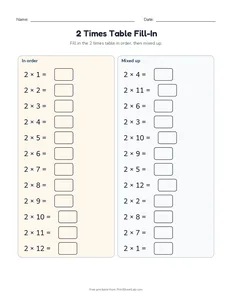
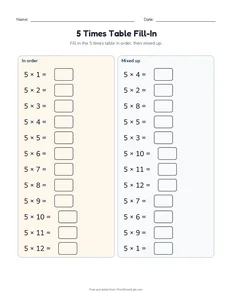
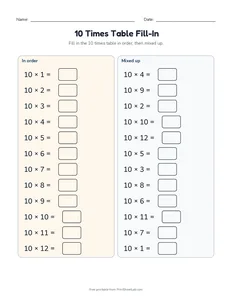
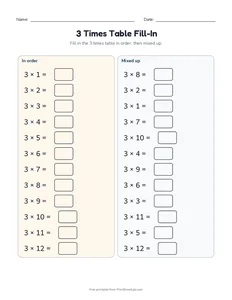
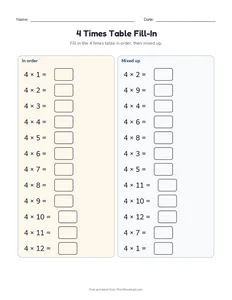
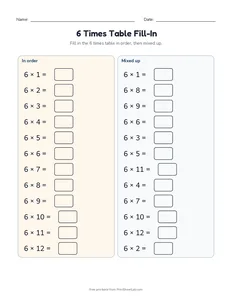
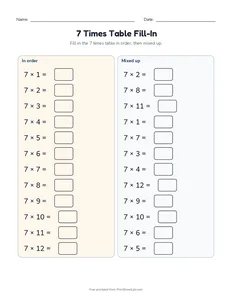
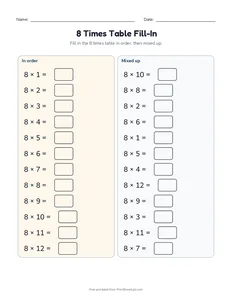
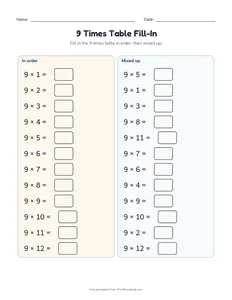
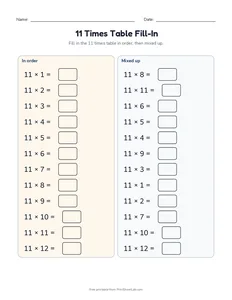
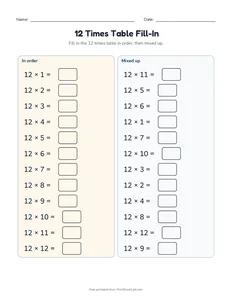
Print free times tables worksheets for every table from 2 to 12, or mixed facts up to 12 × 12, with answer keys. Make a single table for practice, a timed drill with time and score boxes, missing factor sheets or matching division facts, then download a PDF for US Letter or A4.
Times tables worksheets to print (PDF)
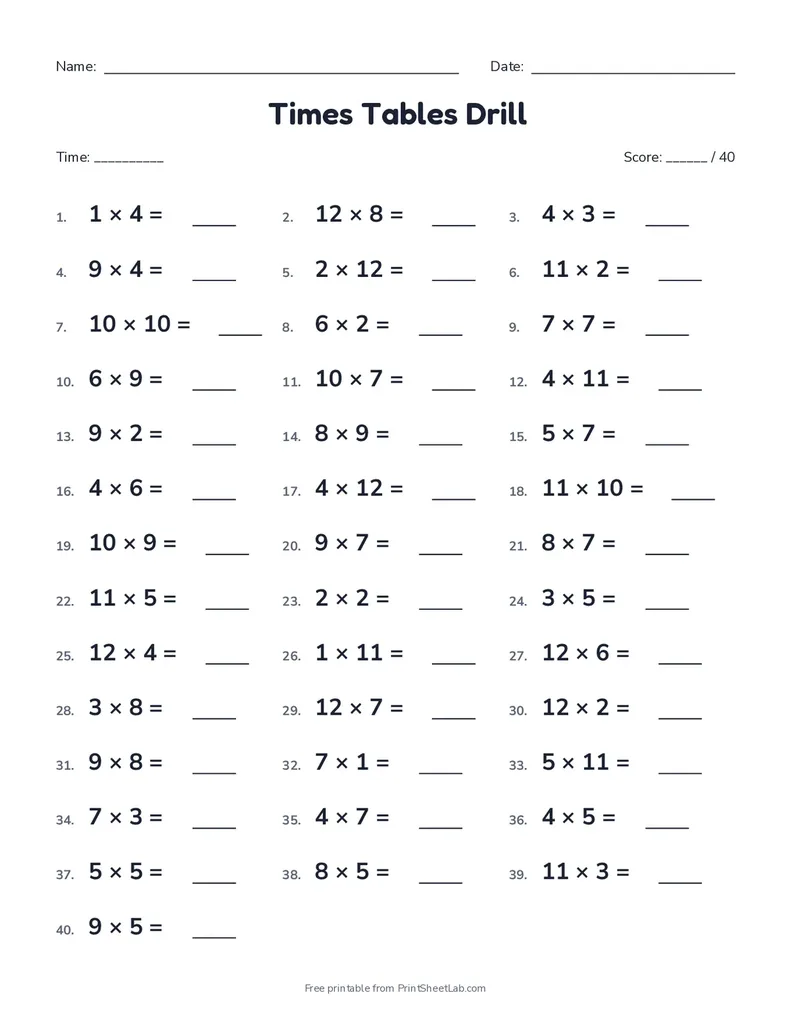
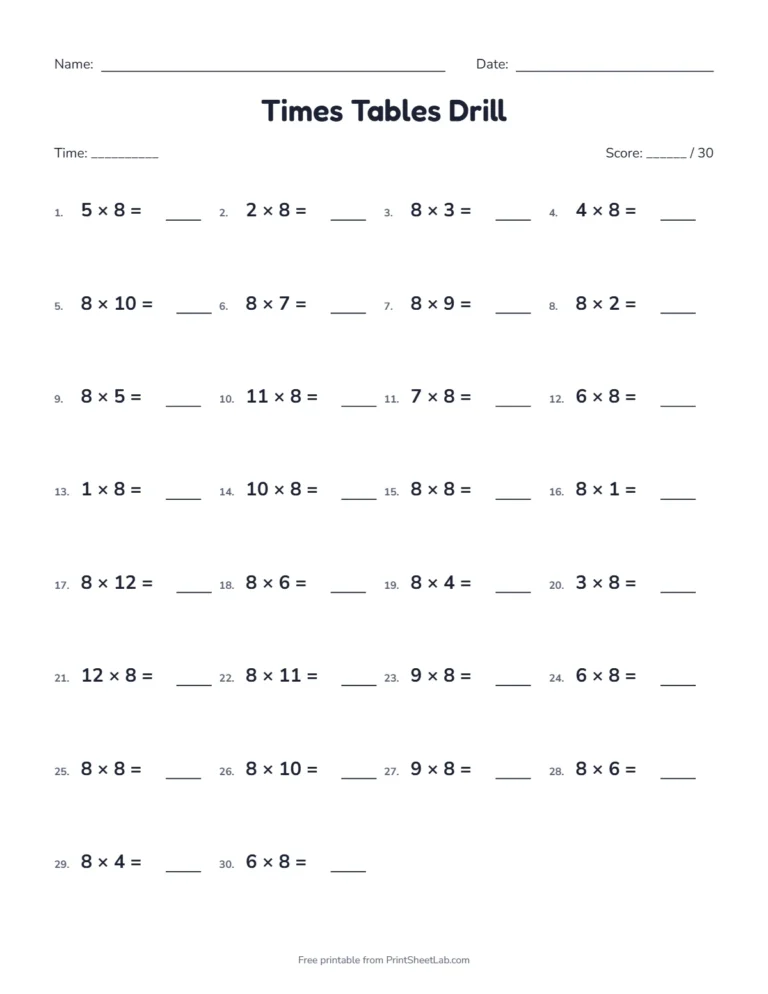
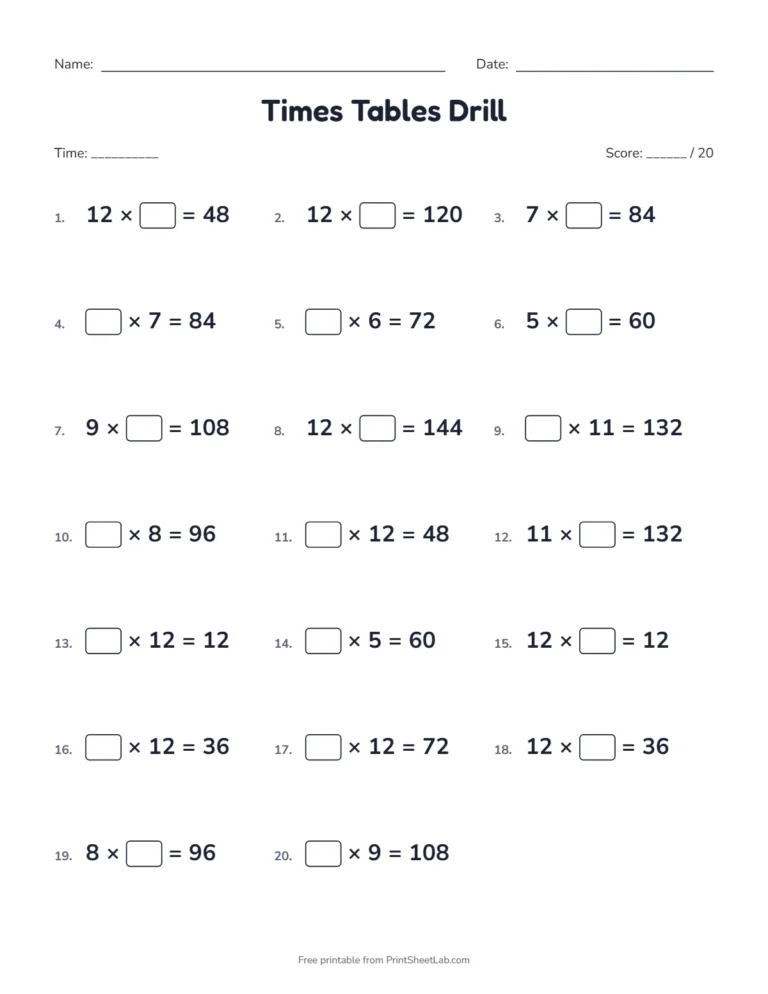
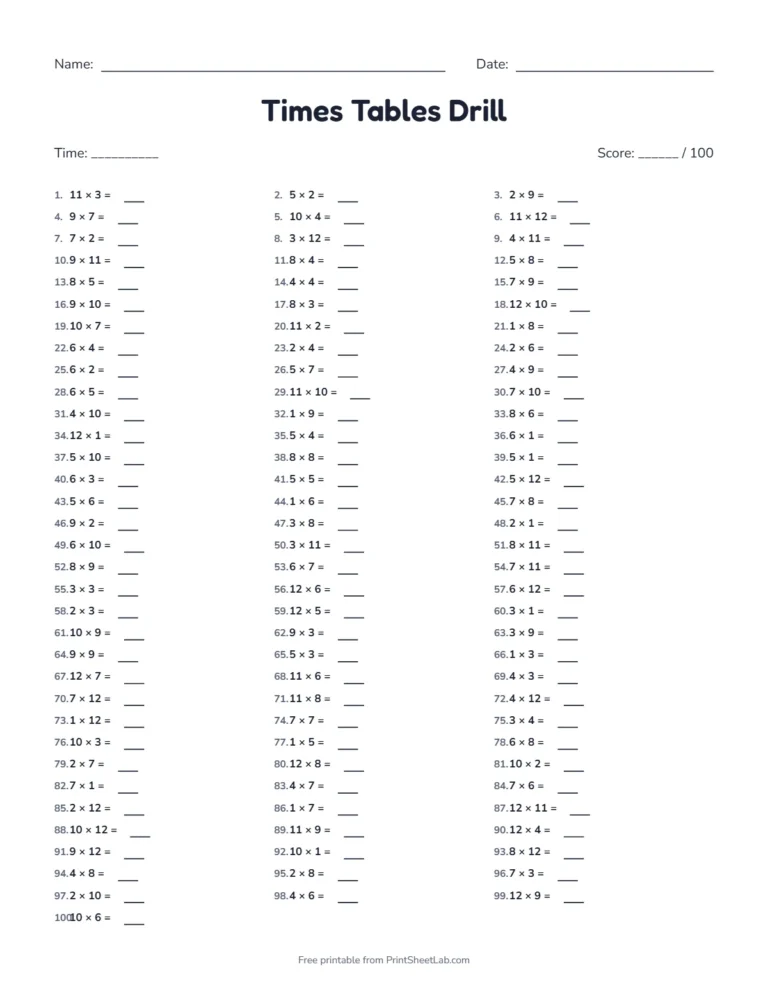
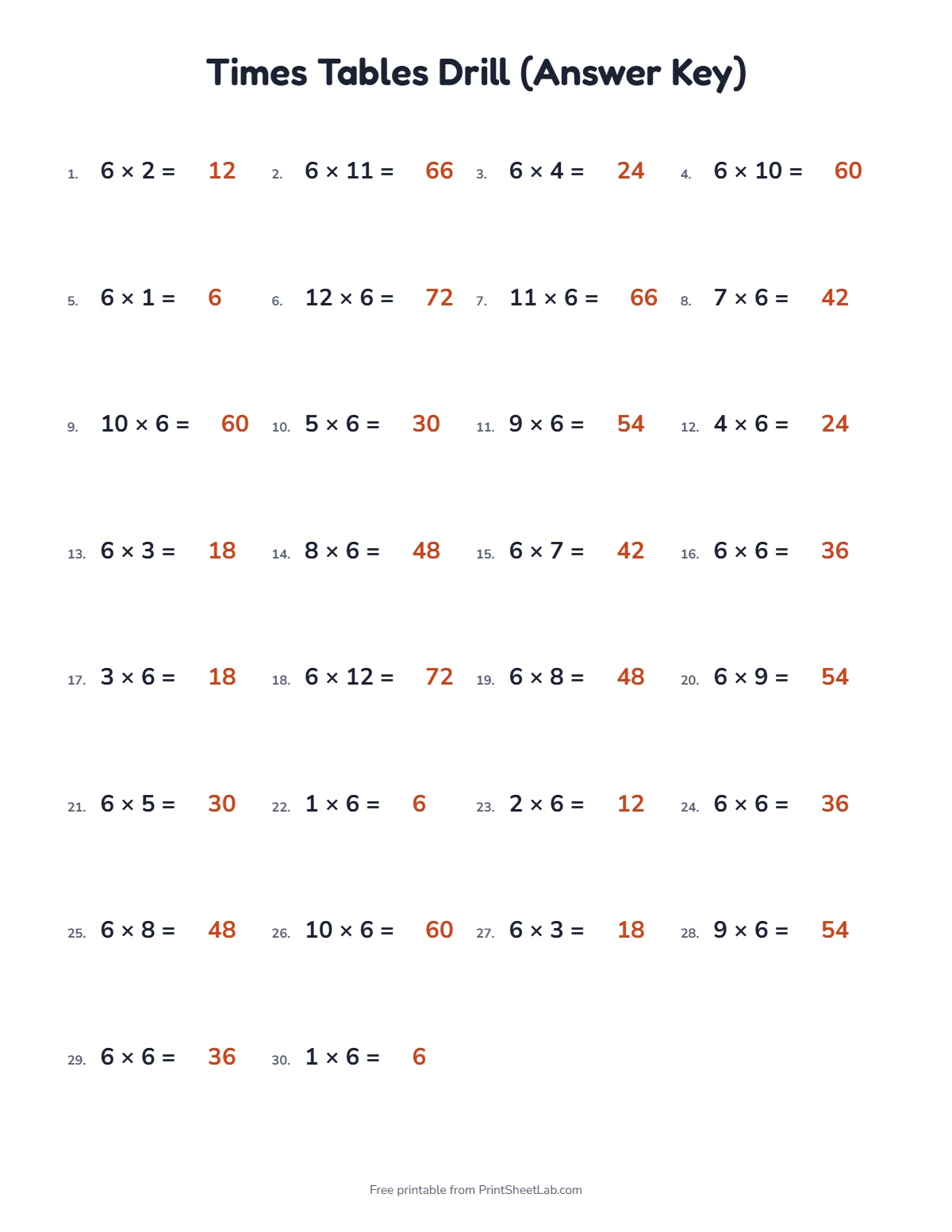
These times tables worksheets show what the generator prints: the 8 times table, missing factors for the 12 times table, a mixed 100-fact drill and the answer key. Click a picture for the PDF, or use the generator above to choose the table, the layout and the number of problems.
New: print a multiplication chart from 10 × 10 to 20 × 20, or practice with the interactive times table chart.
Times tables worksheets for every table
Each table has its own page with a fill-in chart, a times table wheel, skip counting, fact practice, missing factors, division facts, games and story problems:
- 2 times table worksheets
- 3 times table worksheets
- 4 times table worksheets
- 5 times table worksheets
- 6 times table worksheets
- 7 times table worksheets
- 8 times table worksheets
- 9 times table worksheets
- 10 times table worksheets
- 11 times table worksheets
- 12 times table worksheets
- Mixed 100-fact drill (maker)
Times tables worksheets 1-12: the grid by the numbers
The times tables worksheets 1-12 cover a grid of 144 facts, but the grid has patterns that make it easier to learn. This table counts the facts and the products:
| The 12 × 12 grid by the numbers | Value |
|---|---|
| Facts from 1 × 1 to 12 × 12 | 144 |
| Different products | 59 |
| Facts with an odd product (both numbers odd) | 36 (25%) |
| Facts with a product of 100 or more | 11 (8%) |
| Facts with a product of 25 or less | 61 (42%) |
| Sum of all 144 products | 6,084 |
Only 59 different numbers appear as products. The sum of all 144 products is 6,084, which is exactly 78 × 78, since 1 + 2 + … + 12 is 78. Wikipedia’s article on the multiplication table has more patterns.
Multiplication facts worksheets: which products come up most often?
Some products can be made in several ways, so children meet them more often. Of the 59 different products, these six appear the most often among the facts with two numbers from 1 to 12, counting 3 × 4 and 4 × 3 as one fact:
| Product | Ways to make it with two numbers from 1 to 12 | The facts |
|---|---|---|
| 12 | 3 | 1 × 12, 2 × 6, 3 × 4 |
| 24 | 3 | 2 × 12, 3 × 8, 4 × 6 |
| 36 | 3 | 3 × 12, 4 × 9, 6 × 6 |
| 4 | 2 | 1 × 4, 2 × 2 |
| 6 | 2 | 1 × 6, 2 × 3 |
| 8 | 2 | 1 × 8, 2 × 4 |
The turn-around rule, called the commutative property, says that 3 × 4 = 4 × 3, so a child who knows one of them knows both. This leaves 78 different facts to learn in multiplication facts worksheets from 1 × 1 to 12 × 12, and 66 if the 1s are left out.
Times table practice sheets: patterns in the last digits
Times table practice sheets work better when children notice patterns. This table shows the last digit of the first ten answers for each table from 2 to 9. A child who can see that the 5s end in 5 and 0 will not need to count:
| Times table | Last digit of the first ten answers | The pattern |
|---|---|---|
| 2 | 2 4 6 8 0 2 4 6 8 0 | always even, and the digits repeat every 5 steps |
| 3 | 3 6 9 2 5 8 1 4 7 0 | runs backwards through the odd and even digits |
| 4 | 4 8 2 6 0 4 8 2 6 0 | even digits, in a cycle of 5 |
| 5 | 5 0 5 0 5 0 5 0 5 0 | alternates between 5 and 0 |
| 6 | 6 2 8 4 0 6 2 8 4 0 | the same last digits as the 4s, in a different order |
| 7 | 7 4 1 8 5 2 9 6 3 0 | a cycle through all ten digits, which makes it hard |
| 8 | 8 6 4 2 0 8 6 4 2 0 | the reverse of the 2s pattern |
| 9 | 9 8 7 6 5 4 3 2 1 0 | counts down from 9 to 0 |
The 9s have the best pattern of all. The digits of every answer add up to 9, and the tens digit goes up as the ones digit goes down:
| Nine times | Answer | Digits add up to |
|---|---|---|
| 9 × 1 | 9 | 9 |
| 9 × 2 | 18 | 9 |
| 9 × 3 | 27 | 9 |
| 9 × 4 | 36 | 9 |
| 9 × 5 | 45 | 9 |
| 9 × 6 | 54 | 9 |
| 9 × 7 | 63 | 9 |
| 9 × 8 | 72 | 9 |
| 9 × 9 | 81 | 9 |
| 9 × 10 | 90 | 9 |
Times tables drills: how long should a drill take?
Times tables drills are meant to build fluency, so they are timed. A common aim is 3 seconds for each fact, which is fast enough to count as recall and not as counting. At that rate, the drills on the worksheets take:
| Drill | Problems | Seconds a fact | Time to allow |
|---|---|---|---|
| 20-problem drill | 20 | 3 | 1 minute |
| 40-problem drill | 40 | 3 | 2 minutes |
| 60-problem drill | 60 | 3 | 3 minutes |
| 100-problem drill | 100 | 3 | 5 minutes |
In England, the multiplication tables check for Year 4 pupils asks 25 questions with 6 seconds for each one, so the drills above are harder than the check and prepare for it well. Start with a longer time and make it shorter as the child improves.
The hardest times table facts, and a trick for each
Not all facts are equally hard. Teachers find that the facts with 6, 7, 8 and 9 take the longest to learn. These eight facts are the ones that most children find hardest, with a trick for each:
| Fact | Product | Trick that helps |
|---|---|---|
| 7 × 8 | 56 | 5, 6, 7, 8: “56 = 7 × 8” |
| 6 × 8 | 48 | double 6 × 4 = 24 |
| 7 × 9 | 63 | 70 − 7 = 63 |
| 6 × 7 | 42 | six sevens is 42; count 7, 14, 21, 28, 35, 42 |
| 8 × 9 | 72 | 80 − 8 = 72 |
| 6 × 9 | 54 | 60 − 6 = 54 |
| 7 × 7 | 49 | a square: 49 |
| 8 × 8 | 64 | a square: 64 |
Practice these facts on their own, one or two a day, on the times tables worksheets for the 6, 7, 8 and 9 times tables.
Times tables drills
Switch on Timed drill to add time and score boxes. A common plan is:
| Drill | Problems | Good for |
|---|---|---|
| 1-minute drill | 20 | Warm-ups and one table at a time |
| 3-minute drill | 60 | Mixed tables once most facts are known |
| 5-minute drill | 100 | Full mixed practice up to 12 × 12 |
Print a few versions (A, B, C) so children can repeat the drill during the week without learning the answers by position. Let each child try to beat their own score rather than race classmates.
Which order to learn the times tables
- 2, 5 and 10: doubles, counting in fives, and adding a zero.
- 3, 4 and 6: 4 is double 2, and 6 is double 3.
- 11 and 9: 11 × 1 to 11 × 9 repeat the digit (11 × 4 = 44), and the digits of 9 × 1 to 9 × 10 add up to 9 (9 × 7 = 63).
- 7, 8 and 12: by now most of these facts are already known from other tables.
Because 7 × 8 is the same as 8 × 7, there are only 78 different facts from 1 × 1 to 12 × 12, not 144.
Times tables worksheets around the world
In the US, the Common Core standards expect children to know all products of two one-digit numbers from memory by the end of grade 3. In England, Year 4 pupils take the multiplication tables check, an online check of facts up to 12 × 12. These worksheets work for both, and for any school that practices tables up to 12.
Ways to practice with times tables worksheets
- One table a week: print the same table in versions A to E and use one each day.
- Beat your score: keep the drill sheets in a folder and write the score on the front, so progress is easy to see.
- Say it, then write it: saying the fact aloud before writing it helps it stick.
- Link to division: after a table is secure, print the matching division facts on the division worksheets page.
Practice it as a game
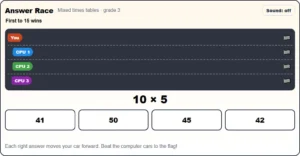
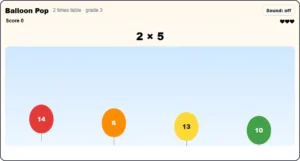
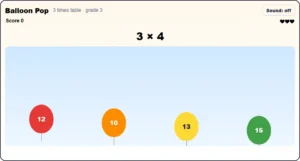
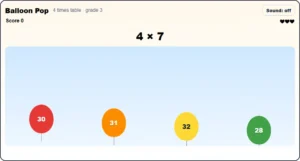
Free online games for the same skill: balloon pop, memory match, races and more. No sign-up.

Frequently asked questions
5 quick answers
Are these times tables worksheets free?
Yes, with answer keys, no sign-up and no watermark.
Can I make a worksheet for just the 7 times table?
Yes. Open the 7 times table worksheets page, or choose 7 under “Times table focus” in the maker on this page.
Do the facts include 0 and 1?
Choose where facts start: 0, 1 or 2. Starting at 2 leaves out the easiest facts.
Can I print times tables and division together?
Yes. Choose “Mixed × and ÷” as the operation, or print a division facts sheet from the division worksheets page.
Can I print on A4?
Yes. Choose A4 before downloading.
More math worksheets
- Multiplication worksheets for multi-digit problems.
- Division worksheets.
- Math worksheet generator.