Blank number lines are one of the most flexible tools in math class. Use them for addition and subtraction jumps, skip counting, rounding, fractions and negative numbers. These free printable blank number lines have 4 to 10 lines per page, with 5, 10, 12 or 20 spaces on each line, either blank or numbered from any start and counting by 1, 2, 5, 10, 25 or 100.
Blank number lines to print (PDF)
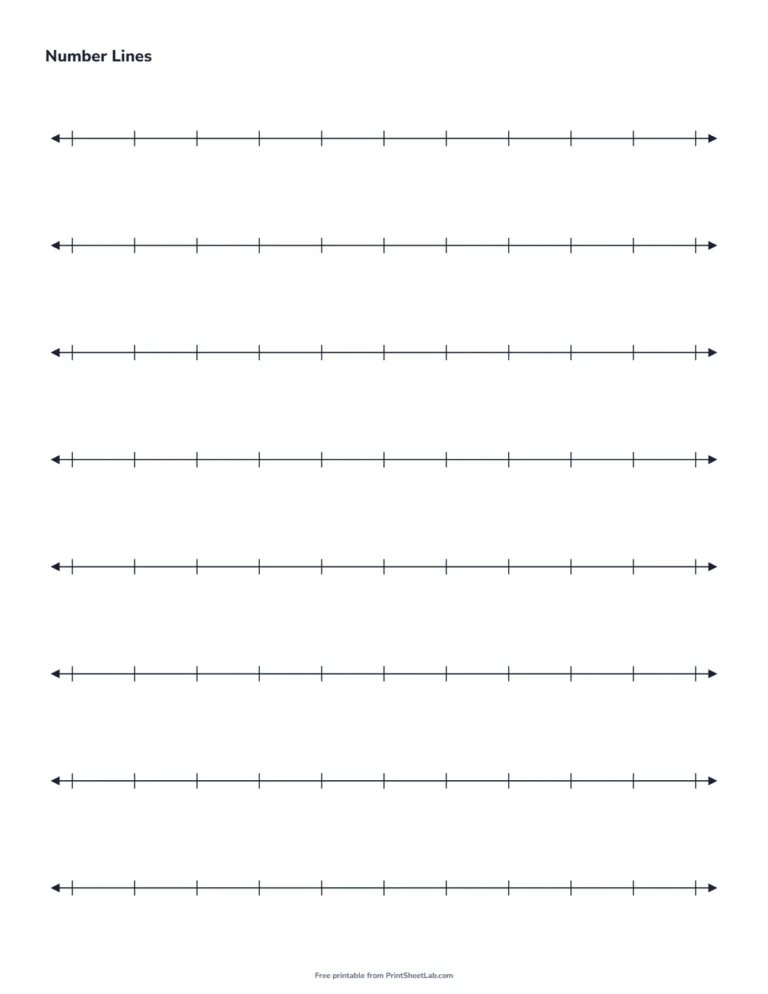
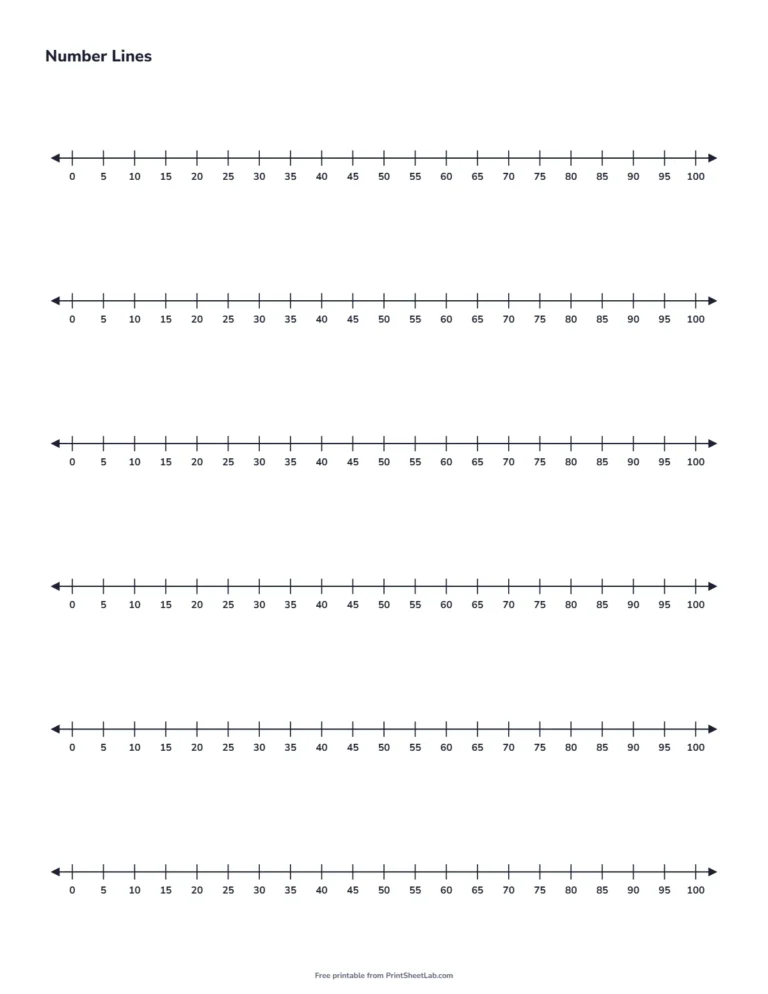
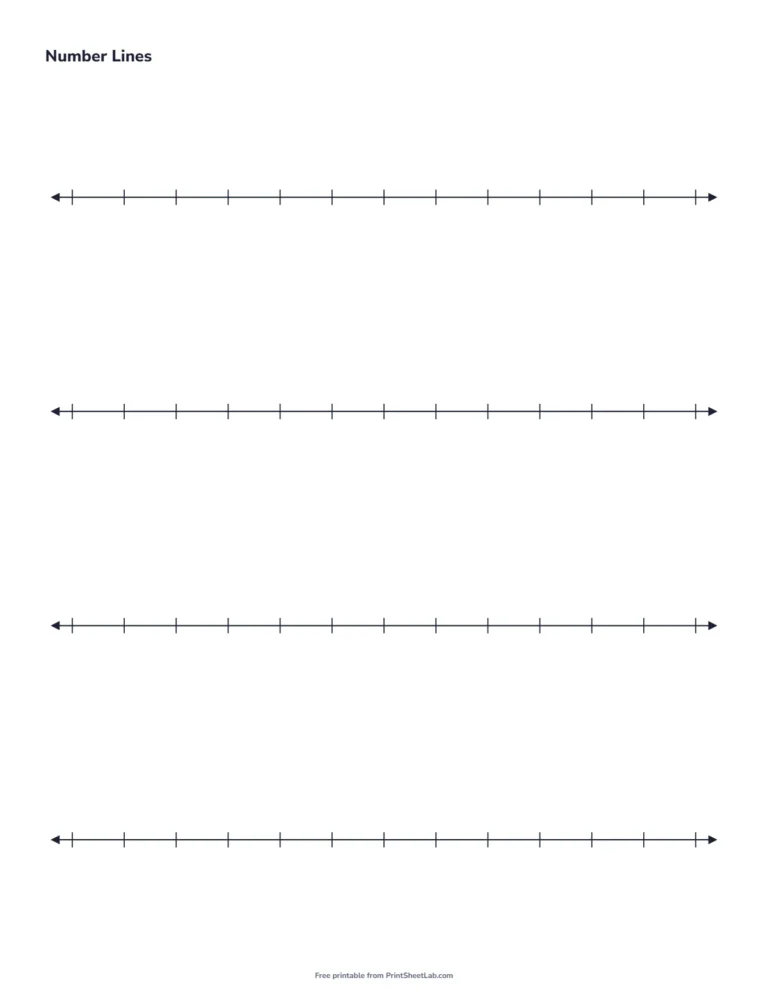
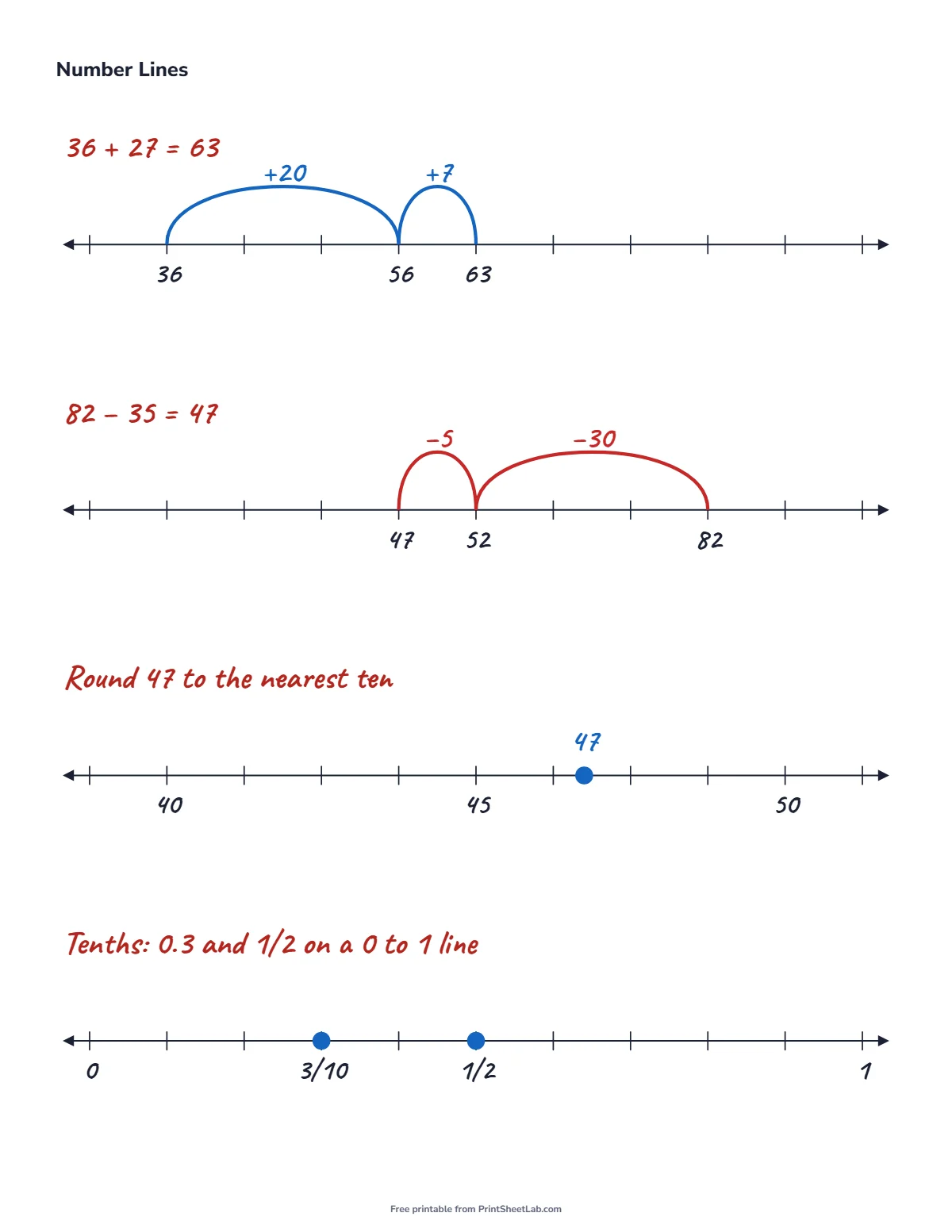
These four pages show the choices: a page of 8 blank number lines, six number lines that count by 5s to 100, four lines with 12 spaces for fractions, and a filled example with jumps. Click a picture for the PDF, or use the generator above to choose the number of lines, the number of spaces and the numbers.
What is a number line?
A number line is a straight line with equal spaces marked on it, where each mark stands for a number and the numbers get larger from left to right. The arrows at each end show that it continues. Wikipedia’s number line article gives the history. These blank number lines have an arrow at each end, a mark at each space and room under the line for labels.
Empty number line template: how many fit on a page?
You choose how many lines go on a page, and how many spaces each one has. More lines make a page of quick practice, while fewer lines leave room for drawing jumps above and below the line. This table shows the vertical space for each line on a Letter page, and the number of marks you get:
| Lines per page | Space for each line | 5 spaces | 10 spaces | 12 spaces | 20 spaces |
|---|---|---|---|---|---|
| 4 | 2.37 in | 24 | 44 | 52 | 84 |
| 6 | 1.58 in | 36 | 66 | 78 | 126 |
| 8 | 1.19 in | 48 | 88 | 104 | 168 |
| 10 | 0.95 in | 60 | 110 | 130 | 210 |
Every line is the same width, 6.9 inches from the first mark to the last. With 10 spaces, the marks are 0.69 inch apart, with 20 spaces they are 0.35 inch apart, and with 5 spaces they are 1.38 inches apart. For jumps, choose 4 lines per page, which leaves 2.4 inches for each one.
Open number line: jumps for addition and subtraction
An open number line (also called an empty number line) has no fixed scale, so you only mark the numbers you need. It is a standard tool for mental math in elementary school. To add 36 and 27, put 36 on the line, jump 20 to reach 56, then jump 7 to reach 63. To take 35 away from 82, start at 82, jump back 30 to reach 52, then jump back 5 to reach 47. The filled example shows both. Spaces do not have to be to scale. What matters is the strategy: split the second number into tens and ones, and jump in steps that are easy to do in your head.
Skip counting number line: from 0 to 100 and beyond
To print a skip counting number line, choose a start number and what to count by. The generator offers 1, 2, 5, 10, 25 and 100. This table shows how far a line goes if it starts at 0:
| Count by | Starting at 0, 10 spaces | Starting at 0, 20 spaces | Skip counting practice |
|---|---|---|---|
| 1 | 0 to 10 | 0 to 20 | Counting and bonds within 20 |
| 2 | 0 to 20 | 0 to 40 | Even numbers, doubles |
| 5 | 0 to 50 | 0 to 100 | Nickels, 5-minute clock marks |
| 10 | 0 to 100 | 0 to 200 | Tens, rounding |
| 25 | 0 to 250 | 0 to 500 | Quarters, quarter hundreds |
| 100 | 0 to 1,000 | 0 to 2,000 | Hundreds and place value |
You can start at any number, including a negative one. A line with 20 spaces that starts at −10 and counts by 1 covers −10 to 10, which is the range most students need to learn negative numbers.
Fraction number line: how to use 5, 10, 12 and 20 spaces
For fractions, label 0 at the left and 1 at the right, and let each space be one fraction. The number of spaces decides which fractions are possible, because the marks you can name are the divisors of the number of spaces. This table shows what each choice supports:
| Spaces | Fractions you can show | Marks |
|---|---|---|
| 5 | Fifths | 1/5, 2/5, 3/5, 4/5, 1 |
| 10 | Tenths, fifths and halves | 1/10, 1/5, 3/10, 2/5, 1/2, 3/5, 7/10, 4/5, 9/10, 1 |
| 12 | Twelfths, sixths, quarters, thirds and halves | 1/12, 1/6, 1/4, 1/3, 5/12, 1/2, 7/12, 2/3, 3/4, 5/6, 11/12, 1 |
| 20 | Twentieths, tenths, fifths, quarters and halves | All 20 marks; every 2nd is a tenth, every 4th a fifth, every 5th a quarter, and the 10th a half |
Twelve spaces are special: they allow halves, thirds, quarters and sixths on the same line, which is perfect for comparing fractions. A line with 10 spaces also works for decimals, since each space is one tenth. For fraction and decimal number line worksheets with answer keys, see the number line generator.
Rounding on a blank number line template
To round 47 to the nearest ten, make a number line from 40 to 50, with 10 spaces counting by 1. Mark 45 in the middle, then plot 47. It is closer to 50 than to 40, so it rounds to 50. Any number that lies on or to the right of the midpoint rounds up. This works the same way for hundreds when you count by 10 from 300 to 400.
Number lines for time and money
Some settings turn the number line into a measuring tool:
| Spaces | Count by | What the line shows |
|---|---|---|
| 12 | 1 | 0 to 12: months of the year, or hours |
| 12 | 5 | 0 to 60: minutes on a clock face, one mark for every 5 minutes |
| 20 | 5 | 0 to 100: a hundred chart in a line |
| 20 | 25 | 0 to 500 |
A line with 12 spaces and numbers counting by 5 is an unrolled clock face, and it is a good way to show elapsed time. Draw a jump from 15 to 40 and you see that 25 minutes have passed.
Number lines and the Common Core standards
Number lines are named in many of the Common Core standards for grades K to 6. This table matches common skills with a setting on the generator:
| Grade | Skill | Standard | Try this setting |
|---|---|---|---|
| K | Count forward from any number | K.CC.A.2 | 10 spaces, numbers from any start |
| 2 | Show whole numbers as lengths from 0 on a number line | 2.MD.B.6 | 10 or 20 spaces, start at 0 |
| 2 | Count within 1,000; skip-count by 5s, 10s and 100s | 2.NBT.A.2 | 10 spaces counting by 5, 10 or 100 |
| 3 | Show fractions on a number line | 3.NF.A.2 | 12 or 10 spaces, blank |
| 3 | Round to the nearest 10 or 100 | 3.NBT.A.1 | 10 spaces, start at 40 and count by 1 |
| 6 | Place positive and negative numbers on a number line | 6.NS.C.6 | 20 spaces, start at −10 |
Tips for teaching with a number line
- Print a class set of blank lines, and let students write their own numbers, so they think about the scale.
- Use a different color for each jump, and write the size of each jump above the arc.
- Ask students to explain the jumps out loud. The words matter as much as the picture.
- Start with the numbered line for beginners, then take away the numbers as they gain confidence.
- Laminate one page and use a dry-erase pen for whole-class practice.
Printing tip
Print at 100% or “Actual size” and turn off “Fit to page”, so every measurement on the sheet is exact. Choose Letter or A4 paper in the generator before you download the PDF.
Blank number lines: frequently asked questions
Can I make fraction number lines?
Yes. Use 10 or 12 spaces and label the marks yourself, or use the number line generator to print fraction number lines with answer keys.
How many number lines fit on a page?
You can print 4, 6, 8 or 10 lines on a page. Four gives the most room for jumps, and ten gives the most practice.
What is the difference between a blank number line and an open number line?
A blank number line has marks at equal spaces but no numbers. An open or empty number line has no marks, and you mark only the numbers you need. The same sheet works for both.
Can I print number lines that start at a negative number?
Yes. Type the starting number, such as −10, and the line is numbered from there.
Are these blank number lines free?
Yes. They are free to print for home and classroom use, with no sign-up.
More printable paper
- Specialty paper generator with every layout on this site
- Paper generator for lined, graph, dot grid, isometric and handwriting paper
- Graph paper, lined paper and dot grid paper