Conversion calculators change a measurement from one unit to another without changing its size: miles to kilometers, pounds to kilograms, Celsius to Fahrenheit, cups to grams. These free conversion calculators cover units, temperature, cooking and fuel economy, and each shows the factor or formula it used.
Quick answer: Pick the conversion calculator for the thing you are measuring. Length, weight, volume, area and speed: unit converter. Heat: temperature converter. Baking: cups to grams. Cars: MPG calculator. Example: 25 °C is 25 × 9/5 + 32 = 77 °F, and 1 US cup of all-purpose flour is about 120 g.
How to choose the right conversion calculator
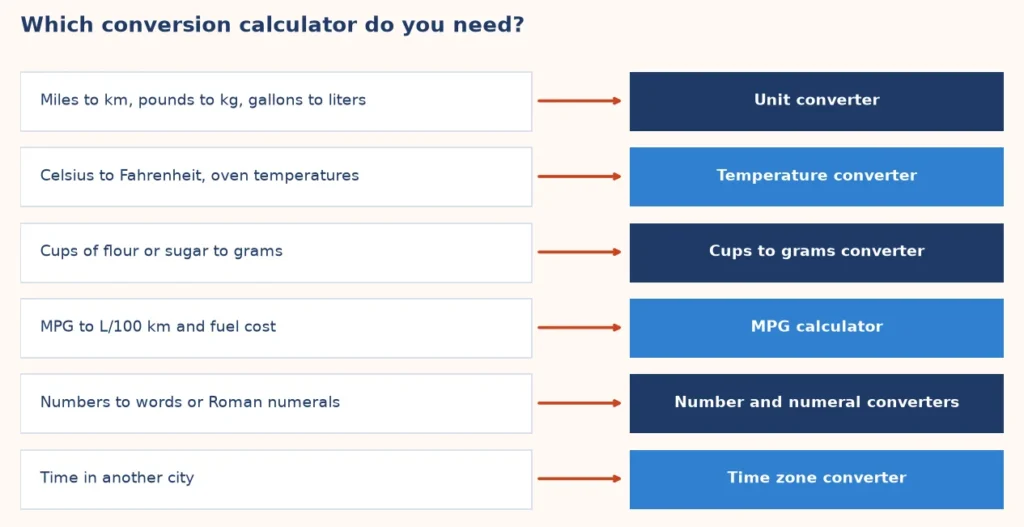
Conversion calculators are built around one idea: every unit is a fixed multiple of a base unit, except temperature scales, which also have an offset, and cooking cups, which depend on the ingredient. That is why one tool is not enough, and why good conversion calculators come in several kinds. The table matches each job to a converter, and all of them run in your browser.
| If you want to… | Use this converter | Example |
|---|---|---|
| Convert length, weight, volume, area or speed | Unit converter | 12 in = 30.48 cm |
| Convert °C, °F, K or °R | Temperature converter | 25 °C = 77 °F |
| Turn recipe cups into grams or ounces | Cups to grams converter | 1 cup flour = 120 g |
| Convert MPG, L/100 km and fuel cost | MPG calculator | 32 mpg = 7.35 L/100 km |
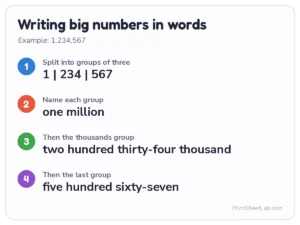
| Write a number in words | Number to words converter | 1,234 = one thousand two hundred thirty-four |
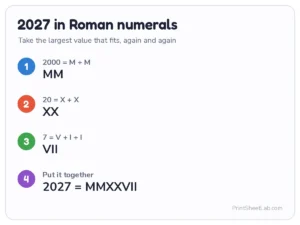
| Convert years and dates to Roman numerals | Roman numeral converter | 2026 = MMXXVI |
| Turn a decimal into a fraction | Decimal to fraction calculator | 0.375 = 3/8 |
| Convert a time between cities | Time zone converter | 9:00 AM in New York is 2:00 PM in London |
| Convert hours and minutes | Time calculator | 90 minutes = 1 h 30 min |
Unit conversion calculators: length, weight, volume, area and speed
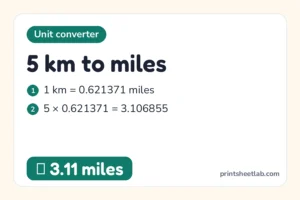
Unit conversion calculators multiply by a fixed factor. The factor between inches and centimeters is exactly 2.54, and the National Institute of Standards and Technology publishes the exact values. So 12 inches is 12 × 2.54 = 30.48 cm, and going back means dividing: 30.48 ÷ 2.54 = 12. The unit converter handles six kinds of measure and shows the factor used.
| Measure | US to metric | Metric to US |
|---|---|---|
| Length | 1 inch = 2.54 cm; 1 foot = 0.3048 m; 1 mile = 1.609344 km | 1 m = 3.2808 ft; 1 km = 0.6214 mi |
| Weight | 1 ounce = 28.3495 g; 1 pound = 0.45359237 kg | 1 kg = 2.2046 lb |
| Volume | 1 US fluid ounce = 29.5735 mL; 1 US gallon = 3.7854 L | 1 L = 0.2642 US gal |
| Area | 1 square foot = 0.092903 m²; 1 acre = 4,046.86 m² | 1 hectare = 2.4711 acres |
| Speed | 1 mph = 1.609344 km/h | 1 km/h = 0.6214 mph |
The metric and imperial converters: three systems, not two
Metric and imperial converters have to separate three systems. The metric system (SI) is used almost everywhere. US customary units are used in the United States. Imperial units are the older British system, now used in part in the UK. They share names but not sizes: a US gallon is 3.785 liters and an imperial gallon is 4.546 liters, so a US pint is 473 mL and an imperial pint is 568 mL.
This is why a recipe from a British book can come out wrong in an American kitchen. Always check which gallon, pint or cup a source uses before converting.
Temperature and unit converters: Celsius, Fahrenheit and kelvin
Temperature converters need two steps because the scales start at different points. Fahrenheit to Celsius is °C = (°F − 32) × 5/9, and Celsius to Fahrenheit is °F = °C × 9/5 + 32. Kelvin is Celsius plus 273.15. For 25 °C: 25 × 9/5 + 32 = 77 °F and 25 + 273.15 = 298.15 K. The temperature converter also gives Rankine and a table of reference points.
| Reference point | °C | °F | K |
|---|---|---|---|
| Absolute zero | -273.15 | -459.67 | 0 |
| Same number on both scales | -40 | -40 | 233.15 |
| Water freezes | 0 | 32 | 273.15 |
| Room temperature | 20 | 68 | 293.15 |
| Normal body temperature | 37 | 98.6 | 310.15 |
| Water boils at sea level | 100 | 212 | 373.15 |
A quick mental shortcut for Celsius to Fahrenheit is to double the number and add 30: for 25 °C that gives 80, close to the exact 77. Remember that a temperature change converts differently: a rise of 10 °C is a rise of 18 °F, because there is no offset for a difference.
Kitchen conversion calculators: cups, grams and oven temperatures
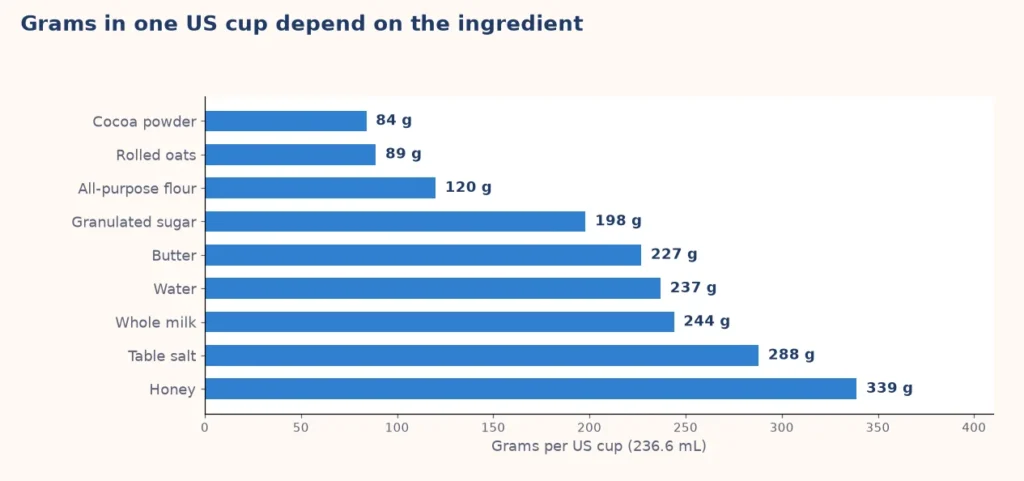
Kitchen conversion calculators solve the problem that a cup is a volume and a gram is a weight. A cup of flour, a cup of sugar and a cup of honey fill the same space but weigh very different amounts, so there is no single cups to grams factor. The cups to grams converter uses a weight for each of 27 ingredients, based on the King Arthur Baking ingredient weight chart and USDA data.
| Ingredient | 1 US cup | 1/2 cup | 1/4 cup |
|---|---|---|---|
| Cocoa powder | 84 g | 42 g | 21.0 g |
| Rolled oats | 89 g | 44 g | 22.2 g |
| All-purpose flour | 120 g | 60 g | 30.0 g |
| Granulated sugar | 198 g | 99 g | 49.5 g |
| Butter | 227 g | 114 g | 56.8 g |
| Water | 237 g | 118 g | 59.2 g |
| Whole milk | 244 g | 122 g | 61.0 g |
| Table salt | 288 g | 144 g | 72.0 g |
| Honey | 339 g | 170 g | 84.8 g |
Not all cups and spoons are the same size
The US cup is 236.6 mL, but the US legal cup used on nutrition labels is 240 mL, the metric cup used in Australia, Canada and New Zealand is 250 mL and the old UK imperial cup is 284 mL. Spoons differ too. A metric tablespoon is 15 mL in the UK, a US customary tablespoon is about 14.8 mL and an Australian tablespoon is 20 mL, so a recipe that calls for 3 tablespoons can differ by a third.
| Spoon or cup | Size in mL | Used in |
|---|---|---|
| US customary tablespoon | 14.8 | United States |
| Metric tablespoon | 15 | UK, Canada, much of the world |
| Australian tablespoon | 20 | Australia |
| US cup | 236.6 | United States |
| Metric cup | 250 | Australia, Canada, New Zealand |
| UK imperial cup | 284 | Older British recipes |
Oven temperatures need converting too. A recipe at 350 °F is 177 °C, and most European ovens are set at 180 °C. In British recipes, gas mark 4 is 180 °C or 350 °F, gas mark 6 is 200 °C or 400 °F, and gas mark 7 is 220 °C or 425 °F.
Fuel economy and measurement converters for cars
Fuel economy is the one unit where a bigger number can mean the opposite thing. In the United States, miles per gallon (MPG) rises as a car gets more efficient. In Canada, Europe and Australia, liters per 100 kilometers (L/100 km) falls as a car gets more efficient. The conversion is L/100 km = 235.215 ÷ MPG (US), so 32 mpg is 235.215 ÷ 32 = 7.35 L/100 km.

UK drivers add a third unit: miles per imperial gallon. Since an imperial gallon is larger, the same car gets more miles per gallon. 32 US mpg is 32 × 1.20095 = 38.4 UK mpg. The MPG calculator converts all three units and works out the fuel cost of a trip.
| US mpg | UK mpg | L/100 km | km/L |
|---|---|---|---|
| 20 | 24.0 | 11.76 | 8.50 |
| 25 | 30.0 | 9.41 | 10.63 |
| 30 | 36.0 | 7.84 | 12.75 |
| 35 | 42.0 | 6.72 | 14.88 |
| 40 | 48.0 | 5.88 | 17.01 |
| 50 | 60.0 | 4.70 | 21.26 |
Number and numeral converters
Some conversions change how a number is written, not what it measures. The number to words converter spells out amounts, so 1,234,567 is “one million, two hundred thirty-four thousand, five hundred sixty-seven”, useful for checks and legal documents. The Roman numeral converter writes numbers from 1 to 3,999 as I, V, X, L, C, D and M, so 2026 is MMXXVI and 1994 is MCMXCIV. The decimal to fraction calculator turns 0.375 into 3/8.
Names for large numbers differ by country. The US and, today, the UK use the short scale, where a billion is 1,000,000,000. Some countries in continental Europe use the long scale, where a billion is 1,000,000,000,000, so a number in words can mean two different things.
Online converters around the world
Online converters hide a lot of regional detail. Almost every country uses the metric system, but the United States uses US customary units for everyday life, the UK mixes miles, pints and stone with metric, and Canada uses metric for most measures but feet, inches and pounds for height and weight. Cooking adds more differences. Use the conversion calculators that match the country of your source, and say which units you chose when you share a result.
| Everyday measure | United States | Canada | United Kingdom | Australia |
|---|---|---|---|---|
| Road distance | Miles | Kilometers | Miles | Kilometers |
| Body weight | Pounds | Pounds | Stone and pounds | Kilograms |
| Weather | Fahrenheit | Celsius | Celsius | Celsius |
| Fuel economy | MPG | L/100 km | MPG (imperial) | L/100 km |
| Baking | Cups and spoons | Cups or grams | Grams, gas marks | Metric cups, grams |
How accurate are conversion calculators?
Conversion calculators are only as precise as their factors. Many factors between US and metric units are exact by definition: an inch is exactly 2.54 cm, a pound is exactly 0.45359237 kg and a mile is exactly 1.609344 km. Others, such as cups of flour, are averages. Good conversion calculators say which kind of factor they use and show enough decimals for you to round sensibly.
Rounding rules matter in school and science. If you measure 12.3 cm, converting to inches gives 4.842519… but your answer should keep three significant figures, so write 4.84 in. The significant figures calculator and the rounding calculator help with the last step, and the same care applies to every measurement converter you use.
Measurement converters for school, science and work
Measurement converters are common homework tools. Students convert units in physics, chemistry and cooking classes, and a mistake in a single conversion can ruin a long calculation. Tradespeople use the same measurement converters on site: a 2.4 m board is 7.87 ft, and a 20 L bucket is 5.28 US gallons. Write the unit with every number and check that it cancels the way you expect.
Real-life uses of conversion calculators
Conversion calculators earn their keep when two systems meet, and these three cases show how.
Traveling. A road sign says 80 km/h, which is 80 ÷ 1.609344 = 49.7 mph. A forecast says 30 °C, which is 86 °F, and a suitcase limit of 23 kg is 50.7 lb.
Baking. A US recipe asks for 2 cups of flour and 1 cup of sugar. In grams that is 240 g and 198 g, which is the safest way to follow it on a kitchen scale in any country.
Buying a car. A European listing gives 6.5 L/100 km. In US terms that is 235.215 ÷ 6.5 = 36.2 mpg, which you can compare with a US model directly.
Questions people ask about conversion calculators
How do I convert cups to grams?
Multiply the cups by the weight of one cup of that ingredient. A US cup of all-purpose flour is about 120 g, so 2 cups is 240 g. Sugar is about 198 g per cup and butter about 227 g, so there is no one factor for every ingredient.
What is the easiest way to convert Celsius to Fahrenheit?
Multiply by 9/5 and add 32. For a quick estimate, double the Celsius number and add 30. So 20 °C is exactly 68 °F, and the shortcut gives 70 °F, which is close enough for weather.
Why is a US gallon different from a UK gallon?
They come from different historical definitions. The US gallon is 3.785 liters and the imperial gallon, defined in Britain in 1824, is 4.546 liters, about 20% larger. That is why mpg figures differ between the two countries.
Common mistakes with conversion calculators
- Using one factor for every ingredient. A cup of honey weighs almost four times a cup of cocoa.
- Mixing US and imperial units. Pints, gallons and cups differ by country.
- Converting a temperature difference like a temperature. A 10 degree rise in Celsius is an 18 degree rise in Fahrenheit.
- Rounding too soon. Keep several decimals through a chain of conversions and round once at the end.
- Reading mpg and L/100 km the same way. A higher mpg is better, but a higher L/100 km is worse.
Frequently asked questions
9 quick answers
What are conversion calculators?
Conversion calculators are free online tools that change a quantity from one unit to another, such as miles to kilometers, pounds to kilograms, Celsius to Fahrenheit or cups to grams. The best conversion calculators show the factor or formula used, so you can check the answer.
How many centimeters are in an inch?
There are exactly 2.54 centimeters in one inch. To convert inches to centimeters multiply by 2.54, so 12 inches is 30.48 cm. To go back, divide by 2.54.
How do I convert Celsius to Fahrenheit?
Multiply the Celsius temperature by 9/5, then add 32. For example, 25 °C × 1.8 = 45, and 45 + 32 = 77 °F. At −40 the two scales show the same number.
How many grams are in a cup of flour?
A US cup of all-purpose flour weighs about 120 grams, or 4.2 ounces, according to the King Arthur Baking chart. A cup of sugar weighs about 198 g and a cup of butter about 227 g.
How do I convert MPG to L/100 km?
Divide 235.215 by the miles per US gallon. For 32 mpg the answer is 7.35 L/100 km. For UK imperial mpg, divide 282.481 by the figure instead, because an imperial gallon is larger.
What is the difference between a US and an imperial gallon?
A US gallon is 3.785 liters and an imperial gallon is 4.546 liters, about 20% more. The same car therefore shows a higher mpg in the UK than in the US.
Are a metric tablespoon and a US tablespoon the same?
Almost. A metric tablespoon is 15 mL and a US customary tablespoon is about 14.8 mL. An Australian tablespoon is 20 mL, which makes a noticeable difference in recipes.
How do I write a year in Roman numerals?
Break the year into thousands, hundreds, tens and ones and write each in Roman symbols. 2026 is MM for 2,000, XX for 20 and VI for 6, so MMXXVI. The Roman numeral converter does it in one step.
Are these conversion calculators free?
Yes. They are free, need no account and run in your browser, so your numbers stay on your device. Use official sources for legal or scientific work.
More calculator hubs
- All free online calculators with steps for every topic
- Home improvement calculators for volume, area and material estimates
- Health and fitness calculators for weight, BMI and pace conversions
- Math calculators for fractions, ratios and scientific notation
- Financial calculators for currency, tax and pricing
- Date and time calculators for time and time zone conversions
Sources and further reading
- NIST Guide to the SI, Appendix B: Conversion factors (exact US to metric factors)
- NIST: SI units (the seven base units)
- Wikipedia: Tablespoon (sizes in the UK, US and Australia)
- Wikipedia: Conversion of units (methods and tables)
Cup weights are typical values; ingredients vary by brand and packing. Last updated: October 2026.