This living or nonliving game helps kindergarten and first grade children sort things into living and nonliving groups by playing: sort twenty items into two bins, pop balloons, race cars or sprint through true and false sentences. Every item is a simple word, such as tree, rock, frog or robot, and the game explains where a wrong guess belongs. It is a free kindergarten science game that needs no sign-up, works on phones and tablets, and comes with a printable living and nonliving sorting mat.
Living or nonliving game: see how it plays
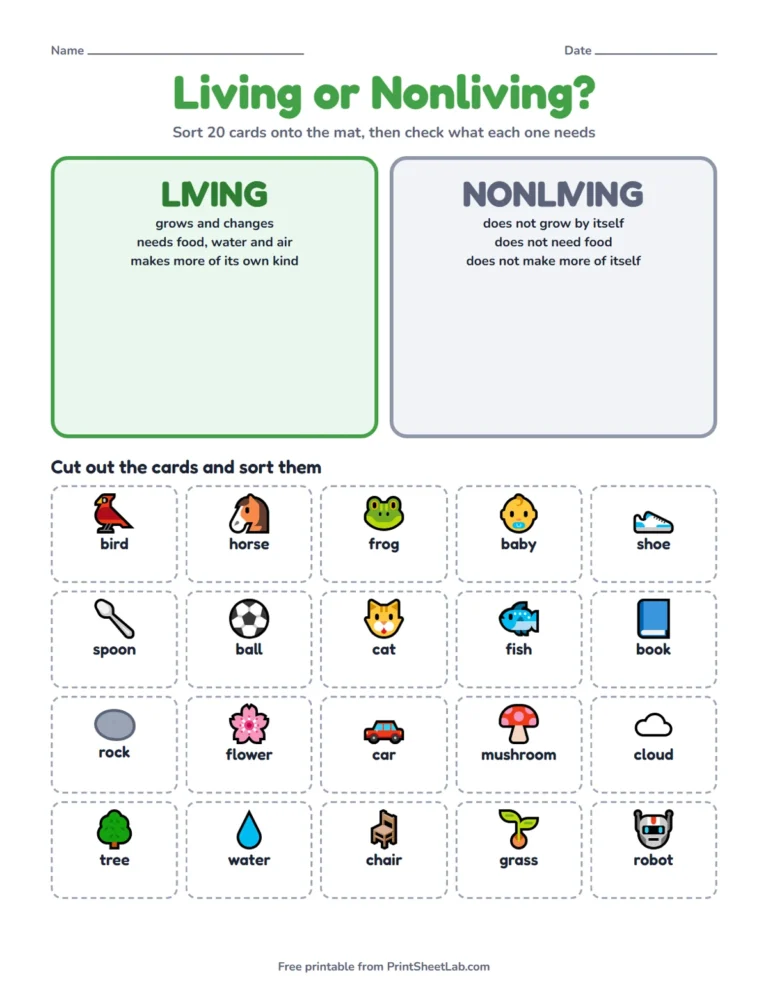
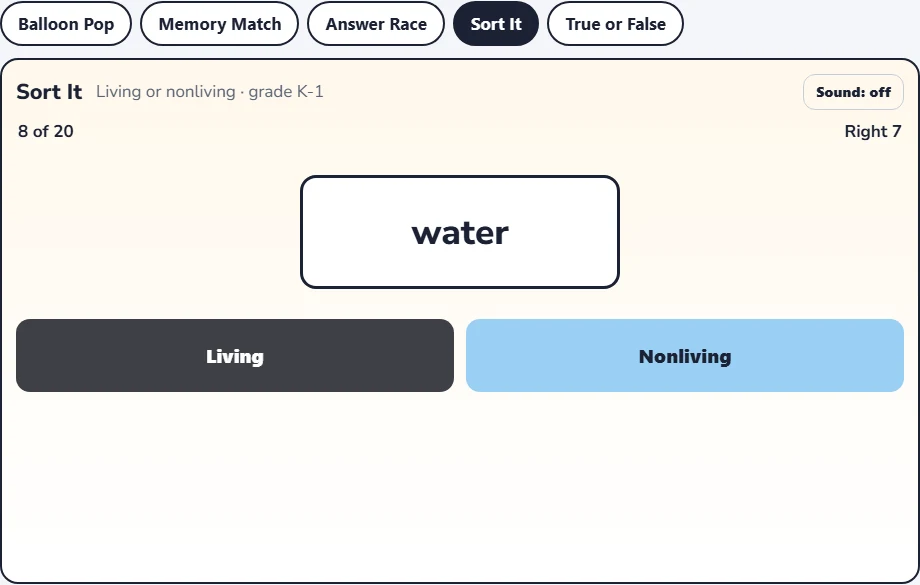
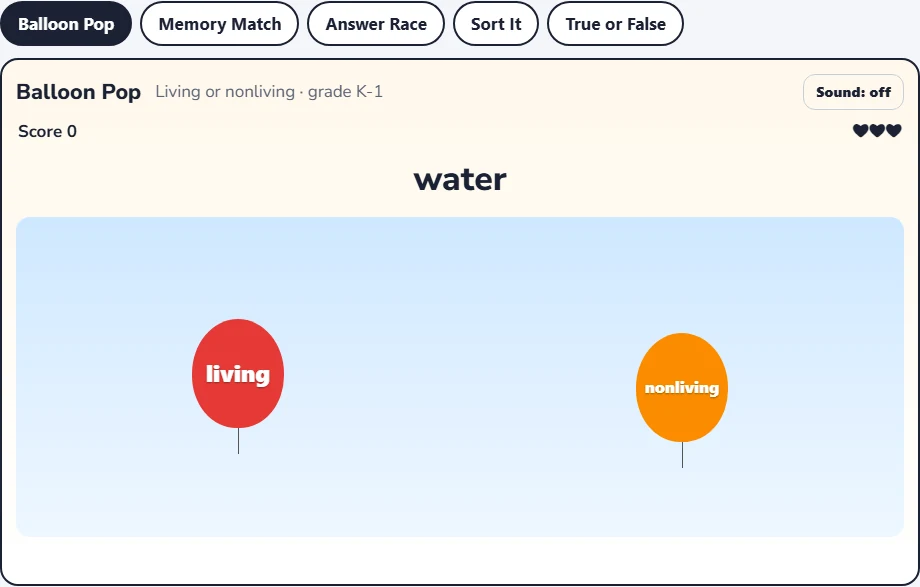
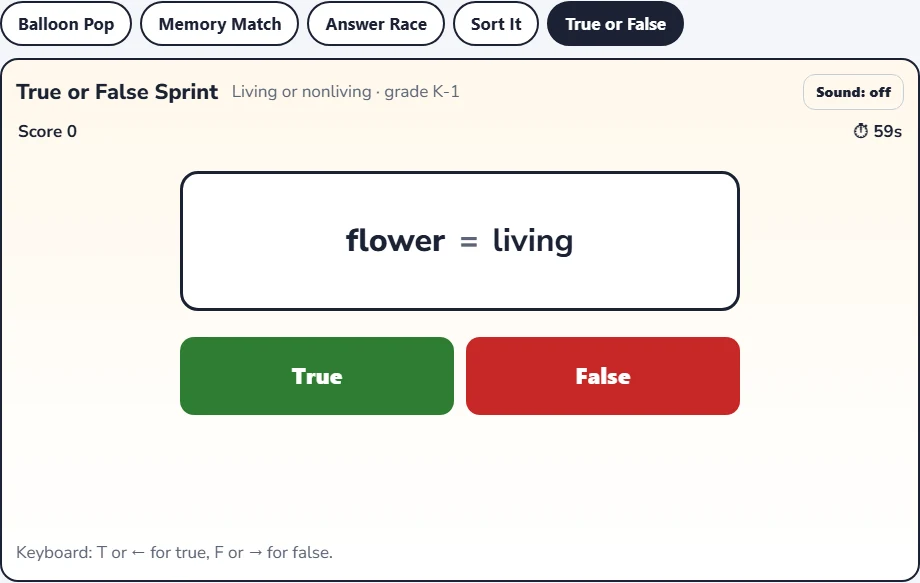
The game below opens in Sort It mode and has three more ways to play. The printable sorting mat has a living box, a nonliving box and twenty picture cards to cut out, and the pictures show Sort It, Balloon Pop and True or False on this page.
How the living or nonliving game works
- Sort It: twenty items, one at a time. Tap Living or Nonliving for each one, and see how many you get right. A wrong tap tells you where the item belongs.
- Balloon Pop: answers float up on balloons, and you pop the right one before it drifts off the top. Each balloon says living or nonliving, and the thing to judge, such as water or tree, appears above them. The game speeds up as your score climbs, and three misses ends the round.
- Answer Race: every right answer moves your car forward, and you race three computer cars to the finish flag. The first to 15 wins, and wrong taps cost time, not places.
- True or False: sixty seconds on the clock. Decide whether each sentence, such as flower = living, is right or wrong. A streak of five or more scores double.
What makes something living?
Scientists use a short checklist to decide whether something is alive. Living things:
- Grow and change: a seed becomes a plant, and a baby becomes a child.
- Need food, water and air: they take in what they need to stay alive.
- Reproduce: they make more of their own kind, as seeds, eggs or babies.
- Respond to the world: a plant turns toward light and a cat jumps at a sound.
- Remove waste: they get rid of what they do not need.
In British classrooms, the checklist is often learned as a mnemonic called MRS GREN: movement, respiration, sensitivity, growth, reproduction, excretion and nutrition. Wikipedia’s life article and its page on the organism explain how scientists define a living thing.
Living nonliving sort: all twenty things in the game, and why
| Item | Group | Why |
|---|---|---|
| tree | Living | A plant: it grows, needs water and light, and makes seeds |
| cat | Living | An animal that eats, moves, grows and has kittens |
| fish | Living | An animal that breathes with gills, grows and lays eggs |
| flower | Living | Part of a plant that grows from a seed and makes seeds of its own |
| bird | Living | An animal that eats, grows and lays eggs |
| baby | Living | A person who eats, grows and changes every day |
| frog | Living | An animal that starts as a tadpole and grows into a frog |
| mushroom | Living | A fungus: a living thing that is neither a plant nor an animal |
| grass | Living | A plant that grows and needs sunlight and water |
| horse | Living | An animal that eats, moves, grows and has foals |
| rock | Nonliving | It does not grow, eat or reproduce |
| chair | Nonliving | A made object; wooden chairs came from trees but are no longer alive |
| car | Nonliving | It moves but does not grow, eat or reproduce |
| cloud | Nonliving | It changes shape but is made of water droplets, not cells |
| shoe | Nonliving | A made object that does not grow or need food |
| book | Nonliving | Made from paper; it does not grow or need food |
| water | Nonliving | Living things need it, but it is not alive itself |
| spoon | Nonliving | A made object that does not grow or eat |
| ball | Nonliving | It can roll and bounce, but it is not alive |
| robot | Nonliving | It moves and seems to act, but it does not grow or reproduce |
Tricky living and nonliving things
- Mushroom: many children think it is a plant, but it is a fungus. Fungi are living things that grow from spores and take in food from what they grow on. Wikipedia’s fungus article explains.
- Water and clouds: they move and change, which can look alive, but they do not grow, eat or make more of themselves.
- Car and robot: they move, but only because someone built them to. They do not eat, grow or reproduce.
- Chair and book: they come from trees, so they were once part of something living. Teachers sometimes call these “once living” materials, and the game puts them in the nonliving group.
- Seeds and eggs: a seed looks still, but it is alive and will grow when it gets water and warmth.
Three groups: living, dead and never alive
Older children can use three groups instead of two. Living things are alive now. Dead things were once alive but are not now, such as a fallen leaf, a log or a bone. Things that were never alive include rocks, water, plastic and metal. This is how many science programs describe the topic in England, where pupils in Year 2 learn to compare things that are living, dead and never alive. The two-bin game here is a first step for younger children.
Kindergarten science game extension: living things in the garden
- Go outside with a clipboard and two columns, living and nonliving.
- List ten things you see: grass, a bench, an ant, a puddle, a leaf, a rock.
- For each, ask children which of the living checklist ideas they can see.
- Back inside, play the game and compare. Which items were hardest to decide?
Living and nonliving sorting mat: how to use it
The printable living and nonliving sorting mat has a Living box, a Nonliving box and twenty picture cards that match the words in the living or nonliving game. Cut out the cards, sort them, and then talk about the tricky ones such as the mushroom and the cloud. Play the game afterwards and see whether the screen agrees.
Living or nonliving word problems and questions
- Is a sunflower living or nonliving? Answer: living, because it grows from a seed and makes more seeds.
- Name three nonliving things in your classroom. Answer: for example a desk, a pencil and a clock.
- A toy robot moves across the floor. Is it alive? Answer: no, because it does not grow, eat or reproduce.
- Which is living, a mushroom or a rock? Answer: a mushroom, because it is a fungus.
Where living and nonliving fits at school
| Level | What children are expected to do |
|---|---|
| Kindergarten (US) | Describe what plants and animals need to survive, which leads naturally to the difference between living and nonliving things |
| Year 2 (England) | Explore and compare the differences between things that are living, dead and never alive |
The living or nonliving game supports this topic. The English national curriculum for science sets out the topic, and our science and social studies hub has more printable activities.
Living or nonliving game: frequently asked questions
What is the difference between living and nonliving things?
Living things grow, need food, water and air, and make more of their own kind. Nonliving things do none of these.
Is fire living or nonliving?
Fire is nonliving. It uses oxygen, grows and moves, but it does not have cells, does not reproduce and is not made by a living process. Fire is not in this game.
Is a plant in the living or nonliving game a living thing?
Yes. Plants grow, make their own food from sunlight, and reproduce with seeds or spores.
What age is the living or nonliving game for?
It suits kindergarten and first grade, about ages 5 to 7, who are learning the basic needs of living things.
Is the living or nonliving game free, and do kids need an account?
Yes, it is free, and no account is needed. Best scores are saved only in the browser on this device.
Does the living or nonliving game work on phones and tablets?
Yes. Every game is built for touch first and also works with a mouse on a computer.