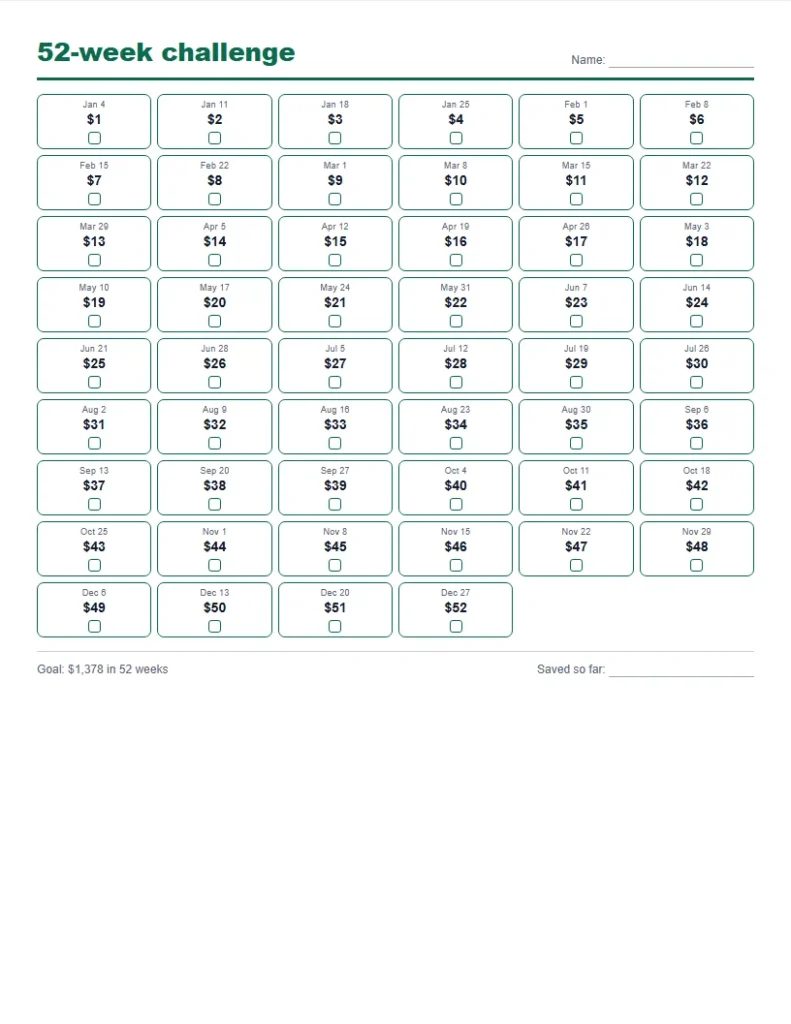
A savings challenge printable is a one-page tracker where every box is one deposit. You tick the box when the money goes into your savings, and the total grows week by week. This page works out the numbers for you: choose the 52-week challenge, the 100 envelope challenge, a 365-day coin challenge or a plan built from your own goal, and print the tracker on Letter or A4.
Quick answer: Pick a challenge and a step in the savings challenge printable, check the total on the tiles, then press Print or save as PDF. The classic 52-week challenge saves $1,378 with a $1 step (week 1 is $1, week 52 is $52); with a 50-cent step it saves $689 and the biggest deposit is $26.
How to use the savings challenge printable
- Choose the challenge. The step is the amount that grows each time: $1 means $1, $2, $3 and so on.
- Check the tiles. They show the total you will save, the smallest and largest deposit, and how far through the challenge you are when half the money is in.
- If you have a target in mind, choose Reach my goal. Type the amount and the number of weeks, and the tool works out the step for you.
- Add a first deposit date if you want each box to show its date. Press Print or save as PDF, then tick a box for every deposit.
The savings challenge tracker is made in your browser and your choices stay on your device. Nothing you type is sent to a server. You can also save the savings challenge printable PDF and tick the boxes on a phone or tablet.
Savings challenge printable options compared
Every climbing challenge follows one rule: the total is the step times n times (n + 1), divided by 2, where n is the number of deposits. These are the totals with the default steps:
| Challenge | Deposits | Size of deposits | Total saved | Half the money is in by |
|---|---|---|---|---|
| 52-week challenge (climbing) | 52 | $1 to $52 | $1,378 | Week 37 |
| 52-week challenge (reverse) | 52 | $52 to $1 | $1,378 | Week 16 |
| 26-week or 26-payday challenge | 26 | $1 to $26 | $351 | Deposit 19 |
| 100 envelope challenge | 100 | $1 to $100 | $5,050 | Envelope 71 |
| 365-day coin challenge | 365 | 1 cent to $3.65 | $667.95 | Day 258 |
| Same amount, $20 a week | 52 | $20 each week | $1,040 | Week 26 |
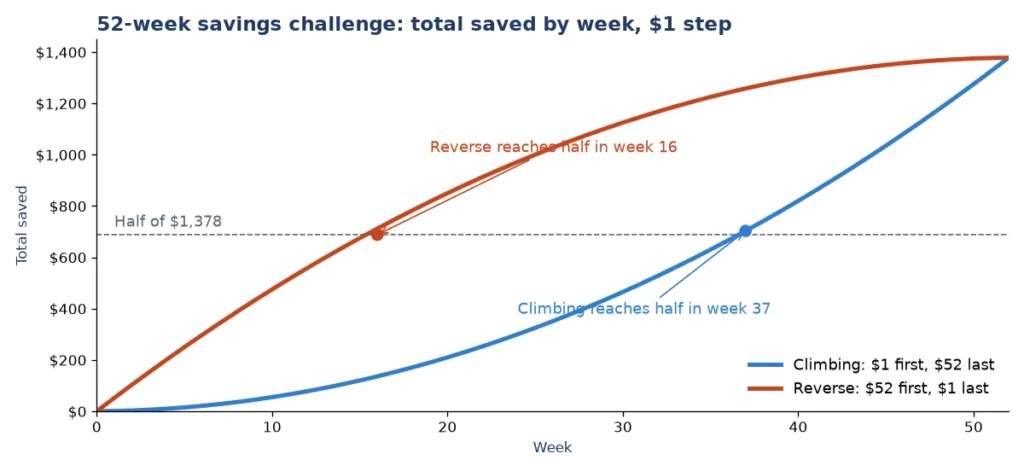
The last column shows how back-loaded a challenge is. In the climbing 52-week challenge, half of the money arrives only in week 37, because the last 16 weeks carry the biggest deposits.
52-week savings challenge printable: what each stretch of the year costs
| Part of the year | Saved at a $1 step | Share of the total | Deposits |
|---|---|---|---|
| Weeks 1 to 13 | $91 | 7% | $1 to $13 |
| Weeks 14 to 26 | $260 | 19% | $14 to $26 |
| Weeks 27 to 39 | $429 | 31% | $27 to $39 |
| Weeks 40 to 52 | $598 | 43% | $40 to $52 |
The last quarter of the challenge saves $598, which is 43% of the whole $1,378. The final four weeks alone cost $202, so in a climbing challenge the hardest deposits land in December, next to holiday spending. That is the reason the reverse challenge exists.
Climbing or reverse 52-week challenge?
The two versions save exactly the same $1,378. They differ in when the effort falls:
- Climbing starts with $1 and ends with $52. It is easy to begin and heavy at the end. Half of the money is in by week 37.
- Reverse starts with $52 and ends with $1. January is expensive, but you reach half of the total by week 16 and the year gets easier as costs such as holidays arrive.
- Both together are a useful pair for two people. A climbing sheet and a reverse sheet add up to $53 every week (week 10 is $10 plus $43), so a couple saves a steady $53 a week and $2,756 over the year.
Work out the step from a goal
If you have a number in mind, the step is the goal divided by n times (n + 1) over 2, rounded up to the next cent so you never fall short. This table shows the step and the biggest deposit for common goals over 52 weeks and over 26 paydays:
| Goal | 52 weeks: step | 52 weeks: biggest deposit | 26 paydays: step | 26 paydays: biggest deposit |
|---|---|---|---|---|
| $500 | $0.37 | $19.24 | $1.43 | $37.18 |
| $1,000 | $0.73 | $37.96 | $2.85 | $74.10 |
| $2,500 | $1.82 | $94.64 | $7.13 | $185.38 |
| $5,000 | $3.63 | $188.76 | $14.25 | $370.50 |
| $10,000 | $7.26 | $377.52 | $28.50 | $741 |
The savings challenge printable does this calculation for you in Reach my goal mode. Because the step is rounded up, the total is a little above the goal: a $1,000 goal over 52 weeks uses a $0.73 step and saves $1,005.94.
Choosing a step for your savings challenge tracker
The step controls the whole savings challenge printable. These are the 52-week totals for common steps, with the biggest deposit you will face in week 52:
| Step | Saved in 52 weeks | Biggest deposit (week 52) |
|---|---|---|
| $0.10 | $137.80 | $5.20 |
| $0.25 | $344.50 | $13 |
| $0.50 | $689 | $26 |
| $1 | $1,378 | $52 |
| $2 | $2,756 | $104 |
| $5 | $6,890 | $260 |
A 25-cent step saves $344.50 and never asks for more than $13 in a week, which suits a tight budget. A $2 step saves $2,756 but needs $104 in the final week. Pick the step for the hardest week, not the first one.
100 envelope savings challenge printable
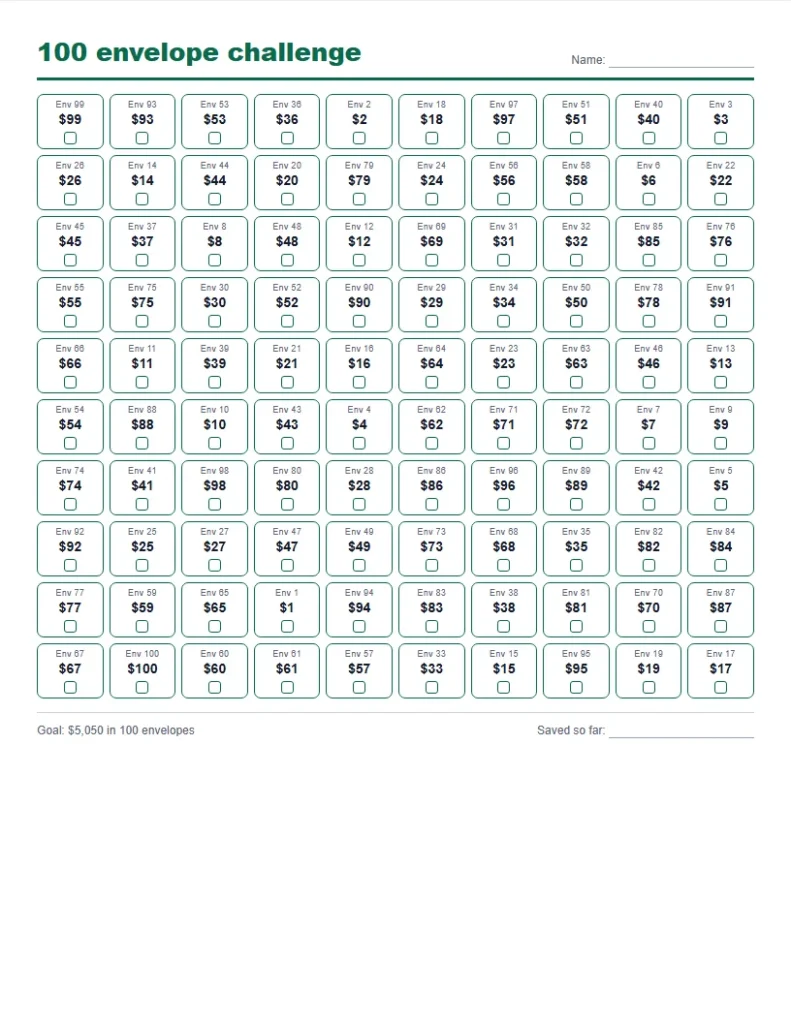
The 100 envelope challenge numbers envelopes from 1 to 100 and saves each amount once, so the full challenge saves $5,050. A short way to see it: the envelopes pair up as 1 and 100, 2 and 99, 3 and 98, and every pair adds to $101. There are 50 pairs, and 50 times $101 is $5,050.
Tick the Shuffle the order option to print the 100 envelope savings challenge printable in a scrambled grid, so you can pick any box without seeing a pattern. How fast you go sets the length of the challenge:
| Envelopes opened each week | Weeks to finish | Average saved each week |
|---|---|---|
| 1 | 100 | $50.50 |
| 2 | 50 | $101 |
| 4 | 25 | $202 |
| 5 | 20 | $252.50 |
| 10 | 10 | $505 |
365-day coin challenge
The 365-day challenge saves one cent on day 1, two cents on day 2 and $3.65 on day 365, which adds up to $667.95. Changing the step scales it: the same pattern with a 5-cent step saves $3,339.75 and a 10-cent step saves $6,679.50, with a final day of $18.25 and $36.50. Choose the 365-day coin challenge and set the step to try your own.
If you miss a deposit
A missed week does not break the challenge, because each box is independent. Tick it later and keep the date column honest. To catch up in a climbing challenge, add the missed amounts: if you skip weeks 10, 11 and 12 at a $1 step, the catch-up deposit is $33. If a late week looks too large, switch to a smaller step on a fresh sheet and carry over the total saved so far.
Where to keep the savings
Keep the challenge money in an account that is separate from everyday spending, so a deposit is not spent by accident. Deposits in an FDIC-insured bank are insured up to $250,000 per depositor, per insured bank, for each ownership category, according to the FDIC. Cash kept in envelopes at home is not insured, so move it to the bank when the stack grows.
Frequently asked questions
7 quick answers
How much does the 52-week savings challenge save?
With a $1 step it saves $1,378: $1 in week 1 up to $52 in week 52. The total is the step times 1,378, so a $0.50 step saves $689 and a $2 step saves $2,756.
Can I do the savings challenge printable with biweekly pay?
Yes. Choose the 26-payday challenge, which has one deposit per paycheck. With a $1 step it saves $351, and a $4 step saves $1,404, close to the 52-week total.
What if I cannot afford the larger deposits?
Choose a smaller step, switch to the reverse challenge so the big deposits come while the year is new, or use Reach my goal with a longer time.
Can two people do the challenge together?
Yes. One sheet climbing and one sheet reverse add up to $53 every week with a $1 step, so together you save $2,756 in a year.
How is the 100 envelope savings challenge printable different?
It has no fixed order. You pick any envelope from 1 to 100 when you can, which suits irregular income. The total is $5,050 at a $1 step.
Do I need to start the savings challenge printable in January?
No. Add any first deposit date and each box shows its own date, or leave the date empty and number the boxes.
Is the savings challenge printable free?
Yes. It is free to print and save as a PDF, with no sign-up.
Related printables and calculators
- Budget planner printable to find the money for the step
- Compound interest calculator to see what a savings balance can earn
- Credit card payoff calculator if debt comes first
- Habit tracker printable for a no-spend month
This page gives general information and tools, not financial advice.
Last updated: October 2026.