This free dice roller rolls any number of dice from 1 to 100, in d4, d6, d8, d10, d12, d20, d100 or a custom number of sides, and shows every die and the total. Add a modifier, keep the highest dice, drop the lowest, or roll a d20 with advantage, then see the exact average for your setup.
It is a dice roller for tabletop games, board games, classroom math and quick decisions. Every roll uses your browser’s secure random generator, so each face has exactly the same chance. Nothing is uploaded.
Quick answer: Choose a die, set how many to roll, and press Roll the dice. A fair die with s sides shows each face with probability 1 in s, and the average of n dice is n × (s + 1) ÷ 2. For two six-sided dice that is 2 × 7 ÷ 2 = 7, and 4d6 with the lowest die dropped averages 12.24.
How to use this dice roller
- Pick the type of die: d4, d6, d8, d10, d12, d20, d100, or Custom to type any number of sides from 2 to 1000.
- Type how many dice to roll (1 to 100) or tap a quick button.
- Add a modifier if the rules say so, for example +3 for a skill bonus or −2 for a penalty.
- Optionally choose to keep the highest dice, drop the lowest, or (on a d20) roll with advantage or disadvantage.
- Press Roll the dice. The total appears in large type, each die is listed, and dropped dice are crossed out.
| Input | What it means | Limits |
|---|---|---|
| Type of die | The number of faces on every die you roll | d4 up to d100, or custom 2 to 1000 sides |
| Number of dice | How many dice are rolled together | 1 to 100 |
| Modifier | A whole number added to (or subtracted from) the total | −100,000 to +100,000 |
| d20 advantage | Roll two d20 and keep the higher (advantage) or lower (disadvantage) | Shown only for the d20 |
| Keep or drop | Keep the highest or lowest dice, or drop the highest or lowest | Drop at most one fewer than you roll |
The result card also shows the possible range, the exact average roll for your setup and, for plain dice, the chance of rolling that total or higher. Use Copy result to paste the roll into a chat or a game log, and Copy link to share a setup such as 4d6 drop the lowest.
How the dice roller works
Each die is a fair random whole number from 1 to the number of sides. The tool asks your browser for random 32-bit numbers with crypto.getRandomValues, then keeps only values that divide evenly into the number of sides. That step, called rejection sampling, removes the small bias that the plain remainder method creates, so a d6 really is 1 in 6 for every face.
For plain dice the formulas are short. Let n be the number of dice and s the number of sides.
- Lowest total: n (every die shows 1), plus the modifier.
- Highest total: n × s (every die shows its top face), plus the modifier.
- Average total: n × (s + 1) ÷ 2, plus the modifier.
- Chance of one particular face: 1 ÷ s.
Worked example 1: 4d6 drop the lowest
Roll 4 six-sided dice and drop the lowest. Suppose the dice show 5, 3, 6 and 2. The lowest die is the 2, so the kept dice are 5, 3 and 6, and the total is 5 + 3 + 6 = 14. The possible range is 3 to 18. The exact average for this method is 12.245, because dropping the lowest die removes the worst die each time. A plain 3d6 averages only 10.5.
Worked example 2: d20 with advantage and a +5 modifier
Choose the d20, press Advantage and set the modifier to 5. The roller throws two d20, say 7 and 16, keeps the 16, and adds 5 for a total of 21. The range is 6 to 25 and the average is 13.825 + 5 = 18.825. A single d20 averages 10.5 + 5 = 15.5, so advantage adds about 3.3 points.
Dice types and what each one is used for
Polyhedral dice are named by their number of faces. The table shows each die’s average and the chance of any single face, which is 1 divided by the number of sides.
| Die | Sides | Average roll | Chance of one face | Typical use |
|---|---|---|---|---|
| d4 | 4 | 2.5 | 25% | Small damage dice, such as a dagger |
| d6 | 6 | 3.5 | 16.67% | Board games, ability scores, most classroom math |
| d8 | 8 | 4.5 | 12.5% | Medium weapon damage, healing dice |
| d10 | 10 | 5.5 | 10% | Percentile dice, damage in many systems |
| d12 | 12 | 6.5 | 8.33% | Big weapon damage, such as a greataxe |
| d20 | 20 | 10.5 | 5% | Attack rolls, saving throws and skill checks |
| d100 | 100 | 50.5 | 1% | Percentile tables and random events |
DnD dice roller for Dungeons and Dragons
This DnD dice roller covers the standard tabletop notation: NdS + M, which means roll N dice with S sides and add M. A longsword hit might be 1d8 + 3, a fireball is 8d6, and an attack roll is 1d20 + your bonus. Choose the die, the count and the modifier and the tool does the rest. The advantage rules below come from the 5th edition System Reference Document.
How to roll 4d6 drop lowest for ability scores
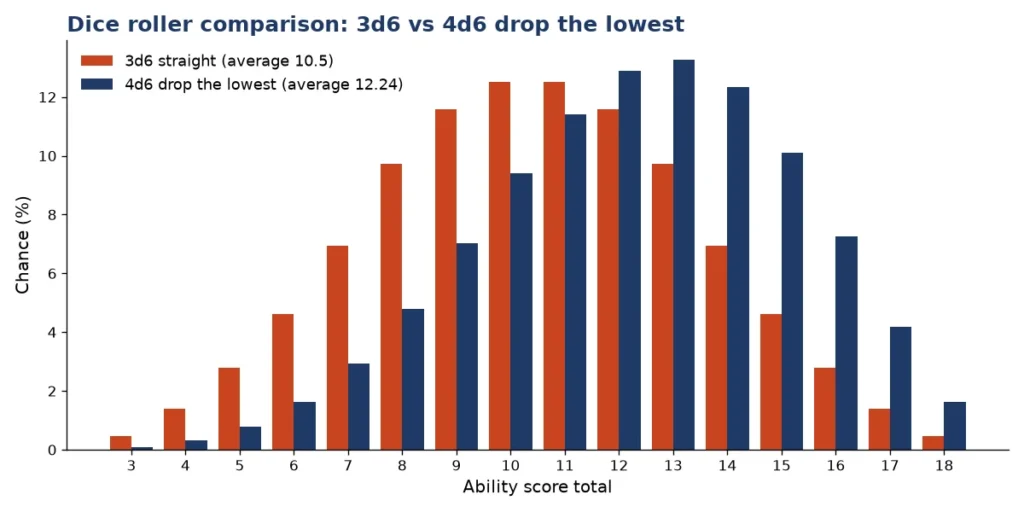
Set the die to d6, the number of dice to 4, pick Drop the lowest and leave 1 in the box. Roll six times, one for each ability. The table shows why many players prefer this method: the same score of 15 or higher is more than twice as likely.
| Method | Average | Score 13 or more | Score 15 or more | Score 18 |
|---|---|---|---|---|
| 3d6 straight | 10.5 | 25.93% | 9.26% | 0.46% |
| 4d6 drop the lowest | 12.24 | 48.77% | 23.15% | 1.62% |
| 5d6 keep the highest 3 | 13.43 | 66.13% | 37.71% | 3.55% |
Chance to hit: attack rolls with a +5 bonus
An attack hits when d20 + bonus meets or beats the target’s armor class (AC). A natural 20 always hits and a natural 1 always misses in the 5th edition attack rules, so the chance never goes above 95% or below 5%. The table is computed exactly for a +5 bonus.
| Target | Roll needed | Normal | Advantage | Disadvantage |
|---|---|---|---|---|
| AC 10 | d20 ≥ 5 | 80% | 96% | 64% |
| AC 12 | d20 ≥ 7 | 70% | 91% | 49% |
| AC 14 | d20 ≥ 9 | 60% | 84% | 36% |
| AC 15 | d20 ≥ 10 | 55% | 79.75% | 30.25% |
| AC 16 | d20 ≥ 11 | 50% | 75% | 25% |
| AC 18 | d20 ≥ 13 | 40% | 64% | 16% |
| AC 20 | d20 ≥ 15 | 30% | 51% | 9% |
Most spells and weapons are simply a number of dice plus a modifier, so the same inputs work for damage rolls. For a critical hit, many groups roll the damage dice twice: set the number of dice to double the usual count.
D20 dice roller with advantage and disadvantage
This d20 dice roller handles the most common 5th edition rule: with advantage you roll two d20 and use the higher, and with disadvantage you use the lower. Advantage is a dice roller option that matters a lot. It lifts a 50% chance to 75%, and the average roll rises from 10.5 to 13.825.
Dice roller with advantage: the exact odds
The chance of beating a target number T (rolling T or higher) with one d20 is p = (21 − T) ÷ 20. With advantage it is 1 − (1 − p)², because you fail only if both dice fail. With disadvantage it is p², because both dice must succeed.
| Needed on the d20 | Normal | Advantage | Disadvantage |
|---|---|---|---|
| 2 or higher | 95% | 99.75% | 90.25% |
| 5 or higher | 80% | 96% | 64% |
| 8 or higher | 65% | 87.75% | 42.25% |
| 11 or higher | 50% | 75% | 25% |
| 14 or higher | 35% | 57.75% | 12.25% |
| 16 or higher | 25% | 43.75% | 6.25% |
| 18 or higher | 15% | 27.75% | 2.25% |
| 20 or higher | 5% | 9.75% | 0.25% |
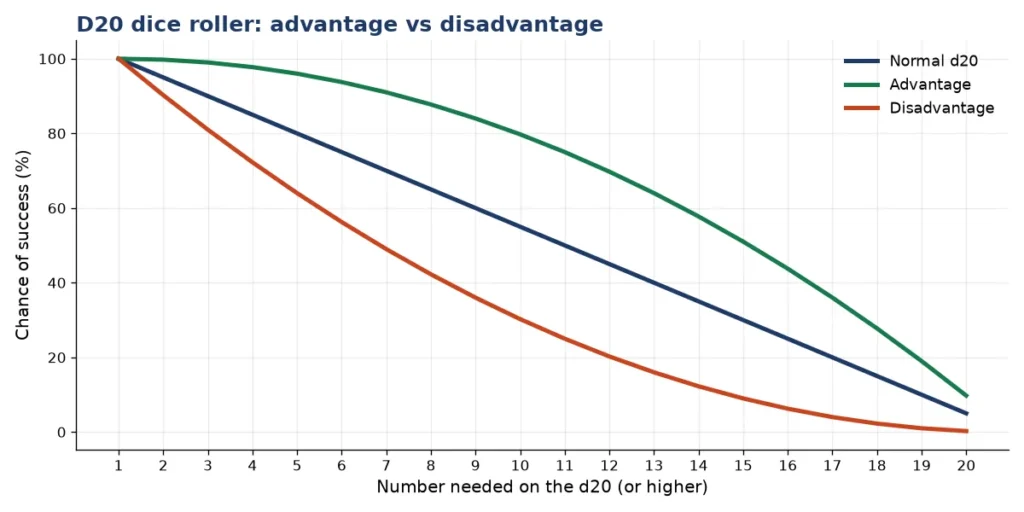
Two more numbers help in play. The chance of a natural 20 is 5% on one die, 9.75% with advantage and 0.25% with disadvantage. The chance of a natural 1 is 5%, 0.25% with advantage and 9.75% with disadvantage.
Dice roller with modifier, keep highest and drop lowest
A dice roller with modifier adds a fixed number after the dice are summed: 2d6 + 3 means roll two six-sided dice and add 3, so the range is 5 to 15. Negative modifiers work the same way, and the result card shows the dice sum and the modifier separately so you can check the arithmetic.
The keep and drop options cover the common “roll many, keep some” systems. Keep the highest 3 of 5 dice, drop the lowest of 4, or keep the lowest die for a penalty roll. The exact average shown under the result is computed from the order statistics of the dice, not estimated by simulation.
| Notation | Dice roller setting | Range | Average |
|---|---|---|---|
| 2d6 + 3 | d6, 2 dice, modifier +3 | 5 to 15 | 10 |
| 4d6 drop lowest | d6, 4 dice, drop the lowest 1 | 3 to 18 | 12.24 |
| 5d6 keep highest 3 | d6, 5 dice, keep the highest 3 | 3 to 18 | 13.43 |
| 8d6 (fireball) | d6, 8 dice | 8 to 48 | 28 |
| d20 advantage + 5 | d20, advantage, modifier +5 | 6 to 25 | 18.83 |
D100 dice roller and custom dice roller
The d100 dice roller gives a whole number from 1 to 100 with a 1% chance each. Physical percentile dice use two d10, one for tens and one for ones, so a result of 100 is a double zero. Use the d100 for random tables, loot charts and “roll under 35” skill checks: the chance of rolling 35 or under is exactly 35%.
The custom dice roller accepts any number of sides from 2 to 1000. A 2-sided die is a coin, a 12-sided die can model a clock face, and a 30-sided die picks a day of the month. Use a d7 for the day of the week. For a plain range with no dice, use the random number generator.
Roll dice online for board games, school and decisions
When you need to roll dice online, the tool replaces the physical dice at a screen or on a call. Remote game nights, a missing die and a class of 30 children who each need a roll are all good reasons. The full screen button shows the dice large enough for a whole room.
- Board games: roll 2 dice for Monopoly or Catan and read the total. In Monopoly, rolling doubles gives another turn, and three doubles in a row sends you to jail.
- Math class: roll 2 dice 20 times, tally the totals, and compare the results with the exact chances on the dice probability calculator. Seven turns up most often, 1 time in 6.
- Practice and games: pair a dice roller with printable boards from the bingo cards or roll for a turn order.
Probability of common dice rolls
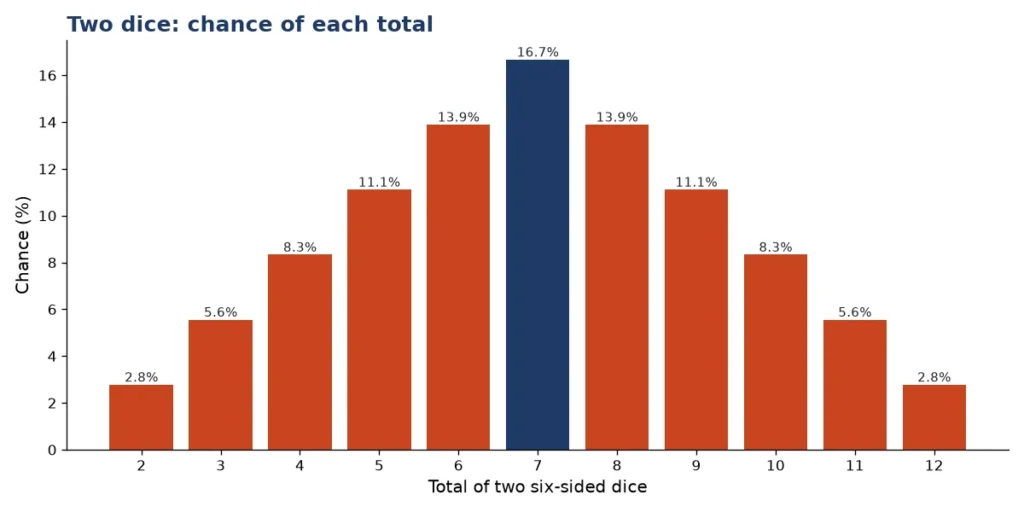
These exact chances answer the most common dice questions. The 2d6 values are computed from all 36 equally likely outcomes.
| Roll | Chance | Odds |
|---|---|---|
| One particular face on 1d6 | 16.67% | 1 in 6 |
| At least one 6 on 2d6 | 30.56% | 1 in 3.27 |
| At least one 6 on 4d6 | 51.77% | 1 in 1.93 |
| Total of 7 on 2d6 | 16.67% | 1 in 6 |
| Total of 12 on 2d6 | 2.78% | 1 in 36 |
| Doubles on 2d6 | 16.67% | 1 in 6 |
| Total of 18 on 3d6 | 0.46% | 1 in 216 |
| Natural 20 on 1d20 | 5% | 1 in 20 |
| d20 with advantage, 11 or higher | 75% | 3 in 4 |
For any other combination, type the dice and target into the dice probability calculator, which builds the full distribution.
Tips and common mistakes when rolling dice
- Do not add the modifier to each die. A +3 on 2d6 is added once, to the total, so the range is 5 to 15, not 8 to 18.
- Streaks are normal. Three sixes in a row on a d6 happen 1 time in 216 and will happen to every player sometime. A die has no memory.
- Check the notation. “3d8” means three eight-sided dice.
Questions people ask about the dice roller
Is an online dice roller truly random?
Yes, within the limits of your device. This dice roller uses the browser’s cryptographic generator and rejection sampling, which is more uniform than the typical math-library shortcut. Each roll is independent, so previous results never change the next one.
Dice roller 1-6: how do I roll a single six-sided die?
Select d6 and set the number of dice to 1. You get a whole number from 1 to 6, each with a 1 in 6 chance. Press the button again for a new roll. For two dice, set the number to 2 and read the total.
Dice roller for Monopoly and other board games
Select d6 and roll 2 dice. The result shows each die separately, so you can see doubles at once. The total is the number of spaces to move. Seven is the most common total at 16.67%, and 2 or 12 each come up only 2.78% of the time.
Dice roller for stats: which method gives the best ability scores?
Rolling 4d6 and dropping the lowest averages 12.24 per score, compared with 10.5 for 3d6. The 5d6 keep-highest-3 method averages 13.43 and is much more generous, so check with your game master before you use it.
Frequently asked questions
11 quick answers
How many dice can the dice roller roll at once?
The dice roller rolls 1 to 100 dice at once and lists every die. Each die can have 2 to 1000 sides, using the custom option.
Which dice does the dice roller support?
It supports the standard d4, d6, d8, d10, d12, d20 and d100, plus a custom die with any number of sides from 2 to 1000.
How does advantage work on a d20?
You roll two d20 and use the higher number. Disadvantage uses the lower. Advantage raises the chance of rolling 11 or higher from 50% to 75%.
What does 4d6 drop the lowest mean?
Roll four six-sided dice, ignore the lowest one, and add the other three. The total ranges from 3 to 18 and averages 12.24.
How do I add a modifier to a dice roll?
Type the number in the modifier box. It is added once to the total after the dice are summed. Use a minus sign for a penalty, for example −2.
What is the average of 2d6?
The average of 2d6 is 7. Each die averages 3.5, and 2 × 3.5 = 7. The total 7 is also the most likely at 6 chances in 36.
What is the chance of rolling a 6 on a d6?
The chance is 1 in 6, which is 16.67%. The chance of at least one 6 on two dice is 30.56%.
Is the dice roller fair for games and giveaways?
Yes. Every face has an equal chance and the generator is the same one browsers use for security tasks. It is fine for games and classroom use.
Can I roll a d100 with this dice roller?
Yes. Pick d100 to get a number from 1 to 100, with each number a 1% chance. Two d10 can stand in for it at the table.
Does the dice roller save my rolls?
It keeps the last 10 rolls on the page while it is open. Nothing is sent to a server or stored after you close the page.
How is this different from the random number generator?
A dice roller models real dice, with sides, several dice, modifiers and keep rules. The random number generator picks numbers in any range, with or without repeats.
Related calculators and printables
- Dice probability calculator: the exact chance of any total, with a chart
- Coin flip: flip 1 to 100 coins and see the streaks
- Random name picker: pick winners or make teams
- Random number generator: any range, with or without repeats
- Mean, median and mode calculator: summarize a set of rolls
- Printable bingo cards and worksheets for game-night and class
Sources and further reading
- Dungeons and Dragons System Reference Document: the official rules text for advantage, disadvantage and d20 rolls.
- Dice on Wikipedia: history, shapes and fairness of dice.
- MDN: Crypto.getRandomValues(): the browser random generator used for every roll.
Last updated: October 2026.