This free temperature converter changes Celsius, Fahrenheit, Kelvin and Rankine into each other and shows all four answers at once. Type one number, pick the scale you start with and read the result, with the formula worked out step by step underneath.
Use the temperature converter for a weather forecast, an oven setting, a science problem or a body temperature reading. It never needs a Calculate button, because the answer updates as you type, and it warns you if a number falls below absolute zero.
Quick answer: To convert Celsius to Fahrenheit, multiply by 9/5 (1.8) and add 32, so 25 °C is 25 × 1.8 + 32 = 77 °F. To convert Fahrenheit to Celsius, subtract 32 and multiply by 5/9, so 98.6 °F is 37 °C. Kelvin is Celsius plus 273.15, so 25 °C is 298.15 K.
How to use this temperature converter
The temperature converter has three boxes and one result card. Follow these steps and the answer is on screen in a few seconds.
- Type the temperature in the first box. Use a minus sign for temperatures below zero, such as -5.
- Choose the scale you are converting from: Celsius (°C), Fahrenheit (°F), Kelvin (K) or Rankine (°R).
- Pick how many decimal places you want, from 0 to 3. Two is a good default.
- Read the four answers in the result card. The headline shows the most useful pair (Celsius to Fahrenheit, or the reverse) and the cards show every scale.
- Open the how it works list for the formula with your numbers, or tap Copy result to paste the answer into a message.
| Input or output | What it means |
|---|---|
| Temperature | The number you start with. It can be negative for °C and °F, but never below absolute zero. |
| Convert from | The scale of that number: °C, °F, K or °R. |
| Decimal places | How many digits to show after the decimal point, 0 to 3. |
| Result cards | The same temperature on all four scales. |
| Reference table | Landmark temperatures such as freezing, body temperature and boiling, with your value highlighted next to the closest one. |
Temperatures below absolute zero (-273.15 °C, -459.67 °F, 0 K) cannot exist, so the tool shows a plain message instead of a wrong number.
Temperature conversion formula
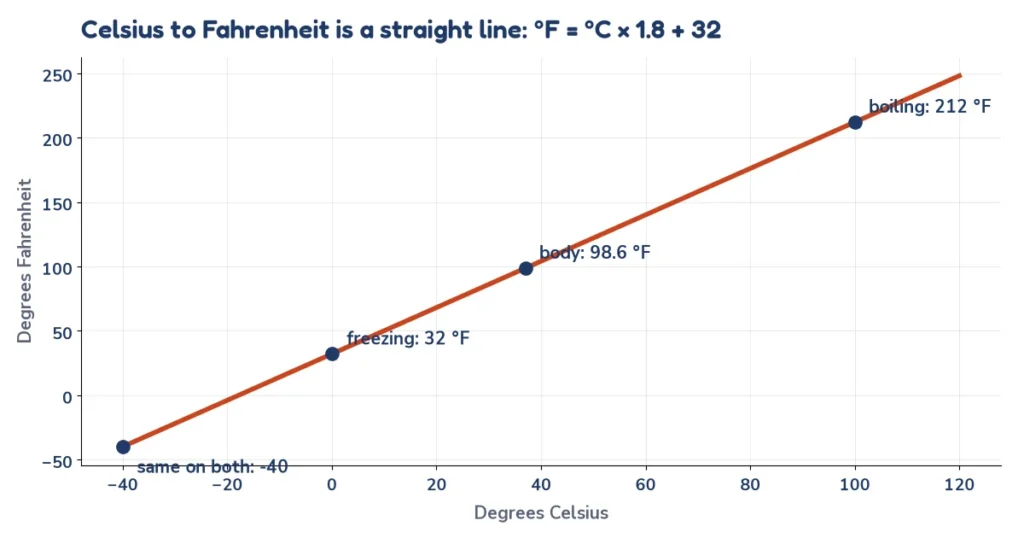
Every scale is a straight-line change of every other scale, so each conversion is a short temperature conversion formula: multiply, add or subtract. Degrees Celsius and Kelvin have the same size, and degrees Fahrenheit and Rankine have the same size, which is why the Kelvin and Rankine formulas are so simple. The table lists all twelve formulas with one worked number, 25 °C, so you can check any row.
| Conversion | Formula | Example (25 °C = 77 °F) |
|---|---|---|
| Celsius to Fahrenheit | °F = °C × 9/5 + 32 | 25 × 1.8 + 32 = 77 |
| Fahrenheit to Celsius | °C = (°F − 32) × 5/9 | (77 − 32) × 5/9 = 25 |
| Celsius to Kelvin | K = °C + 273.15 | 25 + 273.15 = 298.15 |
| Kelvin to Celsius | °C = K − 273.15 | 298.15 − 273.15 = 25 |
| Fahrenheit to Kelvin | K = (°F − 32) × 5/9 + 273.15 | (77 − 32) × 5/9 + 273.15 = 298.15 |
| Kelvin to Fahrenheit | °F = (K − 273.15) × 9/5 + 32 | (298.15 − 273.15) × 1.8 + 32 = 77 |
| Fahrenheit to Rankine | °R = °F + 459.67 | 77 + 459.67 = 536.67 |
| Rankine to Fahrenheit | °F = °R − 459.67 | 536.67 − 459.67 = 77 |
| Kelvin to Rankine | °R = K × 9/5 | 298.15 × 1.8 = 536.67 |
| Rankine to Kelvin | K = °R × 5/9 | 536.67 × 5/9 = 298.15 |
| Celsius to Rankine | °R = (°C + 273.15) × 9/5 | (25 + 273.15) × 1.8 = 536.67 |
| Rankine to Celsius | °C = °R × 5/9 − 273.15 | 536.67 × 5/9 − 273.15 = 25 |
In every formula, the letters stand for the temperature on that scale: °C is degrees Celsius, °F is degrees Fahrenheit, K is kelvin (written without a degree sign) and °R is degrees Rankine. A one degree change on the Celsius scale equals 1.8 degrees on the Fahrenheit scale, because there are 180 Fahrenheit degrees (32 to 212) between freezing and boiling water and only 100 Celsius degrees (0 to 100).
Celsius to Fahrenheit
Celsius to Fahrenheit is the conversion people need most, for weather reports, recipes and travel. Multiply the Celsius temperature by 1.8 (the same as 9/5) and add 32.
Example: 25 °C × 1.8 = 45, and 45 + 32 = 77, so 25 °C is 77 °F. The calculator gives the same 77 °F and also shows 298.15 K and 536.67 °R.
For a quick mental estimate, double the Celsius number and add 30. For 25 °C that is 80 °F, only 3 degrees off the exact 77 °F. The shortcut gets less accurate for very hot and very cold numbers, so use the temperature converter when it matters.
Celsius to Fahrenheit chart
This chart gives the Fahrenheit and Kelvin value for common Celsius temperatures, rounded to one decimal place for Fahrenheit.
| °C | °F | K |
|---|---|---|
| -40 | -40 | 233.15 |
| -30 | -22 | 243.15 |
| -20 | -4 | 253.15 |
| -10 | 14 | 263.15 |
| 0 | 32 | 273.15 |
| 5 | 41 | 278.15 |
| 10 | 50 | 283.15 |
| 15 | 59 | 288.15 |
| 20 | 68 | 293.15 |
| 25 | 77 | 298.15 |
| 30 | 86 | 303.15 |
| 35 | 95 | 308.15 |
| 40 | 104 | 313.15 |
| 50 | 122 | 323.15 |
| 75 | 167 | 348.15 |
| 100 | 212 | 373.15 |
Fahrenheit to Celsius
To go from Fahrenheit to Celsius, subtract 32 first and then multiply by 5/9 (about 0.5556). The order matters: subtract before you multiply.
Example: normal body temperature is 98.6 °F. 98.6 − 32 = 66.6, and 66.6 × 5/9 = 37, so 98.6 °F is exactly 37 °C. It shows the same result when you choose Fahrenheit as the starting scale.
For a mental estimate, subtract 30 and halve the answer. For 98.6 °F that gives 34.3 °C, which is rough, but it is close enough for deciding whether to wear a coat.
Fahrenheit to Celsius chart
| °F | °C | K |
|---|---|---|
| -40 | -40 | 233.15 |
| -20 | -28.9 | 244.26 |
| 0 | -17.8 | 255.37 |
| 10 | -12.2 | 260.93 |
| 20 | -6.7 | 266.48 |
| 32 | 0 | 273.15 |
| 40 | 4.4 | 277.59 |
| 50 | 10 | 283.15 |
| 60 | 15.6 | 288.71 |
| 70 | 21.1 | 294.26 |
| 80 | 26.7 | 299.82 |
| 90 | 32.2 | 305.37 |
| 100 | 37.8 | 310.93 |
| 110 | 43.3 | 316.48 |
| 212 | 100 | 373.15 |
Celsius to Kelvin and Kelvin to Fahrenheit
Celsius to kelvin only needs an addition: K = °C + 273.15. Water freezes at 0 °C, which is 273.15 K, and boils at about 100 °C, which is 373.15 K. Kelvin has no degree sign and is never negative.
For Kelvin to Fahrenheit, first subtract 273.15 to get Celsius and then use the Celsius to Fahrenheit rule: °F = (K − 273.15) × 9/5 + 32. For example, 1,000 K minus 273.15 is 726.85 °C, and 726.85 × 1.8 + 32 = 1,340.33 °F. The tool does both steps and lists them.
Fahrenheit to Kelvin goes the other way: (°F − 32) × 5/9 + 273.15. Rankine to Fahrenheit is the easiest of all: subtract 459.67. Rankine is an absolute scale like Kelvin, but its degrees are Fahrenheit sized, so engineers who work in Fahrenheit use it in heat calculations.
Absolute zero and the Kelvin scale
Absolute zero is the lowest possible temperature, where particles have the least energy. It is 0 K, which is -273.15 °C or -459.67 °F, and it is also 0 °R. The National Institute of Standards and Technology (NIST) explains that the Kelvin scale starts there, so it is called an absolute scale, and that one kelvin is the same size as one degree Celsius.
Since 2019 the kelvin has been defined by fixing the value of the Boltzmann constant rather than by the triple point of water. In daily life the difference is invisible: the conversion K = °C + 273.15 is still the one to use.
Temperature reference table: water, body, oven and absolute zero
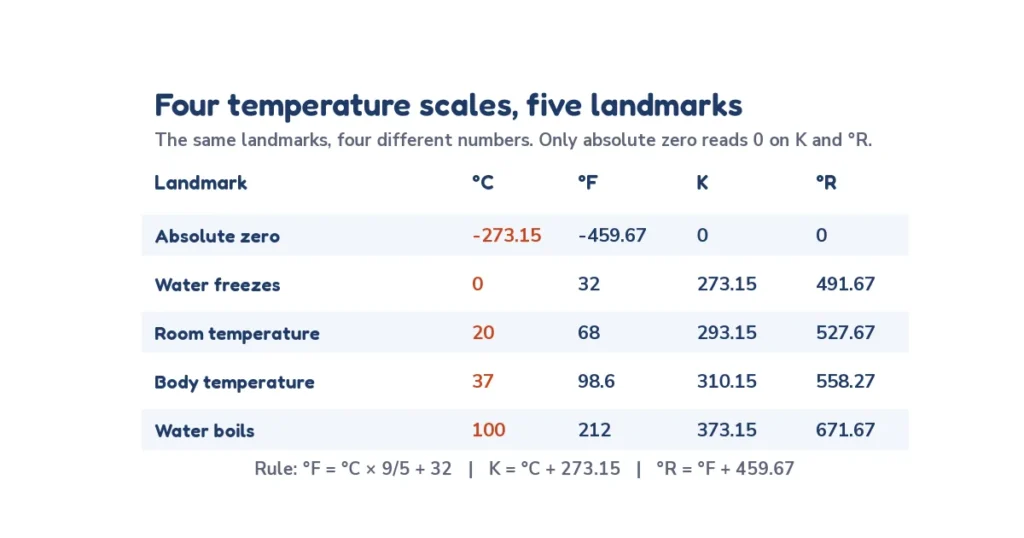
This computed table puts the landmark temperatures on all four scales. When you use the tool, the closest row is highlighted so you can see where your number sits.
| Reference point | °C | °F | K | °R |
|---|---|---|---|---|
| Absolute zero | -273.15 | -459.67 | 0 | 0 |
| Same number on both scales | -40 | -40 | 233.15 | 419.67 |
| Water freezes | 0 | 32 | 273.15 | 491.67 |
| Refrigerator (40 °F) | 4.44 | 40 | 277.59 | 499.67 |
| Room temperature | 20 | 68 | 293.15 | 527.67 |
| Normal body temperature | 37 | 98.6 | 310.15 | 558.27 |
| Water boils at sea level | 100 | 212 | 373.15 | 671.67 |
| Moderate oven (350 °F) | 176.67 | 350 | 449.82 | 809.67 |
| Hot oven (450 °F) | 232.22 | 450 | 505.37 | 909.67 |
Water boils at 100 °C (212 °F) at standard sea level pressure. Higher up, where the air pressure is lower, water boils at a lower temperature, which is why cooking times are longer on a mountain.
Two worked examples
Example 1: Celsius to Fahrenheit, Kelvin and Rankine
A summer day is forecast at 25 °C. Choose Celsius, type 25 and the temperature converter gives:
- Fahrenheit: 25 × 1.8 + 32 = 77 °F
- Kelvin: 25 + 273.15 = 298.15 K
- Rankine: 298.15 × 1.8 = 536.67 °R
Example 2: Fahrenheit to Celsius for an oven
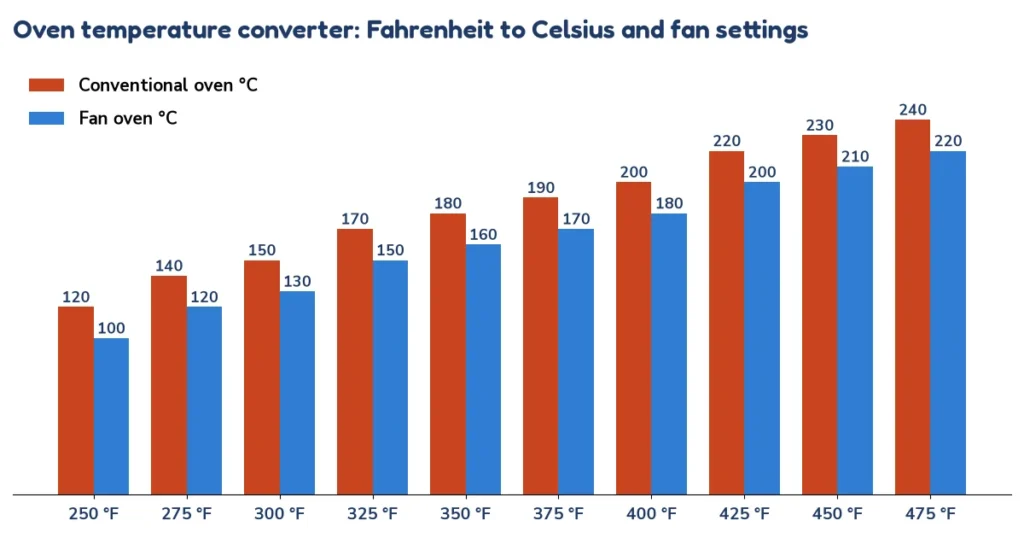
A US recipe says to bake at 350 °F. Choose Fahrenheit and type 350. The exact answer is (350 − 32) × 5/9 = 176.67 °C, which is 449.82 K and 809.67 °R. Recipes round it to 180 °C, and a fan oven is usually set about 20 °C lower, at 160 °C.
Oven temperature converter: Fahrenheit to Celsius
Recipes use rounded oven settings, so the exact Celsius number is not the one printed on the dial. The table shows the exact conversion, the usual recipe setting and the fan setting (20 °C lower). Use it next to the calculator above, and see the cups to grams converter for gas marks.
| °F | Exact °C | Recipe °C | Fan °C |
|---|---|---|---|
| 250 | 121.1 | 120 | 100 |
| 275 | 135 | 140 | 120 |
| 300 | 148.9 | 150 | 130 |
| 325 | 162.8 | 170 | 150 |
| 350 | 176.7 | 180 | 160 |
| 375 | 190.6 | 190 | 170 |
| 400 | 204.4 | 200 | 180 |
| 425 | 218.3 | 220 | 200 |
| 450 | 232.2 | 230 | 210 |
| 475 | 246.1 | 240 | 220 |
Weather and body temperature charts
Weather: Celsius to Fahrenheit
People who travel between the United States and the rest of the world meet both scales. This chart shows how a forecast feels.
| °C | °F | How it feels |
|---|---|---|
| -30 | -22 | Arctic cold |
| -20 | -4 | Severe cold |
| -10 | 14 | Very cold winter day |
| 0 | 32 | Freezing point of water |
| 10 | 50 | Cool spring day |
| 20 | 68 | Mild, room temperature |
| 25 | 77 | Warm |
| 30 | 86 | Hot |
| 35 | 95 | Very hot |
| 40 | 104 | Heat wave |
| 45 | 113 | Extreme heat |
Body temperature
The NHS describes a high temperature (fever) in adults as 38 °C or above and says normal body temperature is different for everyone and changes during the day. The chart converts the same readings to Fahrenheit. It is an information table, not medical advice: talk to a doctor or a pharmacist if you are worried about a fever.
| °C | °F | Meaning |
|---|---|---|
| 35 | 95 | Low (hypothermia is below 35) |
| 36.1 | 97 | Low end of normal |
| 37 | 98.6 | Typical average |
| 37.2 | 99 | High end of normal |
| 38 | 100.4 | Fever (NHS) |
| 39 | 102.2 | High fever |
| 40 | 104 | Very high fever |
Fahrenheit vs Celsius: who uses which scale?
Most of the world uses Celsius. Fahrenheit is the everyday scale in the United States and its territories, and in a few other places, including the Cayman Islands and Palau, according to the Fahrenheit article on Wikipedia. Countries such as Canada, the UK and Australia use Celsius for weather, and cooks in the UK may still see gas marks or Fahrenheit on older ovens.
Science uses kelvin everywhere, and US engineering sometimes uses Rankine for heat calculations. The tool lets you move between all four, so you can read a US recipe in Canada or a science problem in a US classroom.
Real-life uses of a temperature converter
- Cooking and baking: change a US oven setting to Celsius, or the reverse, and lower a fan oven by about 20 °C.
- Weather and travel: 30 °C is 86 °F, so pack shorts. -10 °C is 14 °F, so pack a heavy coat.
- Science homework: chemistry and physics use kelvin, so convert Celsius first, then add 273.15.
- Health: thermometers sold in the US often show °F, and doctor guidance in other countries uses °C.
Common mistakes and tips
- Forgetting the order: for Fahrenheit to Celsius subtract 32 first, then multiply by 5/9. For Celsius to Fahrenheit, multiply first, then add 32.
- Using 273 instead of 273.15 for Kelvin. It is fine for homework that says to round, but the exact value is 273.15.
- Writing a degree sign on kelvin. The unit is just K.
- Treating a temperature difference like a temperature: a change of 10 °C is a change of 18 °F, with no 32 added, because the 32 only applies to points on the scale.
- Entering a minus sign by mistake. -5 °C is 23 °F, but 5 °C is 41 °F.
Questions people ask about temperature conversion
What is 0 kelvin in Celsius and Fahrenheit?
0 kelvin is absolute zero, which is -273.15 °C and -459.67 °F. It is also 0 °R. No object can be cooled below this temperature.
How do you convert Rankine to Fahrenheit?
Subtract 459.67 from the Rankine value. For example, 536.67 °R minus 459.67 is 77 °F. Rankine to Kelvin is also simple: multiply by 5/9.
What temperature is the same in Celsius and Fahrenheit?
-40 is the same on both scales: -40 °C equals -40 °F. It is the point where the two straight lines cross, and you can check it with the formula: -40 × 1.8 + 32 = -40.
Frequently asked questions
10 quick answers
How do I convert Celsius to Fahrenheit?
Multiply the Celsius temperature by 9/5 (1.8) and add 32. For 20 °C that is 20 × 1.8 + 32 = 68 °F. The tool does this as you type.
How do I convert Fahrenheit to Celsius?
Subtract 32 from the Fahrenheit temperature and multiply by 5/9. For 68 °F that is (68 − 32) × 5/9 = 20 °C.
What is 0 °C in Fahrenheit?
0 °C is 32 °F, the temperature at which pure water freezes at sea level pressure. It is also 273.15 K and 491.67 °R.
What is 100 °C in Fahrenheit?
100 °C is 212 °F, the boiling point of water at standard sea level pressure. It is also 373.15 K.
What is 37 °C in Fahrenheit?
37 °C is 98.6 °F, the number usually given as normal body temperature. Real normal temperatures vary from person to person and through the day.
How do I convert Celsius to Kelvin?
Add 273.15 to the Celsius temperature. For example, 25 °C + 273.15 = 298.15 K. Kelvin never has a degree sign.
How do I convert Kelvin to Fahrenheit?
Subtract 273.15 to get Celsius, multiply by 9/5 and add 32. For 300 K that is 26.85 °C and 80.33 °F.
Why do Americans use Fahrenheit?
The United States kept the Fahrenheit scale from the British system of units it used before metrication, and everyday life, weather reports and recipes are all built around it. Almost every other country moved to Celsius.
Is the temperature converter accurate?
Yes. It uses the exact formulas, 273.15 for kelvin and 459.67 for Rankine, and rounds only the displayed number, so 98.6 °F shows as exactly 37 °C.
Does the temperature converter work offline?
Yes. All the math runs in your browser, nothing is uploaded, and you can copy the result or a link to the numbers.
Related calculators
- Cups to grams converter: ingredient weights, plus oven temperatures with fan and gas marks
- Unit converter: length, weight, volume and more
- Percentage calculator: percent change between two numbers
- Scientific notation calculator: very large and very small numbers
- MPG calculator: miles per gallon and L/100 km
- Decimals worksheets and the full calculator list
Sources and further reading
- The kelvin: introduction (NIST)
- Fahrenheit scale (Wikipedia)
- Rankine scale (Wikipedia)
- High temperature (fever) in adults (NHS)
Last updated: October 2026.