A bingo number chart is a single page that lists every number in the game, so the caller can see at a glance what has been drawn and what is still in the bag. This page gives you the real bingo number chart for 75-ball games, with the numbers sorted under B, I, N, G and O, and the 1-90 version used for housie and tambola. It also shows how to print each one, how to run a game from it, and the exact odds behind every call.
In short: the 75-ball chart has five rows of 15 numbers (B 1-15, I 16-30, N 31-45, G 46-60, O 61-75) and the 90-ball chart has nine rows of 10. Press the button above to open the card maker with 75-ball cards, print the caller sheet and calling cards from its Print tab, or call numbers on screen with the bingo caller. All of it is free, with no sign-up.
Bingo numbers 1-75: the full chart by letter
The bingo number chart below is the standard layout for American bingo. The five letters form the rows, and each row holds 15 numbers in order. A call such as N 38 therefore sends the player to the N column of the card and the caller to the third row of the chart. There is one number in each cell and no number appears twice, so the bingo number chart is also a checklist of the 75 balls.
| Letter | Col. 1 | Col. 2 | Col. 3 | Col. 4 | Col. 5 | Col. 6 | Col. 7 | Col. 8 | Col. 9 | Col. 10 | Col. 11 | Col. 12 | Col. 13 | Col. 14 | Col. 15 |
|---|---|---|---|---|---|---|---|---|---|---|---|---|---|---|---|
| B | 1 | 2 | 3 | 4 | 5 | 6 | 7 | 8 | 9 | 10 | 11 | 12 | 13 | 14 | 15 |
| I | 16 | 17 | 18 | 19 | 20 | 21 | 22 | 23 | 24 | 25 | 26 | 27 | 28 | 29 | 30 |
| N | 31 | 32 | 33 | 34 | 35 | 36 | 37 | 38 | 39 | 40 | 41 | 42 | 43 | 44 | 45 |
| G | 46 | 47 | 48 | 49 | 50 | 51 | 52 | 53 | 54 | 55 | 56 | 57 | 58 | 59 | 60 |
| O | 61 | 62 | 63 | 64 | 65 | 66 | 67 | 68 | 69 | 70 | 71 | 72 | 73 | 74 | 75 |
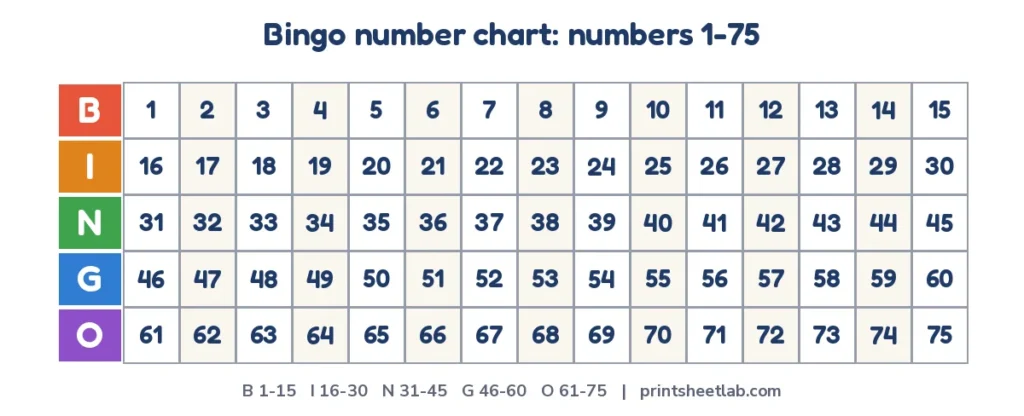
The picture above is the same bingo number chart as an image. Use whichever is easier to print: the table prints as part of the page, and the image can be saved or copied into a document. Either way, keep the letters in front of the numbers, because players listen for the letter first and then the number, and the letter tells them which column of their card to scan.
What each row of the chart means
| Letter | Numbers | How many | Share of the 75 |
|---|---|---|---|
| B | 1 to 15 | 15 | 20% |
| I | 16 to 30 | 15 | 20% |
| N | 31 to 45 | 15 | 20% |
| G | 46 to 60 | 15 | 20% |
| O | 61 to 75 | 15 | 20% |
Every row of the bingo number chart has the same number of balls, so a random call is equally likely to be any of the five letters at the start of a game. That changes as the game goes on, which is the subject of the odds section below.
Bingo number sheet for 90-ball games: numbers 1-90
Housie, tambola and UK-style bingo use 90 balls, and the 90-ball bingo number chart is the matching bingo number sheet is a block of nine rows with ten numbers in each. It has no letters. Players hold a ticket of 3 rows and 9 columns that carries 15 numbers, and the caller crosses off the board as numbers come up.
| Row | Col. 1 | Col. 2 | Col. 3 | Col. 4 | Col. 5 | Col. 6 | Col. 7 | Col. 8 | Col. 9 | Col. 10 |
|---|---|---|---|---|---|---|---|---|---|---|
| 1 to 10 | 1 | 2 | 3 | 4 | 5 | 6 | 7 | 8 | 9 | 10 |
| 11 to 20 | 11 | 12 | 13 | 14 | 15 | 16 | 17 | 18 | 19 | 20 |
| 21 to 30 | 21 | 22 | 23 | 24 | 25 | 26 | 27 | 28 | 29 | 30 |
| 31 to 40 | 31 | 32 | 33 | 34 | 35 | 36 | 37 | 38 | 39 | 40 |
| 41 to 50 | 41 | 42 | 43 | 44 | 45 | 46 | 47 | 48 | 49 | 50 |
| 51 to 60 | 51 | 52 | 53 | 54 | 55 | 56 | 57 | 58 | 59 | 60 |
| 61 to 70 | 61 | 62 | 63 | 64 | 65 | 66 | 67 | 68 | 69 | 70 |
| 71 to 80 | 71 | 72 | 73 | 74 | 75 | 76 | 77 | 78 | 79 | 80 |
| 81 to 90 | 81 | 82 | 83 | 84 | 85 | 86 | 87 | 88 | 89 | 90 |
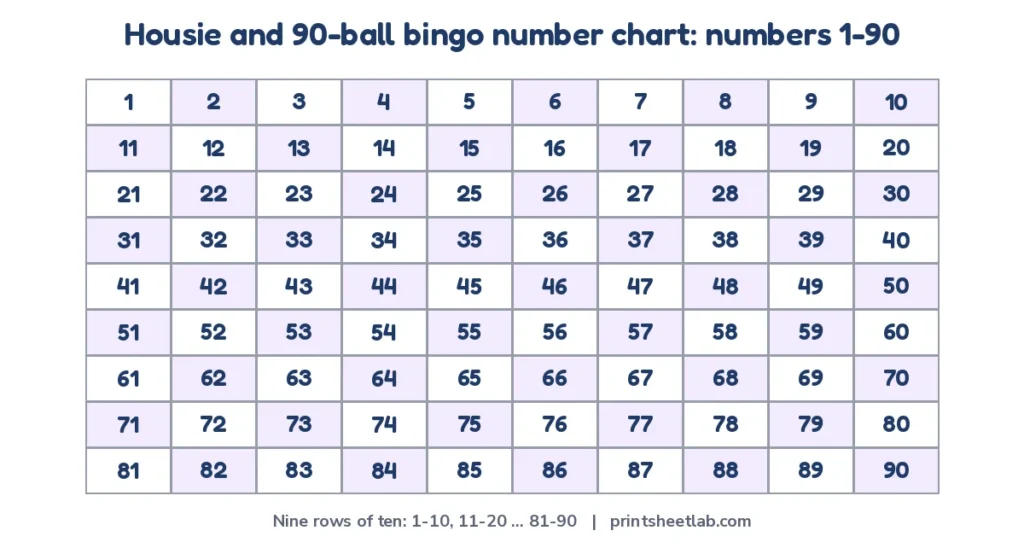
In the first table column of a real ticket, numbers run from 1 to 9; the second column holds 10 to 19; and so on until the last column, which holds 80 to 90. That is a different grouping from the ten-number rows above, which exist only to make the board easy to read. If you run tambola, the matching call list with nicknames is on the housie number calls page, and the cards come from the 90-ball bingo cards page.
Bingo number board and bingo master board: what each is for
People use several names for the same idea, and the names matter when you shop or search. They are not all identical, so here is how each kind of bingo number chart differs in practice.
| Name | What it is | Who looks at it |
|---|---|---|
| Bingo number chart | A printed or on-screen list of all numbers, used as a reference | Caller and anyone checking numbers |
| Bingo number board | The same chart sized up as a board, often on a wall or a TV | Everyone in the room |
| Bingo master board | The caller’s own copy, where each called number is marked off | The caller, and the person verifying a win |
| Bingo number sheet | A printed page of numbers, usually 1-90 for housie | Tambola hosts and ticket checkers |
| Caller sheet | A list of numbers in the order they will be called | The caller, for pre-shuffled games |
Bingo number board for a TV or projector
A bingo number board is a bingo number chart that is useful because players can check what has been called without asking. In a big room it should be large and visible. The bingo caller has a big-screen mode for exactly that: it shows the current ball and the board with called numbers marked, and you can put it on a TV, a projector or a Zoom screen share.
Bingo master board for the caller
A bingo master board is how the host keeps control of the game. When a player shouts bingo, the host checks the card against the master board, not against memory. If you call from a bag or a cage, mark each ball on the board as it is drawn; if you call from the digital caller, the board marks itself and the last number is highlighted.
Printable bingo number chart: how to print it
A printable bingo number chart should be big enough to read from a table away and light enough on ink to print in ten seconds. There are three ways to get one on paper, depending on how you plan to call.
Option 1: print this page
Open your browser print dialog with Ctrl+P (Cmd+P on a Mac), choose landscape orientation, set the margins to Default or Minimum and tick Background graphics if you want the colored letters. The chart tables fit across a landscape page because they have only 16 columns, and the 1-90 table has 11. If the chart is cut off, lower the scale a little or choose Fit to page.
Option 2: the caller sheet from the card maker
The card maker at the top of this page opens with 75-ball cards. In its Print tab, the option Caller sheet adds a page that lists the numbers for the game, which gives you a printed master board that matches the cards you just made. It is the quickest way to get a sheet that fits the same paper size as your cards.
Option 3: calling cards to cut out
Also in the Print tab, Calling cards to cut out prints one small card per number. You shuffle them, draw one at a time and read it aloud, which makes a no-electronics game for a place without a screen. Cut guides are printed on the page, so cutting is quick. Keep the calling cards face down in one pile and the called ones in another, so you can check them against the chart later.
Whichever way you print the bingo number chart, make one extra copy of the bingo number chart for the person who will check winners, so the caller never has to hand over their working copy.
Bingo calling numbers chart: caller, calls and speed
A bingo calling numbers chart pairs each number with the call the caller reads out. For 75-ball bingo the call is a letter and a number, such as B 7 or O 71. For 90-ball bingo, the call is the number plus an optional nickname. You can read from the chart, draw from calling cards or let a tool do it.
| Way to call | What you need | Best for |
|---|---|---|
| Printed chart and a bag | Numbered balls or slips, a marker, this chart | Small groups, classrooms, a quiet evening |
| Calling cards | The cut-out cards from the card maker Print tab | No screen, no batteries, a cut-and-draw game |
| Digital caller | A browser: bingo caller for 75-ball, tambola number caller for 90-ball | Big rooms, auto-calling, voice and a big screen |
| Live game | Play bingo online where guests join by link | Guests on phones |
The digital caller replaces the paper bingo number chart with a live board. It shuffles the numbers once with your browser’s secure random generator, so every number is called exactly once. Its call board marks the called numbers and highlights the last one, and a list of calls so far shows the order. You can also check a winning card by typing its numbers in.
Speed is a choice. At 8 seconds per call, a 75-number game takes 10 minutes from the first call to the last, and a typical one-line game that ends around call 20 takes under three minutes. Slower calls help children and new players, and faster calls help a group that has played many times.
How to use a master board during a game
Using the bingo number chart well is a small routine. The steps below work for a paper bingo number chart and for the call board on screen, and they are the same for 75-ball and 90-ball games.
- Before the game, set out a clean chart, a pen or markers, and the cards. Tell the room the winning pattern and write it where everyone can see it.
- For each call, say the letter and number, wait two seconds, and mark the number on the chart. Say it a second time so slow markers can catch up.
- Mark the latest number differently. A circle on the newest call and a cross on all earlier ones lets you repeat the last number in one glance.
- Keep a written order. Jot the numbers down in the order they were called, or copy them from the digital list, because a winner is checked against the order as well as the set.
- When someone calls bingo, pause, read the numbers on their card aloud and tick each against your master board. Only declare a winner when every number is marked.
- Reset between rounds. Use a fresh chart or clear the board, and tell the room whether the pattern has changed.
The digital caller covers most of this for you. It highlights the last call, keeps the last five calls on screen, lets you repeat a call or undo a mistake with one key, and has a field where you type a card’s numbers to see whether all of them have been called.
Frequent mistakes a bingo number chart prevents
- Calling a number twice. A marked chart shows it is already used.
- Calling the wrong letter. The row labels show that 38 is an N number and not a G number.
- Disputed wins. The master board settles which numbers were called without an argument.
- Lost track after a break. A marked chart records the whole game.
Numbers by letter: what you can compute about 1-75
A bingo number chart is also a small statistics lesson, and this bingo number chart is the place to start. In a game of 75-ball bingo the numbers are drawn without replacement, which means they behave like a shuffled deck. That makes exact answers possible, and no simulation is needed. Here are the facts you can check yourself with a calculator.
| Letter | Numbers | Expected count in the first 20 calls | Average call number of the first one | Average call number of the last one |
|---|---|---|---|---|
| B | 1 to 15 | 4.0 | 4.75 | 71.25 |
| I | 16 to 30 | 4.0 | 4.75 | 71.25 |
| N | 31 to 45 | 4.0 | 4.75 | 71.25 |
| G | 46 to 60 | 4.0 | 4.75 | 71.25 |
| O | 61 to 75 | 4.0 | 4.75 | 71.25 |
All five letters have the same figures, because each has 15 numbers. In the first 20 calls you expect four from each letter on average, though real games wobble around that. The first B (or any letter) turns up around call 4.75 on average, and the last number of a letter arrives around call 71.25. The averages come from the rule that m specific numbers among N drawn in random order have their first number at about (N+1)/(m+1) and their last at about m(N+1)/(m+1).
Chance that a given number is called by call k
Every number has the same chance of appearing in the first k calls: k divided by 75. After 20 calls the chance that a specific number has been called is 20/75, or 26.7 percent, and after 60 calls it is 60/75, or 80 percent.
| Calls made | Chance a given number was called | Numbers called on average from one letter |
|---|---|---|
| 5 | 6.7% | 1.0 |
| 10 | 13.3% | 2.0 |
| 15 | 20.0% | 3.0 |
| 20 | 26.7% | 4.0 |
| 25 | 33.3% | 5.0 |
| 30 | 40.0% | 6.0 |
| 40 | 53.3% | 8.0 |
| 50 | 66.7% | 10.0 |
| 60 | 80.0% | 12.0 |
| 70 | 93.3% | 14.0 |
Numbers drawn early are no luckier than others in the long run. What matters to a single card is how many of its own 24 numbers have been called so far, and on average that is 24 times k divided by 75.
Why a streak does not mean a letter is due
The draw is without replacement, so the chart does remember what has happened. If ten calls pass with no N number, the chance that the next call is an N rises from 15 in 75 (20 percent) to 15 in 65, which is 23.1 percent, simply because fewer non-N numbers remain. The chance of ten calls without an N is 9.1%, so it happens in about one game in 11.
The reverse is also true: after a run of B numbers, the next call is less likely to be a B. That is the opposite of the gambler’s fallacy, in which people expect a number to be due or overdue, and it only holds for the shuffled-deck draw. Each individual number is still equally likely to be called on any given call before it has appeared.
Average calls to cover a line: exact numbers
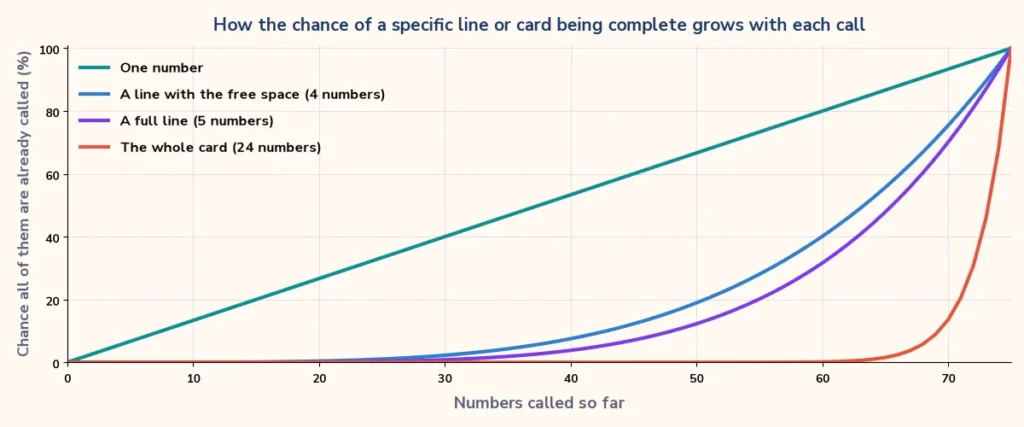
How many calls does a game last? For one card and one fixed pattern the answer is exact. If a pattern needs m specific numbers, it is complete when the last of them is called, and the average position of the last of m numbers among 75 is m x 76 / (m + 1). The center square is free, so patterns through the middle need one number fewer.
| Pattern on one card | Numbers needed | Average call it completes | Chance done by call 30 | By call 50 | By call 60 |
|---|---|---|---|---|---|
| Any row or column that misses the center | 5 | 63.3 | 0.8% | 12.3% | 31.6% |
| A line through the free center | 4 | 60.8 | 2.3% | 18.9% | 40.1% |
| Four corners | 4 | 60.8 | 2.3% | 18.9% | 40.1% |
| Postage stamp (2×2 corner block) | 4 | 60.8 | 2.3% | 18.9% | 40.1% |
| Letter X | 8 | 67.6 | 0.0% | 3.2% | 15.2% |
| Letter T | 8 | 67.6 | 0.0% | 3.2% | 15.2% |
| Letter L | 9 | 68.4 | 0.0% | 2.0% | 11.8% |
| Picture frame | 16 | 71.5 | 0.0% | 0.1% | 1.7% |
| Blackout (whole card) | 24 | 73.0 | 0.0% | 0.0% | 0.1% |
So a single player who needs one particular row has to wait until about call 63, which is 84 percent of the way through the deck, and a blackout on one card typically finishes around call 73. The odds that a particular line is complete by call 30 are only about 1 to 2 percent. A game seems faster than that because there are many lines on a card and many cards in the room, not because any one line is quick.
What happens with many cards in the room
With more cards, someone is nearly always close to a win, so the first winner appears much earlier than the one-card average. Our simulation of random 75-ball cards with a free center gives the median call at which the first winner appears for each pattern. These figures are simulated, unlike the exact values above, and the range in brackets covers the middle half of games.
| Winning pattern | 1 card | 10 cards | 30 cards | 100 cards |
|---|---|---|---|---|
| Any single line | 41 (34 to 48) | 26 (22 to 30) | 21 (17 to 23) | 15 (13 to 18) |
| Four corners | 64 (54 to 70) | 40 (32 to 47) | 33 (26 to 39) | 24 (19 to 29) |
| Letter X | 70 (65 to 73) | 55 (50 to 59) | 48 (44 to 53) | 42 (39 to 46) |
| Blackout (full card) | 74 (72 to 75) | 69 (67 to 70) | 66 (64 to 68) | 64 (62 to 65) |
A line with 30 cards in play is usually won by around call 21, while a blackout still needs about 66 calls, because the last numbers are the hard ones to match. When you plan the evening, plan the time per round from this table: at 8 seconds per call, 21 calls is under three minutes and 66 calls is about nine. For more on game length, see the bingo card generator page, which uses the same simulation.
The 90-ball version
The same formula works for tambola. A ticket has 15 numbers among the 90. The fifth of those numbers (the Early Five prize) arrives around call 5 x 91 / 16, which is 28.4, a full top, middle or bottom row of five numbers is complete at about call 75.8, and the full house of all 15 arrives around call 15 x 91 / 16, which is 85.3. A 90-ball game on one ticket therefore runs almost to the end of the deck.
| Tambola prize on one ticket | Numbers needed | Average call it completes |
|---|---|---|
| Early Five (any five numbers) | 5 of 15 | 28.4 |
| One row of five | 5 specific | 75.8 |
| Four corners (first and last of the top and bottom rows) | 4 specific | 72.8 |
| Full house | 15 specific | 85.3 |
The tambola number caller has a prize list for all of these, and the housie calls guide explains the traditional nicknames. Early Five is the quickest prize because any five of your fifteen numbers will do, while the full house needs every one of them.
Design and printing tips for a bingo number chart people can read
A bingo number chart is only useful if it is legible. These choices decide whether the room can read it.
| Choice | Recommendation | Why |
|---|---|---|
| Orientation | Landscape for 1-75, portrait or landscape for 1-90 | The 75-ball board is 15 columns wide |
| Number size | As large as the page allows, at least 24 points when projected | Readable from the back of a room |
| Colors | One color per letter row, dark text on a light fill | Players find the row by color |
| Paper | Plain paper for one-off, laminate or sleeve for reuse | A laminated board can be wiped and reused |
| Markers | Dry-erase on laminate, chips or crayon on paper | Called numbers need to be easy to see |
| Copies | One for the caller, one for the checker | Disputes are settled without interrupting the game |
If you project the board, use the big-screen mode of the caller rather than a photo of the bingo number chart, because the board updates with every call and the latest number is highlighted. If you are playing by video call, share the caller screen, and ask players to keep their own cards.
Cards and tools that go with the chart
A bingo number chart does little without cards and a way to call. These pages complete the set, and each one links back here.
- Bingo card generator makes 75-ball cards that match this chart, each one different.
- Printable bingo cards has themed cards with words instead of numbers.
- Blank bingo cards are for custom words, which need a word list instead of this chart.
- Bingo card template explains grid sizes, word counts and how many different cards a list can make.
- Bingo caller draws and announces numbers 1-75 automatically.
- Tambola number caller is the 90-ball version with prizes.
- 90-ball bingo cards are the tickets that go with the 1-90 sheet.
- Housie number calls lists the nicknames for 1-90.
The numbers, ranges and combinations on this page follow the standard 75-ball game, which has a short description on Wikipedia. Local halls sometimes vary the patterns, so confirm the rules with your group before you start.
Frequently asked questions
10 quick answers
What is a bingo number chart?
A bingo number chart is a printed or on-screen list of every number in the game. For 75-ball bingo it has five rows labeled B, I, N, G and O with 15 numbers each. Callers use it to mark the numbers they have called and to check winning cards.
What are the bingo numbers 1-75 for each letter?
B is 1 to 15, I is 16 to 30, N is 31 to 45, G is 46 to 60 and O is 61 to 75. Each letter covers 15 numbers, and each number belongs to exactly one letter, so a call such as G 52 is unambiguous.
Can I print a bingo number chart for free?
Yes. Print this page in landscape, or use the card maker above and choose the caller sheet in the Print tab. Both are free, with no sign-up, and the cards and chart match.
What is a bingo master board?
A bingo master board is the caller’s copy of the number chart, on which every called number is marked. It is used to check that a winner’s numbers were all called, and it is the reference when two players disagree.
What is the difference between a bingo number board and a bingo number sheet?
A number board is usually the big version shown to the room on a wall or screen, while a number sheet is a printed page of numbers, most often 1-90 for housie. Both list the same numbers; the difference is size and use.
Is there a bingo calling numbers chart for 90-ball games?
Yes. The 1-90 chart on this page has nine rows of ten, and the tambola number caller and the housie number calls guide give the call list with traditional nicknames. There are no letters in 90-ball games.
How many numbers are called in a game with a bingo number chart?
It depends on the pattern and the number of players. With 30 cards a single line is usually won by call 21 and a blackout by about call 66, out of 75 in total. A game can run through all 75 numbers if nobody wins early.
Why is the chance a number is called by call 20 equal to 20/75?
Every number has the same chance of being in any position in the shuffled order, so the chance that it falls in the first 20 of 75 positions is 20 out of 75, which is 26.7 percent.
Do I need a physical bingo number chart if I use the online caller?
No. The online caller has a call board that marks called numbers and highlights the latest one, and it keeps the list of calls so far. A printed chart is useful as a backup and for a caller who likes to mark by hand.
Can I make calling cards from the bingo number chart?
Yes. In the card maker, open the Print tab and choose Calling cards to cut out. It prints one small card for every number, with cut guides, so you can shuffle and draw them without a screen.