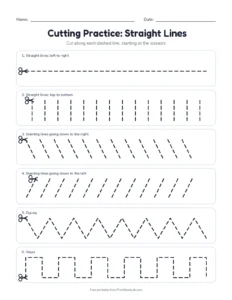
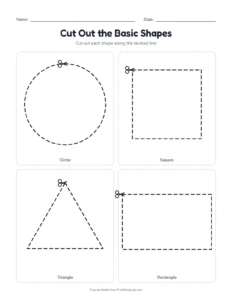
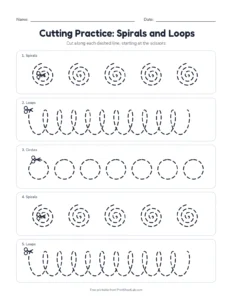
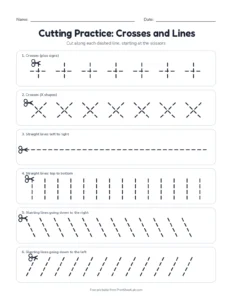
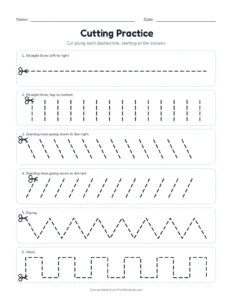
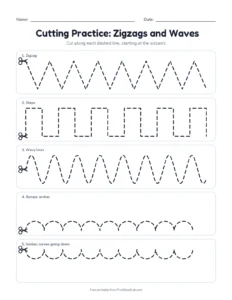
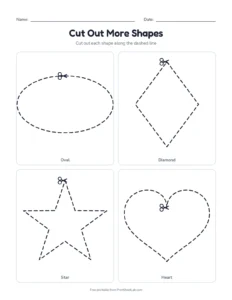
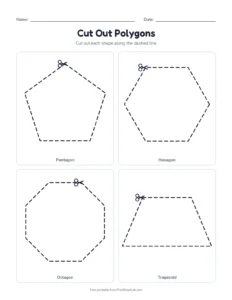
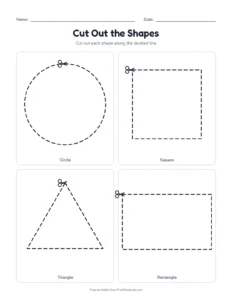
Cutting worksheets build the hand strength and coordination children need for writing, drawing and everyday tasks. Each free printable page has dashed lines or shapes to cut, with a scissors icon showing where to start. There are ten worksheets, from straight lines to spirals and 12 shapes, and a maker above for your own cutting practice.
Quick answer: Cutting worksheets give children dashed lines and shapes to cut with scissors, building fine motor skill, hand-eye coordination and focus. Start with straight lines, then zigzags, curves and shapes. This page has 10 free cutting worksheets (PDF) and a maker for custom cutting practice. Updated October 2026.
Cutting practice worksheets samples
Four of the ten PDFs. The full list is under Ready-to-print worksheets, and the maker above builds any set of lines or shapes.
Straight linesHorizontal, vertical, slanting.PDFCustomizeCurves and loopsWaves, bumps, spirals.PDFCustomizeCut out basic shapesCircle, square, triangle.PDFCustomizeSpirals and loopsFor confident cutters.PDFCustomize
Why cutting practice matters
Cutting uses the small muscles of the hand and works both hands at once: one opens and closes the scissors while the other holds and turns the paper. Occupational therapists often recommend scissor practice because it builds the finger strength and coordination that later help with handwriting. It also trains eye and hand to work together, and children learn to follow a line, which is a skill used in drawing and writing.
The CDC developmental milestones track hand and drawing skills in the preschool years. Cutting is not listed as a single milestone, so use the ages here as a guide and follow your child’s pace.
Cutting skills by age
Children develop cutting in a predictable order. This table shows typical ages and the worksheet that suits each stage. Every child is different, so use it as a guide:
Age (typical)
Cutting skill
Best worksheet
2 to 2.5
Snips edges of paper with help
First cuts: short straight lines
3
Cuts across a strip and along a straight line
Straight and vertical lines
3.5 to 4
Cuts diagonal lines and simple curves
Diagonals and wavy lines
4 to 5
Cuts zigzags, circles and squares
Zigzags and basic shapes
5 to 6
Cuts complex shapes and spirals
Stars, hearts, polygons and spirals
6 to 7
Cuts out detailed pictures smoothly
Spirals and 12 shapes
Cutting lines worksheets: from easy to hard
The line patterns on these pages are ordered by difficulty. Start with straight lines and move on only when your child cuts them smoothly:
Line type
Why it matters
Difficulty
Straight horizontal
Teaches the open and close motion
Easiest
Vertical and diagonal
The child must turn the paper
Easy
Zigzag
Sharp turns teach control of direction
Medium
Wavy and bumps
Smooth curves need constant turning of the paper
Medium
Circles and loops
Closed curves train the non-cutting hand
Hard
Spirals
The longest curve; needs steady focus
Hardest
Scissor skills worksheets: choosing tools
The right scissors make a big difference to success. Here are options and tips:
Tool
Good for
Tip
Blunt-tip child scissors
Ages 3 to 7
Check that they cut paper cleanly
Loop or spring scissors
Beginners or weak grip
Spring opens the blades for the child
Left-handed scissors
Left-handed children
Blades are reversed so the line is visible
Thick paper or card stock
First attempts
Stiffer paper holds its shape
Craft strips
Practice for snipping
Cut strips 2 inches wide
Play dough with plastic scissors
Strength building
Roll a snake and snip it
How to hold scissors
Thumb up: the thumb goes in the small loop and points to the ceiling.
Middle finger in the big loop: the index finger rests outside the loop to guide.
Ring and little fingers tuck into the palm.
Helper hand holds the paper with the thumb up, too.
Turn the paper, not the scissors.
Cutting activities for kids beyond worksheets
Mix worksheets with play to keep cutting fun. Try snipping play dough snakes, cutting straws into beads, trimming fringe on paper, cutting junk mail, and making paper chains. Each activity adds practice without feeling like a lesson. Use the worksheets above for the focused practice and these activities to widen the skill.
Cutting shapes worksheets and cutting worksheets for preschool
This page is also searched as cutting practice, cutting practice worksheets, scissor skills worksheets, cutting lines worksheets, cutting shapes worksheets, cutting activities for kids and cutting worksheets for preschool. All of them are the free PDFs above, for US Letter or A4, with no sign-up. For the youngest cutters, see the preschool cutting practice page, which starts with snipping and straight lines.
Cutting vocabulary
Students answer questions faster when they know the words. These are the terms used on the worksheets and answer keys:
Word
Meaning
Example
Fine motor skills
Small hand and finger movements
Cutting, writing
Hand-eye coordination
Eyes guiding hand movements
Following a line
Helper hand
The hand that holds and turns the paper
Non-dominant hand
Snipping
Making a short single cut
First cuts
Bilateral coordination
Using both hands together for a task
Holding and cutting
Dashed line
A line made of short dashes to follow
The cutting guide
Common cutting mistakes and how to fix them
Mistake
What you see
Fix
Gripping with the whole hand
Scissors pointing sideways
Show the thumb up grip: thumb in the small loop, middle finger in the big one
Turning the scissors instead of the paper
Wobbly cuts
Keep the scissors straight and rotate the paper
Tearing instead of cutting
Ragged edges
Use thicker paper and practice open and close first
Not holding the paper
Paper slides away
Use the helper hand to hold and turn the paper
Cutting off the dashed line
Cuts wander
Start with wide lines and praise effort, not precision
How to use these cutting worksheets
Use the cutting worksheets with an adult nearby. Begin with the straight lines page and let your child cut the first line while you help hold the paper. Praise effort rather than accuracy, and repeat the page on another day if the line was hard to follow. Move to curves and shapes when straight lines feel easy.
Each cutting worksheet is printed on standard paper, which is thin and tricky for beginners. Print on card stock if your child struggles, because stiffer paper holds its shape. Keep sessions to five or ten minutes, and keep the cut pieces for collages or counting games so nothing is wasted.
A weekly plan for cutting practice
Day
Focus
Suggested block
Monday
Straight lines
10 min
Tuesday
Zigzags
10 min
Wednesday
Curves and waves
10 min
Thursday
Basic shapes
10 min
Friday
Play dough snipping or a craft
10 min
Weekly total
Five short sessions
50 min
Frequently asked questions
5 quick answers
Where can I download free cutting worksheets?
Open any worksheet in the Ready-to-print list on this page, choose US Letter or A4, then print or save the PDF. They are free and no account is needed.
At what age can children start cutting?
Many children begin snipping around age 2 to 3 with help, and cut along lines by age 4. Ages vary.
What cutting skills should a 4-year-old have?
A typical 4-year-old can cut along a straight line and often a simple curve, and may start on circles and squares.
How do I teach a child to hold scissors?
Show the thumb-up grip: thumb in the small loop, middle finger in the big loop, index finger outside as a guide, and the other hand holding the paper.
What can I do if my child struggles with cutting?
Use loop scissors, thicker paper, wider lines and play dough snipping, and keep sessions short and positive.