An hourly to salary calculator converts what you earn per hour into what you earn per year, month, two weeks, week and day. At $25 an hour, 40 hours a week and 52 paid weeks, the answer is $52,000 a year. This free tool also works backward from a salary to an hourly rate, and you can change hours, weeks and time off.
This hourly to salary calculator lets you type your hours and weeks instead of trusting a fixed 2,080-hour year. A part-time worker, a teacher paid for 40 weeks and a nurse on a 36-hour week all get a different yearly figure from the same hourly rate, and the tool shows the working for each step.
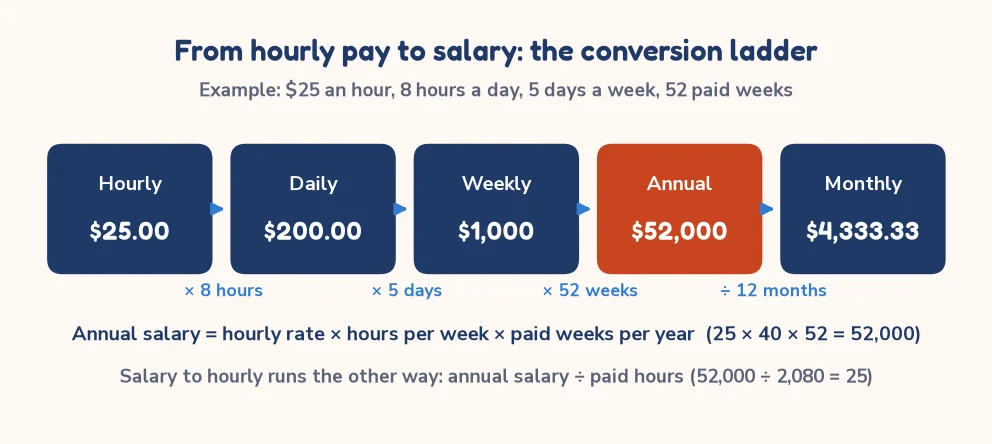
Quick answer: Annual salary = hourly rate × hours per week × paid weeks per year. For $25 an hour that is 25 × 40 × 52 = $52,000 a year, or $4,333.33 a month and $2,000 every two weeks. To go back, divide the salary by the paid hours: $52,000 ÷ 2,080 = $25 an hour.
How to use the hourly to salary calculator
Using the hourly to salary calculator takes a minute. Pick a direction, fill in the boxes and read the answer, which updates as you type. Every result comes with a table of pay periods and a short step-by-step explanation, and a Copy result button gives you a sentence to paste into an email or a budget.
- Choose Hourly to salary or Salary to hourly.
- Type the hourly rate, or the salary and the period it is paid for (year, month, biweekly period, week or day).
- Set your hours per week, days per week and paid weeks per year. The hourly to salary calculator starts at 40 hours, 5 days and 52 weeks.
- Add paid vacation weeks or unpaid days off if they apply to you.
- Read the headline answer and the pay-period table. Use Copy link to share the exact numbers.
| Box | What to type | What it changes |
|---|---|---|
| Hourly rate or salary | Your pay before tax | The starting number |
| Hours per week | 40, 37.5, 32 or your own | Annual pay and daily pay |
| Paid weeks per year | 52, or 50 with two unpaid weeks | Annual pay |
| Paid vacation weeks | 0 to 6 | The hourly rate on hours you work |
| Unpaid days off | Days without pay | Paid days in the year |
Hourly to annual: the formula with a worked example
The hourly to annual formula multiplies three numbers: hourly rate × hours per week × paid weeks per year. The product of the last two, 40 × 52 = 2,080, is the number of paid hours in a standard full-time year. Multiply any hourly rate by 2,080 to get a quick full-time estimate.
Example 1: $25 an hour, full time. There are 40 hours a week over 52 weeks, so 40 × 52 = 2,080 paid hours. Annual pay is 25 × 2,080 = $52,000. Monthly pay is 52,000 ÷ 12 = $4,333.33, biweekly pay is 52,000 ÷ 26 = $2,000, weekly pay is 25 × 40 = $1,000 and daily pay is 25 × 8 = $200.
Example 2: $18.50 an hour, 32 hours over 4 days, 50 paid weeks and 3 unpaid days. A working day is 32 ÷ 4 = 8 hours. Paid days are 50 × 4 − 3 = 197, so paid hours are 197 × 8 = 1,576. Annual pay is 18.50 × 1,576 = $29,156, which the hourly to salary calculator confirms.
Hourly wage to salary: what the paid weeks change
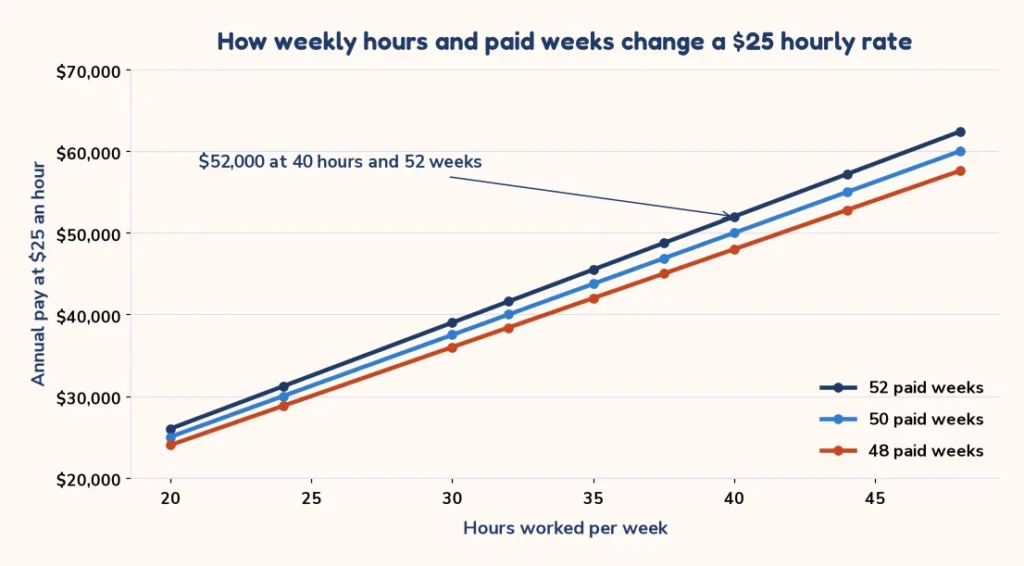
The number of paid weeks matters as much as the rate. Fifty-two weeks assumes you are paid for holidays and vacation. If you take two unpaid weeks, use 50. This table shows the same $25 rate with 40 hours a week.
| Paid weeks | Paid hours | Annual pay at $25 | Average per month | Change from 52 weeks |
|---|---|---|---|---|
| 52 weeks | 2,080 | $52,000 | $4,333.33 | $0.00 |
| 50 weeks | 2,000 | $50,000 | $4,166.67 | $-2,000.00 |
| 48 weeks | 1,920 | $48,000 | $4,000.00 | $-4,000.00 |
| 44 weeks | 1,760 | $44,000 | $3,666.67 | $-8,000.00 |
| 40 weeks | 1,600 | $40,000 | $3,333.33 | $-12,000.00 |
Hourly rate to yearly salary table ( to 0)
This lookup table answers the most common searches, such as $20 an hour per year or $30 an hour annually. It assumes 2,080 paid hours: 40 hours a week for 52 weeks. Every number is computed from the formula above.
| Hourly rate | Annual | Monthly | Biweekly | Weekly | Daily |
|---|---|---|---|---|---|
| $12 | $24,960 | $2,080.00 | $960.00 | $480.00 | $96.00 |
| $15 | $31,200 | $2,600.00 | $1,200.00 | $600.00 | $120.00 |
| $18 | $37,440 | $3,120.00 | $1,440.00 | $720.00 | $144.00 |
| $20 | $41,600 | $3,466.67 | $1,600.00 | $800.00 | $160.00 |
| $22 | $45,760 | $3,813.33 | $1,760.00 | $880.00 | $176.00 |
| $25 | $52,000 | $4,333.33 | $2,000.00 | $1,000.00 | $200.00 |
| $30 | $62,400 | $5,200.00 | $2,400.00 | $1,200.00 | $240.00 |
| $35 | $72,800 | $6,066.67 | $2,800.00 | $1,400.00 | $280.00 |
| $40 | $83,200 | $6,933.33 | $3,200.00 | $1,600.00 | $320.00 |
| $50 | $104,000 | $8,666.67 | $4,000.00 | $2,000.00 | $400.00 |
| $60 | $124,800 | $10,400.00 | $4,800.00 | $2,400.00 | $480.00 |
| $75 | $156,000 | $13,000.00 | $6,000.00 | $3,000.00 | $600.00 |
| $100 | $208,000 | $17,333.33 | $8,000.00 | $4,000.00 | $800.00 |
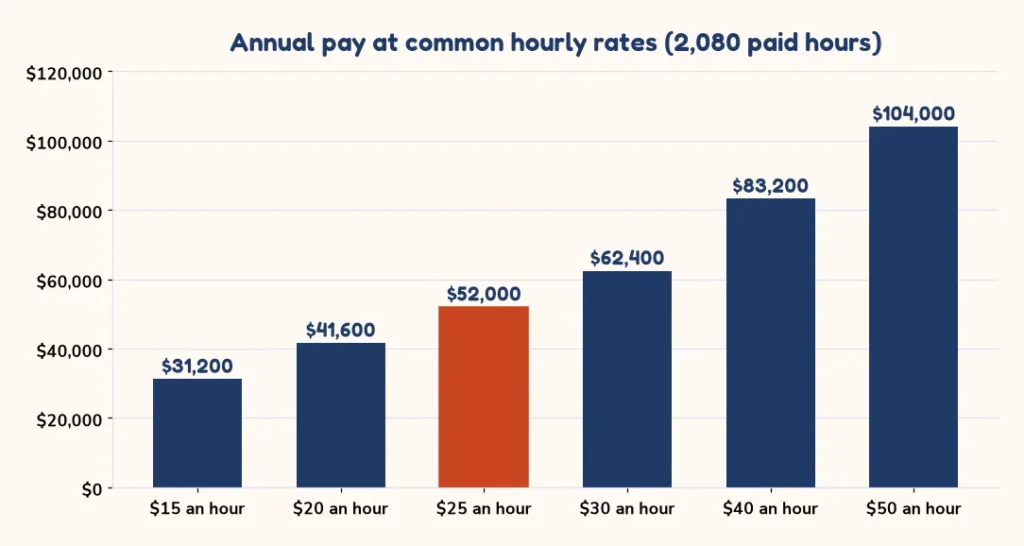
For example, $20 an hour is $41,600 a year, $3,466.67 a month and $1,600 every two weeks. Use the hourly to salary calculator for any rate that is not in the table, such as $23.45 or $41.
Hourly to monthly salary and hourly to biweekly pay
Hourly to monthly
To convert hourly to monthly, first find the annual pay, then divide by 12. For $25 an hour, 52,000 ÷ 12 = $4,333.33 a month. A month is not exactly four weeks: 52 weeks ÷ 12 months is about 4.33 weeks, so multiplying weekly pay by 4 understates a month by about 8 percent.
Hourly to biweekly
Biweekly means every two weeks, which gives 26 paychecks a year. Biweekly pay is hourly rate × hours per week × 2, or annual pay ÷ 26. At $25 an hour that is 25 × 80 = $2,000. Semi-monthly pay is different: it means twice a month, 24 paychecks, so each one is annual pay ÷ 24 = $2,166.67.
| Pay frequency | Paychecks a year | Paycheck at $25 an hour |
|---|---|---|
| Weekly | 52 | $1,000.00 |
| Biweekly | 26 | $2,000.00 |
| Semi-monthly | 24 | $2,166.67 |
| Monthly | 12 | $4,333.33 |
Salary to hourly: the annual to hourly formula
To convert salary to hourly, divide the annual salary by the paid hours in the year. The annual to hourly formula is hourly rate = annual salary ÷ (hours per week × paid weeks). A $52,000 salary at 40 hours and 52 weeks is 52,000 ÷ 2,080 = $25 an hour. If the salary is paid monthly, multiply by 12 first; if it is biweekly, multiply by 26.
Example 3: an $85,000 salary with 3 paid vacation weeks. The paid hours are 2,080, so the hourly rate is 85,000 ÷ 2,080 = $40.87. If you subtract the 120 vacation hours you do not work, the rate on hours at the desk is 85,000 ÷ 1,960 = $43.37. Switch the hourly to salary calculator to Salary to hourly and it shows both, because comparing a salary with a contract rate needs the second figure.
Annual to hourly table ($30,000 to $150,000)
| Annual salary | Hourly (2,080 hours) | Hourly (2,087 hours) | Weekly | Biweekly | Monthly |
|---|---|---|---|---|---|
| $30,000 | $14.42 | $14.37 | $576.92 | $1,153.85 | $2,500.00 |
| $40,000 | $19.23 | $19.17 | $769.23 | $1,538.46 | $3,333.33 |
| $50,000 | $24.04 | $23.96 | $961.54 | $1,923.08 | $4,166.67 |
| $60,000 | $28.85 | $28.75 | $1,153.85 | $2,307.69 | $5,000.00 |
| $80,000 | $38.46 | $38.33 | $1,538.46 | $3,076.92 | $6,666.67 |
| $100,000 | $48.08 | $47.92 | $1,923.08 | $3,846.15 | $8,333.33 |
| $120,000 | $57.69 | $57.50 | $2,307.69 | $4,615.38 | $10,000.00 |
| $150,000 | $72.12 | $71.87 | $2,884.62 | $5,769.23 | $12,500.00 |
The second column uses 2,087 hours, the divisor the US federal government applies to most civilian employees, which is why a federal hourly rate comes out a few cents lower than the 2,080 figure.
How many hours are in a work year?
The standard answer is 2,080, but it depends on how you count. Forty hours for 52 weeks is 2,080. The US Office of Personnel Management uses 2,087 hours for federal pay, because a calendar year is slightly longer than 52 weeks. If you take unpaid time off, or work a shorter week, your own number is smaller.
The weekly hours drive the result. At a $25 rate with 52 paid weeks, 20 hours a week pays $26,000 a year, 32 hours pays $41,600, 37.5 hours pays $48,750 and 40 hours pays $52,000.
Paid vacation, holidays and unpaid time off
Paid vacation and paid holidays do not lower an annual salary, because you are paid for them. They do change your effective rate. With 3 weeks of paid vacation and 10 paid holidays (80 hours), a full-time worker is paid for 2,080 hours but works 2,080 − 120 − 80 = 1,880 of them. Divide the salary by 1,880 to compare it fairly with a contractor.
Unpaid time off works the other way. If you are an hourly worker who takes 10 unpaid days, the calculator subtracts 10 days from the paid days, so a $25 rate loses 10 × 8 × 25 = $2,000 a year. Enter the days in the Unpaid days off box to see the effect.
Hourly vs salary: United States, Canada, UK and Australia
The arithmetic in the hourly to salary calculator is the same in every country, but the rules around hours and overtime are not. Check your own contract or local rules before you rely on a single number.
United States
In the United States, most hourly workers are non-exempt under the Fair Labor Standards Act. The US Department of Labor says covered non-exempt employees must be paid at least time and one-half their regular rate for hours over 40 in a workweek. The federal minimum wage is $7.25 an hour, in effect since July 24, 2009, and many states set a higher figure. Salaried staff may be exempt from overtime depending on duties and pay, so a salary does not always mean unpaid extra hours. Our overtime calculator works out the extra pay.
Canada
In Canada, labour standards are set by the provinces and territories for most workers, and by the Canada Labour Code for federally regulated workplaces. Standard hours, overtime and holidays therefore differ by province. Use your province’s numbers for hours and weeks, and treat the 2,080-hour estimate as a starting point.
United Kingdom
Almost all UK workers are entitled to 5.6 weeks of paid holiday a year, according to GOV.UK, and bank holidays can count toward it. That is why a UK salary is usually quoted for all 52 weeks. The 48-hour weekly limit is averaged over 17 weeks unless a worker opts out. UK employers are not required to pay overtime at a higher rate; the contract sets it.
Australia and New Zealand
In Australia, pay rates, hours and loadings are set by awards and agreements, which the Fair Work Commission publishes. Many workers are paid a base hourly rate plus penalty rates, so a straight hourly to salary conversion is a baseline rather than the full picture. Type your own hours per week and weeks per year, and add loadings separately.
Hourly pay to yearly: real-life examples with the hourly to salary calculator
| Situation | Numbers | Yearly result |
|---|---|---|
| Comparing job offers | $22 an hour full time vs $47,000 salary | $22 × 2,080 = $45,760, so the salary pays $1,240 more (about $22.60 an hour) |
| School-year contract | $28 an hour, 30 hours a week, 40 weeks | 28 × 30 × 40 = $33,600 |
| Four-day week | $35 an hour, 32 hours, 52 weeks | 35 × 32 × 52 = $58,240 |
The same method answers budgeting questions. If rent is 30 percent of your gross pay and you earn $25 an hour, take 30 percent of $4,333.33 a month, which is $1,300. Use the percentage calculator to test other shares.
Common mistakes when converting hourly pay to salary
- Forgetting unpaid weeks. If you are not paid for holidays, 52 weeks overstates your pay.
- Ignoring overtime. The calculator uses straight-time pay. Add extra hours with the overtime pay calculator.
- Comparing gross with take-home pay. The result is before tax, health insurance and retirement deductions.
- Assuming 8 hours a day. A 37.5-hour week changes both the daily and annual numbers.
Questions people ask about hourly to salary conversion
How do I convert hourly to salary with overtime?
Work out the regular annual pay, then add overtime pay for the extra hours. Overtime hours are paid at the hourly rate times the multiplier, usually 1.5. Ten overtime hours a week at $25 adds 10 × 37.50 = $375 a week, or $19,500 over 52 weeks.
Is there an hourly to salary calculator after taxes?
This calculator shows gross pay, before tax. Take-home pay depends on your tax rate, filing status, state or province and deductions, so no single conversion fits everyone. Multiply the gross figure by the share you keep to estimate net pay.
Frequently asked questions
7 quick answers
How do you convert hourly to salary?
Multiply the hourly rate by hours per week and by paid weeks per year. At $25 an hour, 40 hours and 52 weeks the salary is 25 × 40 × 52 = $52,000. The hourly to salary calculator also shows the monthly, biweekly, weekly and daily amounts.
How do you convert salary to hourly?
Divide the annual salary by the paid hours in a year, or switch the hourly to salary calculator to Salary to hourly. A $60,000 salary at 40 hours a week for 52 weeks is 60,000 ÷ 2,080 = $28.85 an hour. If your hours or weeks differ, change them in the tool.
How many working hours are in a year?
A standard full-time year has 2,080 working hours, which is 40 hours a week for 52 weeks. The US federal government uses 2,087 for most civilian pay. Your own figure is lower if you work fewer hours or weeks.
How do I convert hourly to biweekly pay?
Multiply the hourly rate by hours per week and by 2. For $25 an hour and 40 hours, that is $2,000 every two weeks. Biweekly means 26 paychecks a year, not 24.
Does the calculator include overtime?
No. The hourly to salary calculator uses straight-time pay for the hours you enter. To add time and a half or double time, use the overtime calculator and add the extra pay to the weekly figure.
Do paid vacation and holidays change my salary?
No. Paid time off is already part of the paid weeks, so the annual pay stays the same. It does change your effective rate on the hours you actually work, which the tool shows when you enter paid vacation weeks.
Is the result before or after tax?
The hourly to salary calculator shows pay before tax. Taxes, benefits and retirement contributions reduce take-home pay, and they vary by country, state and province, so check a payroll tool for net pay.
Related calculators and printables
- Overtime calculator: time and a half, double time and weekly pay
- Work hours calculator: add up hours and breaks
- Percentage calculator: raises, shares and changes
- Time calculator: add and subtract hours and minutes
- Markup calculator: price a service or product from cost
- All free calculators
- Money worksheets for practice with wages and budgets
Sources and further reading
- US Department of Labor: Overtime Pay
- US Office of Personnel Management: Computing hourly rates using the 2,087-hour divisor
- GOV.UK: Holiday entitlement
- Fair Work Commission (Australia)
This page is general information, not financial or payroll advice. Rules on pay, overtime and holidays differ by country, state and contract. Last updated: October 2026.