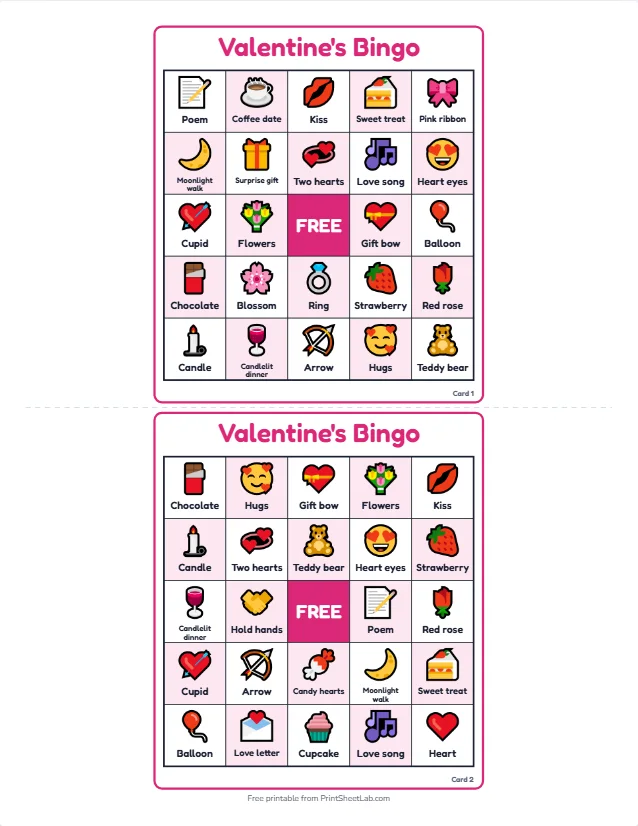
Valentines Day bingo is a love-themed version of the classic game in which the squares are hearts, roses, chocolates and little moments instead of numbers. The template on this page holds 30 squares that a February 14 produces almost anywhere, from the heart on a card and the rose on a restaurant table to a hug, a love song and a plate of something sweet. Choose a card size, press print, and every player receives a different card.
In short: open the card maker above and press Edit and print this card, choose how many cards you need, and download one PDF. It costs nothing, needs no account, and the words you type stay in your browser. All squares can be rewritten, so a school party, a date night and a friends’ night in can each have their own list.
How to play Valentines Day bingo
The rules of Valentines Day bingo are the ones everyone knows from bingo, with a gentler goal. Nobody shouts numbers, because the afternoon or evening itself makes the calls. Each player holds a card and something to mark with. When a square happens in front of them, they mark it, and five in a row across, down or diagonally wins the first prize. A quick agreement at the start about what counts keeps the game friendly, and a teacher, host or couple settles any argument about whether a paper heart counts as a heart.
- Give every player a card and a marker. Crayons, stickers, candy hearts or small paper hearts used as counters all work. Wet markers show through thin paper.
- Agree what counts. A square is marked when you see it yourself, or when someone else points it out to you. It counts once, and a gift, a card or a candy can fill only one square.
- Mark as the party goes on. The free center is already marked, so a first line needs only four more squares.
- Call it out kindly. The winner reads the line aloud, another player checks each square, and a prize changes hands.
- Play again with a harder pattern. After the first line of Valentines Day bingo, try four corners, an X or the whole card.
The reason Valentines Day bingo works is that February 14 is full of predictable details. Nobody knows who will get a rose, but everybody knows a heart will appear before the first cup of punch. A card that names those details gives a room of excited children, or a pair of tired adults at a restaurant, a reason to look around and notice the small things that make the day.
Valentines Day bingo cards: all 30 squares
These Valentines Day bingo cards are made from a list of 30 squares. A standard 5×5 card with a free center needs 24 of them, so each card leaves out six and no two cards are the same. The table sorts the Valentines Day bingo list into families, which helps when you decide what to keep and what to swap for your own room.
| Family | Squares on the list | Where you will see them |
|---|---|---|
| Hearts and symbols | ❤️ Heart, 💞 Two hearts, 💘 Cupid, 🏹 Arrow, 😍 Heart eyes, 🎀 Pink ribbon, 💝 Gift bow | Decorations, cards and clothes. The easiest squares on the list. |
| Messages and music | 💌 Love letter, 📝 Poem, 🎶 Love song, 📸 Selfie | The card exchange, a playlist, a phone camera. |
| Flowers | 🌹 Red rose, 💐 Flowers, 🌸 Blossom | Tables, vases, restaurant counters and the grocery store. |
| Sweets and food | 🍫 Chocolate, 🍬 Candy hearts, 🍓 Strawberry, 🧁 Cupcake, 🍰 Sweet treat, ☕ Coffee date, 🍷 Candlelit dinner | The party table, the dessert menu, a café and a dinner out. |
| Gifts and keepsakes | 🧸 Teddy bear, 💍 Ring, 🎁 Surprise gift, 🎈 Balloon | Gift bags, shop windows and the occasional proposal at the next table. |
| Moments | 🥰 Hugs, 💋 Kiss, 🤝 Hold hands, 🌙 Moonlight walk, 🕯️ Candle | People, mostly. These squares make the game a little more personal. |
The Valentines Day bingo list is not random. Hearts and sweets fill in at nearly every party, so they carry the game, while rarer squares such as the ring, the poem or the moonlight walk make the card feel like a small treasure hunt. If every square were as common as a heart, the first line would arrive before the second song.
How many different cards can you print?
With 30 squares and 24 places on a 5×5 card, the number of different sets of squares is 30 choose 24, which is 593,775. Every set can be arranged in a vast number of orders, so a class of 30 children can have 30 cards that are all different, and a school of hundreds can still avoid repeats. Smaller grids use fewer squares, so 4×4 and 3×3 cards have even more possible sets.
| Card size | Squares used | Different sets from the 30 | Best for |
|---|---|---|---|
| 3×3 with free center | 8 | 5,852,925 | Ages 3 to 6, a short date-night game |
| 4×4 | 16 | 145,422,675 | A short class round or a game with friends |
| 5×5 with free center | 24 | 593,775 | The classic party card |
The story behind the squares
Almost every square in Valentines Day bingo points to a custom that grew up around Valentine’s Day over several centuries. The day began as the feast of a martyred saint, and the link with romantic love is usually traced to medieval poets: the Wikipedia article on Valentine’s Day notes that Chaucer’s fourteenth-century poetry is the first known source that gives the date a romantic meaning. Handwritten love letters and poems followed, and in the United States the first mass-produced valentines of embossed paper lace were sold shortly after 1847 by Esther Howland of Worcester, Massachusetts.
That is why, in Valentines Day bingo, a love letter, a poem and a pink ribbon sit on the same card as chocolate and a teddy bear. Exchanging valentines in school is its own tradition. The same article notes that if the cards made in school activities are counted, the number of valentines exchanged in the United States each year climbs to around a billion, and that teachers receive the most. A Valentines Day bingo card that includes a love letter lets the oldest part of the holiday into the game.
Valentines Day bingo game: four ways to play
One printed Valentines Day bingo card supports several very different games. Choose the one that fits the room, or play two in a row. The table compares them, and the sections underneath give the rules and the prizes.
| Game | Who calls | Length | Best for |
|---|---|---|---|
| Class party spotting game | The party itself | 45 to 60 minutes | Classrooms, libraries and after-school clubs |
| Date night spotting game | The evening | 1 to 3 hours | Couples at a restaurant, a movie or a walk |
| Galentine’s or friends’ night | A host with calling cards | 15 to 25 minutes | Parties at home and group chats on a screen |
| Drawn-card quick round | A caller draws cut-out squares | 10 to 15 minutes | Any group that wants a set length |
Game one: the class party spotting game
This is the version of Valentines Day bingo most teachers want, and the one where printed cards pay off. Each child has a card and marks squares as they happen: a valentine arrives, someone offers a hug, the cupcakes appear on the table.
A good rule is that a square counts only when it happens to you or in front of you, and that one valentine card can fill only one square. Mark a line, call it, and collect a sticker. The simulation further down gives the numbers, including a surprise about which squares to swap.
- Prize for a first line: pick of the sticker sheet or the first cupcake.
- Prize for four corners: choose the next song on the party playlist.
- Prize for everyone: a small sticker for each line completed, so no child leaves with nothing.
- Grown-up job: a helper keeps a spare card and reads squares aloud for children who are still learning to read.
Game two: the date night spotting game
Couples can play Valentines Day bingo at dinner, on a walk or at the movies. Each person takes a card, and the quiet rule is that you mark a square only when you notice it, not when you spot your partner marking one. It turns a normal evening into a shared scavenger hunt: “Did you see that red rose?” The card gives you something to laugh about between courses without staring at a phone. The section on Valentines Day bingo for couples below has rules for keeping it light.
Game three: Galentine’s or a friends’ night
Friends at home can play Valentines Day bingo with the drawn-card version, because the room supplies far fewer squares than a restaurant does. In the Print tab you can add calling cards to cut out, one per square, plus a caller sheet. Shuffle the cut-out squares in a bowl, draw one at a time and read it aloud with some flair.
Every square is called once, in random order, so the game has a predictable length. For a live round on a screen, with guests joining by link, the play bingo online page hosts the 75-ball game, and the play custom bingo online page explains how to play with your own list.
Game four: the drawn-card quick round
When the group is large and the time is short, a drawn-card round of Valentines Day bingo is the best choice. It is the same as game three but with a fixed number of calls, so you can promise a start and an end. The table in the simulation section shows how many calls a first line takes for rooms of different sizes, and which card size to pick for the time you have.
Valentines Day bingo for kids
Valentines Day bingo for kids turns the card exchange, the cupcakes and the paper hearts into a game with a result. Children who are busy looking for a heart on a bulletin board are children who are not wondering who got the most valentines. The pictures let pre-readers play without help, and a few extra rules make it fair for every age.
| Age | Card | How to play |
|---|---|---|
| 3 to 5 | 3×3, one per page | A grown-up reads the pictures aloud. Sticker dots instead of markers. Everyone wins at the first line. |
| 6 to 8 | 3×3 or 4×4 | Words with emoji. Children spot and shout. Play for a line, then for four corners. |
| 9 to 11 | 5×5 | Mark a square only when it happens to you, and add two squares the class invents. |
| 12 and up | 5×5 with swapped squares | Ask each child to write one square for the next round. A square counts only if they can say why. |
In a classroom, Valentines Day bingo fits into the last half hour before the party and needs no preparation beyond printing. The only edit that matters is the list itself, and the Valentines Day bingo simulation shows why. Several squares on the template belong to a date and not to a classroom. Swap them for squares a school party really produces and the game finishes much sooner.
Seven swaps for a school party
In the class party simulation seven squares of the template are seen in under 10 percent of parties. The table lists them with a classroom replacement and the assumed chance of each being seen in a 60-minute party.
| Square to replace | Replace with | Chance seen (old) | Chance seen (new) |
|---|---|---|---|
| 💋 Kiss | Glitter | 5% | 55% |
| 🍷 Candlelit dinner | Sticker | 1% | 80% |
| 🌙 Moonlight walk | Valentine mailbox | 0% | 90% |
| ☕ Coffee date | Pencil | 0% | 50% |
| 🕯️ Candle | Paper doily | 3% | 40% |
| 📸 Selfie | Compliment | 10% | 70% |
| 💍 Ring | Joke on a card | 10% | 60% |
With those seven changes, the number of squares an average child sees in 60 minutes rises from 13 of 30 to 17 of 30. Pair Valentines Day bingo with the Valentines Day worksheets for a quiet-time follow-up. If your school limits sweets, replace the chocolate, candy hearts and sweet treat with a sticker, a pencil and a bookmark, and the card still works.
Valentines Day bingo for couples
Valentines Day bingo for couples is a small, silly way to spend an evening together without a plan. Two people, two cards, one dinner. Valentines Day bingo turns it into a game, and the squares send you on a gentle hunt for roses, candles and a love song, and the first to a line wins the right to choose dessert. It works because you are noticing the evening together, not because anyone is performing romance.
- Let it be playful. The winner chooses the dessert, the playlist, or what to watch later. Nobody takes it seriously, and the loser does the dishes.
- Keep the squares you like. Swap the kiss and the ring for squares that suit you, such as “Someone says our song,” “A couple older than us holding hands” or “Our first date joke.”
- Count a square when your partner spots it. That makes Valentines Day bingo a conversation instead of a contest.
- Use a 3×3 card. The simulation shows that a 5×5 card is a poor fit for Valentines Day bingo at dinner, and a short 3×3 card usually ends before the bill.
- Be careful with public squares. A kiss or a proposal at the next table is not a prop. Count what you can see politely, and leave other people’s moments alone.
If you are playing in a larger group, such as a double date or a night with friends, the couples bingo page has an icebreaker card for pairs who do not know each other well, and the couple quiz questions page has a quiz to play after dinner. The template on this page is a better fit when the evening is a real Valentine’s Day with decorations around you.
Valentines Day bingo, simulated: how long does a game last?
The question every host asks about Valentines Day bingo is how long the game will take, and the honest answer depends on the room. To give an answer with numbers, we simulated two different settings for Valentines Day bingo with the 30 squares on this page. Each square has an assumed chance of showing up and a time window, and each player notices only 70 to 80 percent of what happens. The chances are our assumptions, chosen to feel like a typical evening. They are not survey data. We ran 8,000 games for each setting.
The first setting is a three-hour date night out, from 6 p.m. to 9 p.m. In it a heart, a candle, flowers, a candlelit table and people holding hands are near-certain, while a love letter and a poem are long shots. The second is a 60-minute class party, in which most of the grown-up squares almost never happen. The chart shows both settings of Valentines Day bingo side by side for every square.
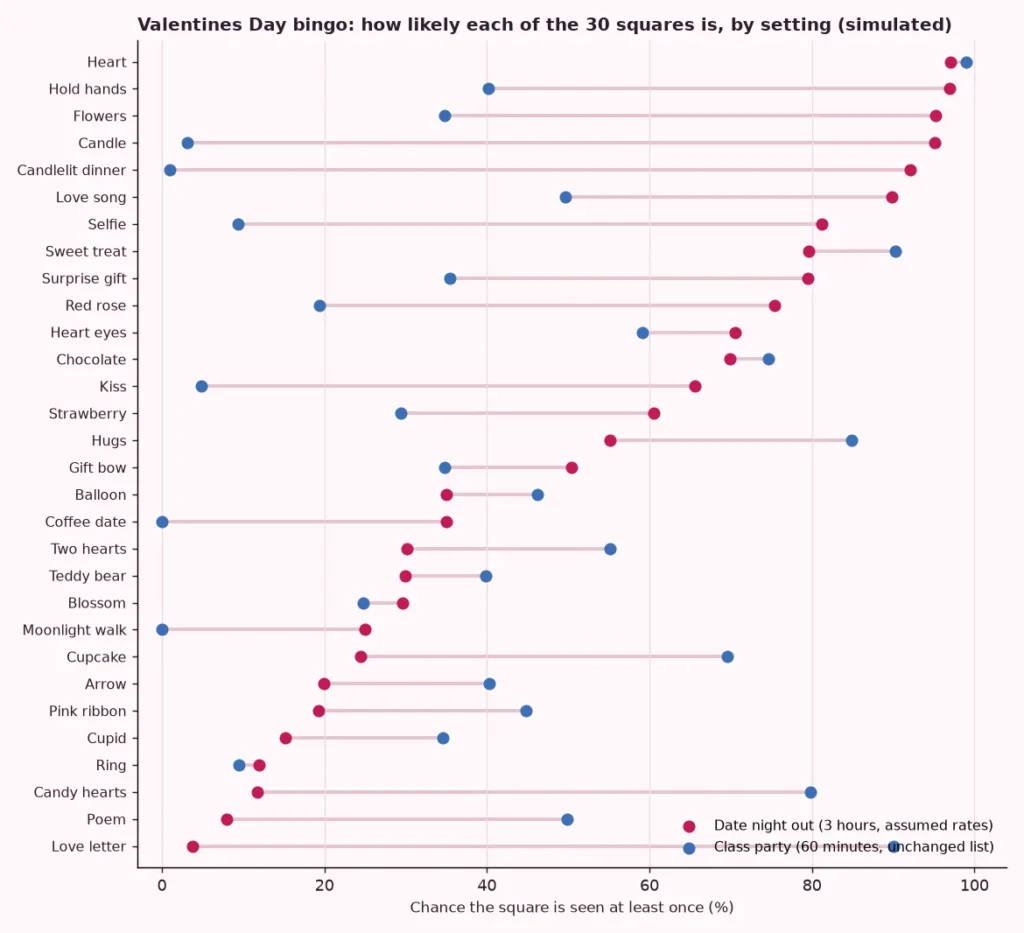
Where the dots are far apart, the setting decides the square. A candlelit dinner is nearly certain on a date night and almost impossible in a classroom, and a love letter is the other way around. On a date night an average player sees about 16 of the 30 squares in three hours. At a class party with the unchanged list an average child sees only about 13 of them in an hour, and 7 squares are seen in fewer than one party in ten.
Date night: a 5×5 card is a long evening
| Cards at the table | 5×5: line by 7 p.m. | 5×5: line by 8 p.m. | 5×5: line by 9 p.m. | 3×3: line by 7 p.m. | 3×3: line by 8 p.m. | 3×3: line by 9 p.m. |
|---|---|---|---|---|---|---|
| 1 card (a solo player) | 0% | 3% | 17% | 10% | 29% | 57% |
| 2 cards (a couple) | 1% | 6% | 30% | 20% | 50% | 81% |
| 4 cards | 1% | 11% | 48% | 35% | 73% | 95% |
| 8 cards | 2% | 20% | 70% | 54% | 91% | 100% |
For a couple on 5×5 cards, the chance that anyone has a line by 9 p.m. is only 30%, and 48% for a double date with four cards. A table of eight friends reaches 70%. A first line on a 5×5 card is a slow burn, so Valentines Day bingo with 5×5 cards suits a long party with many guests and not a table for two.
On 3×3 cards, a couple has a line by 9 p.m. in 81% of the games, and the median first line arrives around 7:59 p.m., and four cards make it 95% and about 7:25 p.m.
Class party: swap seven squares, finish sooner
| Class party (60 minutes) | Chance of a line by 30 min | Chance of a line by 45 min | Chance of a line by 60 min | Median first line |
|---|---|---|---|---|
| 5×5, 24 cards, unchanged list | 2% | 16% | 53% | 59 min |
| 5×5, 24 cards, 7 squares swapped | 7% | 48% | 89% | 46 min |
| 3×3, 12 cards, unchanged list | 43% | 82% | 97% | 32 min |
| 3×3, 12 cards, 7 squares swapped | 68% | 96% | 100% | 24 min |
The numbers explain the swap advice. With the list unchanged, a class of 24 children on 5×5 cards has a line by the end of the hour in only 53% of the parties. After the seven swaps, that rises to 89%, and the median first line arrives after about 46 min. On 3×3 cards for 12 younger children, the swap moves the median from 32 min to 24 min. Swapping squares has a bigger effect than adding more cards, because a square that never happens can never be marked.
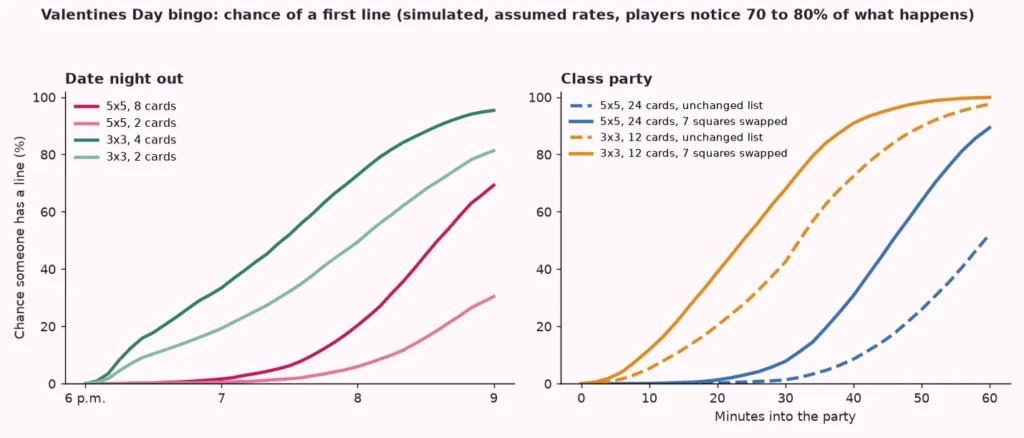
The Valentines Day bingo model assumes each player notices a square with a probability of 80 percent on the date night and 70 percent at the class party, independently of the others. A careful player, or a teacher who points squares out aloud, does better, and a child who forgets to mark does worse. Read the numbers as a floor for an attentive group and a rough guide for the rest.
The drawn-card game: how many calls?
The calling-card version of the Valentines Day bingo game is much more predictable than the spotting games, because all 30 squares are called exactly once in random order. We simulated 8,000 games to see how many calls it takes before somebody has a line on a 5×5 card with a free center.
| Cards in play (5×5) | Calls to a first line (median) | Middle half of games | Calls to a full card (median) |
|---|---|---|---|
| 1 card | 17 | 15 to 19 | 30 |
| 4 cards | 13 | 11 to 15 | 29 |
| 8 cards | 12 | 10 to 13 | 29 |
| 15 cards | 11 | 9 to 12 | 29 |
| 25 cards | 10 | 8 to 11 | 28 |
| 30 cards | 9 | 8 to 11 | 28 |
With 15 players, a first line usually arrives after 11 calls, about a third of the way through the list. A full card needs almost all of them: 29 calls with 15 players. For a faster party, 4×4 cards with 8 players give a first line after 11 calls, and 3×3 cards with 8 players after 5. These assume every call is equally likely at each step, cards are independent random draws, and nobody misses a call.
Other patterns take longer, as the next table shows for 10 players on 5×5 cards. The same patterns are pictured in the bingo patterns guide, and the bingo caller has a pattern picker for number games.
| Pattern | Calls needed (median, 10 players) | Middle half of games |
|---|---|---|
| Any line | 11 | 10 to 13 |
| Four corners | 16 | 14 to 19 |
| X | 23 | 21 to 25 |
| Full card (blackout) | 29 | 28 to 29 |
In Valentines Day bingo the free center makes a difference of only about one call. A single 5×5 card with a free center gets a line after a median of 17 calls, and one with all 25 squares to fill after 18.
Printable Valentines Day bingo: print, cut and hand out
For printable Valentines Day bingo, the Print tab gives you exactly the controls you need. For Valentines Day bingo you choose how many different cards to print, from 1 to 100, how many go on a page (1, 2, 4 or 6), Letter or A4 paper, and portrait or landscape. Cut guides are available for sheets that need trimming. For a class of 26, print 28 cards, two per page, and keep two spares for the child who spills the juice.
- Use pink or red paper for the party, white for the date. Light cardstock holds up to marking and a little frosting. Laminated cards can be wiped and reused next year.
- Put names on the cards. The Design tab can print a name on each card, which saves tears when two similar cards get swapped.
- Use big squares for little hands. One card per page in portrait gives the largest squares, perfect for ages 3 to 6.
- Print the caller sheet and calling cards if you plan the drawn-card game. They come out of the same Print tab.
- Print a spare set. A card for a visiting relative or a teacher costs one sheet of paper.
If you have no printer at hand, save the Valentines Day bingo PDF to a phone or a USB stick and print it anywhere. The shareable link in the card maker keeps only your word list, with no names or pictures, so you can send the list to the other parents or the rest of the class and let everyone print their own.
Valentines Day bingo free printable: what you get
Free, private and nothing to install
This Valentines Day bingo free printable does not ask for an email address or an account, and nothing is added to the PDF except the cards and a small footer. The editor runs in your browser, so the words you type never go to a server. You need only a printer or a PDF viewer.
What you can change
The card maker has five tabs: Setup, Items, Design, Templates and Print. On the Items tab you can rewrite any square, add an emoji or upload your own picture, and decide what the free space shows.
The Design tab holds color themes, fonts, text size, ALL CAPS, borders, rounded corners, tiles or plain grids, and a card background that can be a color, a pattern or your own picture. You can also add a title, a logo and a footer line. The Templates tab holds the other ready-made lists, so you can switch from Valentines Day bingo to another occasion.
You do not have to start here. The bingo card generator offers every card type in one place, and the blank bingo cards page gives you an empty grid to fill by hand.
Customize the cards in the card maker
The best Valentines Day bingo card names your own people and places. Open the Items tab and every square becomes a text box. Here is how some common situations change the list.
- A school or library party. Use the seven swaps above for Valentines Day bingo, and add “Teacher in a red shirt” and “A valentine with a pun.”
- A couple. Put your own history on the card: “Where we met,” “Someone orders our first-date dish,” “Our song.”
- A family. Add squares for the grandparents, the pet and the baking mess: “Burnt cookie,” “Dog wearing a bow.”
- A friends’ night in. Use the free space for “Share a compliment” and add a few jokes about the evening.
- A very young group. Keep only the picture-friendly squares such as heart, rose, teddy bear, balloon and cupcake.
When your list has more than 24 words, the card maker gives each card a different mix. With exactly 24, every card has the same words in a different order. The free space can say “Free” or show its own emoji, text or picture, and the Design tab can print a title such as “Room 12 Valentine Party” and a footer with the date. Shuffle re-deals the squares across all cards, Undo takes back your last change, and the preview lets you zoom in before you download.
Valentines Day bingo for singles and friends: keeping it kind
For some people February 14 is a happy day, and for others it is a hard one. A Valentines Day bingo game should invite everyone in. A few habits make Valentines Day bingo welcoming whoever is at the table.
- Make the card about love in every form. Friends, family, pets and neighbors all belong on a Valentine’s Day card. “A hug from a friend” counts as much as a kiss.
- Never make a square about being single or coupled. Children notice who got fewer valentines, so keep any count of cards out of the game.
- Offer a no-sweets path. Children with allergies or families who avoid sugar can use a sticker or a pencil in place of candy squares.
- Let anyone skip a square. A child who does not want a hug can mark “Wave” instead, and the card maker lets you rewrite it.
- Celebrate the effort. Give a small prize for the most observant card, not just the fastest line.
These are small things, and they make Valentines Day bingo easier for the grown-ups too. A class where nobody feels left out is also a class where the game ends with laughter instead of a dispute.
More bingo cards for the season
Valentines Day bingo is one of a set of occasion lists in the card maker. Valentines Day bingo has plenty of seasonal relatives. Looking ahead, the Easter bingo list has a spring version of the same idea, and the baby shower bingo template suits a gathering that often falls in the same weeks. For a day indoors with children, the classroom bingo list and the getting to know you bingo list both work well at a party table. Every template is gathered on the printable bingo cards hub.
If you want to play with numbers and not pictures, the New Year tambola page shows how a numbers-based game differs: in bingo you mark squares for things you see or find, and in tambola numbers are called and marked on a 3×9 ticket. The how to play bingo guide covers the full rules.
Frequently asked questions
10 quick answers
What is Valentines Day bingo?
Valentines Day bingo is a bingo game in which every square names something from February 14, such as a heart, a rose, a love letter or a box of chocolates. Players mark squares as they see them or as a host calls them, and the first to complete a line wins.
Are these Valentines Day bingo cards really free?
Yes. You can make, edit and print Valentines Day bingo cards without an account or a payment. The editor runs in your browser, so the words and pictures you add never leave your device.
How many squares does the template have?
It has 30 squares. A 5×5 card with a free center uses 24 of them, a 4×4 card uses 16 and a 3×3 card with a free center uses 8. Because the list holds more words than a card has squares, the cards differ from one another.
How many different cards can I print?
Up to 100 different cards in one PDF. There are 593,775 different sets of 24 squares to choose from, so even a large class can have a card each without repeats.
Is there a version for kids at school?
Yes. Use the seven swaps in this page for a classroom, or the 3×3 card for young children. In our simulation, swapping seven squares moved the chance of a line within an hour for 24 children on 5×5 cards from 53% to 89%.
Can couples play Valentines Day bingo on a date?
Yes. Each person takes a card and marks squares as they notice them at the restaurant, on a walk or at the movies. A 3×3 card suits a dinner best: in the simulation, two 3×3 cards produce a line by 9 p.m. in 81% of evenings.
How do I run the drawn-card version?
In the Print tab, add the calling cards and the caller sheet. Cut the cards out, shuffle them and draw one at a time. Players mark the matching square, and the first complete line wins. With 15 players a first line usually comes after about 11 calls.
What prizes work best?
Small, silly prizes work best in Valentines Day bingo. Children like a sticker sheet, the first cupcake or a pick from the playlist. Couples like choosing the dessert or the movie, and friends like a chocolate bar for the winner and a smaller one for everybody else.
Can I change the squares?
Yes. On the Items tab every square can be rewritten, given an emoji or a picture. Swap candy for stickers at school, add your own song for a date, and use the free space for something personal.
What size should I print for young children?
For Valentines Day bingo, print a 3×3 card, one per page, with large pictures for ages 3 to 6. It has only eight squares plus a free center, so a first line comes quickly and the child stays interested.