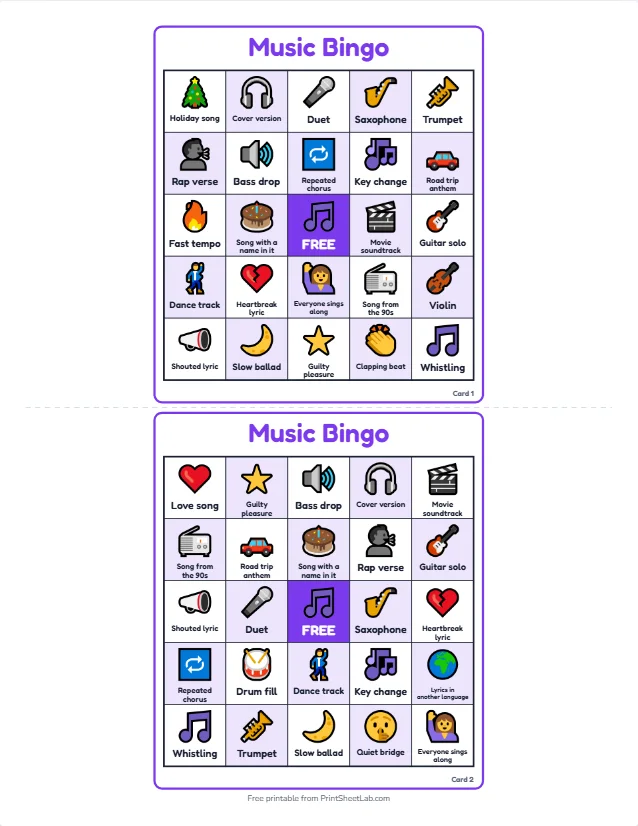
Music bingo is bingo for the ears. Instead of numbers drawn from a drum, the squares are things you can hear in a song, or song titles you tick off as the host plays them. The template on this page has 30 listen-for-it squares, from a guitar solo and a drum fill to a key change and a lyric everybody shouts, plus a free music note in the middle. Pick a card size, press print, and every music bingo player gets a different card to hold while the playlist runs.
In short: open the card maker above and press Edit and print this card. Print as many different cards as you have guests, play any playlist you like from your own phone or speaker, and let people mark what they hear. Prefer the classic music bingo where players mark song titles? Paste your titles into the Items tab and print those instead. It is free, there is no account, and nothing you type leaves your browser. The page does not play music; your speaker does.
How to play music bingo
There are two well-known ways to play music bingo, and the same printed card supports both. In the first, players listen for a feature: a saxophone, a key change, a song with a name in the lyrics. In the second, the card carries song titles and players mark a title when they recognize the song the host plays. The rules of music bingo are plain bingo rules: mark squares, make a line, shout. The table puts the two side by side.
| Listen-for-it | Song-title | |
|---|---|---|
| What is on the card | Sounds and moments such as a guitar solo, a duet or a bass drop | Titles of the songs on your playlist |
| Who needs to know the songs | Nobody. Any playlist works. | Players need to recognize the songs, so the playlist must suit the crowd |
| Who calls | The music does. The host only presses play. | The host plays a short clip of one song at a time |
| Playlist needed | Any playlist of 15 to 25 songs | A list of 30 to 60 songs that match the card exactly |
| Typical length | 20 to 60 minutes | 15 to 45 minutes |
| Best for | Mixed ages, dinners, car rides, classrooms and teams | Decade nights, fan nights, pub-style rounds and families that love one genre |
- Print one card per player and give everyone a pen, a pencil or a few small counters. The free music note in the center is already marked in every music bingo card.
- Agree on the rules before the first song. In listen-for-it, a square counts when you hear it with your own ears. In the song-title version it counts when the host plays that title.
- Start the playlist. Players mark squares as they hear them. Five in a row, across, down or diagonally, wins the first prize.
- The winner reads the line aloud and a neighbor or the host checks it. In the title version the host checks each title against the list of songs already played.
- Play on. Switch to four corners, an X or a full card for later rounds. The bingo patterns guide shows each one.
The first way costs nothing to prepare and the second takes about twenty minutes of playlist building, but both reward the same thing: paying attention to the music instead of the phone. Music bingo is a good reason to put a song on and keep everybody in the room. Because no card says which song is next, even the person who built the playlist can be surprised by a square.
Music bingo cards: all 30 listen-for-it squares
These music bingo cards are made from a list of 30 squares. A standard 5×5 card with a free center needs 24, so each card leaves out six and no two cards are the same. The families below show how the list is built. Instruments and sounds are things you hear in the arrangement, song types describe the feel, and lyrics squares ask you to listen to the words.
| Family | Squares on the list | What you are listening for |
|---|---|---|
| Instruments | 🎸 Guitar solo, 🥁 Drum fill, 🎹 Piano intro, 🎻 Violin, 🎺 Trumpet, 🎷 Saxophone, 🎵 Whistling | A named instrument stepping forward in the mix, or a sound made with the mouth |
| Voices | 🎤 Duet, 🗣️ Rap verse, 🙋 Everyone sings along, 📣 Shouted lyric | Who is singing and how: two voices, spoken rhythm, or the whole room |
| Structure | 🎶 Key change, 🔁 Repeated chorus, 🤫 Quiet bridge, 🔊 Bass drop, 👏 Clapping beat | Moments where the song turns: a lift, a drop, a hush or a repeat |
| Feel and tempo | 🕺 Dance track, 🌙 Slow ballad, 🔥 Fast tempo, 🎼 Instrumental | The overall mood of the track |
| Lyrics and themes | ❤️ Love song, 💔 Heartbreak lyric, 🌍 Lyrics in another language, 🎂 Song with a name in it, 🎄 Holiday song, 🚗 Road trip anthem | What the words are about |
| Context | 📻 Song from the 90s, 🎧 Cover version, 🎬 Movie soundtrack, ⭐ Guilty pleasure | Facts about the song that someone in the room has to know or admit |
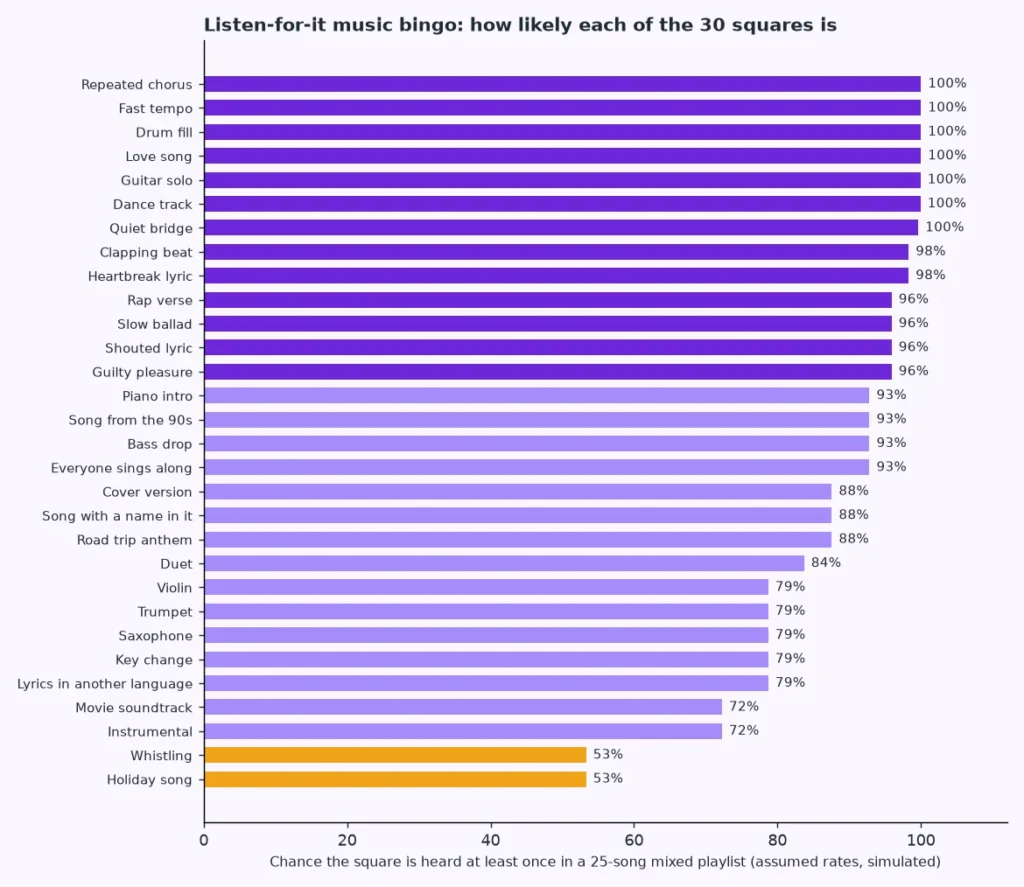
Not every square is equally easy to mark. A repeated chorus appears in nearly every pop song, while a whistle or a holiday song takes real luck. That mix is deliberate in this music bingo list: a handful of near-certain squares gets players going, and a few rare ones keep a full card out of reach until late in the night. The simulation below puts numbers on music bingo.
How many different music bingo cards can you print?
With 30 squares and 24 places on a 5×5 card, there are 30 choose 24 different sets of squares, which is 593,775. Each set can be arranged in an enormous number of orders, so a party of 40 gets 40 cards that are all different, and a school of 400 could too. Smaller grids need fewer squares: a 4×4 card uses 16 and a 3×3 card with a free center uses 8, which gives even more combinations from the same list.
| Card size | Squares used | Different sets from the 30 | Best for |
|---|---|---|---|
| 3×3 with free center | 8 | 5,852,925 | Younger children and very short rounds |
| 4×4 | 16 | 145,422,675 | A quick round in a classroom or at lunch |
| 5×5 with free center | 24 | 593,775 | The classic party card |
The music bingo game: how a listen-for-it round really plays out
The most common question from a music bingo host is how long a round will take, and the honest answer depends on the playlist. To replace a guess with numbers, we simulated 25-song playlists in which every song has its own chance of containing each square.
The chances are our assumptions for a mixed party playlist, not survey data: a repeated chorus appears in 85 of every 100 songs, a fast tempo in 35, a love song in 30, a drum fill in 30, a guitar solo in 25, a violin in 6 and a whistle in 3. On those numbers an average song triggers about 4.4 of the 30 squares. We ran 3,000 playlists for each setup.
Over a 25-song playlist, which at three and a half minutes a song is a long evening of roughly an hour and a half, a listener hears about 26 of the 30 squares. Thirteen squares are all but guaranteed at 95 percent or better, and only four fall below 75 percent: the whistle, the holiday song, the movie soundtrack and the instrumental. The chart shows the full ranking.
Mark everything you hear: the first line arrives in a handful of songs
If players may mark every square they hear in a song, the game is quick. A single player has a line after a median of 7 songs. With 10 cards in the room the first line arrives after 4 songs, and with 20 cards after just 3. That pace suits a short playlist at a dinner, but it means a long evening needs more than one round, or a rule that slows the marking.
One square per song: a game that lasts the playlist
The fix is the rule that makes the game last. Each player may mark only one square per song. Hearing a guitar solo and a key change in the same track means choosing one. Under that rule the median first line takes 16 songs for one card, 10 for ten cards and 9 for twenty, which is a much better fit for a 25-song playlist. Hosts of music bingo also see a better atmosphere: players lean in and ask each other which square to take.
| Cards in the room | First line, mark everything (median songs) | First line, one square per song (median songs) | Full card by song 25, mark everything |
|---|---|---|---|
| 1 card | 7 | 16 | 4% |
| 10 cards | 4 | 10 | 15% |
| 20 cards | 3 | 9 | 21% |
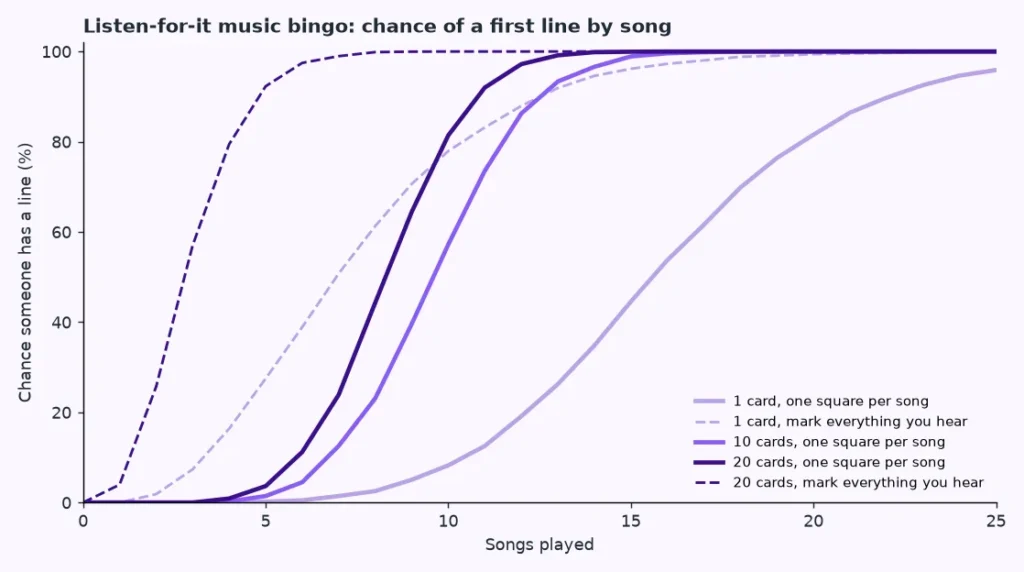
The last column is the useful surprise. Even when players mark everything, a full card on a 25-song playlist happens in only 4% of games for a single card and in 21% of games with 20 cards, because the rare squares (the whistle and the holiday song) simply may not appear.
Under the one-square-per-song rule a full card never happened in the simulation, because 24 squares need a fresh match in at least 24 of the 25 songs. In the simulation each player picks at random among the heard squares still open on the card. A careful player who picks the square that finishes a row does a little better, so treat these numbers as a floor for music bingo.
Song-title music bingo: the classic game
The other style of music bingo is the one many pub nights and family gatherings know. The card holds song titles, and the host plays a short snippet of one song at a time. Players who recognize the song mark that title. It is bingo with a playlist as the drum. The Card Studio does not play music and does not know your songs, but it is built for exactly this job: on the Items tab you paste your own titles, one per line, and the Print tab makes different cards from them.
Build your music bingo playlist
A good music bingo playlist starts with the card list, and the list should be longer than a card holds. A 5×5 card with a free square shows 24 titles, so a playlist of 40 gives every player a different 24 of the 40. Here is a simple build, which takes 20 to 30 minutes.
- Choose a theme. A decade, a genre, a movie soundtrack, an artist, a country, or “songs this family sings in the car.”
- Pick the songs. Choose well-known tracks that most of the room can name from ten to thirty seconds. Skip obscure album cuts for a general crowd.
- Keep titles short. A square is small, so write the title only, such as the first four or five words. Put the artist on your own host sheet if you need it.
- Paste the titles into the Items tab and add an emoji to any square if you like. If you have more titles than squares, the maker uses different titles on different cards.
- Set the order. Put the songs in your music app in the order you want to play them, or print the calling cards from the Print tab, shuffle them and draw one at a time. Keep a list of what has been played so you can check a winner.
Calling cards are the easiest way to keep a fair random order: every title is on its own small card, so the next song is whatever you draw. Players cannot guess the order, and the music app only has to find the song. Some hosts play the first thirty seconds of the chorus, others the first verse, and a hard round plays only the intro.
How long does a song-title game last?
With a title list, song-title music bingo is the standard bingo draw, so the length depends on the number of titles and the number of players. We simulated 3,000 games for each playlist size, with every song played exactly once in random order. A first line is five marked titles in a row, with the free square counting. The table gives the median number of songs played before the first line, and a time estimate that assumes a 45-second clip plus 15 seconds to mark and talk, which is one minute per song.
| Titles on the playlist | Different 5×5 cards | 1 player | 10 players | 20 players | 40 players | Time to a first line, 20 players |
|---|---|---|---|---|---|---|
| 25 | 25 | 14 | 10 | 9 | 8 | 9 min |
| 30 | 593,775 | 17 | 11 | 10 | 9 | 10 min |
| 40 | 62,852,101,650 | 23 | 14 | 13 | 11 | 13 min |
| 50 | 121,548,660,036,300 | 28 | 18 | 15 | 13 | 15 min |
| 60 | 36,052,387,482,172,425 | 34 | 21 | 18 | 16 | 18 min |
| 75 | 25,778,699,578,994,555,700 | 42 | 26 | 22 | 19 | 22 min |
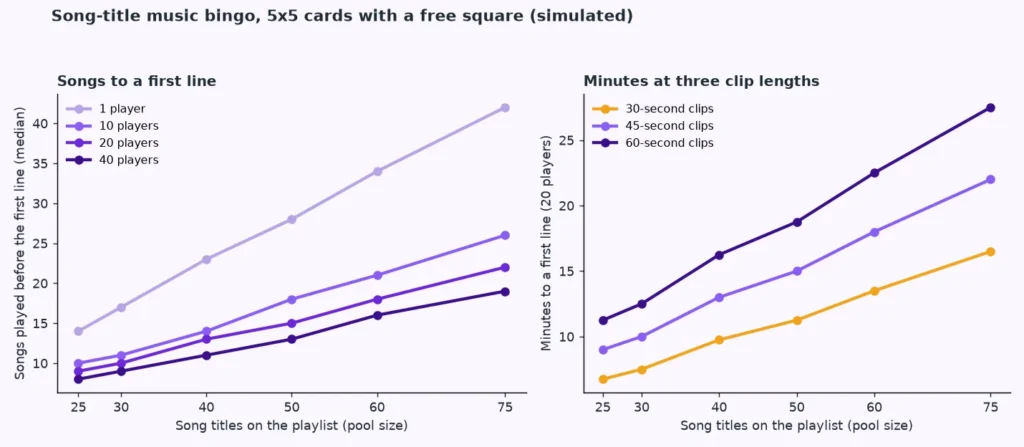
With 40 titles and 20 players, a first line arrives after about 13 songs, which is 13 minutes at one minute a song. A full card is a long haul: 40 songs for a single player, and still 37 for twenty. For a 30-minute round, 40 titles is a good size. For a full evening, go to 60 or more, or play several rounds with different patterns.
The numbers assume everybody recognizes every song in this style of music bingo. In a real room somebody will miss a title, so the real game runs a few songs longer. A playlist with 25 titles is the extreme: a card has 24 of them, so every card is almost identical, and prize ties become common.
Checking a win
When someone calls bingo, ask them to read the titles in the line. The host looks for each title on the played list. If every title was played, the win stands. If one was not, the player keeps going, and music bingo carries on without embarrassment. In music bingo, agree in advance what happens on a tie: split the prize, or play a tiebreaker round with a single clip.
Music bingo template: change the squares
Treat this music bingo template as a starting list for your own music bingo night. Open the Items tab and every square becomes a text box. You can rewrite any square, add an emoji or a picture, and set what the free space says. Here are a few common changes.
- A decade night. Replace the song-type squares with titles, or keep the sounds and add “Song from the 70s,” “Song from the 80s” and “Song from the 2000s.”
- A genre night. Rock, country, hip hop, jazz or musicals all have their own sounds. A jazz list might hold “Muted trumpet,” “Scat singing” and “Walking bass.”
- A family list. Squares such as “Dad’s favorite” or “The song from the wedding” make the card personal.
- A school lesson. Use instrument families (strings, brass, woodwind, percussion) and let students listen for them in a piece of classical music.
- A team event. Add squares that mention the workplace, such as “A song someone has played in the office kitchen.”
When your list has more than 24 squares, each card gets a different mix. With exactly 24, every card has the same squares in a different order. The Design tab holds color themes, fonts, text size, borders, rounded corners, tiles or plain grids and a card background, and you can add a title such as “Friday Night Music Bingo” plus a footer line. The Templates tab holds the other ready-made lists, and Undo and Shuffle are in the Print tab. A preview with zoom shows exactly what will print.
Printable music bingo: print, cut and hand out
For printable music bingo, the Print tab holds the controls. Choose how many different cards to print, from 1 to 100, how many go on a page (1, 2, 4 or 6), Letter or A4 paper, and portrait or landscape. Cut guides help with sheets that need trimming. In the preview above, two cards share a page, which gives each square about 0.8 inches of room, enough for a short phrase and an emoji. One card per page gives bigger squares for longer titles.
- Print the caller sheet and calling cards if you play the song-title version. Both come out of the same Print tab.
- Put names on the cards. The Design tab can print a name on each one, which avoids mix-ups when two guests swap seats.
- Print a few spares. A card with a wine ring on it never wins.
- Use light cardstock or laminate if you will reuse the cards, and mark with dry-erase pens or small counters.
- Save the PDF. A saved file prints from a USB stick or a phone at a copy shop if you are away from home. The shareable link keeps only your words, so you can send the list to a co-host.
Hosting music bingo remotely? Players can keep a printed card at home, and you run the playlist over a video call. The play custom bingo online page explains how to run your own list on screen, and the Zoom bingo page has a template for calls. Be aware that sound quality over a call varies, so the sound-based music bingo squares work better on a call when everyone plays the same track from their own device.
Music bingo for adults
Music bingo for adults is a game that works at a dinner party, a team event or a pub-style night, and it needs surprisingly little. Grown-ups already have drinks to hold and conversation to make, so the card should ask for very little attention and give plenty of talk. The best rule for music bingo is that a square counts when somebody else at the table points it out. That turns the game into a reason to say “Did you hear that key change?” across the table.
A few things make an adult music bingo night run well. Give out the cards before the first song and keep the first round short. Use three prizes of different sizes: one for the first line, one for four corners, and one for a full card. Let a player nominate a song for the next round, which gives shy guests a way into the game. Offer a non-alcoholic choice for every guest, and keep the volume low enough for conversation between songs.
| Round | Pattern | Playlist | Prize idea |
|---|---|---|---|
| 1 | Any line | 10 songs, any genre | First choice from the snack table |
| 2 | Four corners | 10 songs from one decade | Choose the next song |
| 3 | X | 10 songs, shuffled across decades | A small trophy that travels to the next host |
| 4 | Full card | 15 songs, guilty pleasures only | Bragging rights and the last slice of cake |
For rooms that love one style, the sibling pages help. A Hindi film crowd will enjoy Bollywood music bingo, a wedding dance floor suits sangeet dance floor bingo, and an afternoon with friends has its own template in kitty party bingo. A birthday with a big number can use the birthday bingo list alongside a playlist from the guest of honor’s teenage years.
If you run music bingo in a public place or at a business event, check whether the venue already holds the music licenses it needs. At home with friends it is a private party, which is a very different situation, and for a school or care setting the staff usually know what is covered.
Music bingo for kids
Music bingo for kids needs a small rewrite of the list, because several squares are made for grown-up playlists. Keep the sound squares (a drum, a whistle, clapping, a trumpet), drop the heartbreak lyric and the guilty pleasure, and add squares that children can find with their own ears: an animal sound, a song with numbers in it, a song you can dance to, a song you know from school. The Items tab makes the swap in a minute.
| Age | Card | How to play |
|---|---|---|
| 3 to 5 | 3×3, one per page | A grown-up reads each square. Use sticker dots and hand-held instruments. Everyone wins at the first line. |
| 6 to 8 | 3×3 or 4×4 | Mark sounds and instruments. Play for a line, then for four corners. Three or four songs per round. |
| 9 to 12 | 5×5 | One square per song. Add “Name the instrument” as a bonus point. |
| Teens | 5×5 | Song-title version with songs from their own playlists. Let them build it. |
In a classroom, the music teacher can use music bingo to teach instrument families, rhythm and structure: students listen for the chorus, the bridge and the instruments, and name them. Pair it with the classroom bingo list for a different day, and see the bingo activities for the classroom guide for more routines. Pre-readers can use picture-only squares with an emoji and no text.
Theme rounds and variations
The same music bingo card supports many nights. Rotate the ideas below for a monthly music bingo club, or use two in one evening.
- Name the decade. Squares hold decades, and players mark a decade when they think a song comes from it. The host announces the answer after each song.
- Intro bingo. Play only the first five seconds. It is the hardest round and the most fun.
- Cover versions. Mix originals and covers, with a “Cover version” square to mark when somebody spots one.
- Soundtrack night. Use the “Movie soundtrack” square, and add films as titles.
- Holiday playlist. The “Holiday song” square earns its place in December, and the Christmas bingo template adds the rest.
- Road trip. Play the car playlist and mark the “Road trip anthem” square. The road trip bingo list covers what you see out of the window.
Why bingo and music fit together
Bingo itself is old. The Wikipedia article on bingo traces it to an Italian lottery game played by about 1530 and a home version, tombola, created in Naples in the eighteenth century. The modern game spread in 1929 when a toy salesman saw a carnival game called Beano.
For a game that old, the format has been remarkably easy to adapt. Music bingo works because anything that arrives one piece at a time, such as a number, a picture, a word or a song, can be called, and anything that fits on a grid can be marked.
Music suits the format for a practical reason. A song is a series of small events, so one three-minute track can supply several squares, and a playlist is a ready-made stream of calls. Compared with number bingo, music bingo needs no caller and no balls, and nobody needs to know how to read a number board. If you want the number version for the same crowd, the bingo caller draws and shows every number, and the play bingo online page hosts a live game with guests joining by link.
More bingo cards and music games
This is one of the occasion lists in the card maker, all gathered on the printable bingo cards hub. The bingo card generator handles every card type in one place, and the blank bingo cards page gives you an empty grid to fill by hand. Beginners can start with the how to play bingo guide, and for another icebreaker, try human bingo at the start of the evening.
Frequently asked questions
10 quick answers
What is music bingo?
Music bingo is a bingo variation in which the squares are either things you can hear in a song, such as a guitar solo or a key change, or the titles of songs a host plays. Players mark squares as they hear them, and the first to complete a line wins.
Are these music bingo cards really free?
Yes. You can edit and print the cards without an account or a payment. The editor runs in your browser, so the words and pictures you add never leave your device.
Does the page play the music?
No. The page makes the cards. You play the music from your own phone, speaker or music app, and you choose the playlist.
How many squares does the template have?
It has 30 squares. A 5×5 card with a free center uses 24 of them, a 4×4 card uses 16, and a 3×3 card with a free center uses 8. Because the list is longer than a card, cards differ from one another.
How many different cards can I print?
Up to 100 different cards in one PDF. There are 593,775 different sets of 24 squares to choose from, so even a big event can give everyone a unique card.
How long does a game last?
In the listen-for-it version with one square per song, the first line usually arrives after about 9 to 10 songs with 10 to 20 cards in play. With a song-title list of 40 and 20 players it takes about 13 songs.
Can I use my own songs?
Yes. Open the Items tab and paste your own titles, one per line. Use short titles so they fit a square, and put the artist on your host sheet. The Print tab can make calling cards and a caller sheet from your list.
Is there a version for kids?
Yes. Use a 3×3 or 4×4 card, keep sounds such as drums, clapping and whistles, and swap the grown-up squares for animal sounds, numbers and songs they know from school.
What prizes work best?
Small and silly prizes work best: first choice of the next song, the last slice of cake, a trophy that travels to the next host, or a free drink for a full card in adult groups.
Can I play music bingo online?
Yes. Print the cards or send the shareable link to friends so each player has a card at home, and play the same playlist over a video call. The play custom bingo online page explains how to run your own list on screen.