The 5 times table game on this page practices 5 × 1 to 5 × 12 with four free games: Balloon Pop, Memory Match, Answer Race and True or False. Questions come in random order, so children learn the 5 times tables as facts they can recall and not as a chant. This is the table with the friendliest pattern, because every answer ends in 5 or 0. The whole table is 5, 10, 15, 20, 25, 30, 35, 40, 45, 50, 55 and 60. There is no sign-up, scores stay on your device, and it works on phones, tablets and computers.
5 times table game: see how it plays
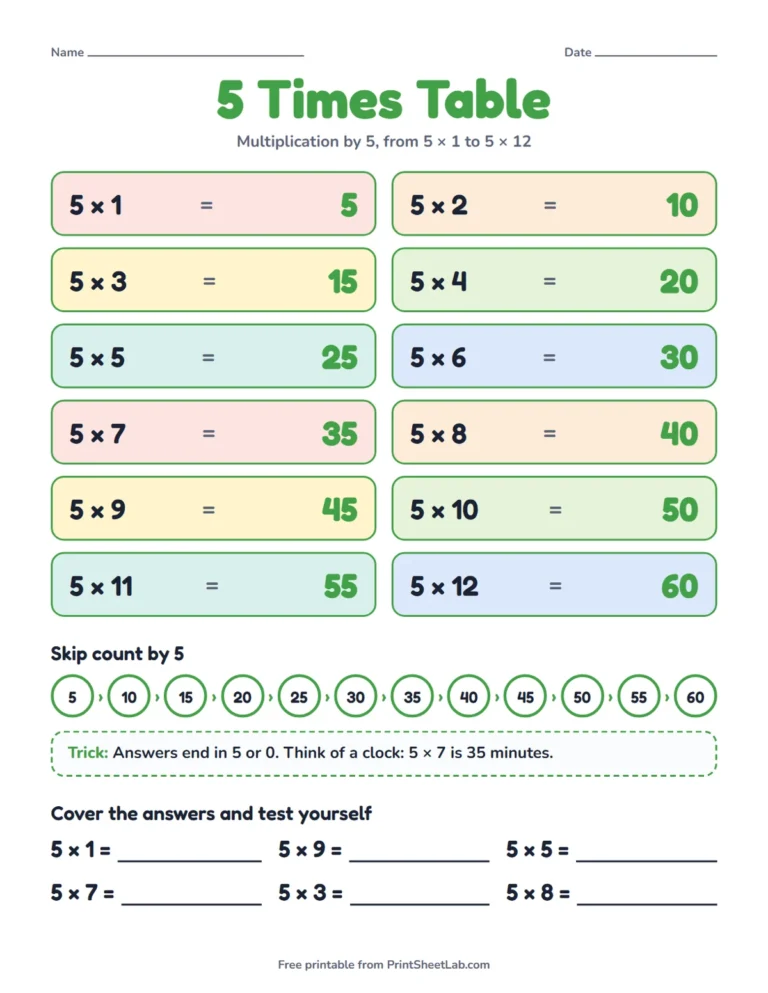
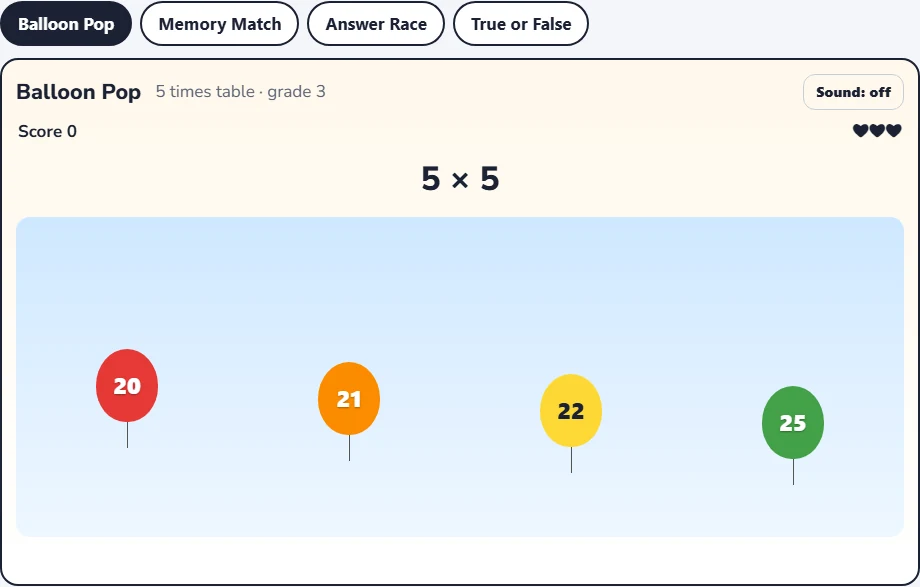
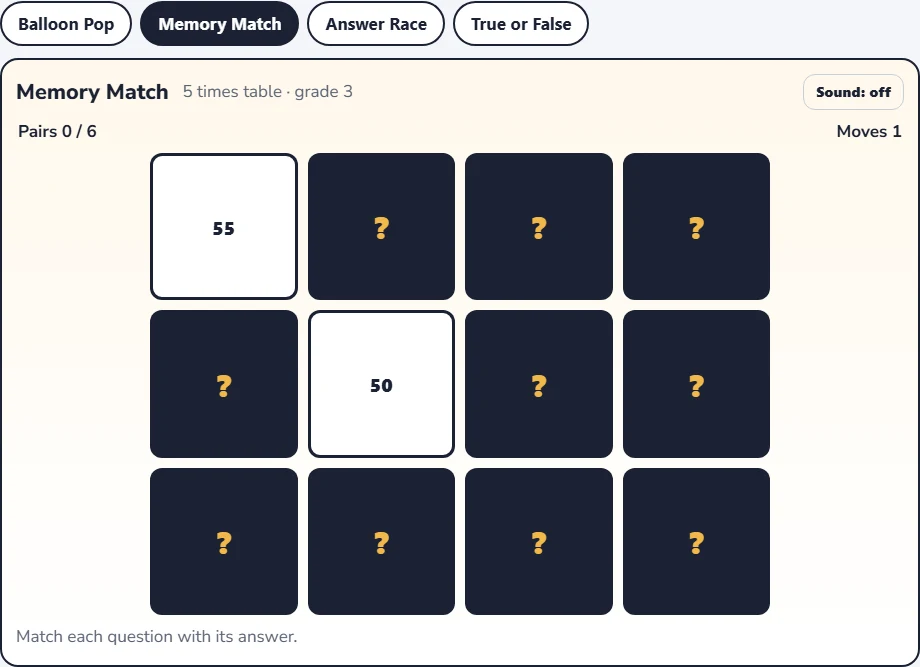
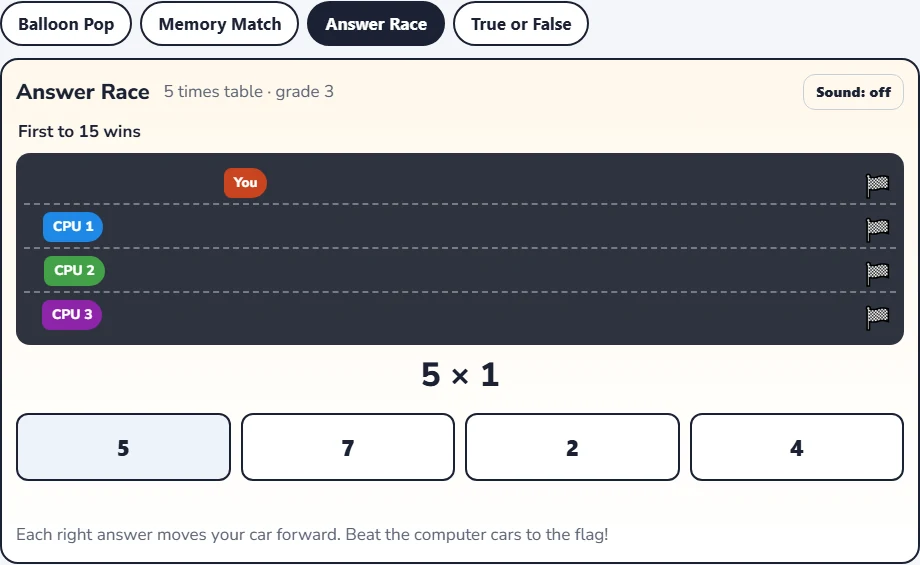
Each of the four modes asks only 5 times table questions, from 5 × 1 up to 5 × 12. The pictures show Balloon Pop, Memory Match and Answer Race on this page, and the printable chart puts all twelve facts, skip counting and a trick on one sheet.
How the 5 times table game works
- Balloon Pop: answers float up on balloons, and you pop the right one before it drifts off the top. The wrong balloons sit within 5 of the right answer, so you have to know the fact and not just spot the odd one out. The game speeds up as your score climbs, and three misses ends the round.
- Memory Match: twelve face-down cards hide six 5 times table questions and their six answers. Flip two at a time and match each question to its answer in as few moves as you can.
- Answer Race: every right answer moves your car forward, and you race three computer cars to the finish flag. The first to 15 wins, and wrong taps cost time, not places.
- True or False: sixty seconds on the clock. Decide whether each 5 times table sentence, such as 5 × 2 = 10, is right or wrong. A streak of five or more scores double.
The 5 times tables at a glance
Here is every fact in the 5 times tables with a quick way to build it from facts you already know:
| Fact | Answer | Build it from |
|---|---|---|
| 5 × 1 | 5 | half of 10 × 1 = half of 10 |
| 5 × 2 | 10 | half of 10 × 2 = half of 20 |
| 5 × 3 | 15 | half of 10 × 3 = half of 30 |
| 5 × 4 | 20 | half of 10 × 4 = half of 40 |
| 5 × 5 | 25 | half of 10 × 5 = half of 50 |
| 5 × 6 | 30 | half of 10 × 6 = half of 60 |
| 5 × 7 | 35 | half of 10 × 7 = half of 70 |
| 5 × 8 | 40 | half of 10 × 8 = half of 80 |
| 5 × 9 | 45 | half of 10 × 9 = half of 90 |
| 5 × 10 | 50 | half of 10 × 10 = half of 100 |
| 5 × 11 | 55 | half of 10 × 11 = half of 110 |
| 5 × 12 | 60 | half of 10 × 12 = half of 120 |
Skip counting by 5: 5, 10, 15, 20, 25, 30, 35, 40, 45, 50, 55, 60. Say the numbers aloud while you walk or jump, because rhythm helps memory. Our guide to skip counting for kids has more ideas.
Multiplication by 5: patterns and tricks
The answers in the 5 times table end in 5 or 0 in turn: 5, 10, 15, 20, 25, 30, 35, 40, 45, 50, 55, 60. Odd multipliers end in 5 and even multipliers end in 0. To check a 5s answer, ask whether it ends in 5 or 0.
Think of a clock face. Every number on the clock is five minutes later than the one before it, so 5 × 7 = 35 is the 7 on the clock, which is 35 minutes past. Another trick is to halve: 5 × 8 is half of 10 × 8, which is half of 80 = 40.
Wikipedia explains skip counting, which is how most children first meet the 5s and 10s.
Only 8 new facts to learn in the 5 times tables
Every fact where the other number is smaller than 5 is a fact you have already met, because 5 × 3 is the same as 3 × 5. If you know the 2 to 4 times tables, only 8 facts are new: 5 × 5 = 25, 5 × 6 = 30, 5 × 7 = 35, 5 × 8 = 40, 5 × 9 = 45, 5 × 10 = 50, 5 × 11 = 55, 5 × 12 = 60.
Five times table practice: the hardest facts
The facts that children most often miss in five times table practice are 5 × 7 = 35, 5 × 8 = 40 and 5 × 12 = 60. Most children find the 5s easy. The slow ones are the later facts, where it helps to think of the clock. The game keeps the questions random, so these facts come up again and again until they feel automatic.
The 5 times table in real life
- Nickels: each is 5 cents, so 9 nickels are 5 × 9 = 45 cents.
- Clocks: each number on the clock is 5 minutes, so the 7 means 5 × 7 = 35 minutes.
- Fingers: a hand has 5 fingers, so 6 hands have 5 × 6 = 30 fingers.
5 times table word problems
Try these on paper or say them aloud, then check the answers:
- A packet has 5 stickers. How many stickers are in 8 packets? Answer: 40.
- Each of 12 short video clips lasts 5 minutes. How many minutes of video is that? Answer: 60.
- Ana saves 5 dollars a week. How much has she saved after 9 weeks? Answer: 45.
Where the 5 times table fits at school
In the United States, the Common Core standards (3.OA.C.7) expect children to know all products of two one-digit numbers from memory by the end of grade 3, so the 5 times table is a grade 3 skill. In England, pupils are expected to know the tables up to 12 × 12 by the end of Year 4, and the national multiplication tables check is taken in June of that year. Short, frequent practice with a 5 times table game works better than one long session, because it spaces out the facts.
Tips for parents and teachers
- Start with the easy facts: 5 × 1 = 5, 5 × 2 = 10, 5 × 5 = 25 and 5 × 10 = 50. Then add 5 × 3 = 15, 5 × 4 = 20, 5 × 11 = 55 and 5 × 12 = 60.
- Play Memory Match first for accuracy, then move to Balloon Pop or Answer Race for speed.
- A few minutes a day beats one long session. Try to beat yesterday’s best score, and plan on two to three weeks for the new facts.
- Ask “how did you know?” after a round. Hearing “I doubled it” or “I used the 10s” tells you the strategy is there.
Prefer paper? Print the 5 times table worksheets with answer keys, or use the multiplication chart to see all the tables together. The guide to times tables tricks covers every table in one place.
5 times table game: frequently asked questions
What is 5 × 12?
5 × 12 = 60, the last fact in the table.
What are the multiples of 5?
The first twelve multiples of 5 are 5, 10, 15, 20, 25, 30, 35, 40, 45, 50, 55 and 60.
What is 5 × 5?
5 × 5 = 25.
What are the hardest facts in the 5 times tables?
Most children find 5 × 7 = 35, 5 × 8 = 40 and 5 × 12 = 60 the hardest.
How long does it take to learn the 5 times table?
It varies, but with five minutes of practice a day most children can learn the 8 new facts in two to three weeks.
What age is the 5 times table game for?
It suits children from about 7 to 10, in grade 2 to grade 4 or Year 3 to Year 5, and it is also a useful quick refresher for older learners.
Is the 5 times table game free, and do kids need an account?
Yes, it is free, and no account is needed. Best scores are saved only in the browser on this device.
Does the 5 times table game work on phones and tablets?
Yes. Every game is built for touch first and also works with a mouse on a computer.
More times tables games
- Previous table: 4 times table game
- Next table: 6 times table game
- Mixed times tables game to practice every table together
- Division facts game for the matching division facts
- All learning games