Christmas bingo is the holiday game that works almost anywhere: around the tree, in a classroom, at the office party or across a long dinner table. Each player holds a card of festive squares such as Santa, a snowman or a candy cane and marks the ones they spot, hear or are handed. The card maker above has the set loaded, with 30 holiday squares, a free space in the center and a different arrangement for every player.
In short: tap Edit and print this card, tweak the squares, choose red and green or your own colors, and print up to 100 cards as one PDF. It costs nothing, needs no account and runs completely in your browser.
Christmas bingo in one minute: the idea and the rules
The idea behind Christmas bingo fits on a napkin. Every player gets a card. Something happens that matches a square, either because a leader draws the matching calling card from a bowl or because the item appears in a movie or on a tree. The player marks it. A full row, column or diagonal wins, and the free space in the middle is already covered for everyone.
What sets Christmas bingo apart is the source of the calls. Instead of numbers called one by one, you can tie the game to something already happening at the party: a film, the tree trimming, a carol sing-along, the meal. That is why this set uses concrete things instead of numbers. Read the story of the festival itself on Wikipedia if you want facts to share between rounds, then get back to the cards.
Printable Christmas bingo: the 30 squares by tradition
The 30 squares are grouped below by the part of the holiday they belong to. The groups matter for planning: if you are running a tree-trimming round, lean on the second family, and for a dinner round the fourth. The spelling and emoji are exactly as they appear on the cards.
| Tradition | Squares | Best used for |
|---|---|---|
| North Pole | 🎅 Santa, 🤶 Mrs. Claus, 🧝 Elf, 🦌 Reindeer, 🛷 Sleigh, 📜 Wish list, ✉️ Letter to Santa | The story squares. Kids shout these first. |
| Tree and trimmings | 🎄 Christmas tree, ⭐ Star, 🔔 Jingle bell, 🎀 Ribbon, 🎇 Lights, 🌲 Wreath, 🌟 Angel | Things you can point to while decorating, the easiest squares for a tree-trimming round. |
| Snow and winter | ⛄ Snowman, ☃️ Frosty, ❄️ Snowflake, 🧣 Scarf, 🧤 Mittens | Cold-weather squares that suit a window, a cartoon or a walk outside. |
| Table and treats | 🍪 Cookies, 🥛 Milk, 🍫 Hot cocoa, 🍬 Candy cane, 🥧 Pie, 🏠 Gingerbread house, 🕯️ Candle | Food and drink. They give a dinner round plenty to listen for. |
| Hearth, gifts and song | 🔥 Fireplace, 🧦 Stocking, 🎁 Present, 🎶 Carol | The cozy corner of the holiday: stockings, presents and the songs in the background. |
Reading the sample Christmas bingo cards
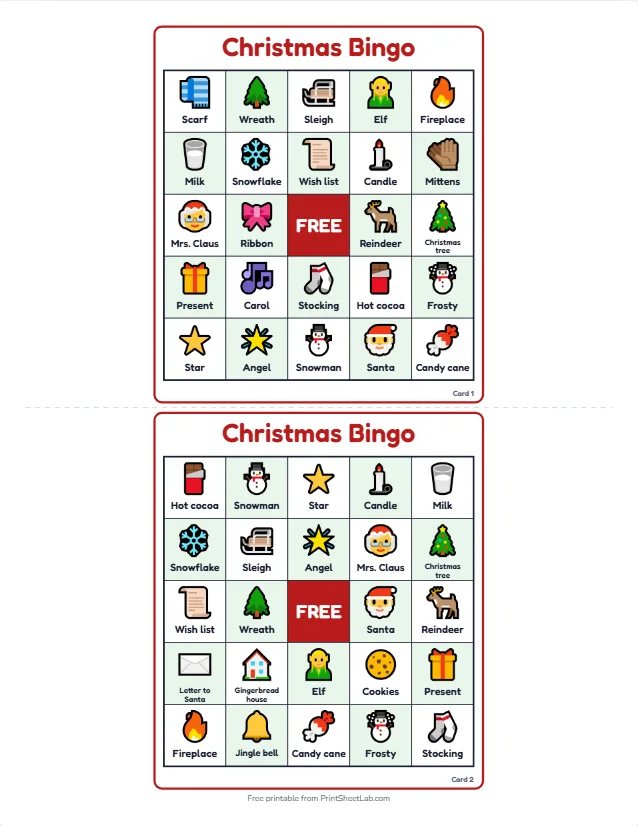
Take the first card in the picture. Its red FREE space sits in the center, and its middle row reads Mrs. Claus, Ribbon, FREE, Reindeer, Christmas tree. Only four of those squares need to be marked for that row to win. The diagonal from the top-left corner reads Scarf, Snowflake, FREE, Hot cocoa, Candy cane, so a cold-weather round with a hot drink at the end could finish that card too.
Card 1 does not carry Jingle bell, Cookies, Gingerbread house, Lights, Pie or Letter to Santa. Card 2 does carry all six, and it leaves out Scarf, Mittens, Ribbon, Lights, Pie and Carol instead. Every Christmas bingo card is built the same way: 24 of the 30 squares, shuffled, with the center free. That is why a player on one side of the sofa groans at “Cookies” while the player on the other side cheers.
Christmas bingo cards: sizes, squares and how many sets exist
The Christmas bingo set is built for a 5×5 card, but the card maker lets you shrink or grow the grid. A bigger grid means more squares to fill and a longer game, a smaller grid finishes faster. The table shows what each size needs from the 30 squares and how many different sets of squares are possible. The count of sets is a combination, written C(30, n): the number of ways to pick n squares out of 30 when order does not matter.
| Card size | Squares used from the 30 | Free space | Different sets of squares | Best for |
|---|---|---|---|---|
| 3×3 | 8 | Center | 5,852,925 | Ages 4 to 6 and quick rounds |
| 4×4 | 16 | None | 145,422,675 | Classrooms and mixed ages |
| 5×5 | 24 | Center | 593,775 | Adults and the classic game |
Notice that the 5×5 card has the fewest sets, only 593,775. A card that uses 24 of 30 squares has little choice about which squares it shows, so the difference between two cards comes mostly from how they are shuffled. Each set of 24 can be arranged in 24 factorial different orders, which is far more than anyone will ever print. For a party, that means all cards differ, even though they share most squares.
If you want every card to differ in content as well, add more squares than the grid needs. A 5×5 card built from 40 squares draws a different 24 each time, and you have far more ways to fill it. The Items tab lets you add as many as you want.
Christmas bingo game: five ways to play
The same Christmas bingo cards support very different parties. Choose the round that suits the room, or run two or three of them in an evening. Each option below says where the calls come from, because that is the part that differs.
Tree-trimming Christmas bingo
Hand out Christmas bingo cards before the box of ornaments is opened. As people hang a star, a bell or a ribbon, they shout the name and everybody marks the square. The tree itself supplies the calls, so you need nothing else. It is a lively round for families, because even the youngest guest can find the Star square and the oldest can find the Angel. The round ends when the tree is finished, whether or not someone has a bingo, so keep a tiny prize for the first complete row.
Movie-night Christmas bingo
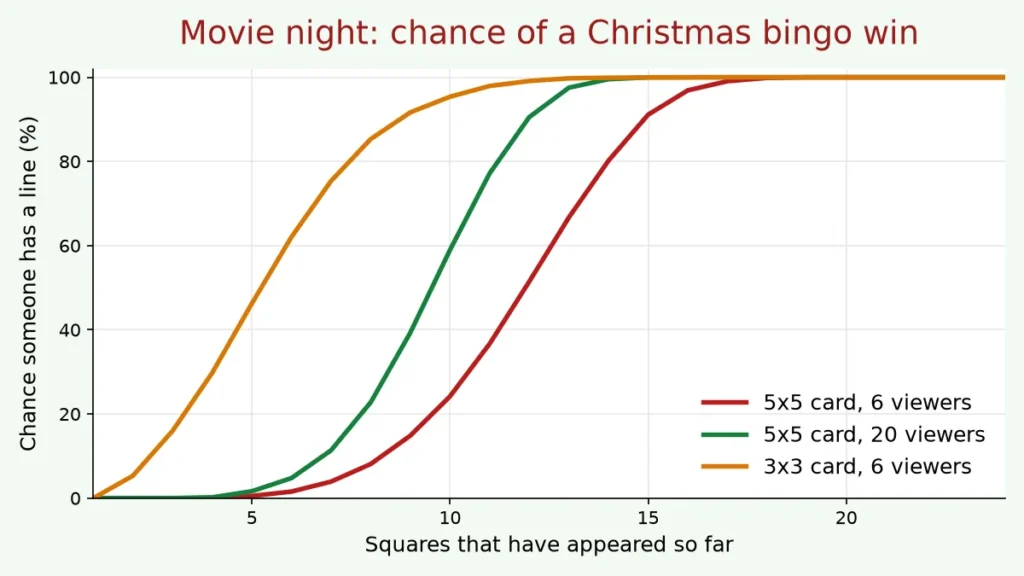
Start a holiday film and mark squares as items appear on screen. Because a film does not show everything, the game can end with no winner. The simulation below puts a number on that risk. If you play with 6 viewers and only 12 of the 30 items show up, there is about a coin-flip chance (51%) of anybody getting a line. Swap in squares from the film itself, such as “Sleigh bells jingle”, for a surer game.
Family dinner Christmas bingo
Place a card at every seat and use the table: marks for Cookies, Pie, Hot cocoa and Candy cane as they arrive, and for Carol when a song plays. For a spoken round, one person draws calling cards from a bowl between courses. The rule that makes dinner bingo work is that the cook decides, because only the cook knows when the pie will arrive.
Classroom or office party Christmas bingo
In a classroom, the teacher can read riddles (“I pull the sleigh through the snow”) and children mark the answer, here Reindeer. For an office party, a host draws calling cards from a bowl while the team eats, and the prize is a mug or a gift card. Keep the rule list short and put the prizes on a visible table. The classroom bingo page has a template made for a regular school day.
Kids versus adults
For Christmas bingo, give the children 3×3 cards and the adults 5×5 cards, then call the same squares for both teams. The smaller grid wins sooner, which makes the game a fair fight for little ones. See the simulation below for how lopsided it gets: with four players on each side, the children get their first line before the adults in 92% of simulated games.
Christmas bingo for kids: keep it short and sweet
Children enjoy Christmas bingo most when the grid is small, the squares have pictures and the game ends quickly. The cards in this set already carry emoji, which let non-readers match a picture to what they hear. Use the 3×3 size for ages four to six, and the 4×4 for seven and up. Print two cards per page so the pictures are big.
- Let the child be the caller for a round, with the calling cards cut from the PDF.
- Use stickers, mini marshmallows or cereal as markers. They are easier for small fingers than a pen.
- Add a square with the child’s own name or a drawing from them in the free space.
- Play for “any line”, then for “four corners”, so that more than one child wins.
- End on a prize everyone gets, such as a candy cane or a sticker.
For a school, tie the squares to a theme: winter animals, holiday words for spelling, or the countries of the world in December. Spelling and sight words work especially well when the squares are the words themselves. For more ready-made kids’ sets, see the printable bingo cards hub.
Christmas bingo for adults: a little more edge
Adults enjoy Christmas bingo most when the squares joke about the holiday. Keep the 5×5 size and replace a few squares with in-jokes: “Someone tangles the lights”, “A relative asks about your job”, “Cookies burn”. The card maker accepts any text, so mix real items with funny ones. A grid with 16 sincere squares and 8 jokes plays well.
For an office or friends’ party, give Christmas bingo an element of play: a bell that anyone can ring when they win, a “bingo bank” of small wrapped gifts and a steal rule, where the winner may swap their prize with someone else’s. The game takes ten minutes and the laughter lasts longer. If the party is in India, our Christmas tambola page uses the number-based version of the same idea.
Christmas bingo free printable: print, share, repeat
This is a Christmas bingo free printable in the full sense: free to open, free to edit, free to print, free to reprint next year. There is no account and no watermark, and nothing you type is uploaded. The steps are short.
- Press Edit and print this card above the article. The maker opens full screen with the set loaded.
- In Setup choose 3×3, 4×4 or 5×5.
- In Items rename squares, add your own in-jokes or pictures, or remove anything that does not fit.
- In Design pick red and green, gold or a quiet black-and-white theme, add a title such as “The Johnsons’ Christmas Bingo” and a footer with the year.
- In Print choose 1 to 100 cards, one to six per page, Letter or A4, then preview.
- Download the PDF, or print directly. Copy the share link to send the words to a family member.
The Templates tab switches to any of the other starter sets in one click. Your changes are saved in the browser, so reopening the page after a break is quick, and the same cards can be reprinted next December with a new title.
How many calls until the first win? A simulation
People often ask how long Christmas bingo takes. We simulated it. In each simulated game the 30 squares are called in random order, one per turn. Each player has a card made of random squares in random positions, with a free center on the 3×3 and 5×5 sizes. 8,000 games per row. It is a simulation, not a record of real parties, but the shape of the result is reliable.
| Card size | 6 players: median call of first line (middle half) | 20 players: median call of first line (middle half) |
|---|---|---|
| 3×3 (8 squares and free) | 6 (4 to 8) | 4 (3 to 5) |
| 4×4 (16 squares) | 11 (10 to 13) | 9 (8 to 10) |
| 5×5 (24 squares and free) | 12 (11 to 14) | 10 (9 to 11) |
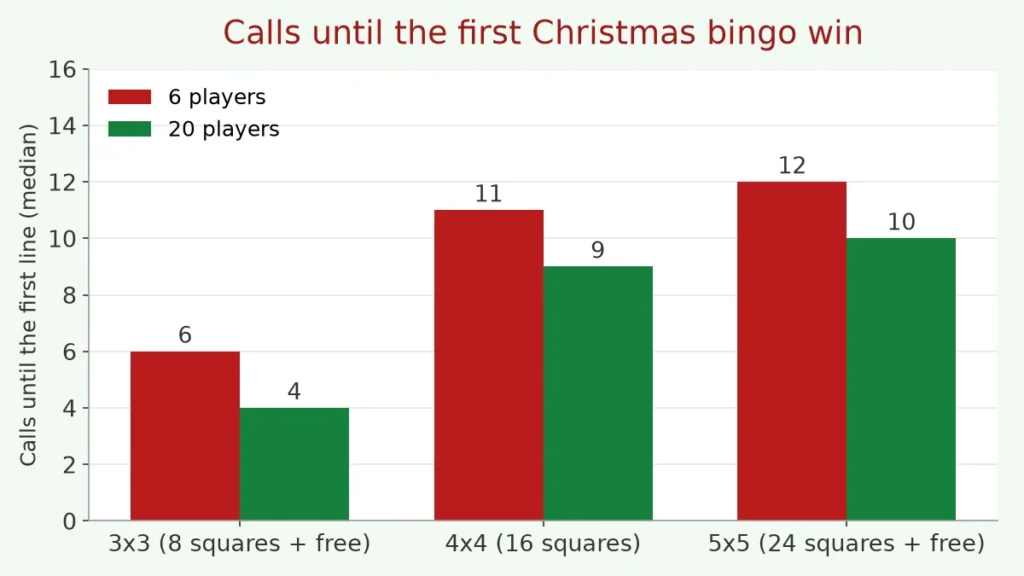
In a Christmas bingo game, a family of six on 5×5 cards sees its first line after about 12 calls out of 30. A party of twenty needs only 10, because many more cards are in play. A 3×3 card for six little players finishes after 6 calls on average, so a children’s round is over in a few minutes.
Other Christmas bingo patterns take much longer. For the same 5×5 cards, four corners needs a median of 18 calls with six players and 14 with twenty. Covering the whole card takes 29 calls for six players and 28 for twenty, practically the last square in the pile.
Movie night: will anyone win?
In a film, not every Christmas bingo square appears. The table shows the share of simulated games, with 5×5 cards, that produced a line when only the stated number of the 30 squares showed up.
| Squares that appear | 6 viewers | 20 viewers |
|---|---|---|
| 8 of 30 | 8% | 24% |
| 10 of 30 | 24% | 60% |
| 12 of 30 | 51% | 91% |
| 15 of 30 | 90% | 100% |
The lesson: with a short film or a short list of events, either have more viewers or switch to a smaller card. At 15 of 30 squares, even a family of six wins about nine times out of ten.
Kids versus adults
With four children on 3×3 cards and four adults on 5×5 cards, the children get the first line in 92% of games, the adults in 5% and the two tie in 3%. The median call of the first line is 7 for the children and 13 for the adults. If you want the sides to be even, give adults the 4×4 card or ask them to play for four corners.
Christmas bingo prizes and house rules
Christmas bingo prizes should be small and seasonal. Agree on rules before the first call so that the game stays friendly.
| Round | Prize idea | House rule |
|---|---|---|
| Any line | Candy canes or a hot cocoa mix | The free center counts as marked |
| Four corners | A small ornament | All four corner squares, not the center |
| X pattern | A holiday mug | Both diagonals, including the free center |
| Full card | A bigger wrapped gift | Play on until someone covers every square |
| Last to win | A jingle bell to wear | For good humor |
- One win per player until everyone has won, so prizes spread around the room.
- Ties share the prize or play a quick tiebreaker on one more call.
- The caller checks a winning card against the list of calls before the prize is handed over.
- If a young child wins twice in a row, offer to pick the next round’s music.
Supplies and timing for Christmas bingo
| Setting | Cards | Markers | Time |
|---|---|---|---|
| Family of 6 at home | 6 on 5×5, or 6 on 3×3 for children | Pens, candy | 10 to 15 minutes per round |
| Class of 25 | 25 on 4×4, 2 per page | Stickers, pencils | 15 minutes including the rules |
| Office party of 20 | 24 on 5×5 | Pens, mini candies | 20 minutes, one or two rounds |
| Movie night | 1 per viewer | Pens | The length of the film |
| Tree trimming | 1 per person | Pens | Until the last ornament goes on |
Etiquette and inclusion at a Christmas bingo party
- Not everyone celebrates Christmas. For a mixed group, Christmas bingo still works if you swap religious squares for winter ones, or add a few from another holiday.
- Let guests opt out gracefully. A card is a friendly invitation, not an obligation.
- Keep prizes light so that nobody feels competitive pressure during Christmas bingo at a family table.
- Make sure there is a square for everyone. Add the names of pets or in-jokes for the family.
- Keep an eye on small children with small markers and candy.
Printing tips
Use the preview in the Print tab before sending your Christmas bingo cards to the printer, and print one test page. Red and green themes need color ink, so for large classes pick the black-and-white style. Two cards per page gives big squares for children, six per page saves paper for a large office party. Add cut guides if you want to separate the cards with scissors. Ask the printer for card stock if the cards will be used again next year.
A caller sheet and calling cards are part of the print options. Cut the cards, put them in a bowl and draw one at a time to run the spoken round. For virtual parties, see play bingo online, which deals cards to guests on their own phones.
More Christmas bingo and related pages
- Printable bingo cards: the hub for every template.
- Bingo card generator: build cards with numbers or with your own words.
- Road trip bingo for the drive to the grandparents.
- Blank bingo cards for a set of your own family traditions.
- Christmas Cheer tambola tickets with illustrated holiday tickets.
- Christmas tambola for the number-calling version.
- Bingo caller to draw numbers if you also want a classic round.
Frequently asked questions
10 quick answers
How do you play Christmas bingo?
Every player gets a card of holiday squares. When something matching a square happens or is called, players mark it. The first to complete a row, column or diagonal says “Bingo!” and wins a small prize.
Is this Christmas bingo really free to print?
Yes. The cards open in the card maker above, and you can download the PDF without an account. There is no watermark, and your words stay in your browser.
What size card should I use for young children?
Use 3×3 for ages four to six and 4×4 for seven and up. In the simulation a 3×3 card for six players finished after about six calls, so rounds are short.
How many cards can I print at once?
Christmas bingo prints up to 100 different cards in one PDF, with one, two, four or six per page on Letter or A4 paper.
Can I change the pictures and words?
Yes. The Items tab lets you rename, remove or add squares, each with an emoji or a picture. The Design tab changes colors, fonts, borders and the title.
Can adults enjoy it too?
Yes. Use the 5×5 size and add squares that joke about the holiday. Prizes like a mug or a bottle of cocoa are a good fit.
Do I need a caller?
Not for movie or tree-trimming Christmas bingo, because the events call themselves. For a spoken round, cut the calling cards out of the PDF and draw them from a bowl.
How long does a game last?
In the simulation, a family of six on 5×5 cards had a first line after about 12 of 30 calls. A children’s 3×3 round took about 6. A full card takes nearly all 30 calls.
Can I play it online?
Yes. Share the Christmas bingo PDF or the link with the words, or use the online bingo page, which deals each guest a card on their own phone.
Are the simulation numbers exact?
No. They come from 8,000 simulated games per row and describe the typical case. A real party can be faster or slower.