A ratio calculator simplifies a ratio to its lowest terms, solves a proportion with a missing number, shares a total in a ratio and checks whether two ratios are equal. This free ratio calculator accepts whole numbers and decimals, handles two or three parts and shows each step, from the greatest common factor to the cross-multiplication.
Quick answer: To simplify a ratio, divide every part by the greatest common factor: 12 : 18 ÷ 6 = 2 : 3. To solve A : B = C : D for the missing number, cross-multiply: D = B × C ÷ A, so 3 : 4 = 9 : 12. To share a total in a ratio, divide the total by the sum of the parts and multiply: $40 in 3 : 5 is $15 and $25.
How to use the ratio calculator
Choose what you want to do with the buttons above the boxes, type the numbers and read the answer, which updates as you type. Every mode shows the working under How it works, and decimals are fine in every box. Keep both parts of a ratio in the same unit before you type them.
| Button | You type | Example | Answer |
|---|---|---|---|
| Simplify a ratio | two or three parts | 12 : 18 | 2 : 3 |
| Solve a proportion | A, B, C and D, with one box empty | 3 : 4 = 9 : ? | 12 |
| Share a total | a total and two or three ratio parts | 40 shared 3 : 5 | 15 and 25 |
| Equivalent ratios? | two ratios | 4 : 6 and 10 : 15 | Yes |
- Pick the button that matches your question.
- Fill in the boxes. In Solve a proportion, leave the one you want to find empty.
- Read the answer, the table of extra facts and the steps, then tap Copy result to share it.
Ratio examples and a printable cheat sheet
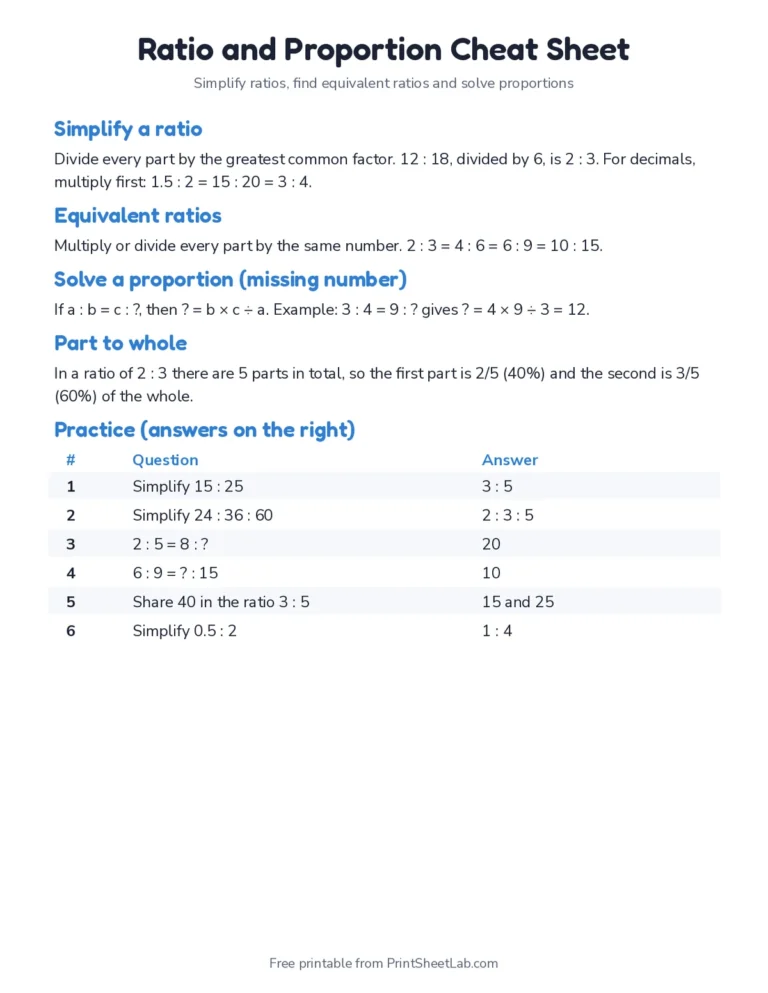
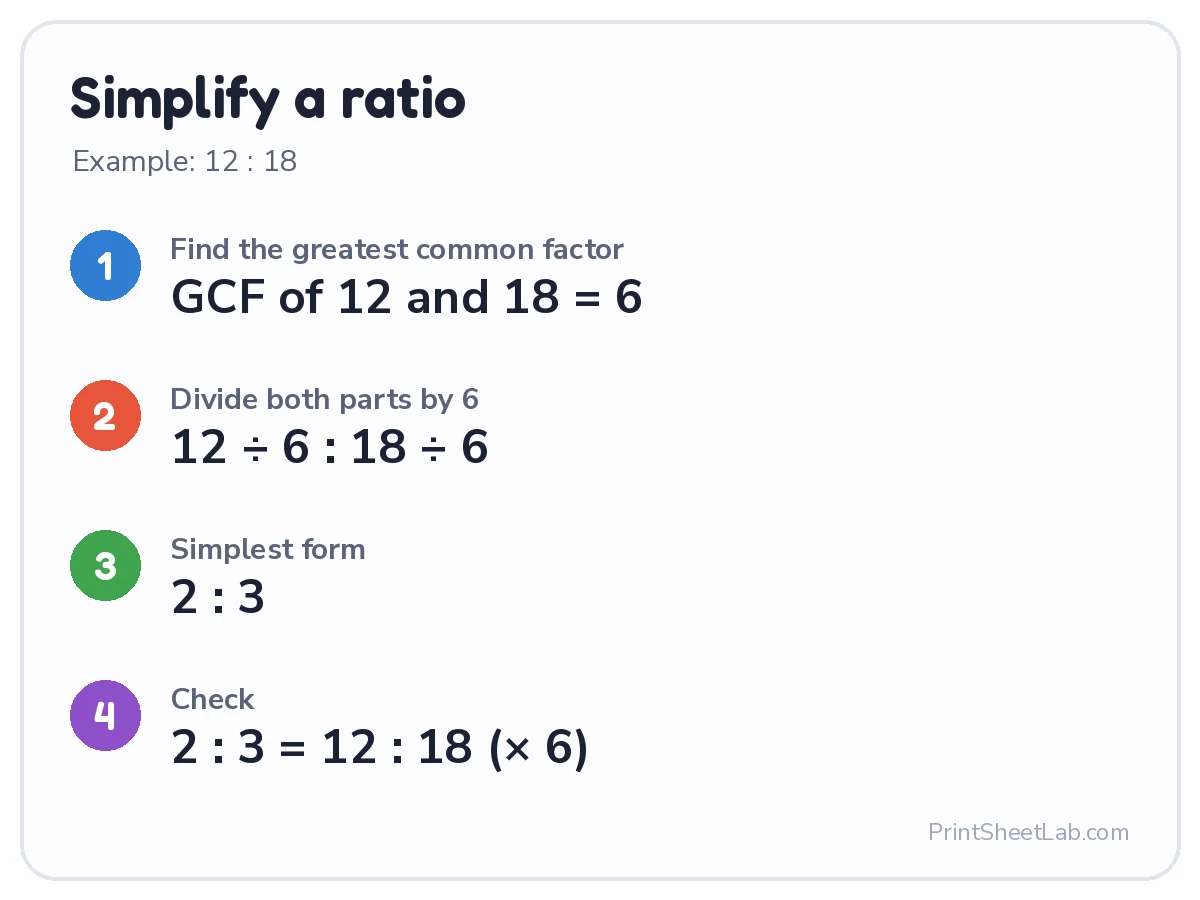
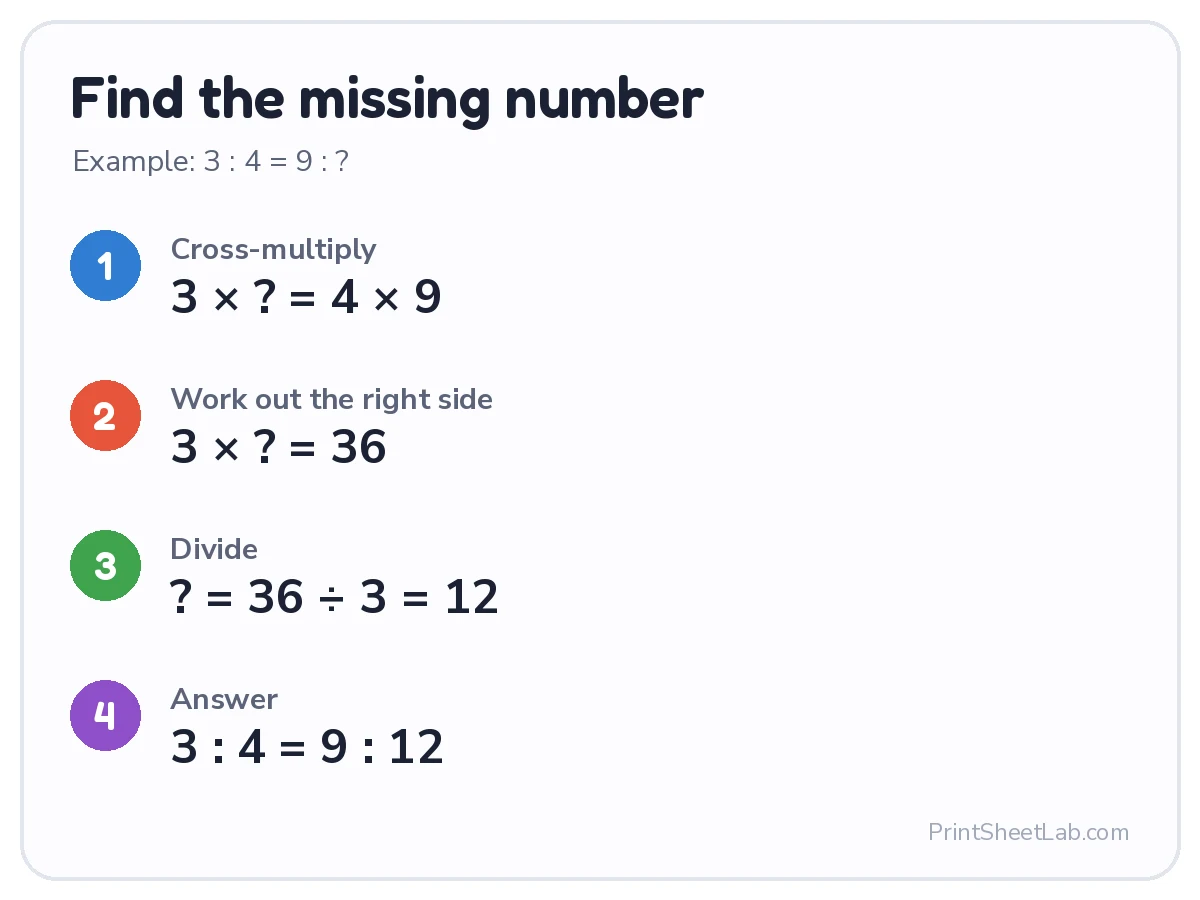
The cards show how to simplify ratios, how to solve a missing number ratio problem and how equivalent ratios scale a recipe. The printable cheat sheet covers simplifying, equivalent ratios, proportions and part-to-whole problems, with six practice questions and answers.
How to simplify ratios
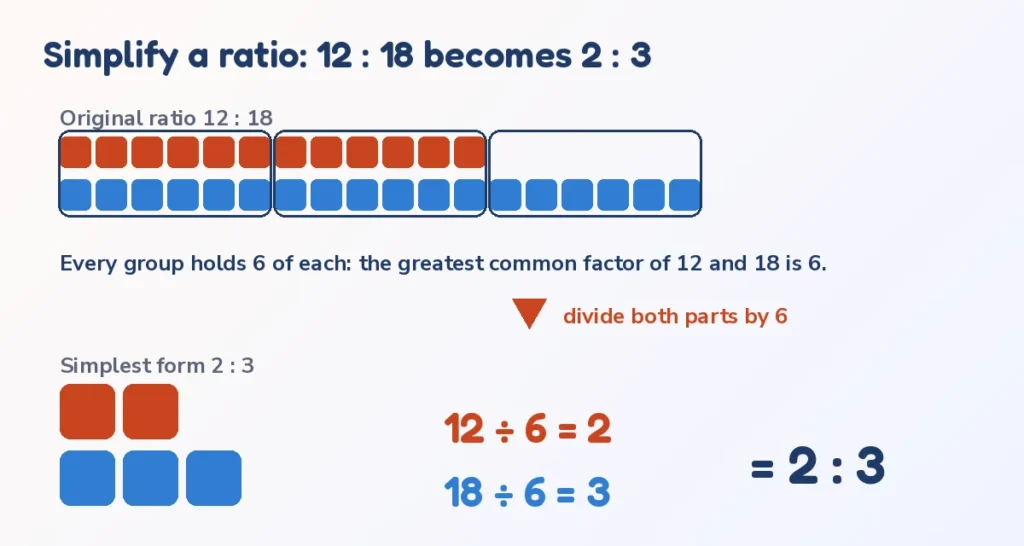
A ratio compares two amounts. To simplify a ratio, divide both parts by their greatest common factor (GCF). For 12 : 18, the GCF of 12 and 18 is 6, so 12 : 18 = 2 : 3. The ratio means the same thing, two of the first for every three of the second, but the numbers are as small as possible.
- 20 : 30 = 2 : 3 (divide by 10)
- 45 : 60 = 3 : 4 (divide by 15)
- 7 : 21 = 1 : 3 (divide by 7)
- 0.5 : 2 = 5 : 20 = 1 : 4 (multiply by 10 first, then divide by 5)
Ratios with units must use the same unit first: 50 cm : 2 m is 50 cm : 200 cm = 1 : 4. The GCF and LCM calculator works out the factor for larger numbers.
How to simplify a ratio step by step
- Write the ratio with whole numbers. If a part has decimals, multiply every part by 10, 100 or 1,000.
- Find the GCF. For 36 : 60 the common factors are 2, 3, 4, 6 and 12, so the GCF is 12.
- Divide each part by it: 36 ÷ 12 = 3 and 60 ÷ 12 = 5.
- Check that the new parts share no factor but 1. The answer is 3 : 5.
When a ratio is already in lowest terms, such as 5 : 8, the ratio calculator says so. Simplifying never changes the meaning, only the size of the numbers.
Ratio calculator 3 numbers: simplifying a three-part ratio
Type a third part in the Simplify a ratio mode and the ratio calculator divides all three by the GCF of all three. 24 : 36 : 60 has a GCF of 12, so it simplifies to 2 : 3 : 5. With decimals, 0.25 : 0.75 : 1.5 is first scaled by 100 to 25 : 75 : 150, divided by 25, and becomes 1 : 3 : 6. Three-part ratios are common in paint, concrete and recipe mixes.
How to write and read a ratio
A ratio can be written with a colon (3 : 5), with the word to (3 to 5) or as a fraction (3/5). All three say the same thing when the ratio compares parts. Read 3 : 5 as “three to five”. The first number belongs to the first thing named, so the boys-to-girls ratio of 12 : 15 is not the girls-to-boys ratio.
To see a ratio as a single number, divide the first part by the second. 15 : 25 is 15 ÷ 25 = 0.6, which also means 1 : 1.67 once you divide both parts by 15. The ratio calculator shows A ÷ B for every simplified ratio, so you can compare ratios quickly without converting them one by one.
Equivalent ratios
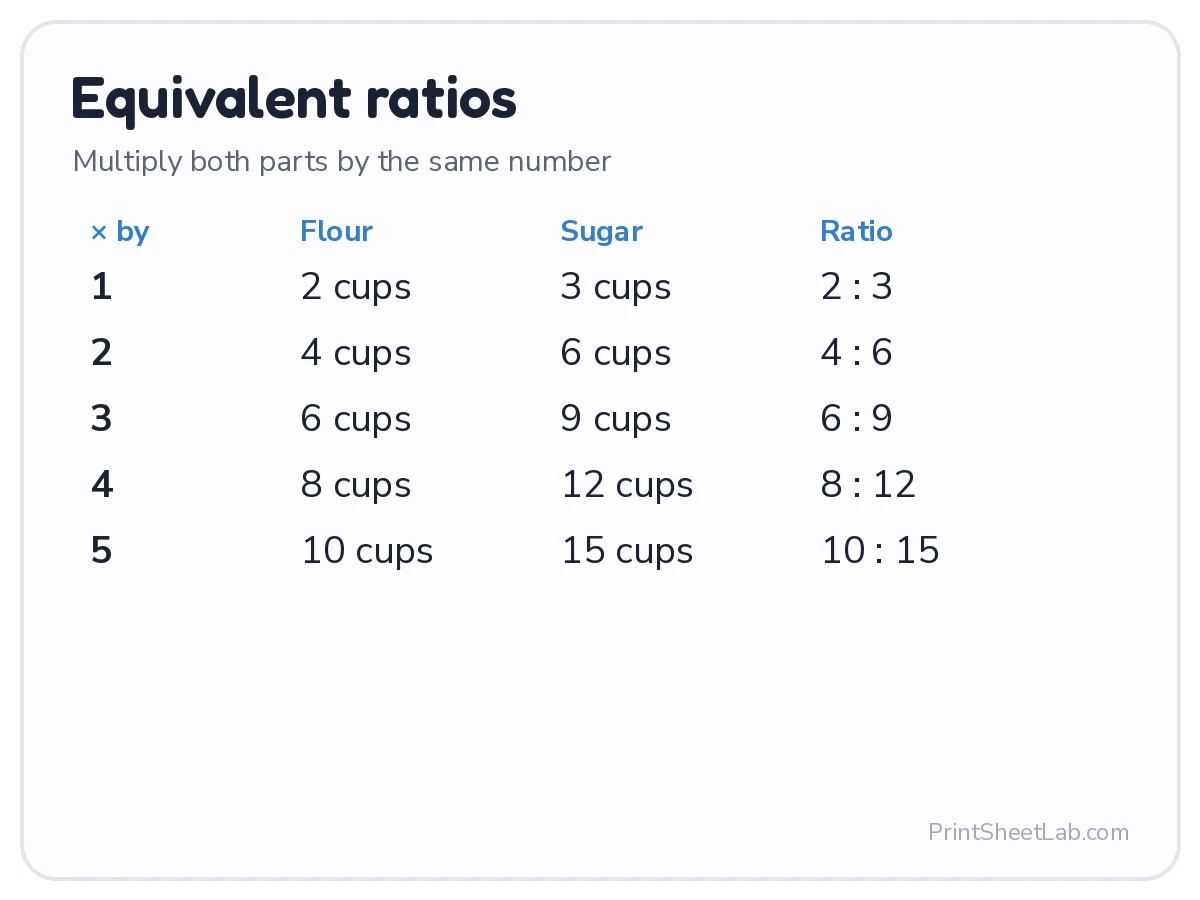
These are ratios that stay in the same proportion. Multiply or divide both parts by the same number and you get equivalent ratios: 2 : 3 = 4 : 6 = 6 : 9 = 8 : 12. A recipe that uses 2 cups of flour for every 3 cups of sugar keeps the same balance whether you make one batch (2 : 3) or five batches (10 : 15).
| Multiply by | Equivalent ratio of 2 : 3 | Cross-products |
|---|---|---|
| × 1 | 2 : 3 | 2 × 3 = 3 × 2 |
| × 2 | 4 : 6 | 2 × 6 = 3 × 4 |
| × 3 | 6 : 9 | 2 × 9 = 3 × 6 |
| × 4 | 8 : 12 | 2 × 12 = 3 × 8 |
| × 5 | 10 : 15 | 2 × 15 = 3 × 10 |
| × 6 | 12 : 18 | 2 × 18 = 3 × 12 |
To test two ratios, simplify both or cross-multiply. 4 : 6 and 10 : 15 are equivalent because 4 × 15 = 6 × 10 = 60. A ratio table lists these multiples in rows, which is a favorite method in sixth and seventh grade. The Equivalent ratios? button of the ratio calculator checks two ratios for you and shows both simplified forms.
Proportion calculator: missing number ratio problems
A proportion says two ratios are equal, such as 3 : 4 = 9 : ?. To find the missing number, cross-multiply: 3 × ? = 4 × 9 = 36, so ? = 36 ÷ 3 = 12. The proportion calculator mode does this in one step and shows the working, giving 3 : 4 = 9 : 12.
| Missing box | Formula for A : B = C : D |
|---|---|
| A | A = B × C ÷ D |
| B | B = A × D ÷ C |
| C | C = A × D ÷ B |
| D | D = B × C ÷ A |
- Shopping: if 3 notebooks cost $4.50, then 3 : 4.5 = 8 : ? gives $12 for 8 notebooks.
- Maps: on a map where 1 cm stands for 5 km, a 7.5 cm route is 1 : 5 = 7.5 : ?, which is 37.5 km.
- Work: if 4 workers paint a room in 6 hours, 4 : 6 does not scale to 8 workers by a simple proportion, because more workers means less time. That is an inverse proportion: 4 × 6 = 8 × 3.
If the gap is somewhere else, leave that box empty instead: 6 : 9 = ? : 15 gives 10, and 6 : ? = 10 : 15 gives 9.
Ratio calculator for recipes and mixing
A ratio calculator for recipes keeps a dish balanced when you scale it up or down. If a dough uses flour, water and salt in the ratio 100 : 65 : 2 by weight, 500 g of flour needs 500 × 65 ÷ 100 = 325 g of water and 500 × 2 ÷ 100 = 10 g of salt. Use the Solve a proportion mode once for each ingredient.
Drinks work the same way. A cordial diluted 1 : 4 is 1 part cordial and 4 parts water, which makes 5 parts. For a 1 liter jug, one part is 1,000 ÷ 5 = 200 ml, so use 200 ml of cordial and 800 ml of water. The Share a total mode gives both amounts at once.
| Cordial : water | Parts in total | Cordial in 1,000 ml | Water in 1,000 ml |
|---|---|---|---|
| 1 : 3 | 4 | 250 ml | 750 ml |
| 1 : 4 | 5 | 200 ml | 800 ml |
| 1 : 5 | 6 | 166.67 ml | 833.33 ml |
| 1 : 9 | 10 | 100 ml | 900 ml |
Share a total in a ratio
A ratio of 2 : 3 has 5 parts in total, so the first part is 2/5 (40%) of the whole and the second is 3/5 (60%). To share $40 in the ratio 3 : 5, add the parts (8), find one part ($40 ÷ 8 = $5) and multiply: $15 and $25. This is also how business partners split profit and how mixtures work.
| Total | Ratio | Working | Shares |
|---|---|---|---|
| $40 | 3 : 5 | 40 ÷ 8 = 5 per part | $15 and $25 |
| $1,000 | 2 : 3 : 5 | 1,000 ÷ 10 = 100 per part | $200, $300 and $500 |
| $90 | 1 : 2 | 90 ÷ 3 = 30 per part | $30 and $60 |
| $250 | 7 : 3 | 250 ÷ 10 = 25 per part | $175 and $75 |
For percents of a whole, use the percentage calculator, and for fraction work, the fraction calculator.
Ratio calculator for screens, scale models and maps
Screens describe their shape with an aspect ratio. A 1920 × 1080 display simplifies by the GCF 120 to 16 : 9, the standard widescreen ratio. Type the width and height into the Simplify a ratio mode to find the aspect ratio of any image, video or screen.
| Width × height | Aspect ratio | Typical use |
|---|---|---|
| 1,920 × 1,080 | 16 : 9 | HD video and monitors |
| 1,280 × 1,024 | 5 : 4 | older 5 : 4 monitors |
| 1,024 × 768 | 4 : 3 | classic 4 : 3 screens |
| 3,440 × 1,440 | 43 : 18 | ultrawide monitors (sold as 21 : 9) |
| 1,080 × 1,080 | 1 : 1 | square social posts |
| 1,200 × 630 | 40 : 21 | link preview images |
| 1,080 × 1,920 | 9 : 16 | vertical phone video |
Model makers use scale ratios: on a 1 : 50 model, 4 cm stands for 4 × 50 = 200 cm, or 2 m, in real life. Maps work the same way. On a 1 : 50,000 map, 7.5 cm is 7.5 × 50,000 = 375,000 cm, which is 3.75 km. To change units on the way, use the unit converter.
Ratios in class, sport and science
A class with 12 boys and 15 girls has a boys-to-girls ratio of 12 : 15, which is 4 : 5 in lowest terms. A basketball player who makes 9 of 12 free throws has a made-to-missed ratio of 9 : 3, or 3 : 1.
In science, a drink mixed 1 part concentrate to 4 parts water stays the same strength whether you make one cup or a whole jug, and a bike in a 2 : 1 gear turns the back wheel twice for every turn of the pedals. Prices are ratios too: 12 eggs for $4.80 is 4.80 ÷ 12 = $0.40 per egg, a quick way to compare two pack sizes, and a ratio calculator shows when two deals are really the same.
Ratios and proportional relationships are a core topic in sixth grade math in the US (see the Common Core standards for grade 6). Wikipedia’s ratio article covers the notation and more advanced uses, such as the golden ratio.
Ratio, fraction, rate and proportion compared
| Term | What it compares | Example |
|---|---|---|
| Ratio | two or more quantities of the same kind | 2 boys : 3 girls |
| Fraction | a part with its whole | 2/5 of the class are boys |
| Rate | two different units | 60 miles per 2 hours |
| Proportion | two equal ratios | 2 : 3 = 4 : 6 |
| Percent | a part out of 100 | 40% are boys |
A ratio of 2 : 3 becomes the fractions 2/5 and 3/5 once you add the parts, and the percents 40% and 60%. The ratio calculator lists those conversions for every simplified ratio.
| Ratio | Fractions of the whole | Percents |
|---|---|---|
| 1 : 1 | 1/2 and 1/2 | 50% and 50% |
| 1 : 2 | 1/3 and 2/3 | 33.3% and 66.7% |
| 1 : 3 | 1/4 and 3/4 | 25% and 75% |
| 2 : 3 | 2/5 and 3/5 | 40% and 60% |
| 3 : 5 | 3/8 and 5/8 | 37.5% and 62.5% |
| 1 : 4 | 1/5 and 4/5 | 20% and 80% |
| 1 : 9 | 1/10 and 9/10 | 10% and 90% |
Common ratio mistakes to avoid
- Reversing the order. 2 : 3 and 3 : 2 are different, so keep the parts in the order the question gives them.
- Mixing units. 50 cm : 2 m is not 50 : 2; convert to 50 : 200 first.
- Adding instead of multiplying to scale. 2 : 3 scaled up by 4 is 8 : 12, not 6 : 7.
- Stopping early. 6 : 12 is not simplified; divide again to reach 1 : 2.
- Treating a part-to-part ratio as a fraction. 2 : 3 means 2/5 and 3/5 of the whole, not 2/3.
Ratio questions people ask
How do I find the ratio between two numbers?
Write the numbers as A : B and simplify. The ratio between 15 and 25 is 15 : 25, and dividing both by 5 gives 3 : 5. Put the first quantity first.
How do I simplify a ratio with decimals?
Multiply every part by 10, 100 or 1,000 until all are whole numbers, then divide by the GCF. 1.5 : 2 becomes 15 : 20 and then 3 : 4.
What is a ratio calculator with 3 numbers used for?
It simplifies a three-part ratio such as 24 : 36 : 60, or shares a total among three people in the ratio 2 : 3 : 5, such as $1,000 giving $200, $300 and $500.
Ratio calculator: frequently asked questions
What is 12 : 18 in simplest form?
2 : 3. Both parts divide by their greatest common factor, 6.
Can I simplify a ratio with decimals?
Yes. The ratio calculator multiplies both parts by 10, 100 or 1,000 to make them whole, then simplifies.
Can I simplify a ratio with three parts?
Yes. Add a third part and divide every part by the GCF of all three: 24 : 36 : 60 = 2 : 3 : 5.
What is the difference between a ratio and a fraction?
A ratio compares parts with each other (2 boys to 3 girls), while a fraction compares a part with the whole (2/5 of the class are boys).
How do I know if two ratios are equivalent?
Simplify both, or cross-multiply. 4 : 6 and 10 : 15 are equivalent because 4 × 15 = 6 × 10 = 60.
Does the order of a ratio matter?
Yes. 2 : 3 and 3 : 2 are different. Keep the parts in the order the question gives them.
How do I turn a ratio into a percentage?
Add the parts and divide each part by the sum. In 2 : 3 the parts are 2/5 = 40% and 3/5 = 60%.
How do I solve a proportion with a missing number?
Cross-multiply and divide. For 3 : 4 = 9 : ?, the answer is 4 × 9 ÷ 3 = 12.
Can a ratio have a zero or a negative part?
The ratio calculator needs parts greater than zero, because a ratio compares real quantities, and zero or negative parts have no useful meaning in everyday ratios.
How do I write a ratio?
Use a colon, the word to, or a fraction: 3 : 5, 3 to 5 and 3/5 all describe the same comparison of parts. Keep the numbers in the order of the things named.
How do I share money in a ratio?
Use Share a total. For $40 in the ratio 3 : 5, one part is 40 ÷ 8 = $5, so the shares are $15 and $25.
Related calculators
- Percentage calculator
- Fraction calculator
- GCF and LCM calculator
- Simplify fractions calculator
- Unit converter
- Fractions worksheets
- All calculators
Sources and further reading
- Ratio (Wikipedia)
- Aspect ratio of images (Wikipedia)
- Common Core 6th grade ratios and proportional relationships
Last updated: October 2026.