Holi bingo gives the festival of colors a game that works even when everyone is covered in powder. The template on this page has 29 squares that a Holi morning produces almost by itself, from the first pinch of color on a cheek and a pichkari squirting across the yard to a plate of gujiya and a neighbor who arrives dressed in white. Choose a card size, press print, and every player gets a different card.
In short: open the card maker above and press Edit and print this card, pick how many cards you need and download one PDF. It is free, there is no account, and nothing you type leaves your browser. Every square can be rewritten, so a backyard party, a classroom and a community fair can each get a list of their own.
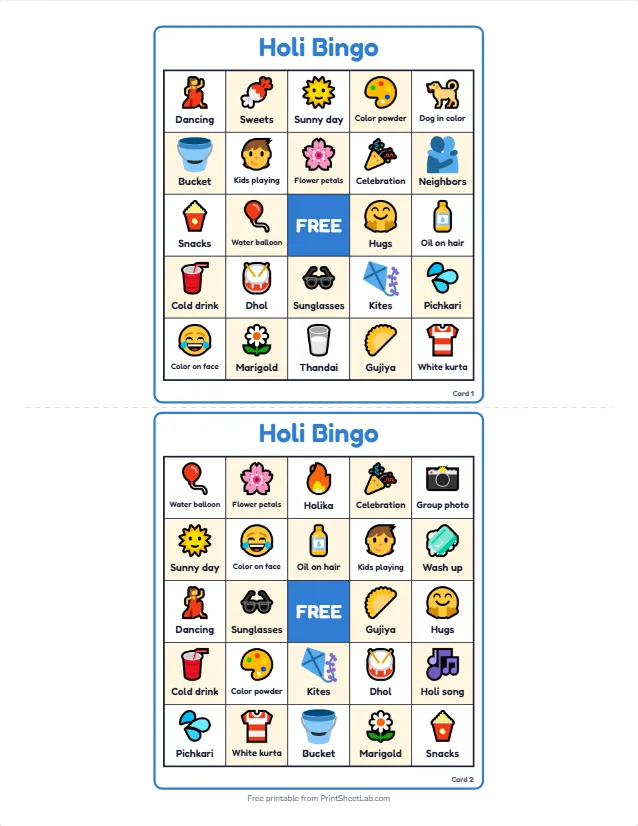
How to play Holi bingo
The idea is the bingo everyone knows, played with a festival instead of a caller. Each guest gets a card, and when one of the squares happens in front of them they mark it. A full row, column or diagonal wins. The free center square is already marked, so a first line needs only four more. Because Holi is wet and colorful, the cards need a little protection, and the rules below keep the game fair for people with powder on their hands.
- Give every player a card, a pencil and a zip-top bag. A card in a sealed sandwich bag survives splashes, and a pencil marks through the plastic better than a pen.
- Agree on the rules before the color starts. A square counts when you see it with your own eyes, and each square counts once.
- Mark Holi bingo squares as the morning unfolds. Color powder, the pichkari, the dhol, the first plate of sweets: each one is a square.
- Call a line out loud. The winner reads the five squares aloud and a friend with clean hands checks them.
- Play on. Move Holi bingo to four corners or an X after the first line, or keep the same card for the whole day.
Holi suits bingo because the festival is full of things you can point at. The Wikipedia article on Holi describes people throwing colored powder and water at each other, using water guns and water-filled balloons, carrying drums from place to place, and singing and dancing. A Holi bingo card that names those moments gives children a reason to look around, instead of only at the person aiming a pichkari at them.
Holi bingo cards: all 29 squares
These Holi bingo cards are made from a list of 29 squares. A standard 5×5 card with a free center needs 24 of them, so each card leaves out five and no two cards are alike. The table groups the list the way a host tends to think about it, which helps when you decide which squares to keep and which to replace with something from your own street.
| Group | Squares on the list | Where you will see them |
|---|---|---|
| Color play | 🎨 Color powder, 💦 Pichkari, 🎈 Water balloon, 🌈 Rainbow face, 😂 Color on face, 🪣 Bucket | Everywhere on the color day. These are the engine of the game and fill in first. |
| Clothes and care | 👕 White kurta, 🧴 Oil on hair, 🕶️ Sunglasses, 🧼 Wash up | The start of the morning, and the end of it. |
| Food and drink | 🥛 Thandai, 🥟 Gujiya, 🍬 Sweets, 🍿 Snacks, 🥤 Cold drink | Trays carried between homes. They arrive in the second half of the morning. |
| Music and movement | 🥁 Dhol, 🎶 Holi song, 💃 Dancing, 🎉 Celebration | Speakers, drums and the street itself. |
| People | 🧒 Kids playing, 🤗 Hugs, 🫂 Neighbors, 📸 Group photo, 🐕 Dog in color | The point of the festival. Hugs and neighbors are very likely, a dog in color is rare. |
| Setting and decoration | 🔥 Holika, 🌸 Flower petals, 🌼 Marigold, 🌞 Sunny day, 🪁 Kites | The bonfire the night before, and the weather and flowers of the day. |
The Holi bingo list is not random. The color squares appear within minutes, while the long shots (kites, a dog in color, flower petals) give a card its treasure-hunt feel. If every square on a Holi bingo card were as common as color powder, the game would be over before anyone had finished their first handful.
How many different cards can you print?
With 29 squares and 24 places on a 5×5 card, the number of different sets of squares is 29 choose 24, which is 118,755. Each set can be put in a huge number of orders, so a class of 30 and a block party of 150 can both get a different Holi bingo card for every player. A smaller grid needs fewer squares, so a 4×4 or 3×3 Holi bingo card has even more possible sets.
| Card size | Squares used | Different sets from the 29 | Best for |
|---|---|---|---|
| 3×3 with free center | 8 | 4,292,145 | Ages 3 to 5, and the short game |
| 4×4 | 16 | 67,863,915 | A quick round before the sweets come out |
| 5×5 with free center | 24 | 118,755 | The classic party morning |
The two days behind the squares: Holika Dahan and Rangwali Holi
Holi is a Hindu spring festival that is also a cultural celebration, and the Wikipedia article says it gives Hindus and non-Hindus alike a chance to play with colored water and powder. It is celebrated at the end of winter, on the last full moon day of the Hindu lunisolar month of Phalguna, so the date moves each year.
It typically falls in March and sometimes in late February. The Wikipedia date listing shows the 2026 festival running from the evening of March 3 to March 5, with the color day on March 4. Always check a local calendar for the year you play.
| When | Name | What happens | Squares that fit |
|---|---|---|---|
| The night before | Holika Dahan (also called Chhoti Holi) | People gather around a lit bonfire, with songs and dancing. The ritual comes from the story of Holika, who tried to burn Prahlada in a bonfire but was herself burned, while Prahlada stayed unharmed. | Holika, Dhol, Dancing, Holi song, Group photo |
| The next morning | Rangwali Holi (Dhuleti) | People smear and drench each other with colors. Water guns and water-filled balloons are common, groups carry drums from place to place, and families, friends and neighbors visit and share Holi sweets. | Color powder, Pichkari, Water balloon, Rainbow face, Gujiya, Neighbors, Hugs |
| Afterwards | Rest and cleaning | Washing up, resting, and a second round of sweets and cold drinks. | Wash up, Cold drink, Snacks |
Holi is also described as a festival of forgiveness and new starts, which is why the Hugs square matters. People who have fallen out are expected to meet and make peace. Other regions add their own twists: in Maharashtra the color celebrations take place on Rang Panchami, five days after the main day, and in Manipur the festival lasts six days and merges with the festival of Yaosang. Your list can follow whichever tradition your family keeps.
The Holika square is the one on a Holi bingo card that belongs to the night before. In the game it works as a carry-over: a player who attends the bonfire can mark it that evening and bring the card to the color day with one square already done. In our simulation we assumed half the players attend.
The real colors behind the color powder
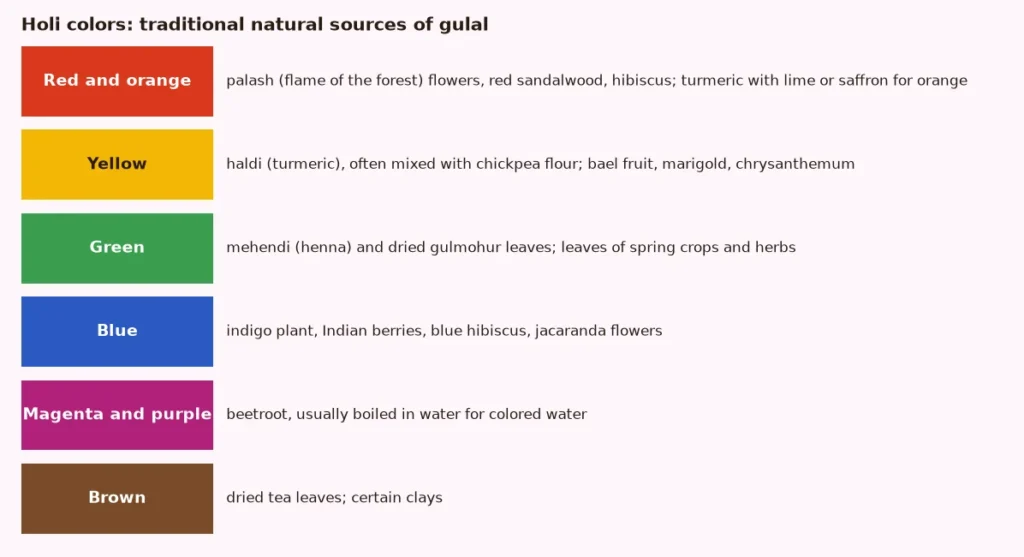
Traditional Holi colors, called gulal, were made from plants. The Wikipedia article lists the sources: the bright red and deep orange of palash flowers, turmeric for yellow, mehendi and dried leaves for green, indigo and jacaranda for blue, and beetroot for magenta and purple. The swatch chart shows them side by side. It is a useful reference for a class, because every color in Holi bingo has a plant behind it.
Three ways to play a Holi bingo game
One printed card supports three quite different Holi mornings. Pick the Holi bingo game that suits your guests, or run two in a row. The table compares them, and the sections below give rules and prizes.
| Game | Who calls | Length | Best for |
|---|---|---|---|
| Holi bingo color-day spotting game | Nobody. The morning does. | 2 to 4 hours | Backyard parties, school fields and community fairs |
| Holi bingo with calling cards | A host draws cut-out squares | 10 to 20 minutes | Indoor parties, offices, libraries and the rest after the color |
| The clean-hands Holi bingo watcher game | The party itself | About an hour | Guests who would rather not be colored, grandparents, and anyone with sensitive skin |
Game one: the Holi bingo color-day spotting game
This is the version most hosts want. Players carry a card in a bag and mark squares as they see them: the first color on a cheek, the pichkari fight in the yard, the dhol on the street. A useful rule keeps the game going all morning: mark only one square at a time, then wait for something new. Without that rule, a player can tick the whole color group in the first ten minutes. The simulation further down gives the numbers.
- Prize for the first line: first choice from the sweets tray, or the first cold drink.
- Prize for four corners: pick the next song on the speaker.
- Prize for everyone: a small pack of natural-color powder or a rubber bracelet in the color of their choice.
- Grown-up job: a helper with clean hands holds the cards of the smallest players during the water fight.
Game two: Holi bingo with calling cards
When everyone sits down to eat, the drawn-card Holi bingo game is easy to run. In the Print tab, switch on the calling cards and the caller sheet, cut out the squares and shuffle them in a bowl. The host draws one at a time, reads it aloud, and everyone with that square marks it. For a live round with guests on their own screens, the play bingo online page hosts the 75-ball game, and the play custom bingo online page explains how to play with your own list.
It is also the version of Holi bingo for the indoor part of the day. After the color and the shower, the family sits down with clean cards, and the draw replays the morning square by square. Children love ticking off squares they remember doing.
Game three: the clean-hands Holi bingo watcher game
Not everyone wants to be colored, and a good festival has a place for them. In the Holi bingo watcher game a player stays on the edge of the action, perhaps on a veranda or by the food table, and marks squares they see others doing. The same Holi bingo card works, the same rules apply, and the watcher never has to get wet.
It is also a way for grandparents and for guests who are visiting a Holi gathering for the first time to join in, with the added benefit that someone is paying attention to the details. Pair each watcher with a child who can explain what they are seeing.
Holi bingo game: a real simulation
A host planning a Holi bingo game always asks how long it will last. To answer with numbers instead of a guess, we simulated a Holi day from 8 a.m. to 5 p.m. Every square has an assumed chance of appearing in a time window, and we ran 8,000 mornings.
The chances are our assumptions, chosen to feel like a lively family gathering. They are not survey data. Color powder is seen at 99 of 100 parties, a pichkari at 80, a dhol at 55, and kites at only 10. About half of the guests (our assumption) attend the bonfire the night before and start the day with the Holika square already marked.
Holi bingo on the color day: a first line comes around 11:36 a.m.
In an average morning a guest sees about 21 of the 29 squares, so a 5×5 card with 24 squares ends the day with about 17 marked, plus the free center. A full card essentially never happens, because the rare squares (kites, a dog in color, flower petals) are unlikely to all turn up. The chart shows when each square usually appears.
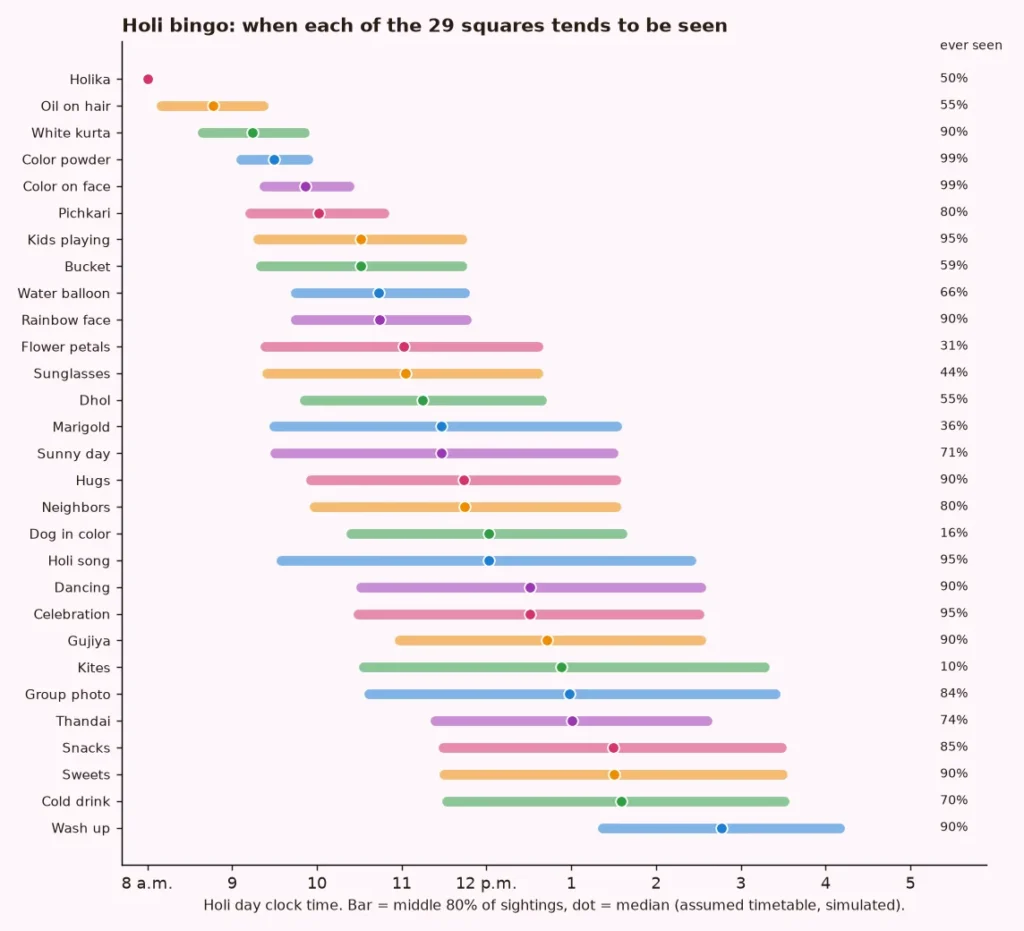
The color squares come first, from about 9 a.m., while the food squares build from 11 a.m. and Wash up closes the day after lunch. That order is useful for a Holi bingo host: put the early squares on the cards of the youngest players, and keep the late ones for the afternoon rounds.
| Cards at the party (5×5) | Median time of a first line | Middle half of mornings | Line by noon | Line by 2 p.m. |
|---|---|---|---|---|
| 1 card (one guest) | 1:12 p.m. | 12:06 p.m. to 2:22 p.m. | 23% | 69% |
| 6 cards | 11:36 a.m. | 11:02 a.m. to 12:18 p.m. | 67% | 98% |
| 12 cards | 11:14 a.m. | 10:41 a.m. to 11:47 a.m. | 83% | 99% |
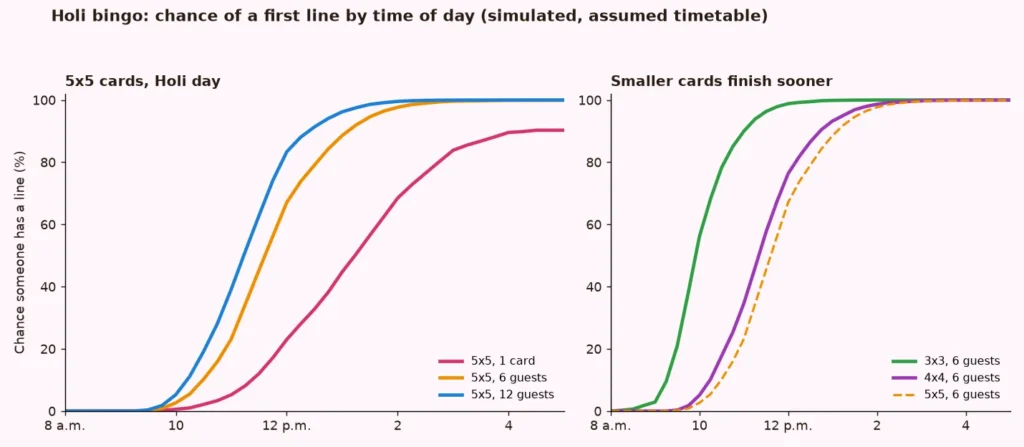
A single guest has a first line at a median of 1:12 p.m., and only 23% of lone guests have one by noon. With six guests the first line arrives around 11:36 a.m., and with twelve a little earlier at 11:14 a.m.. Smaller cards are quicker: a 3×3 card with six players has a median of 9:54 a.m., and a 4×4 card with six players 11:20 a.m.. The curves show how the chance climbs through the morning.
Other Holi bingo patterns for a longer game
A first line comes quickly, so a host who wants the party to last should add a second prize. We simulated four corners, an X and a full card as well.
| Pattern (5×5 card) | 1 card | 6 cards |
|---|---|---|
| Any line, median time | 1:14 p.m. | 11:35 a.m. |
| Four corners | only 25% of cards ever get there | 79% of games, median 1:42 p.m. |
| X pattern | only 6% of cards | 28% of games |
| Full card | almost never | almost never |
Four corners is the best second prize in Holi bingo: with six cards on the table, about 79% of games reach it, usually around 1:42 p.m.. The X is a long shot, finishing in only about 28% of six-card games, and a full card is not a realistic goal on a single morning. That is a feature, not a flaw: it keeps the first line exciting and leaves the rare squares as bragging rights.
Holi bingo with calling cards: how many calls?
In the drawn-card Holi bingo game all 29 squares are called exactly once, in random order, so the game has a predictable length. We simulated 8,000 games to find out how many calls it takes before someone has a line.
| Cards in play (5×5) | Calls to the first line (median) | Middle half of games | Calls to a full card (median) |
|---|---|---|---|
| 1 card | 17 | 14 to 19 | 29 |
| 4 cards | 13 | 11 to 15 | 28 |
| 8 cards | 11 | 10 to 13 | 28 |
| 15 cards | 10 | 9 to 12 | 28 |
| 25 cards | 9 | 8 to 11 | 28 |
| 30 cards | 9 | 8 to 10 | 27 |
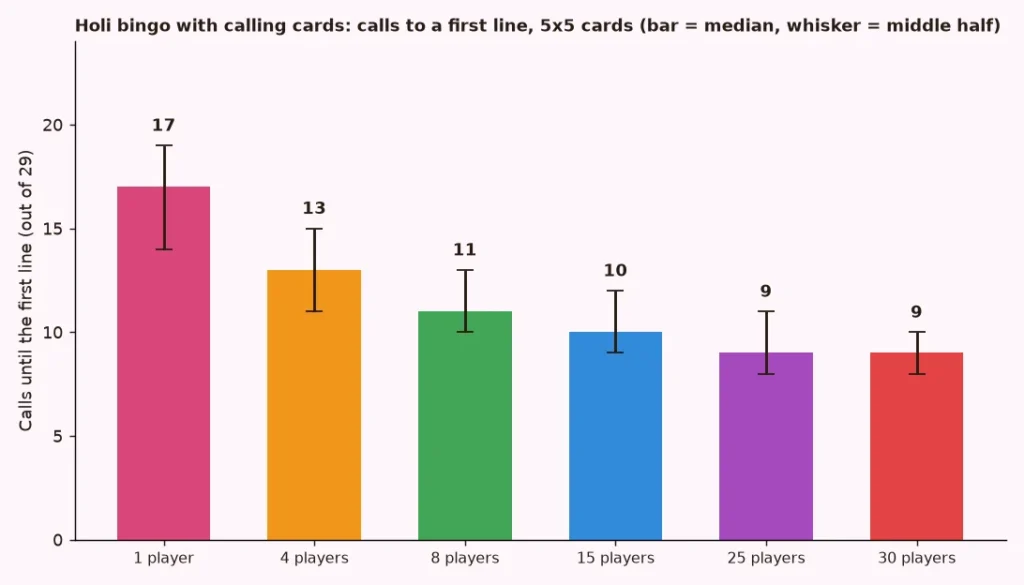
A party with 15 players on 5×5 cards usually sees a first line after 10 calls, about a third of the way through the list. A full card takes nearly everything: a median of 28 calls with 15 players. For a faster game, 4×4 cards with 8 players reach a first line at 10 calls, and 3×3 cards with 8 players at 5. The assumptions: every call is equally likely at each step, cards are independent random draws, and nobody misses a call.
Printable Holi bingo: print, protect and hand out
For printable Holi bingo, the Print tab has the controls you need and nothing extra. Choose how many different cards to print, from 1 to 100, how many go on a page (1, 2, 4 or 6), Letter or A4 paper, and portrait or landscape. Cut guides are available for sheets that need trimming. For a class of 28, print 30 cards, two per page, and keep two spares for the card that ends up in a puddle.
- Laminate or bag the cards. Holi is wet. A zip-top bag, a clear sleeve or a laminated sheet turns a printed card into one that lasts.
- Print names on the cards. The Design tab can print a name on each Holi bingo card, which saves tears when two white kurtas look identical by noon.
- Use big squares for little hands. One card per page in portrait gives the largest squares, best for ages 3 to 5.
- Print the caller sheet and calling cards for the indoor round. They come out of the same Print tab.
- Print a color-free backup. Keep a set of clean Holi bingo cards in the house for the afternoon game after the shower.
Hosts who are away from a printer can save the PDF to a phone or a USB stick and print it anywhere. The shareable link in the card maker keeps only your word list, with no names or photos, so you can send it to the other families and let everyone print their own.
Holi bingo for kids
Holi bingo for kids is a tidy way to organize a messy day. Children playing Holi bingo and hunting for a bucket or a rainbow face stay with the group, and the pictures on every square let pre-readers play without help. The right setup depends on age.
| Age | Card | How to play |
|---|---|---|
| 3 to 4 | 3×3, one per page | A grown-up reads the pictures. Sticker dots, no pens. Everybody wins at the first line. |
| 5 to 7 | 3×3 or 4×4 | Words with emoji. Kids spot and shout. Play for a line, then four corners. |
| 8 to 10 | 5×5 | One square at a time, plus two squares they invent themselves, like a funny hat or a favorite song. |
| 11 and up | 5×5 with a custom list | Let them write the list for the group, or let them run the calling-card version for the younger kids. |
Classrooms get a lot from this. A round of Holi bingo fits into the last half hour before an assembly, and it needs only a printer. Pair it with the Holi activities for kids page for a full lesson. Many schools hold a dry Holi, with colors thrown on a field and no water, and a card kept in a sleeve works fine there.
If a class includes children who do not celebrate, let them play as observers and ask a child who does celebrate to say a sentence about each square. A game becomes an introduction, and the child who knows the answers is proud to share them.
Holi party bingo for families, offices and community fairs
Holi party bingo is a different animal from the version with sticker dots, and it needs a lighter touch. Guests at a party already have drinks to hold and people to find, so the card should ask for very little. The best rule is that a square counts when someone else points it out to you. That turns Holi party bingo into a conversation: “Is that your white kurta? It counts for my card!” The card becomes an excuse to talk to a stranger, not a puzzle to solve alone.
Three tweaks make it grown-up. First, change the list: replace Kites with “Someone tells a Holi story from their hometown,” and Bucket with “A bandana in a bright color.” Second, use a 4×4 card with no free space so the game ends in about an hour.
Third, give prizes that suit the party: first pick of the sweets, a pack of natural colors, or a turn at choosing the next song. For more ideas, the Holi tambola page uses numbers called from a bag on a 3×9 ticket instead of squares you spot, and the Rang Barse Holi tambola tickets come with an illustrated design.
Holi bingo free printable: what you get
Free, private and nothing to install
This Holi bingo free printable does not ask for an email or an account, and nothing is added to your PDF but the card itself and a small footer. The editor runs in your browser, so your word list never goes to a server. You need only a printer or a PDF viewer.
What you can change
The card maker has five tabs: Setup, Items, Design, Templates and Print. On the Items tab you can rewrite any square, add an emoji or upload your own picture, and decide what the free space shows. The Design tab holds color themes, fonts, text size, ALL CAPS, borders, rounded corners, tiles or plain grids, and a card background that can be a color, a pattern or your own picture.
You can also add a title, a logo and a footer line, for example “Patel family Holi 2027”. The Templates tab holds the other ready-made lists, and the Print tab holds the numbers: how many cards, which paper, which layout.
You do not have to start from this page. The bingo card generator offers every card type in one place, and the blank bingo cards page gives you an empty grid to fill by hand.
Customize the cards in the card maker
The best Holi bingo card names your own street. Open the Items tab and every square turns into a text box. Here is how a few common situations change the list.
- Your family. “Grandpa has color on his white shirt,” “The neighbor with the biggest pichkari,” “A second helping of gujiya.”
- A school or library event. Swap thandai for a fruit juice, add “Someone explains the Holika story,” and keep the sweets nut-free.
- A very young group. Delete the wet squares (water balloon, bucket) and add friendly ones (a smiling sun, a flower crown).
- A workplace. Use “Colleague in a white shirt,” “A rangoli at reception” and “Sweets on a desk.”
- A language-learning class. Write each square in Hindi, Gujarati or Marathi next to the English word.
When your list has more than 24 words, the card maker gives every card a different mix. With exactly 24, every card has the same words in a different order. The free space can say “Free” or show its own emoji, text or picture. Shuffle re-deals the squares across all cards, Undo takes back your last change, and the preview lets you zoom in before you download.
Playing Holi bingo kindly and safely
Holi is a joyful festival, and it also asks for care. A few habits keep Holi bingo fun for everyone. They apply to any game you play at a color festival, not just Holi bingo.
- Color only willing players. The tradition treats everyone as fair game, but today a good host sets the rule up front: you color people who want it. A watcher is a player too, as the third game shows.
- Protect eyes and skin. The Holi article reports a 2007 study in which a synthetic dye used in some colors, malachite green, caused severe eye irritation in Delhi when eyes were not washed, and a 2009 report of metal-based industrial dyes in colors sold without labels. It also notes that campaigns now teach children to make safe colors from flowers and vegetables. Choose colors that say what they are made of, and rinse eyes with clean water after play.
- Oil first, wash later. A common habit is to rub oil on hair and skin before play. It is a square on the card, because it makes the washing easier afterward.
- Keep pets out of it. The Dog in color square is the rarest on the list for a reason. Skip it if you are unsure the colors are safe for animals, or mark it with a photo of a pet in a bright bandana.
- Watch the water. Water balloons and buckets belong where there is space and where slipping is not dangerous. Keep the cards in bags and phones in sealed pouches.
- Mind the sweets. Gujiya and many Holi sweets contain nuts, milk or flour. Ask about allergies before prizes are handed out.
None of this is a rulebook. It is what a thoughtful host already does, and a Holi bingo card works best when it is written together with the people who celebrate. Ask a grandparent or a neighbor to look over the list before you print it. They will point out the square that you forgot, and quite likely the story that goes with it.
More bingo cards for the festive season
Holi bingo is one of a whole set of occasion lists in the card maker. The autumn festival of lights has its own Diwali bingo list, and the nine nights of dance are covered by Navratri bingo. For a spring list closer to home, there is Easter bingo, and the summer bingo template takes over once the weather warms. Every template is gathered on the printable bingo cards hub, and number-based bingo runs on the bingo caller.
Frequently asked questions
10 quick answers
What is Holi bingo?
Holi bingo is a bingo variation in which every square names something you see or do at Holi, such as color powder, a pichkari, gujiya or a dhol. Players mark squares as they spot them or as a host calls them, and the first to complete a line wins.
Are these Holi bingo cards really free?
Yes. You can make, edit and print the Holi bingo cards without an account or a payment. The editor runs in your browser, so the words and pictures you add never leave your device.
How many squares does the template have?
It has 29 squares. A 5×5 card with a free center uses 24 of them, a 4×4 card uses 16 and a 3×3 card with a free center uses 8. Because the list holds more words than a card has squares, cards differ from one another.
How many different cards can I print?
Up to 100 different cards in one PDF. There are 118,755 different sets of 24 squares to choose from, so even a big community fair can give every guest a card without repeats.
What is the Holika square?
It refers to Holika Dahan, the bonfire on the night before the color day. Players who attend can mark it that evening and bring the card to the party with one square already done. If your group skips the bonfire, change the square to any other you prefer.
How long does a Holi bingo game last?
On the color day, a six-guest group with 5×5 cards usually has a first line around 11:36 a.m. in our simulation, and a 3×3 card around 9:54 a.m.. A calling-card game with 15 players usually has a winner after about 10 calls.
When is Holi?
Holi falls on the last full moon day of the Hindu month of Phalguna, usually in March and sometimes in late February. In 2026 the bonfire was on March 3 and the color day on March 4. Check a local calendar for the exact date where you live, and print the Holi bingo cards a few days ahead.
Can I play Holi bingo if I do not want to be colored?
Yes. The clean-hands watcher game lets you stay on the edge of the action and mark squares you see others doing. The same card works, and nobody has to get wet.
Can I change the squares to match my family or school?
Yes. In the card maker, every Holi bingo square can be rewritten, given an emoji or a picture. Swap thandai for juice, add your own family jokes, and use the free space for something personal.
What size should I print for young children?
For Holi bingo with young children, print a 3×3 card, one per page, with large pictures for ages 3 to 5. It has only eight squares plus a free center, so a first line comes quickly and the child stays interested.