Getting to know you bingo is the icebreaker that turns a quiet room of strangers into a room full of questions. Every student, new hire or camper gets a card of statements such as “has a pet” or “can juggle”, then walks around finding a different person for each square. This page gives you a free set of 29 squares, rules for a class or a crowd, card sizes by age, a first-week plan and a simulation of how long a first line takes in a class of 24.
In short: press Edit and print this card in the card maker above to open the editor with the 29 squares loaded. Edit any square on the Items tab, pick 1 to 100 different cards, and download one PDF. It is free, needs no sign-up, and nothing you type is uploaded.
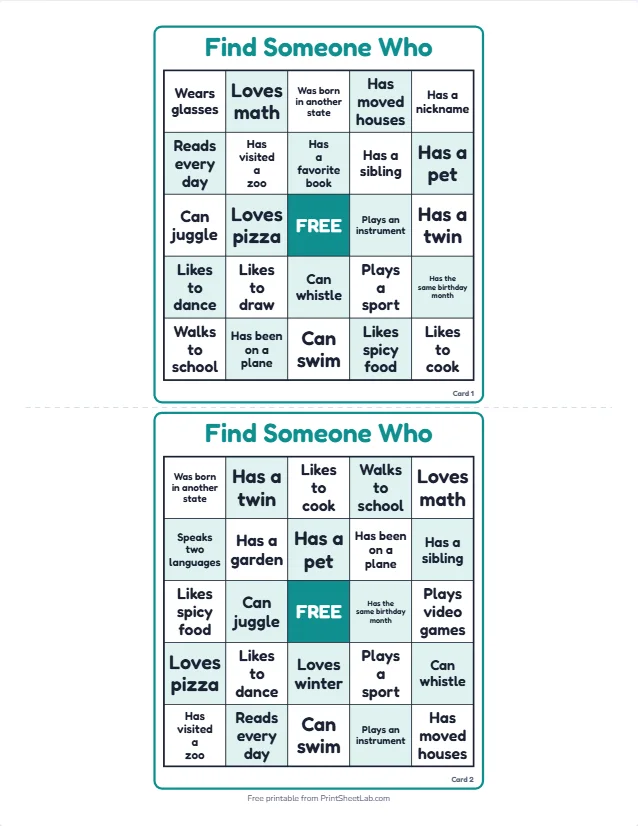
Getting to know you bingo: what it is and why it works
A teacher on the first morning of term faces 25 children who mostly do not know each other. A manager on a new project faces a team that has never shared a table. In both cases, getting to know you bingo gives people a purpose for talking before they have anything to say. The getting to know you bingo card does the work of starting the conversation, and the conversation does the work of building the group.
The structure is simple. Each square holds a statement that is true of some people and not of others. A student asks, “Do you have a pet?”, and if the answer is yes, the other person signs or initials the square. Once a student has a full row, column or diagonal, they call “Bingo!”. Because the middle square is free, a line through the center takes only four signatures, which is a few minutes of walking.
Getting to know you bingo also scales across ages with almost no change. Six-year-olds do it with a 3×3 grid and a teacher reading the squares aloud; adults do it with a 5×5 grid over coffee. The classroom management literature, summarized in the Wikipedia article on classroom management, stresses early routines and relationships, and getting to know you bingo builds both in one activity: it teaches the signal for starting, the signal for stopping, and the names of the people at the next desk.
Get to know you bingo: the 29 squares in this set
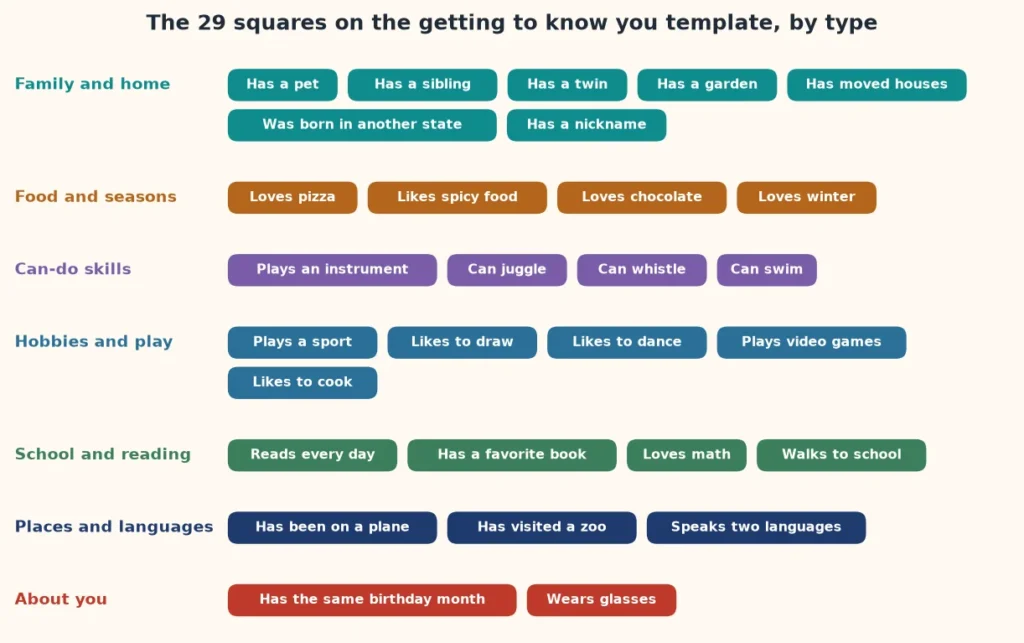
This get to know you bingo template uses 29 statements. Nothing on it asks for private information: there are no questions about family structure, money, health or religion, and every square is something a child or an adult can say yes or no to in a second. A 5×5 card with a free center needs 24 squares, so five of the 29 are left out of each card, and which five changes from card to card.
| Type | Squares on the list | Count |
|---|---|---|
| Family and home | Has a pet, Has a sibling, Has a twin, Has a garden, Has moved houses, Was born in another state, Has a nickname | 7 |
| Food and seasons | Loves pizza, Likes spicy food, Loves chocolate, Loves winter | 4 |
| Can-do skills | Plays an instrument, Can juggle, Can whistle, Can swim | 4 |
| Hobbies and play | Plays a sport, Likes to draw, Likes to dance, Plays video games, Likes to cook | 5 |
| School and reading | Reads every day, Has a favorite book, Loves math, Walks to school | 4 |
| Places and languages | Has been on a plane, Has visited a zoo, Speaks two languages | 3 |
| About you | Has the same birthday month, Wears glasses | 2 |
One square needs a note. “Has the same birthday month” means the same month as the person holding the card, so teach students to ask, “Is your birthday in March?” if they were born in March. A square that depends on the card holder can confuse younger children, and you may want to rename it “Has a birthday in my month” on the Items tab.
The squares of getting to know you bingo are not equally easy. In our simulation below we assume that about 15 percent of squares fit 60 percent of a class (pets, pizza, swimming), 25 percent fit 40 percent, 30 percent fit a quarter, 20 percent fit about one in eight, and 10 percent fit about one in twenty (twins, juggling).
That mix averages 29 percent, which is higher than an adult room, because children share more habits. These are our planning assumptions, not survey data, and a class of swimmers or a class of newcomers will behave differently.
How to play getting to know you bingo
The rules of getting to know you bingo fit on the whiteboard. Here is the sequence for running getting to know you bingo with a class or a group of up to about 40.
- Give each person a card and a pencil. Pencil is kinder than pen for children, because a mistaken initial can be erased.
- Model one square. Walk up to a volunteer, ask “Do you play an instrument?” and show how they sign. Children who see the first conversation copy it.
- State the rules. Ask one person at a time. One signature per person on your card. You may not sign your own card. Sign a square only if the statement is true.
- Set the time. 5 to 10 minutes is enough for a line in a class of 24 (see the simulation), 15 for a mixed adult group. Show the clock or use a timer on the board.
- Mingle. Everyone stands and walks. Teachers watch for children who are left out and quietly steer them to a partner.
- Call a bingo. A student with a line says “Bingo!” and reads the signed squares to the class. The people who signed stand up when their name is read.
- Share back. Ask two or three questions: “Who found someone who has a twin?” “What was the strangest thing you learned?” The share-back is where the names stick.
Variations on the winning rule
| Win condition | What it needs | Best for |
|---|---|---|
| One line | 4 signatures through the center, 5 elsewhere | Every class; the default |
| Four corners | 4 signatures, but no free center help | A short second round |
| Two lines | About 8 to 9 signatures | Groups of 20 or more with 15 minutes |
| Blackout | 24 different people (needs 25 people in the room) | Large groups only; too hard for most classes |
| Time limit, most squares | Whatever you can sign before the bell | Mixed ages, and the fairest for shy students |
Time limits and prizes
In getting to know you bingo, the time limit is a more important choice than the prize. An open-ended “first to finish” round gives the quickest student the whole stage and leaves the rest standing around once the winner has shouted. A fixed round, such as seven minutes with a visible timer, keeps all students mingling until the end and lets the teacher count signed squares afterwards.
For prizes, use something that helps the group: first choice of a seat, a sticker for the whole table, five minutes of free reading. Competition is not the aim here; the winner is simply the person who happens to stand near the right people.
Getting to know you bingo free: set up the card maker
This getting to know you bingo free set is built in the browser, so there is nothing to download first. The full-screen editor has five tabs: Setup, Items, Design, Templates and Print. Here is what each tab does for getting to know you bingo.
- Setup. The template is a 5×5 grid with a free center. Choose 3×3 (8 squares plus a free center) for the youngest children or 4×4 (16 squares, no free space) for a middle level.
- Items. Edit the 29 statements, delete any that do not fit, or add your own. The free square can say FREE, show an emoji, hold a picture or carry your class name.
- Design. Choose a color theme (this template uses teal), font, text size, borders and a title. The title here is “Find Someone Who”; change it to “Meet Room 12” or anything else. You can also add a logo and print each student’s name on their card.
- Print. Choose 1 to 100 different cards, 1, 2, 4 or 6 per page, Letter or A4, portrait or landscape, and optional cut guides. Download the PDF or print directly. A shareable link stores your words only.
Getting to know you bingo has plenty of different cards to go around. With 29 statements and 24 squares per card there are 118,755 different sets of 24. A 4×4 card uses 16 squares, which gives 67,863,915 sets from the same list, and a 3×3 card uses 8, giving 4,292,145 sets. Each set can also be arranged in many orders, so a stack of 100 cards will not have two neighbors holding the same board. The caller sheet and calling cards in the Print tab are for number bingo and can be left off.
Get to know you bingo printable: card sizes by age
The right grid size for getting to know you bingo depends on reading level and attention span, not on the size of the class. A get to know you bingo printable that is too big loses younger children halfway round the room. Here is the size we suggest for each stage, with what each size needs.
| Age or stage | Card | Squares needed | Signatures for a line | Notes |
|---|---|---|---|---|
| Pre-K to grade 1 (ages 4 to 7) | 3×3 with free center | 8 | 2 or 3 | Teacher reads each square; use emoji or pictures on the Items tab |
| Grades 2 and 3 (ages 7 to 9) | 4×4, or 3×3 to start | 16 (or 8) | 4 (or 2 to 3) | No free square on 4×4; allow two names per person at first |
| Grades 4 and 5 (ages 9 to 11) | 5×5 with free center | 24 | 4 or 5 | Keep squares short; a pencil and a clipboard help |
| Middle and high school | 5×5 | 24 | 4 or 5 | Rewrite squares for the grade; avoid anything childish |
| Adults and teams | 5×5, first line | 24 | 4 or 5 | Neutral squares, 10 to 15 minutes |
The editor handles all three sizes of getting to know you bingo. Remember that a grid needs fewer squares than your list holds, so a list of 29 is enough for every size above, and extra squares just rotate across cards. If a class is very small, say eight students, go down a size. A 5×5 card needs four different signatures for the shortest line, and a class of eight can offer only seven partners.
First day of school bingo: a plan for week one
First day of school bingo is the same game with a purpose: names, faces and a shared first success. Teachers use it on the first morning because it requires nothing from students except standing up and talking, and it shows the teacher at once who is confident, who is shy and who needs a friend. The plan below fits a 30-minute slot and uses the getting to know you bingo template as it is.
| Minutes | What happens | What the teacher does |
|---|---|---|
| 0 to 3 | Hand out cards and pencils, and explain the rules | Model one conversation with a volunteer |
| 3 to 5 | Practice round: find one signature each | Check that everyone knows how to ask |
| 5 to 15 | First mingle for a line | Steer students who are alone toward a partner |
| 15 to 20 | Bingo reading and share-back | Ask who learned something surprising |
| 20 to 28 | Second mingle for a different line | Use the squares nobody has signed as discussion starters |
| 28 to 30 | Collect cards | Skim them to see who signed whose, which shows who is already connected |
For first day of school bingo, collect the cards at the end and read them. A card with a name in every square belongs to a connected student; a card with four signatures from the same small group is a hint about who is sitting together. You can also keep the cards, and in the second week use the signed names to make seating groups. If the cards go home, they double as a note to parents: “Ask me who has a twin”.
Getting to know you bingo suits any first day, not just school. For the first day of a course, a camp, a club or a new team, swap two or three squares for local ones, as the customizing section explains. If your lesson on day one is about the class itself, our classroom bingo page covers review games where the teacher calls the clues, and the icebreaker questions page has 84 questions to use alongside the cards.
All about me bingo: let students write the squares
A second way to use these cards is all about me bingo, where the squares come from the students. Each child writes three or four true statements about themselves on slips of paper, such as “I have a pet snake” or “I can ride a unicycle”. The teacher types the slips into the Items tab, prints a set of cards, and students find the child who wrote each statement. Instead of finding anyone who fits, they have to find the specific person, which turns the game into a quick tour of the class.
All about me bingo needs more preparation, but it produces unusually good conversations. It works best with 20 to 30 children, because the list must have at least 24 squares to fill one 5×5 card and more than 24 to give different cards. The teacher should read the slips first, remove anything that might embarrass a child, and make sure every child appears at least once. Typed lists also make a good classroom display: print one card, enlarge it, and let the class see themselves on the wall.
You can also run all about me bingo as a take-home activity. Ask each student to fill in a blank card with five facts about themselves in the center row and column, then trade cards at the start of the next lesson. For a blank grid to write on, use the blank bingo cards page, which has an empty card in every size.
Icebreaker bingo for staff, camps and families
The same getting to know you bingo template works as icebreaker bingo far beyond the classroom. The point of an icebreaker is to make the first conversation easy, and icebreaker bingo does that with a task instead of a topic. The table below shows what we would pick for each setting.
| Setting | Group size | Card | Time | What to change |
|---|---|---|---|---|
| Class of children | 15 to 30 | 3×3 or 5×5, one line | 5 to 10 min | Little. The template works as it is |
| Summer camp or after-school club | 20 to 60 | 5×5, two rounds | 10 min each | Add camp squares: “Has been on a bunk bed” |
| Staff training day | 10 to 40 | 5×5, first line | 10 to 15 min | Replace childish squares; add work-neutral ones |
| New team onboarding | 6 to 15 | 3×3 or 4×4 | 8 to 10 min | Allow two names per person |
| Family gathering | 15 to 50 | 5×5 plus family squares | 15 min | Add squares such as “Lives in another state” |
| Parents’ evening or club meeting | 20 to 80 | 5×5, time-boxed | 15 min | Add squares about the school, the club or the neighborhood |
For adult groups, the sibling page on human bingo has an adult-tone list with squares such as “Has run a marathon”, and its page goes deeper on rules for large crowds and on blackout games. For a group on a video call, use Zoom bingo or meeting bingo, and for a themed party see the kitty party icebreaker games.
How long until a first line? A classroom simulation
We simulated getting to know you bingo in a class of 24 to answer the question every teacher asks: how long will this take? Each simulated student holds a card, and meets the 23 other students one at a time in random order.
In each conversation every unsigned square independently matches the partner with its own chance, drawn from the mix described above (average 29 percent). The partner signs one matching square, picked to build the line that is closest to finished, or two squares in the “two names per person” version. A conversation takes 30 seconds, including the walk. Each cell below is 2,500 simulated students.
| Card | Squares | Median to a line, one name per person | Median to a line, two names per person | Students with a line in 5 min (one name) | Same (two names) |
|---|---|---|---|---|---|
| 3×3, free center | 8 | 3 conversations, 1.5 min | 2 conversations, 1 min | 100 percent | 100 percent |
| 4×4, no free square | 16 | 7 conversations, 3.5 min | 4 conversations, 2 min | 94 percent | 99 percent |
| 5×5, free center | 24 | 8 conversations, 4 min | 5 conversations, 2.5 min | 83 percent | 98 percent |
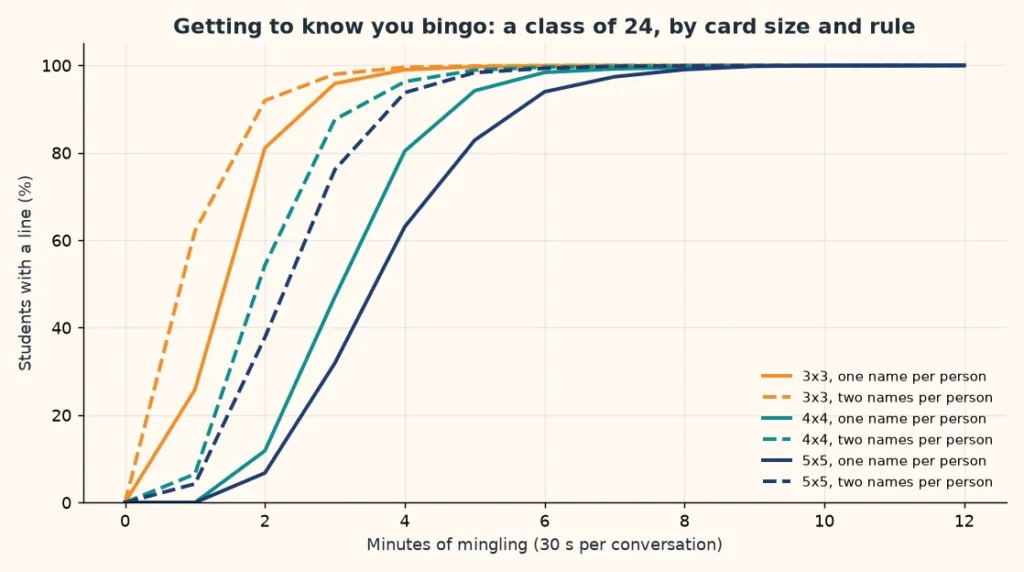
The numbers say three things about getting to know you bingo. First, card size is the big lever: the median student finishes a 3×3 line in 1.5 minutes, a 4×4 line in 3.5 minutes and a 5×5 line in 4 minutes.
Second, allowing two names per person is a strong shortcut: on a 5×5 card it cuts the median from 8 conversations to 5, which is 2.5 minutes instead of 4, and on a 4×4 card from 7 to 4. Third, nearly everyone finishes: after five minutes, 83 percent of students have a 5×5 line, and after ten minutes almost all of them do.
Assumptions, and why real classes are slower
- One card per student, 24 other students, each met at most once in random order.
- A conversation lasts 30 seconds. Real children take longer: a shy child, a search for a pencil and a long story about a pet all add time. Minutes scale linearly, so at 60 seconds per conversation, a 5×5 line takes about twice the figures above.
- Every unsigned square is checked against each partner, as if the child held out the card. A child who asks one question at a time is slower.
- Squares are independent of each other. In life a child who has a sibling is more likely to have a pet, so matches cluster.
- The mix of square popularity is our assumption (average 29 percent), not a survey.
Because the speed of a conversation is the thing you control least, here is the same data restated for slower mingles. Each cell is the median number of minutes to a first line, using the median conversation counts from the table above.
| Time per conversation | 3×3, one name | 4×4, one name | 5×5, one name | 5×5, two names |
|---|---|---|---|---|
| 30 seconds | 1.5 | 3.5 | 4 | 2.5 |
| 45 seconds | 2.25 | 5.25 | 6 | 3.75 |
| 60 seconds | 3 | 7 | 8 | 5 |
| 90 seconds | 4.5 | 10.5 | 12 | 7.5 |
Use the table to book the time for getting to know you bingo. For a 5×5 card in a class that chats at 60 seconds a time, plan 8 to 10 minutes, and give the same again if you want a second line. For a 3×3 card in kindergarten, 3 to 5 minutes is plenty, which suits a short attention span.
Does class size matter?
Class size matters very little in getting to know you bingo, once you have enough partners. We reran the 5×5 case for different classes: with 18, 24 and 32 students, the median student needed 8 conversations every time, and 100 percent of students finished a line.
A class of 12 is the exception: only 89 percent finished a line, because each student has just 11 partners and some of their squares are rare. If you teach a small class, use a 3×3 or 4×4 card, allow two names per person, or remove the rare squares (twin, juggling) on the Items tab.
Customizing the squares for your group
The 29 squares are a starting point for your own getting to know you bingo. Because the Items tab accepts any text, emoji or picture, you can write a set for one class in about ten minutes. These rules keep a custom getting to know you bingo list working.
- Keep every square true of some students. If nobody can sign it, it is a dead square. In a class of 20, a square that fits only one student in thirty will be empty about half the time.
- Keep every square answerable with yes or no. “Has a pet” works. “Favorite color” does not, because everyone has one.
- Mix the types. The chart above shows seven; a card with some of each gives every student a few easy squares and a few conversation starters.
- Write for the reading level. For ages 6 and 7, use three or four words, no abbreviations, and an emoji beside the text.
- Add local flavor. A square such as “Has been to the school fair” or “Knows the principal’s name” makes the card feel written for this class.
- Leave out the sensitive. Avoid anything about family structure, income, health, religion or appearance. A square like “Wears glasses” is fine, but remove it if you worry about teasing.
| Group | Squares to add or swap in |
|---|---|
| Kindergarten | Has a loose tooth, Can tie shoes, Has a stuffed animal, Likes to paint, Has a brother or sister |
| Upper elementary | Has read a chapter book, Has a collection, Can do a cartwheel, Plays chess, Has been camping |
| Middle and high school | Plays in a band, Has a part-time job, Has been to a concert, Speaks a third language, Knows how to code |
| Staff team | Takes the bus or train, Has worked here for over five years, Has a side project, Drinks tea not coffee, Has run a race |
| Camp or club | Has been on a bunk bed, Can tell a ghost story, Can light a campfire, Has been here before, Can paddle a canoe |
The Design tab lets you brand your getting to know you bingo cards: add a logo, rename the title, and print each student’s name on their card. For a school, the logo and class name turn the sheet into something parents recognize. To start getting to know you bingo from an empty grid rather than the 29 squares, open the bingo card generator.
Accessibility and inclusion
Getting to know you bingo assumes everyone can walk, hear, read and write at the same pace. Adjust the game so that all students can take part.
- Large print. Choose a larger text size in the Design tab, and print one card per page for students with low vision.
- Seated play. Students who cannot walk easily stay at their desks and a few “visitors” circulate. The seated student still collects signatures from the ones who come to them.
- Clear paths. Move chairs and bags so that a wheelchair or a walker can move around the room.
- Alternatives to writing. A check mark, a sticker or a buddy who writes the name for the student with a writing difficulty are all fine.
- Language support. For English learners, pair each statement with an emoji or a picture. A short, clear statement is easier to ask in a second language.
- Quiet option. Allow a student who finds crowds hard to work with one partner or inside a small group. The aim is connection, not a loud room.
More icebreaker pages and templates
- Human bingo is the adult-tone version, with squares such as “Plays chess” and detailed rules for big groups.
- Classroom bingo is for review games, where the teacher calls vocabulary or math clues.
- Zoom bingo and meeting bingo suit video calls and long meetings.
- Printable bingo cards lists every template and links to the card maker.
Frequently asked questions
10 quick answers
What is getting to know you bingo?
Getting to know you bingo is a mingling game. Each square on a card holds a statement such as “has a pet”, and players walk around finding a different person who fits each square. When someone completes a line, they call “Bingo!”. No numbers are called.
How many people do I need?
Getting to know you bingo on a 3×3 card works with eight or more people, and a 5×5 card works best with at least 15. In a class of 12 or fewer, use a smaller card or allow two names per person.
How long does it take?
In our simulation of a class of 24, the median student finished a 5×5 line in about 4 minutes at 30 seconds per chat. Plan 10 minutes for the game, plus a few more to explain it and share back.
Is this a good first day of school bingo?
Yes. This getting to know you bingo set uses squares that are all things a child can answer in a second, and the free center makes the first line short. Teachers use it to learn who is confident and who needs a buddy.
Can students use it for all about me bingo?
Yes. Collect a few true facts from each student, enter them on the Items tab, and print cards. Students then look for the person behind each fact.
Can I change the squares?
Yes. Every square of getting to know you bingo on the Items tab can be edited, deleted or replaced, and you can add emoji or your own pictures. A 5×5 card with a free space needs 24 squares, so keep at least 24 on the list.
Is it free?
Yes. Getting to know you bingo cards are free to print, there is no sign-up, and nothing you type is uploaded. Use them in class, at work or at home.
How many cards can I print at once?
Up to 100 different cards in a single print job, 1, 2, 4 or 6 to a page, on Letter or A4 paper. Each card is a different arrangement of your list.
What grade level is it for?
The getting to know you bingo template reads at about a grade 2 level and works through adults. For ages 4 to 7, use a 3×3 card and read the squares aloud; for grades 4 and up, use 5×5.
Can we do it online?
You can, using chat or a shared document, but it is best in person. For video calls see our Zoom bingo page, and for a custom card game with a link see the play custom bingo online page.