A unit converter changes a measurement from one unit to another, such as inches to cm, pounds to kg or Fahrenheit to Celsius. This free unit converter handles nine measures, from length and weight to energy and pressure, in metric, US customary and UK imperial units, and shows the conversion factor, the working and the answer in every other unit at once.
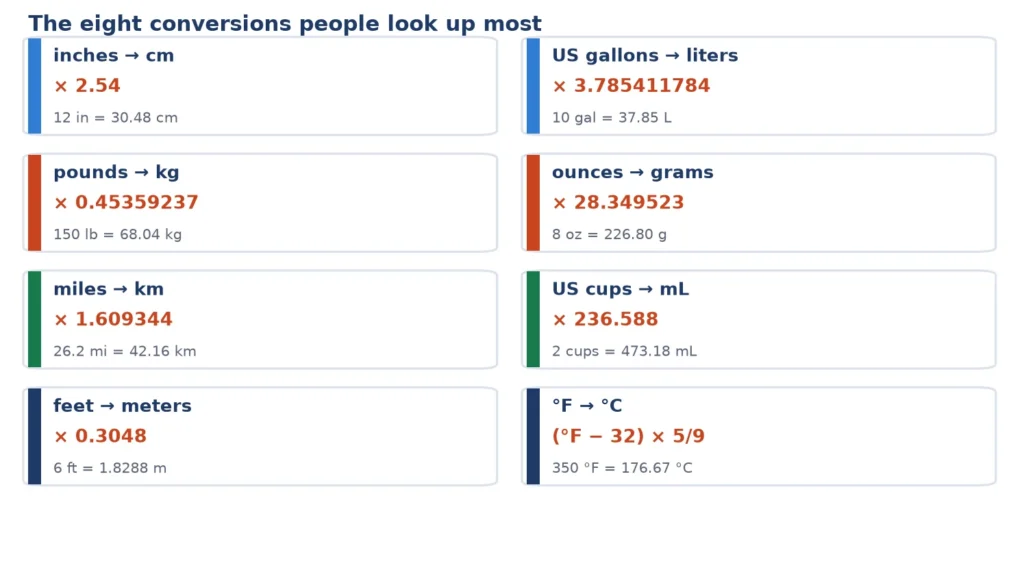
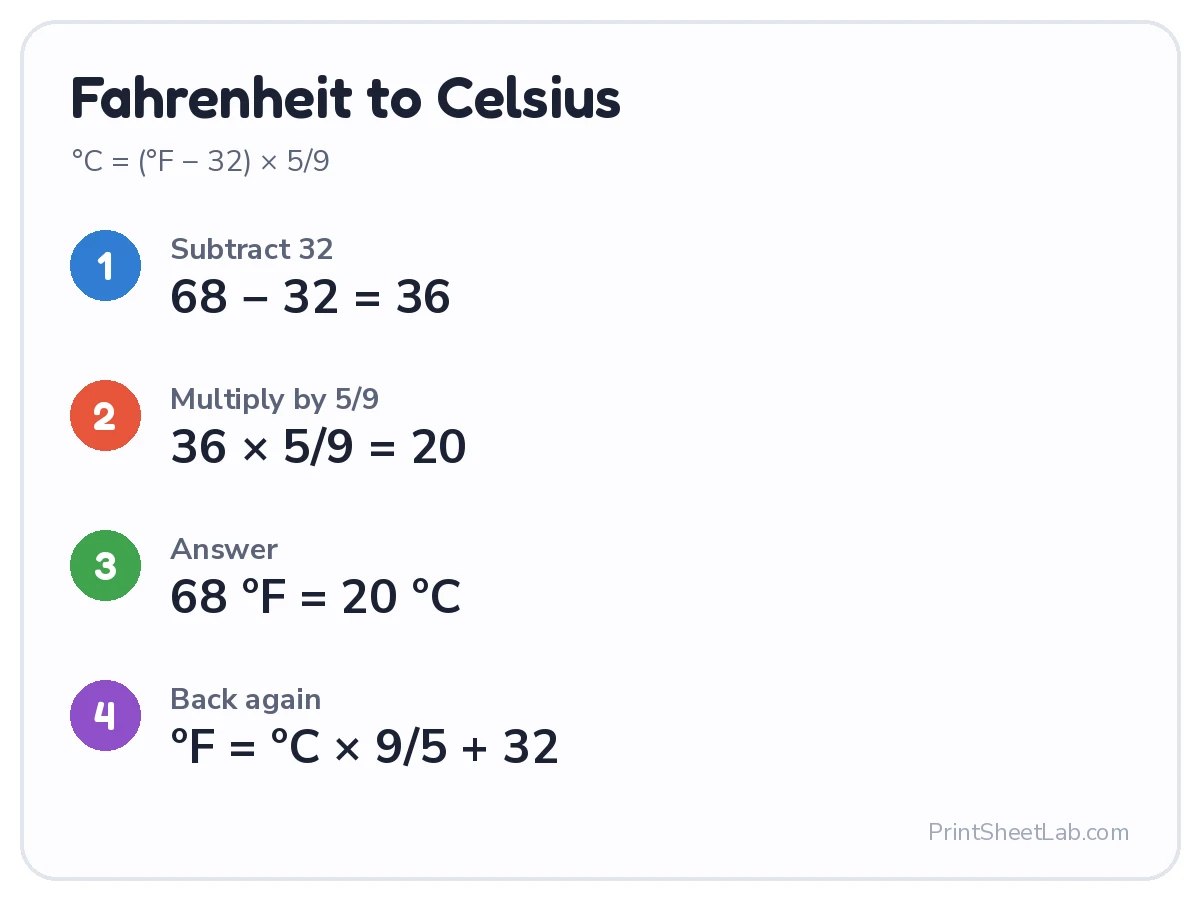
Quick answer: To convert, multiply by the conversion factor. Inches to cm: × 2.54, so 12 in = 30.48 cm. Pounds to kg: × 0.45359237, so 150 lb = 68.04 kg. Miles to km: × 1.609344. Feet to meters: × 0.3048. US gallons to liters: × 3.785411784. Fahrenheit to Celsius uses a formula instead: (°F − 32) × 5/9, so 68 °F = 20 °C.
How to use the unit converter
- Choose what you are converting: length, weight and mass, volume, area, speed, time, temperature, energy or pressure. The unit lists change to match.
- Type the value. Commas, decimals and fractions such as 1/2 or 5 1/2 all work, and the quick-pick buttons fill in common numbers.
- Pick the From and To units. The converter starts with the most common pair for each measure.
- Read the answer, the conversion factor, the reverse factor and the table that shows your value in every other unit of the same measure.
- Open How it works to see the multiplication and a check that goes back the other way, then copy the result or the link.
| Measure | Units included |
|---|---|
| Length | inches, centimeters, feet, meters, yards, miles, kilometers, millimeters, nautical miles |
| Weight and mass | pounds, kilograms, ounces, grams, stone, milligrams, metric tons, US short tons, UK long tons, troy ounces, carats |
| Volume | US gallons, liters, milliliters, US quarts, pints, cups, fluid ounces, tablespoons and teaspoons, UK gallons, quarts, pints and fluid ounces, metric cups, cubic meters, feet, inches and yards |
| Area | square feet, meters, inches, centimeters, yards, acres, hectares, square kilometers and miles |
| Speed | miles per hour, kilometers per hour, meters per second, knots, feet per second |
| Time | hours, minutes, seconds, days, weeks, months, years, milliseconds |
| Temperature | Fahrenheit, Celsius, kelvin |
| Energy | kilocalories (food Calories), kilojoules, joules, calories, watt-hours, kilowatt-hours, BTU |
| Pressure | psi, bar, kilopascals, pascals, atmospheres, millimeters and inches of mercury |
Conversion examples and a printable metric conversion chart
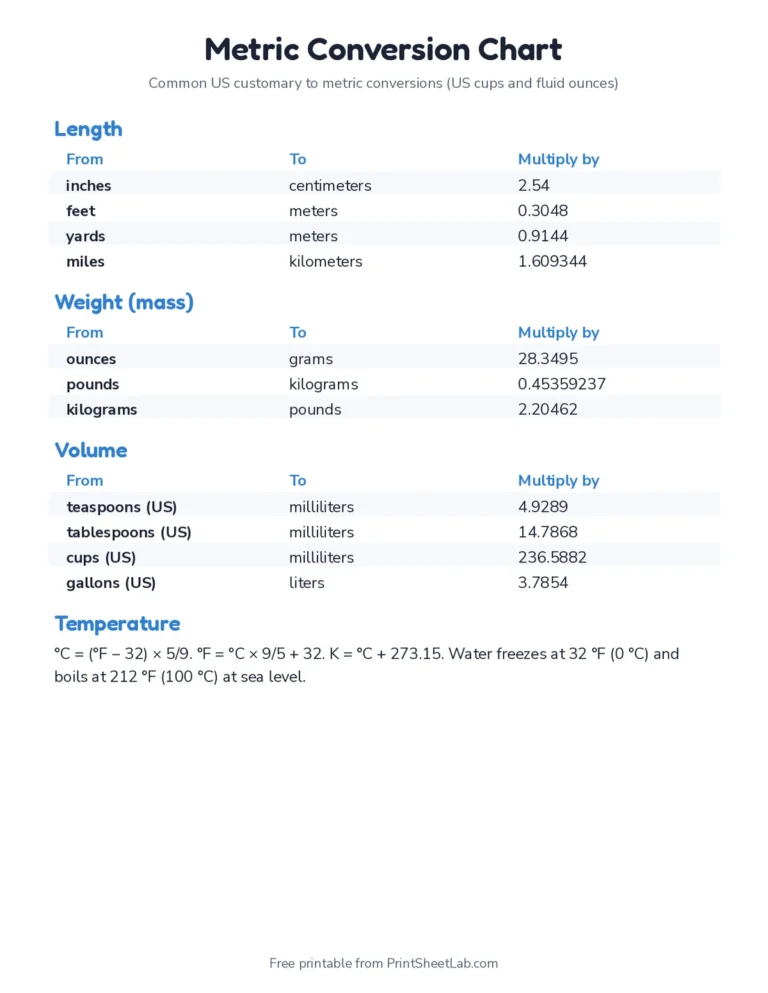
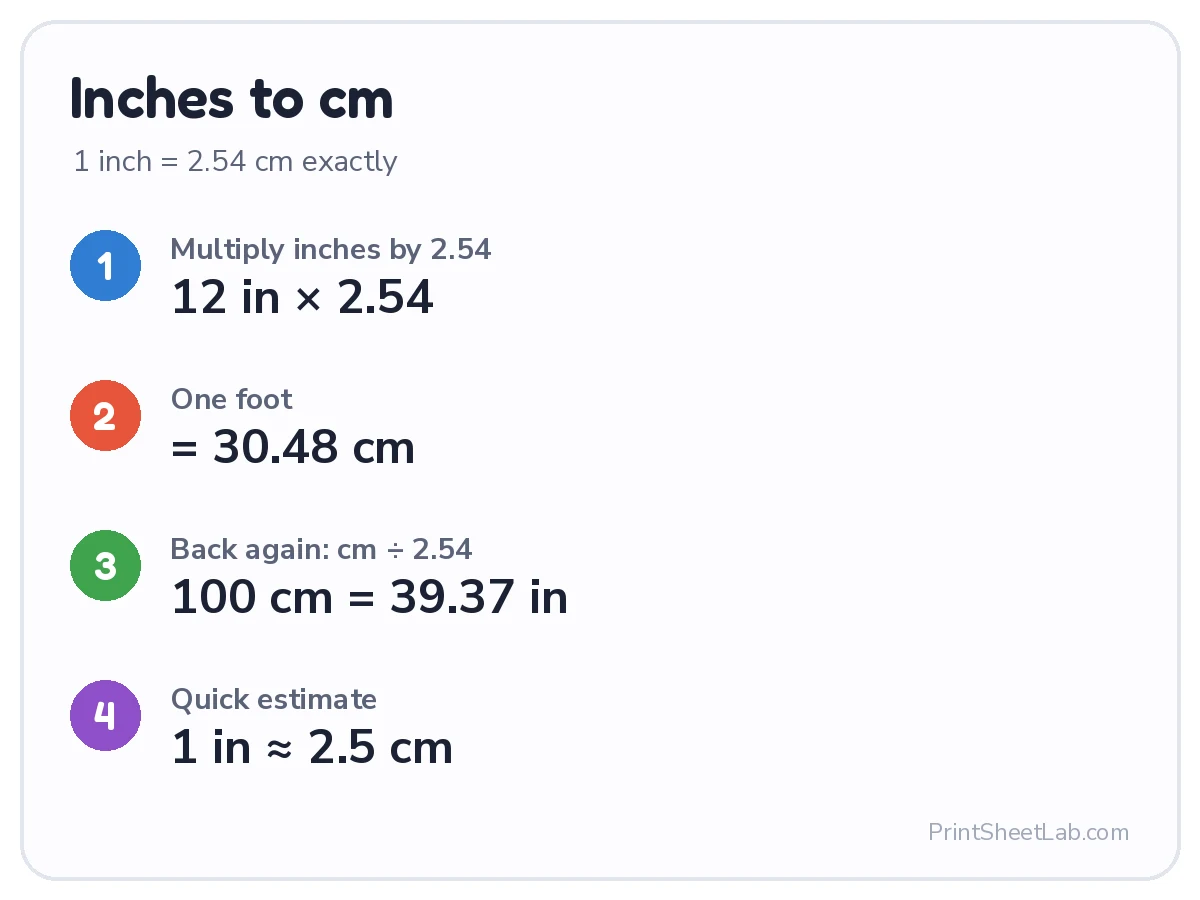
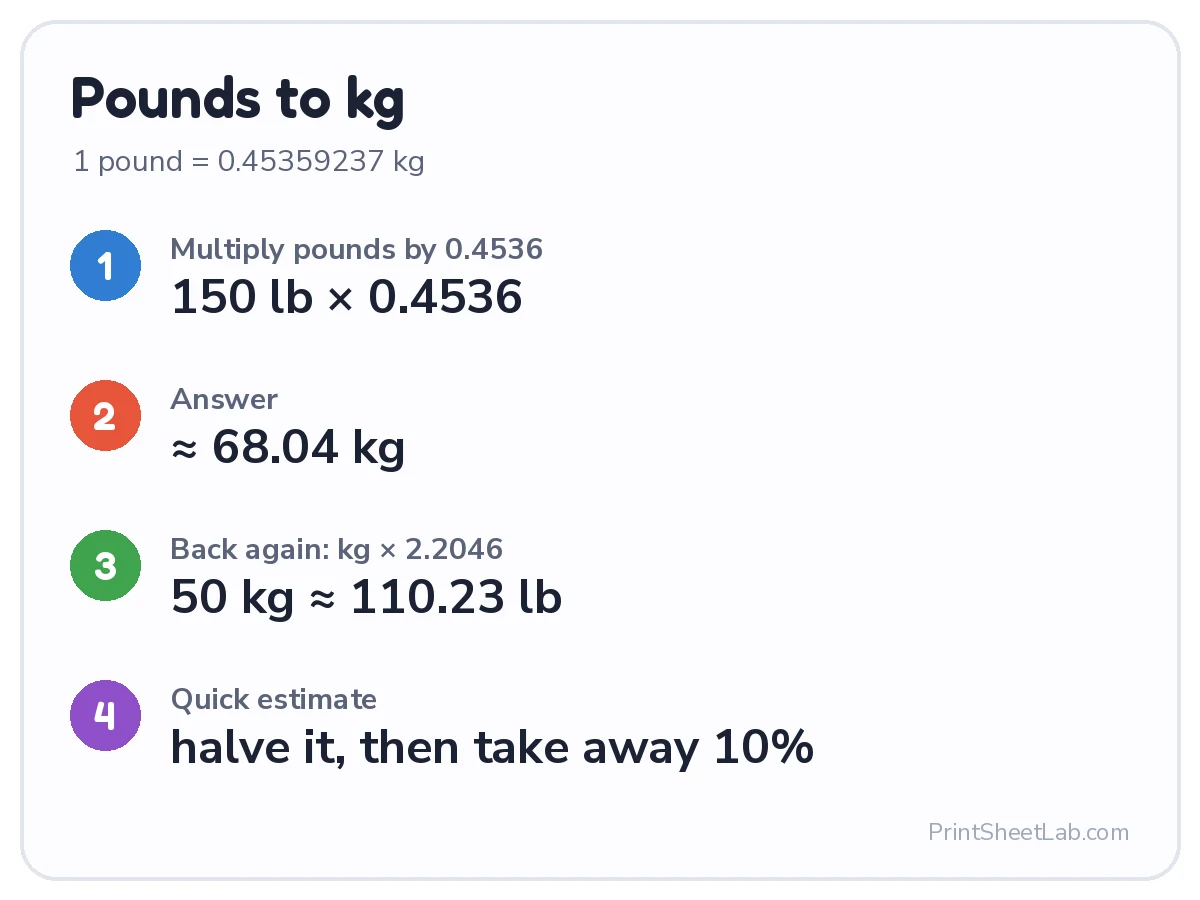
The cards walk through four of the most searched conversions. The printable metric conversion chart lists the multipliers for common length, weight and volume conversions plus the temperature formulas, sized to stick inside a cupboard door or a math notebook.
Inches to cm and other length conversions
One inch is exactly 2.54 centimeters, by international agreement. To convert inches to cm, multiply by 2.54: 12 inches is 30.48 cm, and a 55-inch TV is 139.7 cm across the diagonal. To go back, divide centimeters by 2.54: 100 cm is 39.37 inches. For millimeters, 1 mm is 0.0393701 inches and 25.4 mm is exactly 1 inch. A quick mental estimate is to call an inch 2.5 cm, so 4 inches is about 10 cm.
| Inches | Centimeters | Millimeters | Note |
|---|---|---|---|
| 0.25 | 0.635 | 6.35 | quarter inch |
| 0.5 | 1.27 | 12.7 | half inch |
| 1 | 2.54 | 25.4 | — |
| 2 | 5.08 | 50.8 | — |
| 3 | 7.62 | 76.2 | — |
| 4 | 10.16 | 101.6 | 4 by 6 photo, short side |
| 6 | 15.24 | 152.4 | 6 by 4 photo, long side |
| 8.5 | 21.59 | 215.9 | US letter paper, width |
| 11 | 27.94 | 279.4 | US letter paper, length |
| 12 | 30.48 | 304.8 | one foot |
| 36 | 91.44 | 914.4 | one yard |
A4 paper is 210 by 297 mm, which is 8.27 by 11.69 inches, and US letter is 8.5 by 11 inches, or 21.59 by 27.94 cm. Screen sizes are quoted as the diagonal in inches.
| Screen size (inches) | Centimeters |
|---|---|
| 6.1 | 15.49 |
| 13.3 | 33.78 |
| 15.6 | 39.62 |
| 24 | 60.96 |
| 32 | 81.28 |
| 43 | 109.22 |
| 55 | 139.7 |
| 65 | 165.1 |
| 75 | 190.5 |
Heights are often given in feet and inches. To convert 5 ft 10 in to centimeters, change to inches (5 × 12 + 10 = 70) and multiply by 2.54 to get 177.8 cm.
| Height | Inches | Centimeters | Meters |
|---|---|---|---|
| 5 ft 0 in | 60 | 152.4 | 1.524 |
| 5 ft 2 in | 62 | 157.48 | 1.575 |
| 5 ft 4 in | 64 | 162.56 | 1.626 |
| 5 ft 6 in | 66 | 167.64 | 1.676 |
| 5 ft 8 in | 68 | 172.72 | 1.727 |
| 5 ft 10 in | 70 | 177.8 | 1.778 |
| 6 ft 0 in | 72 | 182.88 | 1.829 |
| 6 ft 2 in | 74 | 187.96 | 1.88 |
| 6 ft 4 in | 76 | 193.04 | 1.93 |
Feet to meters
To convert feet to meters, multiply by 0.3048, which is the exact definition of the international foot. A person 6 feet tall is 1.8288 meters. To convert meters to feet, multiply by 3.28084: a 100 m sprint is about 328 feet. Mile-high Denver sits at 5,280 feet, which is exactly 1,609.344 meters, because a mile is 5,280 feet.
| Feet | Meters | Meters | Feet |
|---|---|---|---|
| 1 | 0.3048 | 1 | 3.281 |
| 3 | 0.9144 | 2 | 6.562 |
| 5 | 1.524 | 5 | 16.404 |
| 6 | 1.8288 | 10 | 32.808 |
| 10 | 3.048 | 50 | 164.042 |
| 100 | 30.48 | 100 | 328.084 |
For rooms and land, remember that areas convert with the square of the factor: 1 square foot is 0.092903 square meters. The area calculator shows the same area in both units.
Miles to km and speed conversions
To convert miles to km, multiply by 1.609344. Ten miles is 16.09344 km, and a marathon of 26.2 miles is 42.16 km (the official distance is 42.195 km, or 26.2188 miles). To convert km to miles, multiply by 0.621371: a 5 km run is 3.107 miles and a 10 km run is 6.214 miles. A mental shortcut is to multiply miles by 1.6, or to divide kilometers by 1.6.
| Miles | Kilometers | Kilometers | Miles |
|---|---|---|---|
| 1 | 1.609 | 1 | 0.621 |
| 5 | 8.047 | 5 | 3.107 |
| 10 | 16.093 | 10 | 6.214 |
| 13.1 | 21.082 | 21.1 | 13.109 |
| 26.2 | 42.165 | 42.2 | 26.219 |
| 100 | 160.934 | 100 | 62.137 |
Speed limits show the same factor in action, converting miles per hour to kilometers per hour. A knot, used at sea and in the air, is one nautical mile per hour, or 1.852 km/h.
| Miles per hour | Kilometers per hour | Meters per second | Knots |
|---|---|---|---|
| 25 | 40.2 | 11.18 | 21.7 |
| 30 | 48.3 | 13.41 | 26.1 |
| 45 | 72.4 | 20.12 | 39.1 |
| 55 | 88.5 | 24.59 | 47.8 |
| 65 | 104.6 | 29.06 | 56.5 |
| 70 | 112.7 | 31.29 | 60.8 |
| 75 | 120.7 | 33.53 | 65.2 |
Pounds to kg and weight conversions
One pound is exactly 0.45359237 kilograms. To convert pounds to kg, multiply by 0.4536 or divide by 2.2046: 150 lb is 68.04 kg. To convert kilograms to pounds, multiply by 2.2046, so 50 kg is 110.23 lb. A handy mental method from pounds to kilograms is to halve the number, then take away 10% of the result: 150 halves to 75, 75 minus 7.5 is 67.5, close to the exact 68.04.
| Pounds | Kilograms | Kilograms | Pounds |
|---|---|---|---|
| 1 | 0.45 | 1 | 2.2 |
| 10 | 4.54 | 5 | 11.02 |
| 50 | 22.68 | 10 | 22.05 |
| 100 | 45.36 | 25 | 55.12 |
| 150 | 68.04 | 50 | 110.23 |
| 200 | 90.72 | 70 | 154.32 |
| 250 | 113.4 | 80 | 176.37 |
| 300 | 136.08 | 100 | 220.46 |
For weights shown as pounds and ounces, such as a baby’s birth weight, convert the ounces to a fraction of a pound first (16 ounces make a pound). 7 lb 8 oz is 7.5 lb, or 3.402 kg. To split kilograms into pounds and ounces, 70 kg is 154.324 lb, which is 154 lb 5.2 oz.
Stone to kg and pounds
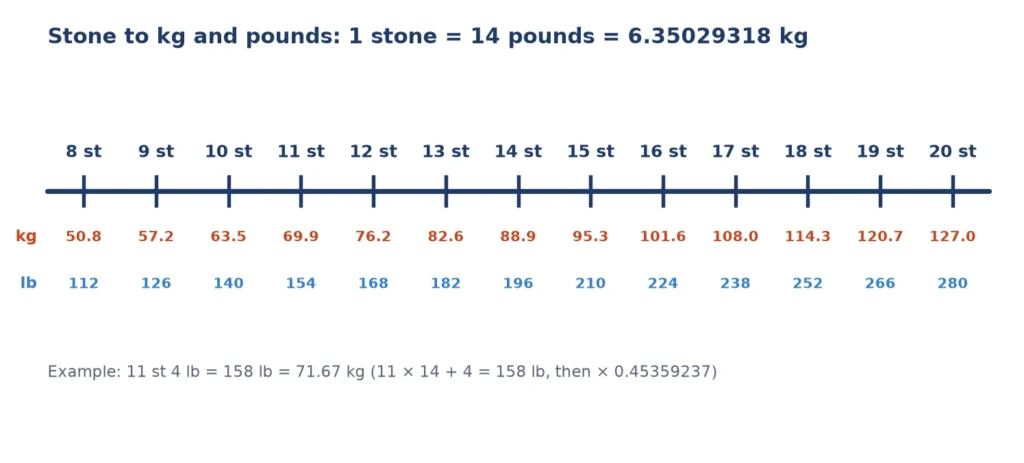
A stone is 14 pounds, or 6.35029318 kg. To convert stone to kg, multiply by 6.35029; to convert stone and pounds, change everything to pounds first. Body weight is quoted in stone and pounds in the UK and Ireland. So 11 stone 4 pounds is 11 × 14 + 4 = 158 lb, and 158 × 0.45359237 = 71.67 kg. To go the other way, divide kilograms by 6.35029: 70 kg is 11.023 stone, which is 11 stone 0.3 lb.
| Stone | Pounds | Kilograms |
|---|---|---|
| 8 st | 112 | 50.8 |
| 9 st | 126 | 57.2 |
| 10 st | 140 | 63.5 |
| 11 st | 154 | 69.9 |
| 12 st | 168 | 76.2 |
| 13 st | 182 | 82.6 |
| 14 st | 196 | 88.9 |
| 15 st | 210 | 95.3 |
| 16 st | 224 | 101.6 |
| 17 st | 238 | 108 |
| 18 st | 252 | 114.3 |
| 19 st | 266 | 120.7 |
| 20 st | 280 | 127 |
The stone is not used for body weight in the United States, which uses pounds. If you see a half stone, it is 7 pounds. Two other units share the name ton: the US short ton of 2,000 lb (907.18 kg) and the UK long ton of 2,240 lb (1,016.05 kg), compared with the metric ton of 1,000 kg.
Ounces to grams
One avoirdupois ounce, the everyday ounce, is 28.349523125 grams, so ounces to grams is a multiplication by 28.35: 8 ounces is 226.8 g. To convert grams to ounces, multiply by 0.035274 or divide by 28.35. Sixteen ounces make a pound, which is why 16 oz is 453.592 g. Precious metals are different: gold, silver and platinum are priced per troy ounce, which is 31.1034768 grams, about 10% heavier than the everyday ounce.
| Ounces | Grams | Grams | Ounces |
|---|---|---|---|
| 0.25 | 7.09 | 10 | 0.353 |
| 0.5 | 14.17 | 50 | 1.764 |
| 1 | 28.35 | 100 | 3.527 |
| 2 | 56.7 | 250 | 8.818 |
| 4 | 113.4 | 500 | 17.637 |
| 8 | 226.8 | 750 | 26.455 |
| 12 | 340.19 | 1,000 | 35.274 |
| 16 | 453.59 | 2,000 | 70.548 |
For cooking, ounces by weight and fluid ounces by volume are not the same thing. A fluid ounce measures space (29.57 mL), while an ounce measures weight (28.35 g). To change cups of an ingredient to grams, you need its density; use the cups to grams converter.
Gallons to liters: US and UK gallons
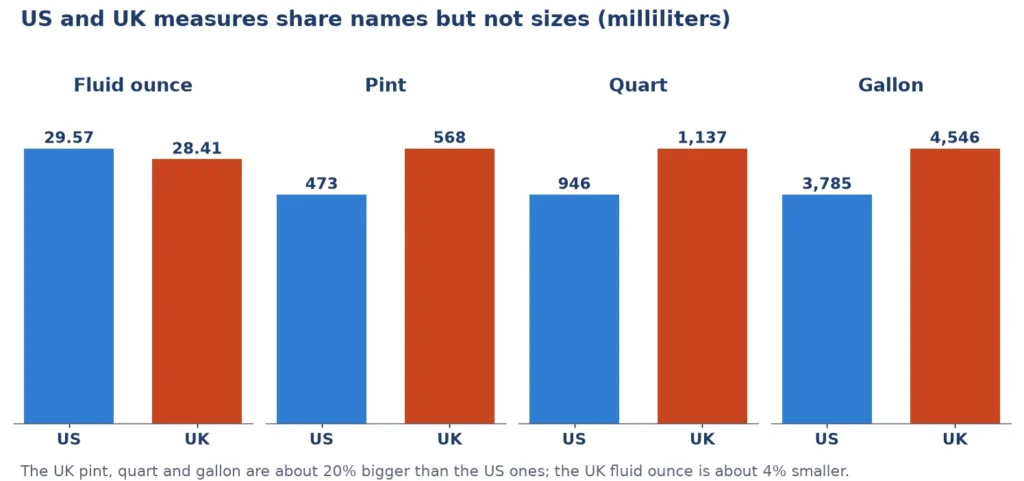
To convert US gallons to liters, multiply by 3.785411784: 10 gallons is 37.85 liters. To convert liters to US gallons, multiply by 0.264172: a 50 liter tank is 13.21 gallons. The UK or imperial gallon is bigger, at exactly 4.54609 liters, so 10 UK gallons is 45.46 liters. Always check which gallon a label or a car manual uses.
| US gallons | Liters | UK gallons | Liters |
|---|---|---|---|
| 1 | 3.79 | 1 | 4.55 |
| 2.5 | 9.46 | 2.5 | 11.37 |
| 5 | 18.93 | 5 | 22.73 |
| 10 | 37.85 | 10 | 45.46 |
| 15 | 56.78 | 15 | 68.19 |
| 20 | 75.71 | 20 | 90.92 |
| 26 | 98.42 | 26 | 118.2 |
Fuel prices make the conversion practical. If gas costs $3.50 per US gallon, that is $3.50 ÷ 3.785 = $0.925 per liter. In the other direction, a price of $1.50 per liter is 1.50 × 3.785 = $5.68 per US gallon. Fuel economy converts too: miles per US gallon times 0.425 gives kilometers per liter, and 235.215 divided by mpg gives liters per 100 km. For that, use the MPG calculator.
Cups to ml and kitchen conversions
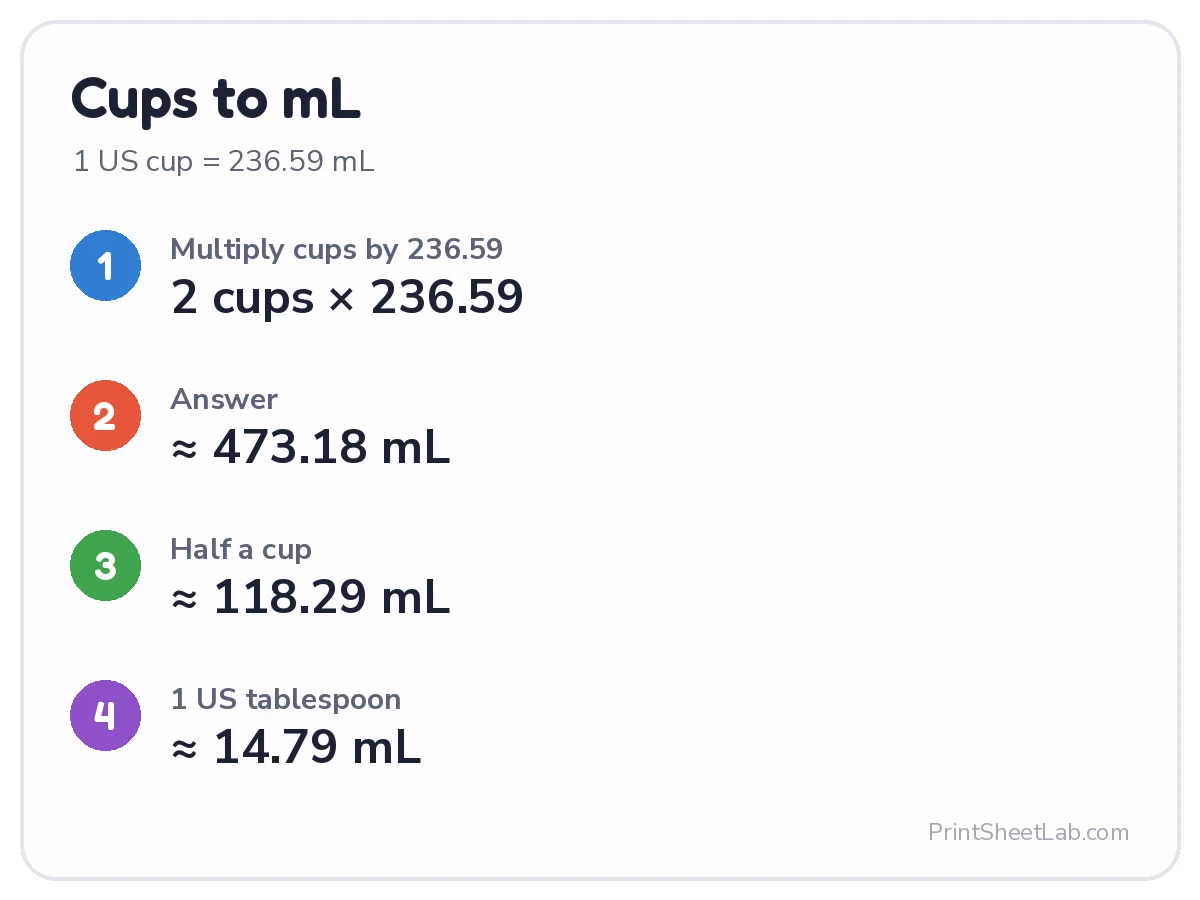
Recipes from different countries use different measures, which is where a unit converter saves the day. One US cup is 236.588 mL, so to convert cups to ml multiply by about 236.6: 2 cups is 473.18 mL and half a cup is 118.29 mL. A US tablespoon is 14.787 mL and a teaspoon is 4.929 mL. A metric cup, used in Australia, New Zealand and some other countries, is 250 mL. In Australia a tablespoon is 20 mL rather than the 15 mL most other countries use, according to Wikipedia’s tablespoon article.
| US measure | Milliliters | US fluid ounces |
|---|---|---|
| 1 teaspoon | 4.9 | 0.17 |
| 1 tablespoon | 14.8 | 0.5 |
| 1/4 cup | 59.1 | 2 |
| 1/3 cup | 78.9 | 2.67 |
| 1/2 cup | 118.3 | 4 |
| 2/3 cup | 157.7 | 5.33 |
| 3/4 cup | 177.4 | 6 |
| 1 cup | 236.6 | 8 |
| 1 pint (2 cups) | 473.2 | 16 |
| 1 quart (4 cups) | 946.4 | 32 |
For baking, weighing dry ingredients is more accurate than measuring by volume, because a cup of flour can weigh more or less depending on how it is packed. Use the cups to grams converter for common ingredients.
Fahrenheit to Celsius and Kelvin
Temperature scales do not start at the same zero, so they need a formula rather than a single multiplier. To convert Fahrenheit to Celsius, subtract 32 and multiply by 5/9: (68 − 32) × 5/9 = 20 °C. To convert Celsius to Fahrenheit, multiply by 9/5 and add 32: 100 × 9/5 + 32 = 212 °F, the boiling point of water at sea level. Kelvin is Celsius plus 273.15, so 20 °C is 293.15 K. The scale −40 is the same in both Fahrenheit and Celsius.
| Fahrenheit | Celsius | Kelvin |
|---|---|---|
| -40 °F | -40 °C | 233.15 K |
| 0 °F | -17.78 °C | 255.37 K |
| 32 °F | 0 °C | 273.15 K |
| 50 °F | 10 °C | 283.15 K |
| 68 °F | 20 °C | 293.15 K |
| 72 °F | 22.22 °C | 295.37 K |
| 98.6 °F | 37 °C | 310.15 K |
| 212 °F | 100 °C | 373.15 K |
| 350 °F | 176.67 °C | 449.82 K |
| 375 °F | 190.56 °C | 463.71 K |
| 400 °F | 204.44 °C | 477.59 K |
| 425 °F | 218.33 °C | 491.48 K |
| 450 °F | 232.22 °C | 505.37 K |
| Celsius | Fahrenheit |
|---|---|
| -10 °C | 14 °F |
| 0 °C | 32 °F |
| 10 °C | 50 °F |
| 20 °C | 68 °F |
| 25 °C | 77 °F |
| 30 °C | 86 °F |
| 37 °C | 98.6 °F |
| 100 °C | 212 °F |
| 180 °C | 356 °F |
| 200 °C | 392 °F |
| 220 °C | 428 °F |
Useful anchors: water freezes at 32 °F (0 °C), a comfortable room is 68 to 72 °F (20 to 22 °C), normal body temperature is about 98.6 °F (37 °C) and a typical baking temperature of 350 °F is 176.7 °C. A temperature change is different from a temperature: a rise of 10 °C is a rise of 18 °F, with no 32 added. See also the temperature converter.
US customary, metric and UK imperial units compared
Three systems are in everyday use. The metric system, built on powers of ten, is standard for science and for most countries. US customary units are used in the United States for most daily life. The UK uses a mixture: metric for most things, but miles on road signs, pints for beer and milk and stone for body weight. The names often match, but the sizes do not.
| Quantity | US customary | UK imperial | Metric |
|---|---|---|---|
| Length | inch, foot, yard, mile | inch, foot, yard, mile (same sizes) | millimeter, centimeter, meter, kilometer |
| Weight | ounce, pound, short ton (2,000 lb) | ounce, pound, stone (14 lb), long ton (2,240 lb) | gram, kilogram, metric ton |
| Fluid ounce | 29.5735 mL | 28.4131 mL | milliliter |
| Pint | 473.176 mL (16 fl oz) | 568.261 mL (20 fl oz) | 500 mL is the common metric pint |
| Quart | 946.353 mL | 1,136.52 mL | 1 liter |
| Gallon | 3.78541 L | 4.54609 L | liter |
| Temperature | degrees Fahrenheit | Celsius is standard | degrees Celsius |
In everyday life, Canada is officially metric but people still quote height in feet and inches, body weight in pounds and oven temperatures in Fahrenheit. Australia and New Zealand are fully metric. The imperial units and US customary units articles on Wikipedia explain the history; for official US factors, see the NIST unit conversion page.
Metric prefixes and powers of ten
Converting inside the metric system only means moving the decimal point, because the units are built on powers of ten. The prefix tells you the size: kilo means 1,000, centi one hundredth and milli one thousandth. So 1 km = 1,000 m, 1 m = 100 cm = 1,000 mm and 1 kg = 1,000 g. The official list of prefixes is on the NIST metric prefixes page.
| Prefix | Symbol | Factor | Example |
|---|---|---|---|
| giga | G | 1,000,000,000 | 1 gigawatt = 1,000,000,000 watts |
| mega | M | 1,000,000 | 1 megabyte = 1,000,000 bytes |
| kilo | k | 1,000 | 1 kilometer = 1,000 meters |
| hecto | h | 100 | 1 hectare = 100 ares |
| deci | d | 0.1 | 1 decimeter = 0.1 meter |
| centi | c | 0.01 | 1 centimeter = 0.01 meter |
| milli | m | 0.001 | 1 milliliter = 0.001 liter |
| micro | μ | 0.000001 | 1 micrometer = 0.000001 meter |
Area, time, energy and pressure conversions
The unit converter also covers area, time, energy and pressure. For area, one acre is 43,560 square feet or 4,046.86 square meters, and a hectare is 10,000 square meters, about 2.471 acres. For time, a week is 168 hours and the converter uses the average Gregorian year of 365.2425 days, so a year is 8,765.82 hours.
Energy has several units, which makes it confusing. A food Calorie on a nutrition label is a kilocalorie: 1 kcal = 4.184 kJ, so a 2,000 Calorie day is 8,368 kJ. Electricity is sold in kilowatt-hours: 1 kWh = 3,600 kJ = 3,412.1 BTU. Pressure is just as varied: tire pressure of 32 psi is 2.206 bar or 220.6 kPa, and standard atmospheric pressure is 101.325 kPa, which is 14.696 psi.
Exact and approximate conversion factors
Some factors are exact by definition and some are rounded. The inch (2.54 cm), the foot (0.3048 m), the yard (0.9144 m), the mile (1,609.344 m), and the pound (0.45359237 kg) are exact, because the English-speaking countries agreed on them in 1959, and the UK gallon (4.54609 L) is exact by its legal definition. The US gallon is defined as exactly 231 cubic inches, which makes it 3.785411784 L. The converter keeps full precision internally and rounds only when it displays the answer. NIST’s appendix of conversion factors lists these values.
When you use a converted value, keep a sensible number of digits. If you measured a board as 36 inches with a tape that reads to the nearest quarter inch, 91.44 cm is more precision than you measured; 91 cm is honest. The converter shows the rounded value to 2 decimals beside the full answer so you can pick.
Common unit conversion mistakes
- Area and volume factors: 1 m = 100 cm, but 1 m² = 10,000 cm² and 1 m³ = 1,000,000 cm³. Choose Area or Volume in the converter rather than converting length twice.
- US and UK measures: a US gallon (3.785 L) is smaller than a UK gallon (4.546 L), and a US pint (473 mL) is smaller than a UK pint (568 mL).
- Temperature differences: a change of 10 °C is a change of 18 °F, not 50 °F. Only actual temperatures use the +32 step.
- Weight and volume ounces: a fluid ounce measures volume and an ounce measures weight. A cup of flour does not weigh 8 ounces.
- Dividing instead of multiplying: inches to cm multiplies by 2.54, and cm to inches divides. Check that the answer is bigger when the unit gets smaller.
Unit converter questions people ask
How many inches are in a meter?
There are 39.3701 inches in a meter. Divide 1 by 0.0254 to get it. A 2-meter door is 78.74 inches, or 6 feet 6.74 inches.
How many cm are in a foot?
There are exactly 30.48 cm in a foot, because 12 inches times 2.54 is 30.48. That is also 0.3048 meters.
How do I convert kg to pounds and ounces?
Multiply kilograms by 2.20462 for pounds, then turn the decimal part into ounces by multiplying by 16. For 70 kg, 70 × 2.20462 = 154.32 lb, and 0.32 × 16 = 5.2 oz, so 154 lb 5.2 oz.
How do I convert a recipe from cups to grams?
Cups measure volume and grams measure weight, so you need the ingredient. A US cup of water is about 237 g, but a cup of flour is about 120 g. Use the cups to grams converter for each ingredient.
What is 14 stone in kg?
14 stone is 88.9 kg, found by multiplying 14 by 6.35029. It is also 196 pounds, since 14 × 14 = 196.
Unit converter: frequently asked questions
How many centimeters are in an inch?
Exactly 2.54 centimeters. To convert inches to cm, multiply by 2.54; to convert cm to inches, divide by 2.54.
How do I convert pounds to kilograms?
Multiply by 0.45359237, or divide by about 2.2046. 100 lb is about 45.36 kg.
How many mL are in a cup?
A US cup is 236.59 mL. A metric cup is 250 mL, and a UK pint, which is not a cup, is 568.26 mL.
What is the formula for Fahrenheit to Celsius?
°C = (°F − 32) × 5/9. For example, 50 °F is 10 °C and 350 °F is 176.7 °C.
How many kilometers are in a mile?
One mile is exactly 1.609344 kilometers. Multiply miles by 1.609344 to get km, or divide km by 1.609344 to get miles.
How many pounds are in a stone?
A stone is exactly 14 pounds, which is 6.35029318 kg. Body weight in the UK and Ireland is often quoted in stone and pounds.
Are the volume units US or UK?
Both are included. The list has US gallons, quarts, pints, cups and fluid ounces, and separate UK gallons, quarts, pints and fluid ounces, plus metric cups and cubic units.
How many grams are in an ounce?
An everyday ounce is 28.3495 grams. A troy ounce, used for gold and silver, is 31.1035 grams.
How accurate is the unit converter?
It uses the exact defined factors where they exist (inch, foot, yard, mile, pound, gallon) and keeps full precision until it displays the answer, rounded to 8 significant digits.
Is the unit converter free?
Yes. It is free to use on any device with no sign-up, and the metric conversion chart is a free printable PDF.
Related calculators
- Temperature converter
- Cups to grams converter
- MPG calculator
- Square footage calculator
- Concrete calculator
- Area calculator
- Volume calculator
- Time calculator
- All calculators
Practice measurement skills with the free measurement worksheets.
Sources and further reading
- NIST unit conversion: U.S. customary and metric
- NIST SP 811, Appendix B: conversion factors
- NIST metric (SI) prefixes
- Imperial units (Wikipedia)
Last updated: October 2026.