New: print a fraction number line or the fraction number lines chart from halves to twelfths, or cut out fraction strips and a fraction wall.
Fractions worksheets to print (PDF)
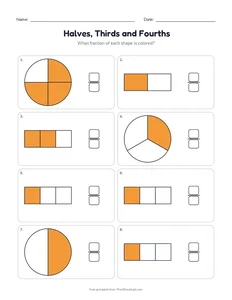
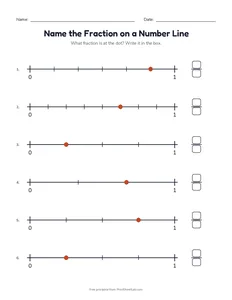
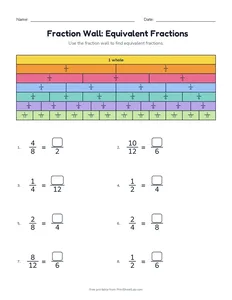
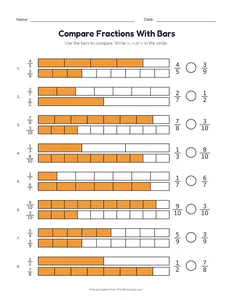
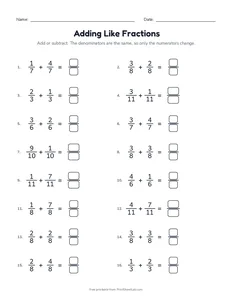
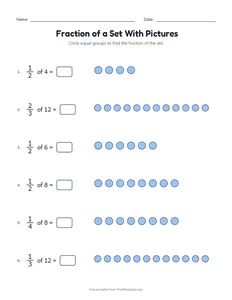
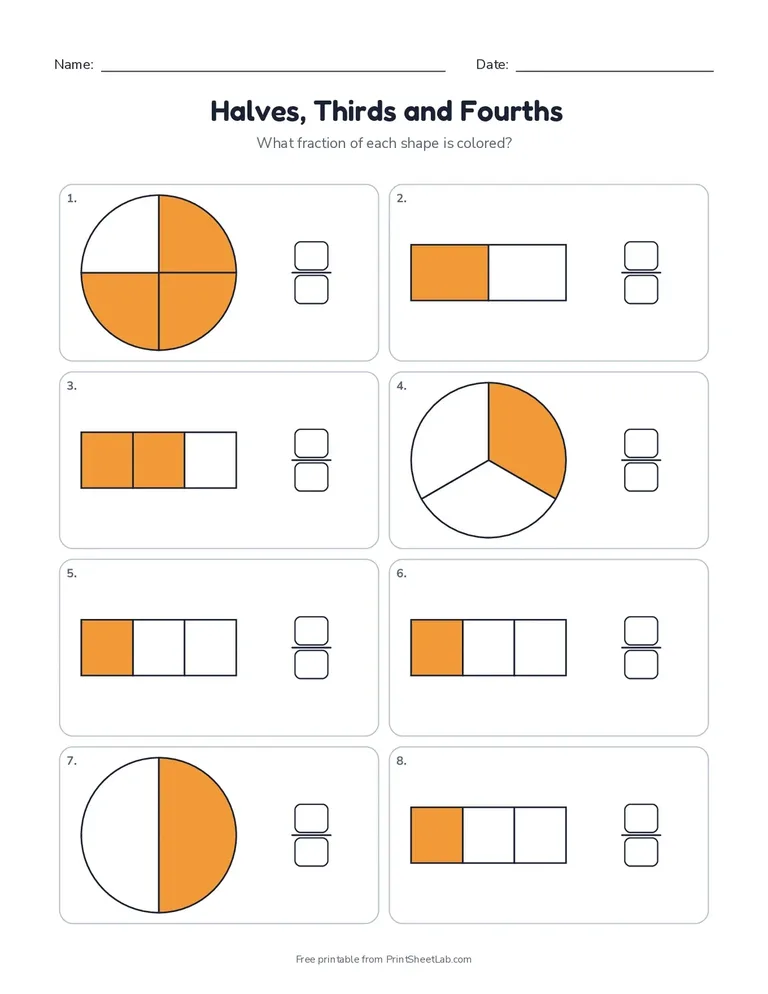
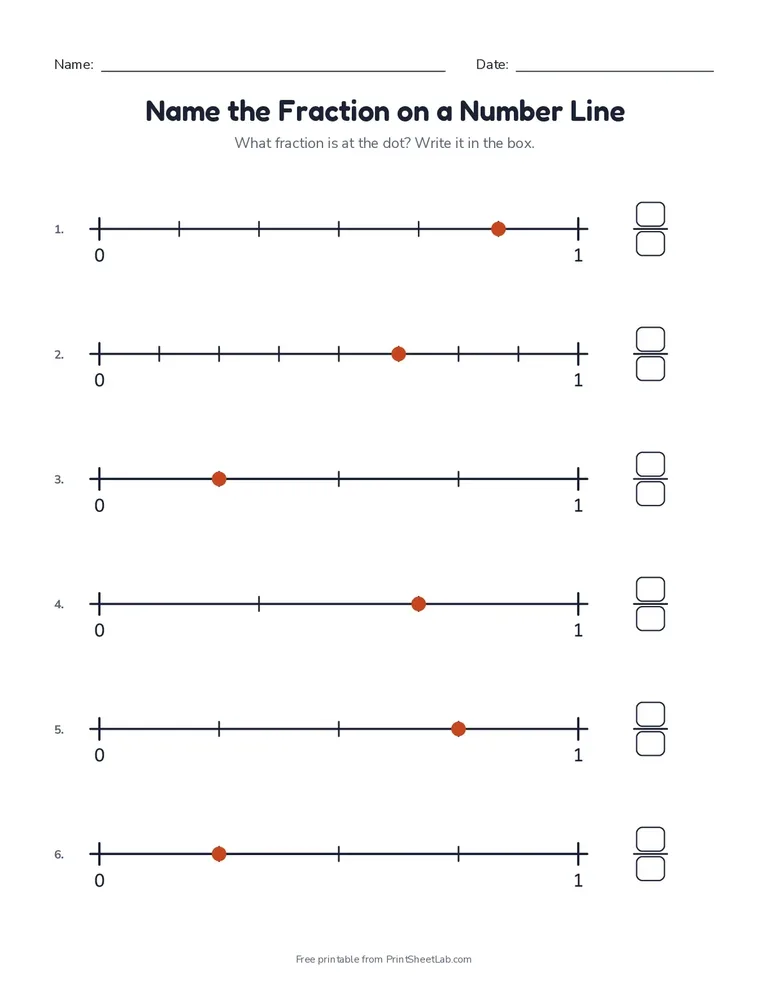
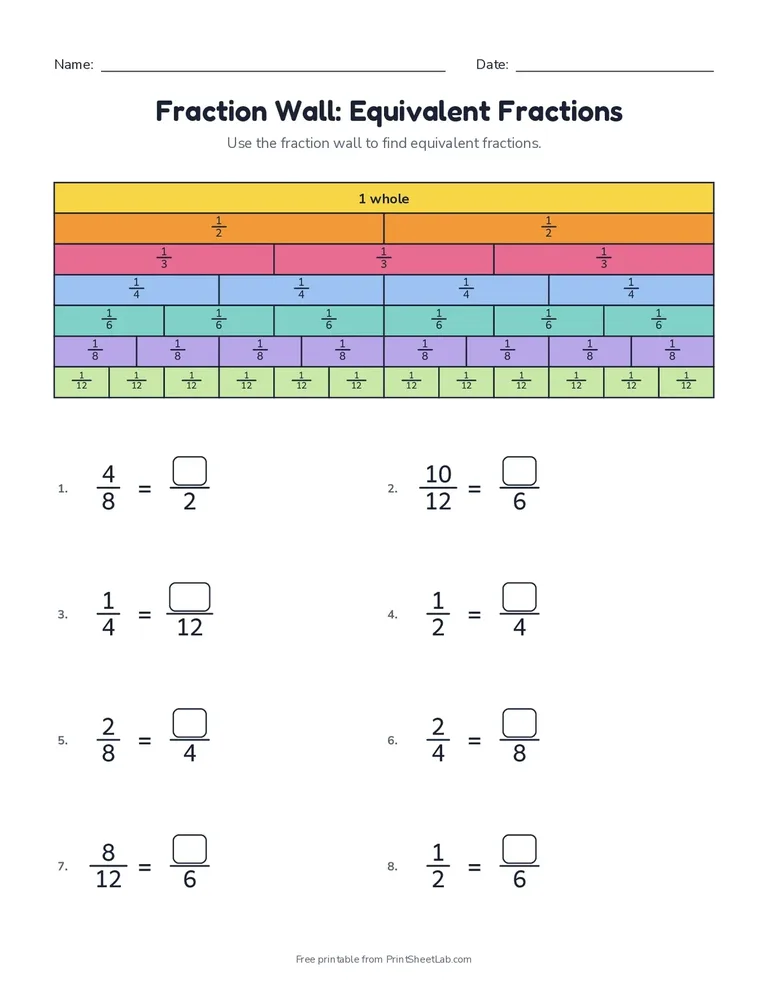
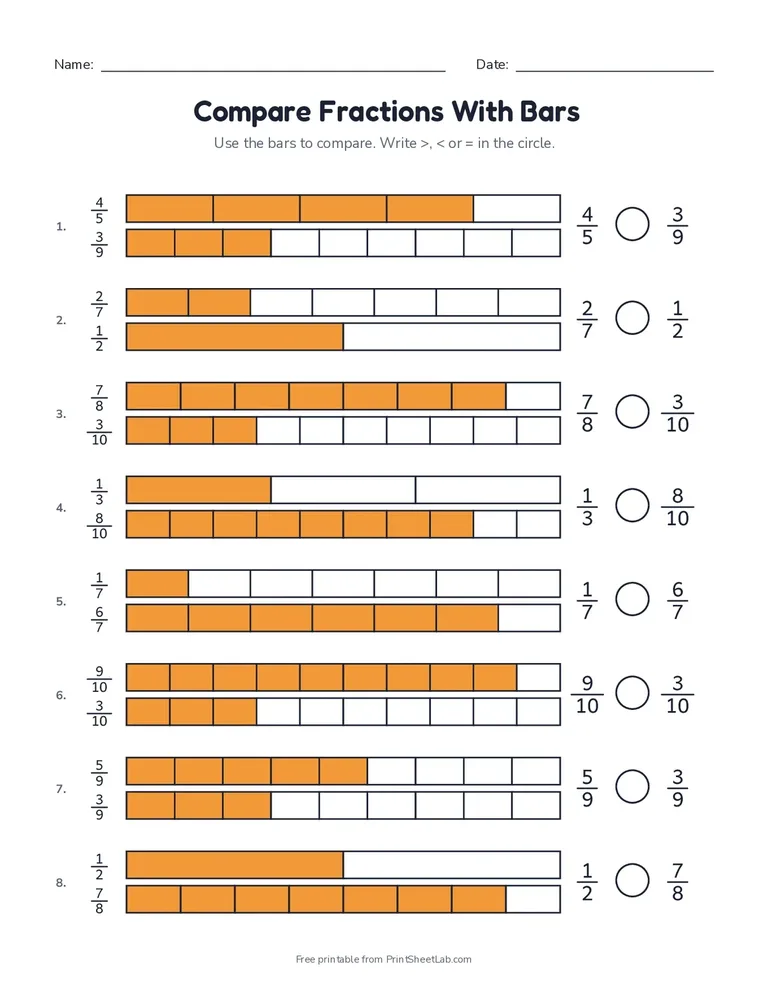
These fractions worksheets are a sample of the 23 printable PDFs in this section, from fractions of shapes to adding fractions. Click a picture for the PDF, or open one of the sets below.
A fraction is a share of a whole
A fraction describes equal parts of one whole. The bottom number, the denominator, says how many equal parts the whole is cut into. The top number, the numerator, says how many of those parts we are talking about. In 3/4 of a pizza, the pizza is cut into 4 equal slices and we have 3 of them.
The word that matters most is equal. A shape cut into 4 pieces of different sizes is not showing quarters. That is why every picture on these worksheets is cut into exactly equal parts, and why the first worksheets ask children to name and color fractions before they ever calculate with them.
How fractions build up by grade
| Grade | What children learn |
|---|---|
| Grades 1 and 2 | Halves, thirds and fourths of shapes (1.G.A.3, 2.G.A.3) |
| Grade 3 | Fractions as numbers, on a number line, equivalent fractions and comparing (3.NF.A.1 to 3.NF.A.3) |
| Grade 4 | Equivalent fractions, comparing with different denominators, adding and subtracting like fractions, mixed numbers (4.NF) |
| Grade 5 | Adding and subtracting unlike fractions, multiplying and dividing fractions (5.NF) |
Three pictures of a fraction
- Part of a shape: 3 of 4 pizza slices.
- Part of a set: 3 of 4 apples are red.
- A point on a number line: 3/4 is three quarters of the way from 0 to 1.
Children who can move between all three understand fractions as numbers, not just as shaded pictures. The worksheets on these pages use all three.
What is in the fractions worksheets
There are 23 fractions worksheets in six sets for grades 1 to 5, each with an answer key:
- Fractions of shapes and sets (Grades 1 to 3, 5 worksheets)
- Fractions on a number line (Grade 3, 3 worksheets)
- Equivalent fractions and simplest form (Grades 3 and 4, 4 worksheets)
- Comparing fractions (Grades 3 and 4, 4 worksheets)
- Adding and subtracting fractions (Grade 4, 3 worksheets)
- Fraction of a number and mixed numbers (Grades 3 to 5, 4 worksheets)
Equivalent fractions worksheets: the same amount, different names
Equivalent fractions name the same amount. Multiplying the top and the bottom of a fraction by the same number gives an equivalent fraction, because you are multiplying by 1 (such as 2/2). For example, half of a pizza is the same as 2 of 4 slices or 3 of 6 slices. Equivalent fractions worksheets give children many examples, such as these:
| Fraction | Equivalent fractions (multiply top and bottom by 2, 3, 4, 5) |
|---|---|
| 1/2 | 2/4 = 3/6 = 4/8 = 5/10 |
| 2/3 | 4/6 = 6/9 = 8/12 = 10/15 |
| 3/4 | 6/8 = 9/12 = 12/16 = 15/20 |
| 2/5 | 4/10 = 6/15 = 8/20 = 10/25 |
| 5/6 | 10/12 = 15/18 = 20/24 = 25/30 |
To go the other way and write a fraction in simplest form, divide the top and the bottom by their greatest common factor:
| Fraction | Greatest common factor | Simplest form |
|---|---|---|
| 8/12 | 4 | 2/3 |
| 18/24 | 6 | 3/4 |
| 15/45 | 15 | 1/3 |
| 14/21 | 7 | 2/3 |
| 30/50 | 10 | 3/5 |
Simplest form means that no number other than 1 divides both the top and the bottom evenly, and fractions worksheets with answers always show it that way. Grade 3 introduces equivalent fractions with number lines and models (3.NF.A.3), and grade 4 uses them to compare and add (4.NF.A.1).
Fraction worksheets grade 3: what third graders learn
Grade 3 is the year when fractions become numbers. In the Common Core, third graders understand a fraction as a part of a whole (3.NF.A.1), place fractions on a number line (3.NF.A.2) and recognize equivalent fractions (3.NF.A.3). Fraction worksheets grade 3 use halves, thirds, fourths, sixths and eighths, with pictures to support every problem. The fractions worksheets in this section follow the same order, so a child can start at the beginning and move on when ready.
Fractions on a number line
A number line shows that a fraction is a number that has a place between 0 and 1. To place 3/4, split the distance from 0 to 1 into 4 equal parts, and count 3 of them from 0. Children who can do this understand that 3/4 is a point and not only a shaded piece of a shape (3.NF.A.2). The fractions on a number line worksheets use halves, thirds, fourths, sixths and eighths, with blank lines for children to mark.
Comparing fractions worksheets: three methods
- Use a benchmark. Compare each fraction with 1/2. 4/9 is less than 1/2, because half of 9 is 4.5.
- Compare the same denominator or numerator. 3/8 is more than 3/10, because eighths are bigger than tenths.
- Find a common denominator. Rewrite both fractions with the same denominator, then compare the numerators.
This table shows the common denominator method for five pairs:
| Compare | Method | Sign |
|---|---|---|
| 3/4 and 5/8 | Common denominator 8: 6/8 and 5/8 | > |
| 2/3 and 3/5 | Common denominator 15: 10/15 and 9/15 | > |
| 4/9 and 1/2 | Common denominator 18: 8/18 and 9/18 | < |
| 7/10 and 7/12 | Common denominator 60: 42/60 and 35/60 | > |
| 5/6 and 5/6 | They are the same | = |
Adding fractions with unlike denominators
To add 1/4 and 1/6, find a common denominator, which is a number that both denominators divide into. The smallest is the least common multiple, 12. Rewrite each fraction, add the numerators and keep the denominator. Grade 5 children do this (5.NF.A.1), after adding fractions with like denominators in grade 4. Here are four examples:
| Problem | Common denominator | Rewritten | Sum |
|---|---|---|---|
| 1/4 + 1/6 | 12 | 3/12 + 2/12 | 5/12 |
| 2/3 + 1/4 | 12 | 8/12 + 3/12 | 11/12 |
| 3/5 + 1/2 | 10 | 6/10 + 5/10 | 1 1/10 |
| 5/6 + 3/8 | 24 | 20/24 + 9/24 | 1 5/24 |
Mixed numbers and improper fractions
A fraction with a top number larger than the bottom one is an improper fraction, and it can be written as a mixed number, which is a whole number and a fraction. Divide the top by the bottom to find the whole number, and the remainder is the new top:
| Improper fraction | Mixed number | How |
|---|---|---|
| 7/3 | 2 1/3 | 7 ÷ 3 = 2 remainder 1 |
| 11/4 | 2 3/4 | 11 ÷ 4 = 2 remainder 3 |
| 17/5 | 3 2/5 | 17 ÷ 5 = 3 remainder 2 |
| 9/2 | 4 1/2 | 9 ÷ 2 = 4 remainder 1 |
Fractions, decimals and percents
A fraction can also be written as a decimal or a percent. These are the values that children meet most often:
| Fraction | Decimal | Percent |
|---|---|---|
| 1/2 | 0.5 | 50% |
| 1/4 | 0.25 | 25% |
| 3/4 | 0.75 | 75% |
| 1/5 | 0.2 | 20% |
| 2/5 | 0.4 | 40% |
| 1/3 | 0.3… | 33.3% |
| 2/3 | 0.6… | 66.7% |
| 1/8 | 0.125 | 12.5% |
For an explanation of the numbers, see Wikipedia’s fraction article, and for more on decimals use the decimals worksheets.
Read the guide: Fractions on a Number Line: How to Teach Comparing and Equivalent Fractions, for the ideas and steps behind this page.
Practice it as a game
Free online games for the same skill: balloon pop, memory match, races and more. No sign-up.
Frequently asked questions
3 quick answers
What is the easiest way to explain fractions?
Share something real: cut a sandwich into 4 equal pieces and eat 1. You ate 1 of 4 equal pieces, which is one fourth, written 1/4.
What is the numerator and denominator?
The denominator (bottom) is how many equal parts make the whole. The numerator (top) is how many of those parts are counted.
Do the fractions worksheets have answer keys?
Yes. Every worksheet has an answer key on the last page of the PDF.