
Grade and GPA calculators turn scores into the numbers schools use: a percentage and letter for one test, a weighted average for a whole course, the score needed on a final exam and a grade point average on the 4.0 scale. These free calculators show the formula and every step.
Quick answer: Use the grade calculator for one score, the weighted grade calculator when categories count differently, the final grade calculator to find the exam score you need, and the GPA calculator to average letter grades by credits. Example: 42 out of 50 is 84%, a B. A 88% course grade needs 96% on a 25% final to reach 90%.
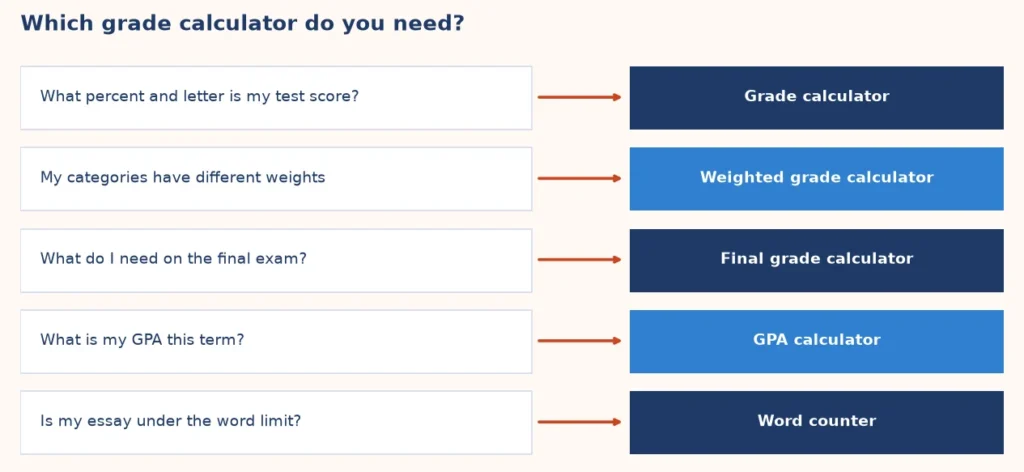
How to choose the right grade and GPA calculator
The right grade and GPA calculator depends on what you already know and what you want. A score on one assignment needs a plain grade calculator. A syllabus with homework, quizzes and exams needs weights. A final exam needs a target. Several courses need credits. This table matches each situation to a tool, and all of them run in your browser.
| If you want to… | Use this calculator | You get |
|---|---|---|
| Turn 42 out of 50 into a percent | Grade calculator | Percentage, letter grade and points lost |
| Average homework, quizzes and exams | Weighted grade calculator | The weighted grade and the score needed for a target |
| Find the final exam score for a target grade | Final grade calculator | The percent needed on the final |
| Work out a semester or cumulative GPA | GPA calculator | GPA on a 4.0 scale, weighted or unweighted |
| Check an essay against a word limit | Word counter | Words, characters, sentences and reading time |
| Turn a score into a percent change | Percentage calculator | How much a grade went up or down |
| Average a list of scores | Mean, median and mode calculator | The mean, median and mode of your marks |
Grade calculators: from a test score to a letter
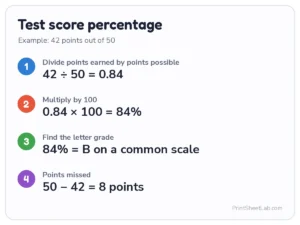
Grade calculators divide the points you earned by the points possible and multiply by 100. A score of 42 out of 50 is 42 ÷ 50 = 0.84, or 84%, which is a B on the common US scale. The grade calculator also shows how many points you lost and how far you are from the next letter, here 3 points from a B+ at 87%.
Letter grades and percentages on the US scale
Many US schools use these bands, but they vary, and some schools use a simpler 90, 80, 70, 60 scale with no plus or minus. Check your syllabus before relying on a table.
| Letter | Percent | GPA points |
|---|---|---|
| A+ | 97 to 100% | 4.0 |
| A | 93 to 96% | 4.0 |
| A- | 90 to 92% | 3.7 |
| B+ | 87 to 89% | 3.3 |
| B | 83 to 86% | 3.0 |
| B- | 80 to 82% | 2.7 |
| C+ | 77 to 79% | 2.3 |
| C | 73 to 76% | 2.0 |
| C- | 70 to 72% | 1.7 |
| D+ | 67 to 69% | 1.3 |
| D | 63 to 66% | 1.0 |
| D- | 60 to 62% | 0.7 |
| F | Below 60% | 0.0 |
How many points do you need for each grade?
Grade calculators also answer the reverse question: how many points can you miss? The table gives the lowest score that keeps each letter on tests of different sizes, using the 90, 80, 70 and 60 percent cut-offs. These grade calculators round up, because you cannot score part of a point on most tests.
| Test total | A (90%) | B (80%) | C (70%) | D (60%) |
|---|---|---|---|---|
| 20 | 18 | 16 | 14 | 12 |
| 25 | 23 | 20 | 18 | 15 |
| 40 | 36 | 32 | 28 | 24 |
| 50 | 45 | 40 | 35 | 30 |
| 100 | 90 | 80 | 70 | 60 |
Weighted grade calculators: when categories count differently
Weighted grade calculators multiply each category score by its weight and add the results: grade = Σ(score × weight) ÷ Σ(weights). Suppose homework is 20% of the course with a 92% average, quizzes are 30% with 85%, and tests are 50% with 78%. The weighted grade is 0.20 × 92 + 0.30 × 85 + 0.50 × 78 = 18.4 + 25.5 + 39.0 = 82.9%, a B-.
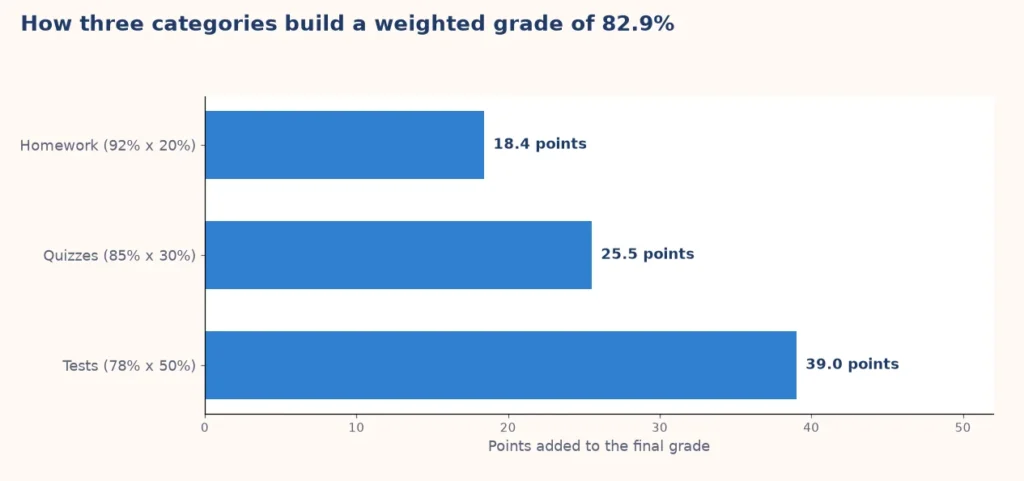
Notice that the best category, homework at 92%, adds the fewest points because its weight is only 20%. The weighted grade calculator lets you add as many categories as your syllabus lists and also solves for the score you need in the last category to reach a target, which is where most students use it.
The same scores with different weights
Weights change the answer even when the scores stay the same. Using the averages of 92%, 85% and 78%, the three common weighting styles below give different course grades, which is why you should always copy the weights from your syllabus into weighted grade calculators instead of using a plain average.
| Weighting style | Homework | Quizzes | Tests | Course grade |
|---|---|---|---|---|
| Test-heavy (20 / 30 / 50) | 20% | 30% | 50% | 82.9% |
| Homework-heavy (40 / 30 / 30) | 40% | 30% | 30% | 85.7% |
| Equal weights (one third each) | 33.3% | 33.3% | 33.3% | 85.0% |
A test-heavy course rewards exam preparation, and a homework-heavy course rewards steady work. Knowing which one you are in tells you where to spend your study hours.
Final grade calculators: the exam score you need
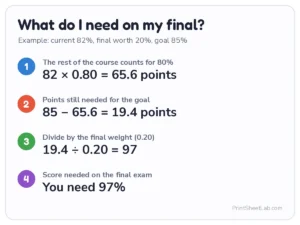
Final grade calculators work backward from the grade you want. The formula is needed = (goal − current × (1 − w)) ÷ w, where w is the weight of the final as a decimal. With an 88% average, a final worth 25% and a goal of 90%, you need (90 − 88 × 0.75) ÷ 0.25 = 24 ÷ 0.25 = 96%.
This table shows the final exam score needed for a 90% course grade when the final is worth 25%. If the answer is over 100, the goal is out of reach without extra credit, and the final grade calculator shows that plainly.
| Current grade | Needed on the final for 90% | Needed for 80% | Needed for 70% |
|---|---|---|---|
| 95% | 75% | 35% | -5% |
| 90% | 90% | 50% | 10% |
| 85% | 105% | 65% | 25% |
| 80% | 120% | 80% | 40% |
| 75% | 135% | 95% | 55% |
GPA calculators: averaging letter grades by credits
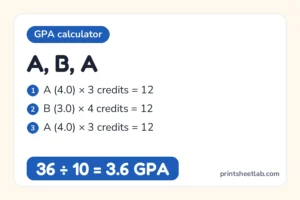
GPA calculators weight each course by its credits. Convert each letter to grade points, multiply by the credits to get quality points, add them up and divide by the total credits. For A (4 credits), B+ (3), A- (3), B (3) and C (2): quality points = 16 + 9.9 + 11.1 + 9 + 4 = 50, and credits = 15, so the GPA is 50 ÷ 15 = 3.33.
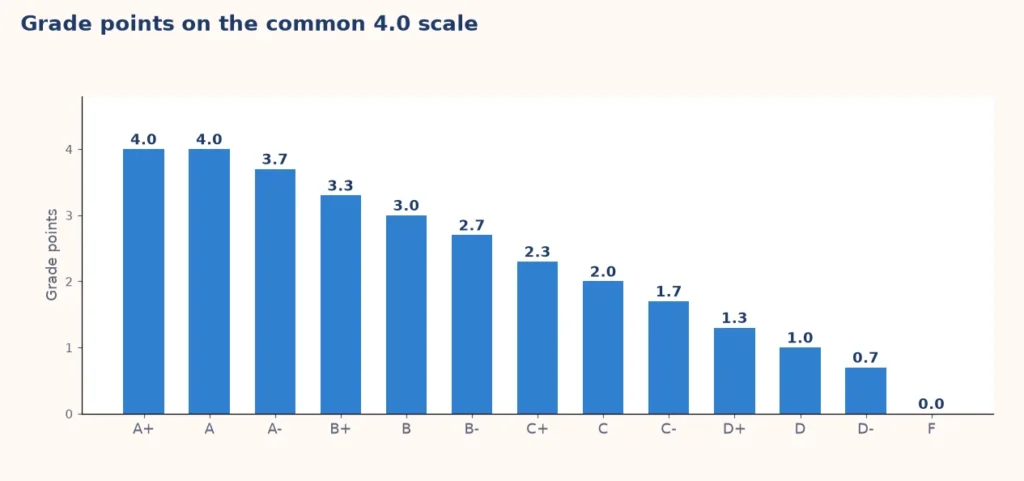
Weighted and cumulative GPA
Many high schools use a weighted GPA that adds a bonus for honors, AP or IB courses, commonly 0.5 for honors and 1.0 for AP, so an A in AP is 5.0. Policies differ by school, so the GPA calculator lets you set the bonuses. Cumulative GPA combines terms the same way: a term GPA of 3.5 over 30 credits and 3.0 over 15 credits gives (3.5 × 30 + 3.0 × 15) ÷ 45 = 3.33.
College grade calculators and grading systems by country
College grade calculators have to match your institution, because grading scales differ. The United States uses letters and a 4.0 GPA. Canada often uses percentages and letters, with some provinces reporting Levels 1 to 4. The United Kingdom uses degree classes at university and numbered grades at school, and Australia uses bands such as High Distinction.
| Country | School grades | University grades |
|---|---|---|
| United States | A to F, percent, 4.0 GPA | A to F, 4.0 GPA, honors and AP bonuses |
| Canada | Percent, letters, or Levels 1 to 4 | Percent and letters, with a GPA scale set by each university |
| United Kingdom | GCSE grades 9 to 1 (England), A-level A* to E | First (70%+), 2:1 (60%+), 2:2 (50%+), Third (40%+) |
| Australia | A to E or school-specific bands | High Distinction (80+), Distinction (70+), Credit (60+), Pass (50+) |
The percentage cut-offs above are typical; each university sets its own. Wikipedia’s pages on academic grading in the United States and the United Kingdom list the common scales, and GOV.UK explains the numbered GCSE grades.
High school and college GPA calculators
High school and college GPA calculators differ in a few details. High schools often report unweighted and weighted GPAs side by side, while colleges report one GPA on a 4.0 scale and add the term and cumulative values on a transcript. Colleges also use credit hours, pass or fail courses that do not count, and repeated courses where the new grade replaces the old one. Always read your registrar’s rules before using GPA calculators for a decision.
How to raise your grade: using calculators to plan
The most useful thing a weighted grade calculator does is show which change helps most. In the 82.9% example, raising the tests average by 5 points adds 0.50 × 5 = 2.5 points to the course grade, while raising homework by 5 points adds only 0.20 × 5 = 1.0. Put your effort where the weight is.
Then check the target. If you want an 85% course grade and tests are 50% of it, the weighted grade calculator tells you the test average you need on the rest of the term. Here the test average needed for an 85% course grade is (85 − 18.4 − 25.5) ÷ 0.50 = 82.2%. Grade calculators turn “I need to do better” into a number such as 82.2%, which is far easier to plan for.
School calculators beyond grades
School calculators cover more than marks. The word counter checks essay and assignment limits, since a missing 50 words can cost a letter. The mean, median and mode calculator finds an average of quiz scores in one step, and the percentage calculator turns “I got 18 of 24” into a percent. Parents and teachers use the same school calculators to track progress across a term.
Real-life uses of grade calculators
Planning a semester. After two tests you hold 84% with a final worth 30%. To finish with an 85, the final grade calculator says you need (85 − 84 × 0.70) ÷ 0.30 = 87.3%, a reasonable target to study for.
Applying to college. Four years of grades give a cumulative GPA. Enter each term in the GPA calculator, then compare it with the middle range published by the schools you are applying to.
Checking a teacher’s gradebook. If an online portal shows 81.5%, the weighted grade calculator confirms whether the weights were applied, because a plain average of the same scores would show a different number.
Questions people ask about grade calculators
How do I calculate my grade in a class?
Multiply each category average by its weight, add the results and divide by the total weight. If weights are 20%, 30% and 50% and your averages are 92, 85 and 78, your grade is 82.9%. A weighted grade calculator does the same in one step.
What GPA do I get with a B average?
A straight B average is 3.0 on the common 4.0 scale. Mixing B+ (3.3), B (3.0) and B- (2.7) averages out near 3.0, and each A- adds 0.7 above a B for that course before credits are weighted.
Can a final grade calculator show an impossible goal?
Yes. If the score needed is above 100%, the goal cannot be reached unless the teacher offers extra credit. With a current grade of 80% and a final worth 25%, a 90% course grade would need 120% on the final.
Which are the best GPA calculators for college?
The best GPA calculators for college let you set credits per course, choose the grade scale and include earlier terms. Look for tools that show the quality points for every course, so you can match them to your transcript. These grade and GPA calculators do that and need no sign-up.
Common mistakes with grade and GPA calculators
- Averaging percentages without weights. A plain average gives equal weight to a quiz and a final exam.
- Using the wrong scale. A 4.0, 4.3 and 5.0 scale give different results, so choose your school’s.
- Forgetting credits. A 4 credit course counts more than a 1 credit course in a GPA.
- Rounding too early. Keep decimals until the end, because schools round the final grade once.
- Treating a calculator as the official grade. Your school’s records decide, so use the tools for planning.
Frequently asked questions
9 quick answers
What are grade and GPA calculators?
Grade and GPA calculators are free online tools that convert scores into percentages, letter grades, weighted course grades, final exam targets and grade point averages. The best ones show the formula and each step, so you can check your own math.
How do I calculate a weighted grade?
Multiply each category grade by its weight as a decimal, then add the products. With homework 92% at 20%, quizzes 85% at 30% and tests 78% at 50%, the weighted grade is 18.4 + 25.5 + 39.0 = 82.9%.
What do I need on the final exam to get an A?
Use needed = (goal − current × (1 − w)) ÷ w, where w is the final’s weight as a decimal. For an 88% grade and a 25% final, a 90% goal needs 96% on the exam.
How is GPA calculated?
Convert each letter grade to grade points, multiply by the course credits, add the quality points and divide by the total credits. A (4 credits), B+ (3), A- (3), B (3) and C (2) give 50 quality points over 15 credits, a 3.33 GPA.
What is the difference between weighted and unweighted GPA?
Unweighted GPA treats every course on a 4.0 scale. Weighted GPA adds a bonus, often 0.5 for honors and 1.0 for AP or IB, so an A in an AP course counts as 5.0. Each school sets its own bonus.
What is a 3.0 GPA in percent?
On the common US scale a 3.0 GPA is a B, which is about 83% to 86% (or 80% to 89% on the simple scale). The exact percent depends on your school, so check its conversion chart.
How do I calculate my cumulative GPA?
Multiply each term GPA by that term’s credits, add the results and divide by the total credits. A 3.5 over 30 credits and a 3.0 over 15 credits give (105 + 45) ÷ 45 = 3.33.
How are UK degrees graded?
UK university degrees are usually First (70% and above), Upper second or 2:1 (60% to 69%), Lower second or 2:2 (50% to 59%) and Third (40% to 49%). Individual universities set their own boundaries.
Are these grade calculators free and private?
Yes. They are free, need no account and run in your browser, so your scores stay on your device. Use them for planning and check official grades with your school.
More calculator hubs
- All free online calculators with steps for every topic
- Math calculators for percentages, averages and fractions
- Date and time calculators for term dates and countdowns
- Financial calculators for student loans and budgets
- Conversion calculators for units and temperature
- Random generators for random name pickers and teams
Sources and further reading
- Wikipedia: Grade point average (how GPA is calculated)
- Wikipedia: Academic grading in the United States (letter, percent and GPA scales)
- Wikipedia: Academic grading in the United Kingdom (GCSE grades 9 to 1 and degree classes)
- GOV.UK: GCSE new grading scale factsheets (Department for Education)
Grading policies differ by school, so confirm scales with your institution. Last updated: October 2026.