This doubles facts game helps first graders learn to double the numbers 1 to 12 by playing: pop balloons, race cars, flip memory cards or sprint through true and false sentences. Every question is a doubles fact such as 6 + 6 or 9 + 9, in random order, and the answers range from 2 up to 24. It is free, needs no sign-up, works on phones and tablets, and comes with a printable doubles chart that also shows near doubles.
Doubles facts game: see how it plays
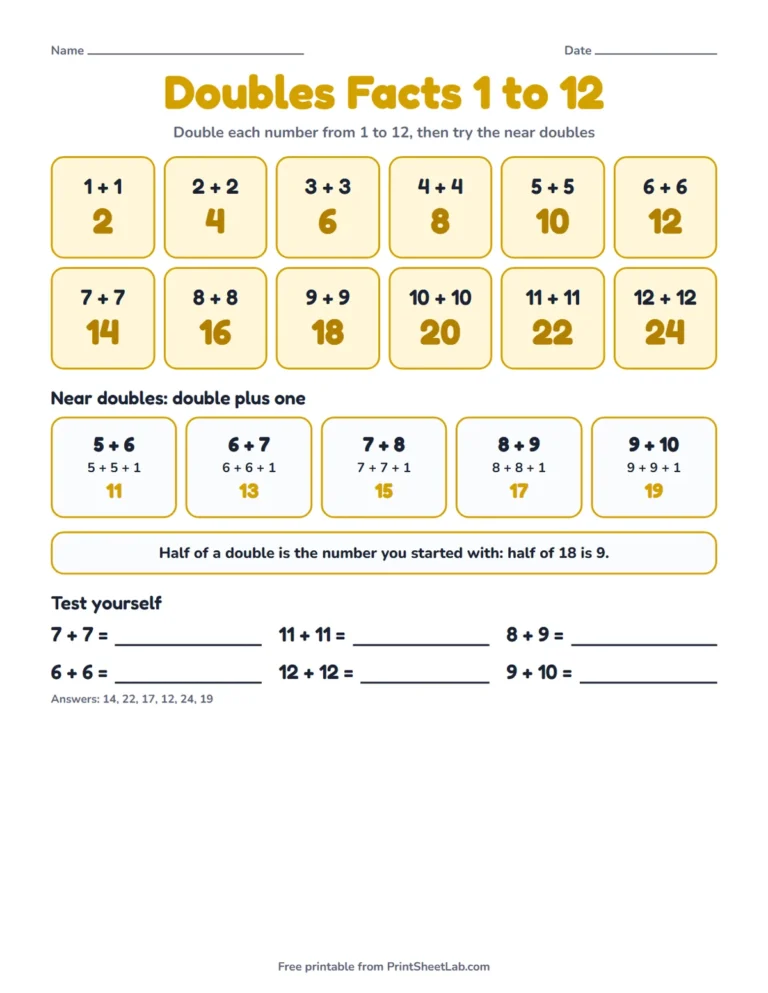
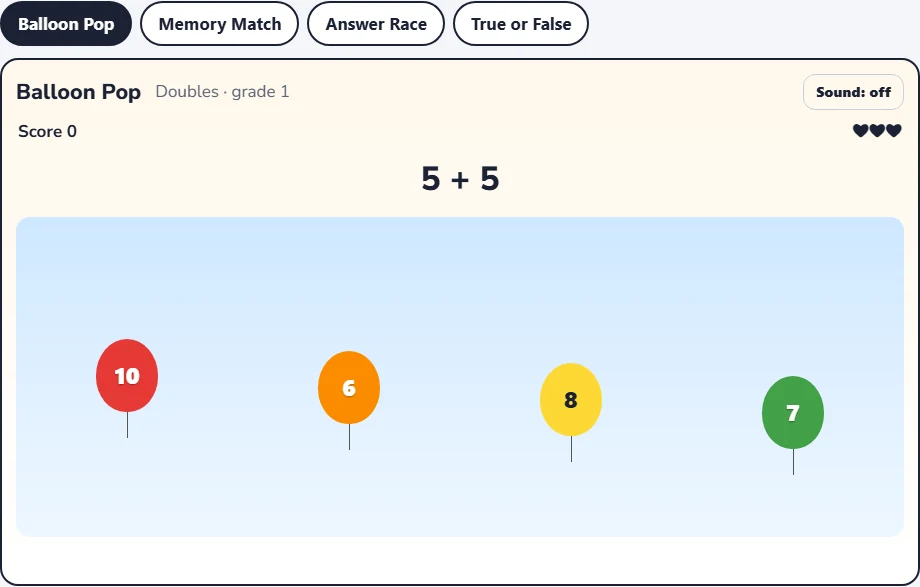
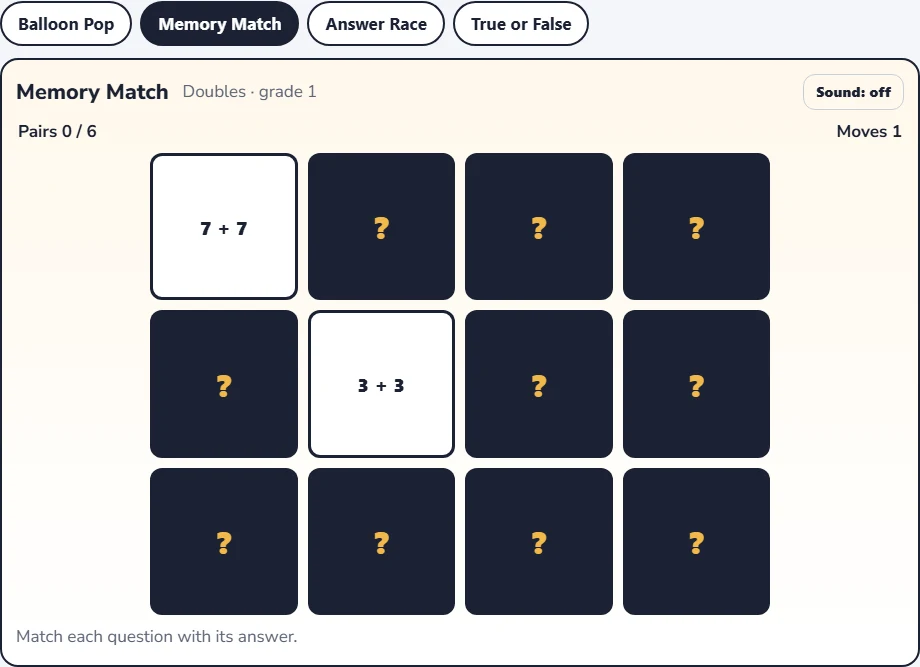
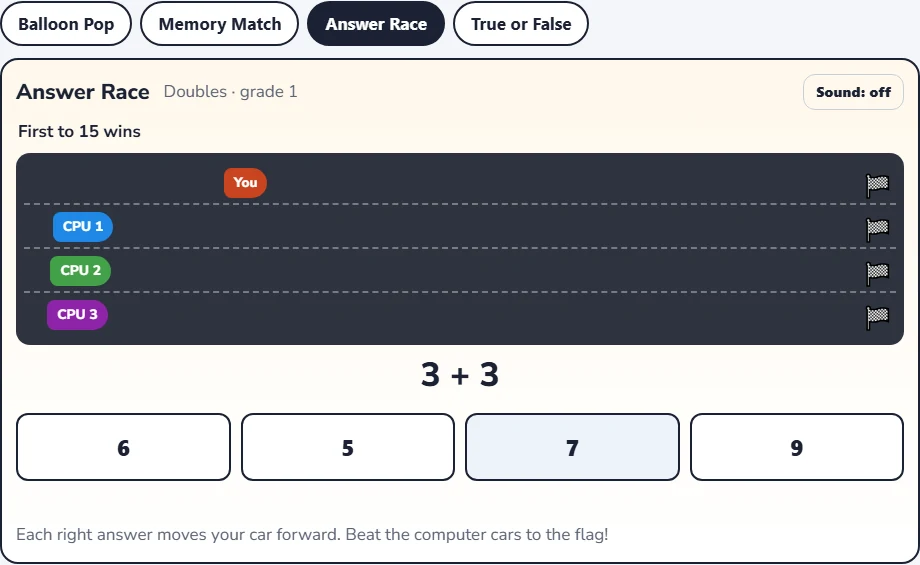
The game below has four modes, and each one asks only doubles addition questions. The printable chart shows every double from 1 + 1 to 12 + 12 and the near doubles, and the pictures show Balloon Pop, Memory Match and Answer Race on this page.
How the doubles facts game works
- Balloon Pop: answers float up on balloons, and you pop the right one before it drifts off the top. The wrong balloons sit within 4 of the right answer, so children must know the double and not just spot the odd one out. The game speeds up as your score climbs, and three misses ends the round.
- Memory Match: twelve face-down cards hide six doubles, such as 7 + 7, and their six answers. Flip two at a time and match each one to its answer in as few moves as you can.
- Answer Race: every right answer moves your car forward, and you race three computer cars to the finish flag. The first to 15 wins, and wrong taps cost time, not places.
- True or False: sixty seconds on the clock. Decide whether each sentence, such as 8 + 8 = 16, is right or wrong. A streak of five or more scores double.
Doubles facts 1 to 12 at a glance
| Double | Answer | Picture to remember it |
|---|---|---|
| 1 + 1 | 2 | One and one more |
| 2 + 2 | 4 | Two eyes, two ears |
| 3 + 3 | 6 | A pair of trios: dice with three dots |
| 4 + 4 | 8 | Four legs plus four legs: two chairs |
| 5 + 5 | 10 | Two hands of five fingers |
| 6 + 6 | 12 | Half a dozen twice: a dozen eggs |
| 7 + 7 | 14 | Two weeks of days: 14 |
| 8 + 8 | 16 | Two spiders have 16 legs |
| 9 + 9 | 18 | Two baseball teams: 18 players |
| 10 + 10 | 20 | Two hands and two feet: 20 fingers and toes |
| 11 + 11 | 22 | Two soccer teams: 22 players |
| 12 + 12 | 24 | Two dozen: 24 eggs |
The answers are all even numbers, and they go up by 2 each time you start from a bigger number: 2, 4, 6, 8, 10, 12, 14, 16, 18, 20, 22, 24. That is the 2 times table, because doubling a number is the same as multiplying it by 2. Our 2 times table game is the natural next step.
Why doubles are the first facts first graders learn
Children find doubles easy to remember because they have a pattern: two equal groups. Doubles also act as anchor facts for many other sums. If a child knows 7 + 7 = 14, they can work out 7 + 8 (one more than 14) and 7 + 6 (one less than 14) without counting. This “doubles plus one” and “doubles minus one” thinking is called the near doubles strategy, and it is one of the most efficient ways to learn the sums to 20. Our guide to addition strategies for kids explains it step by step.
Near doubles: double plus one and double minus one
| Near double | Think | Answer |
|---|---|---|
| 5 + 6 | 5 + 5 + 1 | 11 |
| 6 + 7 | 6 + 6 + 1 | 13 |
| 7 + 8 | 7 + 7 + 1 | 15 |
| 8 + 9 | 8 + 8 + 1 | 17 |
| 9 + 10 | 9 + 9 + 1 | 19 |
| 7 + 6 | 7 + 7 − 1 | 13 |
The Common Core grade 1 standard 1.OA.C.6 names this strategy directly, using the example of knowing 6 + 6 = 12 to work out 6 + 7 = 13. Print the doubles and near doubles worksheets for matching paper practice.
Doubles addition game and doubling numbers game ideas for home and school
- Mirror play: fold a paper in half, put dots on one side and ask children to draw the same on the other side. Count the dots altogether.
- Dice doubles: roll one die and double it, or use two dice and cheer when they match.
- Dominoes: find all the double-domino tiles and add the two halves.
- Halving: turn it around. If the double is 18, what number was doubled? Halving is the start of division.
Doubles facts word problems
- Each child has 7 marbles. How many marbles do 2 children have? Answer: 14.
- A spider has 8 legs, and so does its friend. How many legs altogether? Answer: 16.
- Mia buys 9 stickers on Monday and 9 on Tuesday. How many does she have? Answer: 18.
- There are 11 players on each of 2 soccer teams. How many players are on the field? Answer: 22.
Doubles facts first grade: where they fit at school
| Level | What children are expected to do |
|---|---|
| Kindergarten (US) | Add within 10 using objects and drawings, including equal groups |
| Grade 1 (US) | Add within 20 using strategies such as doubles and near doubles (1.OA.C.6) |
| Year 1 and 2 (England) | Use number bonds and addition facts to 20, including doubling and halving |
The doubles facts game supports these goals. See the Common Core grade 1 operations and algebraic thinking standards for the full text.
Doubles facts game: frequently asked questions
What are doubles facts?
Doubles facts are addition facts where both numbers are the same, such as 4 + 4 = 8 and 9 + 9 = 18.
What is the doubles strategy?
Know the doubles by heart, then use them to find nearby sums. 6 + 7 is one more than 6 + 6, so it is 13.
What are the doubles from 1 to 12?
2, 4, 6, 8, 10, 12, 14, 16, 18, 20, 22 and 24.
What grade is the doubles facts game for?
Doubles up to 5 + 5 start in kindergarten, and the full doubles to 10 + 10 and beyond are first grade skills.
Is the doubles facts game free, and do kids need an account?
Yes, it is free, and no account is needed. Best scores are saved only in the browser on this device.
Does the doubles facts game work on phones and tablets?
Yes. Every game is built for touch first and also works with a mouse on a computer.
A 5-minute routine for the doubles facts game
- Warm up (1 minute): chant the doubles from 1 + 1 to 12 + 12 together, tapping the beat on the table: 2, 4, 6, 8, 10 and on up to 24.
- Play (3 minutes): one round of Balloon Pop and one of Answer Race in the doubles facts game. Try to beat yesterday’s score.
- Stretch (1 minute): take one double the game asked, such as 8 + 8 = 16, and ask the near double: what is 8 + 9? One more than 16, so 17.
Doubles are the quickest facts to learn, and a few minutes a day for two weeks is usually enough for children to know all twelve.